Category: dawn news

  • PTI MNAs demand to know whereabouts of party leaders detained in KP, seek their court production

    PTI MNAs demand to know whereabouts of party leaders detained in KP, seek their court production

    ISLAMABAD: PTI lawmakers from Khyber Pakhtunkhwa on Sunday reiterated their demand for the immediate disclosure of the whereabouts of all detained PTI leaders and workers, their production before the courts and the provision of their legal right to defence.

    The demand was made during a meeting of PTI’s elected members of the National Assembly (NA) from KP, held in Islamabad under the prevailing political and constitutional situation, according to a statement by the party.

    At the meeting, the lawmakers called for the immediate disclosure of the whereabouts of now non-functional chief minister Sohail Afridi, KP Assembly Speaker Babar Saleem Swati, provincial president Junaid Akbar Khan and other detained party leaders and workers.

    Afridi — whose role as the chief minister was rendered non-functional due to governor’s rule — Swati and some other lawmakers have been in “preventive detention” since emergency was imposed, according to police. KP Governor Faisal Karim Kundi also said last month that Afridi and Swati had been placed under house arrest.

    The lawmakers expressed serious concern over the alleged arrests and undisclosed whereabouts of Afridi, Swati, Junaid Akbar Khan, MNAs Dr Amjad, Fazal Muhammad Khan, Naseem Shah, Iqbal Afridi and Zubair Wazir, along with provincial ministers and MPAs.

    They demanded that all detained elected representatives be immediately brought before the public and produced before the relevant courts.

    “Their families should be informed about the reasons for their arrests and places of detention, while they must be granted the full legal right to defend themselves,” the statement said.

    The PTI members stressed that depriving elected representatives of their political activities and keeping them in undisclosed detention amounted to an assault on democratic values and the public mandate.

    In last month’s comments on detentions after governor’s rule, Minister of State for Interior Tallal Chaudhry had said those with cases against them will be tried, while others would be released.

    The participants also condemned the recent detentions of former provincial minister Taimur Saleem Jhagra, Kamran Bangash and Irfan Saleem under the MPO, asserting that their arrests despite protective bail granted by the Peshawar High Court raised serious questions about respect for judicial orders and the rule of law.

    The PTI lawmakers demanded that the three leaders be immediately produced before the court, released and provided with all legal facilities, the statement said.

    Former National Assembly speaker Asad Qaiser, along with MNAs Atif Khan, Saleem Rehman, Sahibzada Sibghatullah, Mehboob Shah, Shahram Khan Tarakai, Shahzada Gastasap, Muhammad Nawaz Khan, Asif Khan, Ali Asghar Khan, Arbab Sher Ali, Sohail Sultan, Ali Khan Jadoon, Sajid Momand, Shah Ahad and Bashir Khan, attended the meeting.

    The PTI statement comes a day after it emerged that President Asif Ali Zardari promulgated an ordinance, doing away with most of the “privileges” of KP lawmakers, including protection against “preventive detention”.

    Through an amendment ordinance related to the privileges of MPAs, drastic changes have been made in the KP Provincial Assembly (Powers, Immunities and Privileges) Act 2026, as 21 of its 40 sections have been omitted, including those providing protection to the MPAs against “preventive detentions” and offences related to “breach” of privileges.

    Four other ordinances promulgated provided a legal framework for special initiatives in the designated 12 districts and other districts in the province.

    With the imposition of emergency in KP on Oct 11, an Area Representative and Development Council (ARDC) was formed to oversee 12 districts that were deemed to face intense security challenges, including the merged districts.

    On governor’s rule and ongoing political situation

    The meeting also condemned reported raids on the homes of PTI workers and detentions under MPO following the imposition of governor’s rule in KP on Oct 11.

    The participants alleged harassment of political workers, violation of the sanctity of homes and restrictions on political activities, condemning them as “blatant violations of the Constitution and fundamental human rights”. They demanded the immediate release of all detained party workers.

    Rejecting the imposition of governor’s rule in KP on the pretext of terrorism, the meeting asserted that the PTI provincial government had consistently adopted a zero-tolerance policy against terrorism. The participants said terrorism could not be “used as a political tool to undermine the democratic mandate” of the province.

    They called for the immediate and effective implementation of the National Action Plan and strict adherence to a resolution adopted by all political parties in KP.

    During the meeting, PTI leaders claimed that governor’s rule had further aggravated the province’s political, economic and administrative challenges. It also criticised KP Governor Kundi, saying that instead of representing the federation and playing a constructive role in resolving provincial issues, his actions were further complicating the situation.

    The participants expressed “serious concern” over delays by the federal government in releasing KP’s financial entitlements and deductions from its resources. They said Prime Minister Shehbaz Sharif had promised Rs160 billion to the province, but under a new agreement, the federal government had made deductions of approximately Rs157bn, which they termed an injustice to the people of the province.

    According to the statement, they contended that the federal government was “treating the province like a stepchild” under the pretext of governor’s rule and stressed that the people of the province could not be deprived of their constitutional and financial rights.

    The meeting also expressed concern over the withdrawal of security provided to JUI-F chief Maulana Fazlur Rehman. The participants maintained that ensuring the security of all political leaders, irrespective of political differences, was the responsibility of the state. They demanded that Fazl and other leaders of his party be immediately provided with the required security.

    The participants welcomed PPP scion Bilawal Bhutto-Zardari’s statement describing Imran as a political prisoner and his support for PTI’s position on the reserved seats issue. They termed Imran a major political stakeholder and said that attempts to exclude him from the political process were detrimental to democracy.

    They stressed that the PPP should go beyond statements and take practical steps, calling for Bilawal to dissociate himself from the imposition of governor’s rule and not vote for its extension in the NA.

    The meeting concluded with a “reaffirmation of the participants’ commitment to the supremacy of the Constitution and the rule of law, the protection of political freedoms, safeguarding the province’s constitutional and financial rights, respect for the public mandate and ensuring the security of all political leaders”, the statement added.

    PTI seeks Imran’s access to personal physician

    According to the statement, the meeting also discussed in detail the health and treatment of incarcerated PTI founder Imran Khan, the law and order situation in KP, concerns over the imposition of governor’s rule, the province’s constitutional and financial rights, and the overall political situation in the country.

    Imran has been in prison since Aug 5, 2023, while his wife was arrested on Jan 17, 2025 in a separate case in which the couple were sentenced. The IHC has allowed him twice-a-week meetings with his family, lawyers and other associates, but despite multiple court directives, the meetings have been largely restricted.

    Imran and Bushra’s lawyers were able to meet the couple earlier this month after a gap of several months, after the Islamabad High Court issued directives for the meeting to aid legal consultation.

    In the meeting, PTI lawmakers demanded that all facilities be provided to Imran in accordance with the jail manual and Supreme Court (SC) judgments.

    They called for him to have immediate access to his personal physician and for the restrictions on meetings with his family, lawyers and political leaders to be removed, maintaining that any negligence or unnecessary restrictions concerning his health and safety would be unacceptable.

    The meeting also strongly condemned the detention of Imran’s sister Aleema Khan, held since late September under Section 3 of the Maintenance of Public Order Ordinance (MPO), and demanded her immediate release.

    It called for Bushra Bibi’s release as well and demanded that she be provided justice in accordance with the law.

    According to the statement, the participants further demanded that cases against Dr Yasmin Rashid, Shah Mahmood Qureshi, Mahmoodur Rashid, Ejaz Chaudhry and other detained PTI leaders and workers be decided on merit, without political victimisation.

    Source: dawn
  • COP31 climate talks set to collapse without political deal

    COP31 climate talks set to collapse without political deal

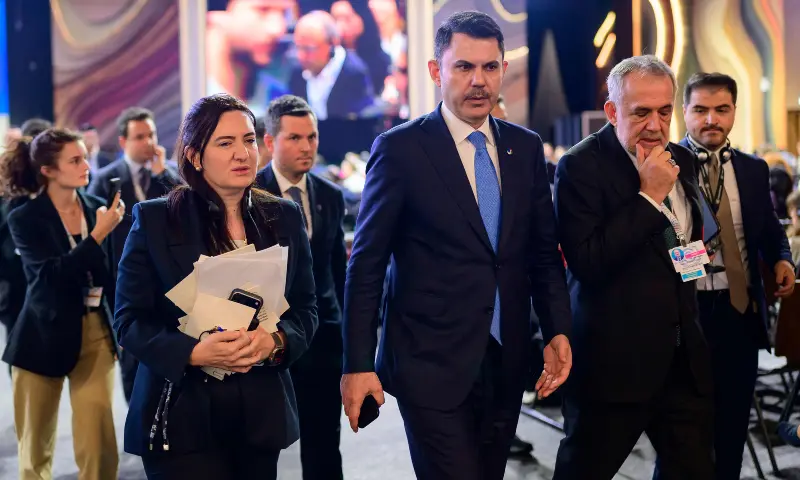
    United Nations climate talks in Turkiye looked set to collapse without a political agreement after COP31 summit president Murat Kurum said there would be no new draft of the deal.

    Earlier, multiple countries and negotiating blocs said they could not accept the version of the text put before them.

    “There will be no new text from now on. We will not be carrying out work on a new text in an environment where there is no consensus,” Kurum said.

    The climate talks fell into disarray on Sunday as the European Union and others rejected a final draft deal put forward by COP31 presidents Turkiye and Australia, saying it was too weak to advance the fight against global warming.

    After more than two weeks of negotiations, which had been due to end on Friday but stretched into the weekend, Kurum said at the closing plenary that a deal was not approved.

    “It is clear that there are parties in this hall who oppose this text. We recognise that there is no consensus on this document. Therefore, these decisions have not been adopted,” he said.

    The last time UN climate talks failed to end with a deal adopted by all was in Copenhagen in 2009.

    The collapse this time is against the backdrop of competing crises, including wars and public outcry over the cost of living, that have overshadowed the problems caused by a warming climate.

    Ireland’s environment minister Darragh O’Brien said the European Union could not support the proposed deal, in part because it made no mention of the fossil fuels that scientists say are driving global warming.

    “It is unconscionable that we would have a climate act that makes no reference to fossil fuel, no reference to transitioning away from fossil fuels,” he said.

    Panama also said it could not support the current text because it fails to meet the scale of the climate crisis.

    This year’s COP is the first since the UN’s environmental body in October that confirmed the rise in global temperature was set to exceed 1.5 degrees Celsius, a threshold countries agreed at Paris climate talks over a decade ago to try not to exceed, and beyond which extreme weather impacts intensify.

    Pressure from Saudi Arabia and other oil producers

    The proposed deal had acknowledged the overshoot, but called for faster development of carbon-removal technologies to eventually reverse it.

    Observers at the venue said Saudi Arabia and other big oil-producing nations had pushed hard in negotiations for keeping explicit mention of fossil fuels out of the text, and carbon removal technologies in.

    While scientists say removing carbon from the atmosphere when paired with steep emissions cuts is vital to avoiding the worst impacts of climate change, critics of the deal said they worried the carbon removal language would be used as a licence to keep pumping oil.

    A representative for the Saudi delegation told the summit he was surprised at the resistance to technology.

    “If indeed the climate challenge, as some have mentioned today, is so important, it makes no sense that solutions, concrete solutions… will be taken off the table,” he said.

    The COP process is the main vehicle through which countries coordinate their efforts to curb global warming. Its annual summit provides an opportunity for nations to signal they are willing to work together to find solutions and help finance the problems rising temperatures cause.

    While a blow to efforts to ratchet up international action, the failure to agree a political declaration in Antalya does not erase the obligations agreed by previous summits or remove the technical and legal frameworks governing multilateral action against climate change.

    Source: dawn

  • PPP-PML-N spat continues as Asif’s jibe at Bilawal draws ‘red line’ warning

    PPP-PML-N spat continues as Asif’s jibe at Bilawal draws ‘red line’ warning

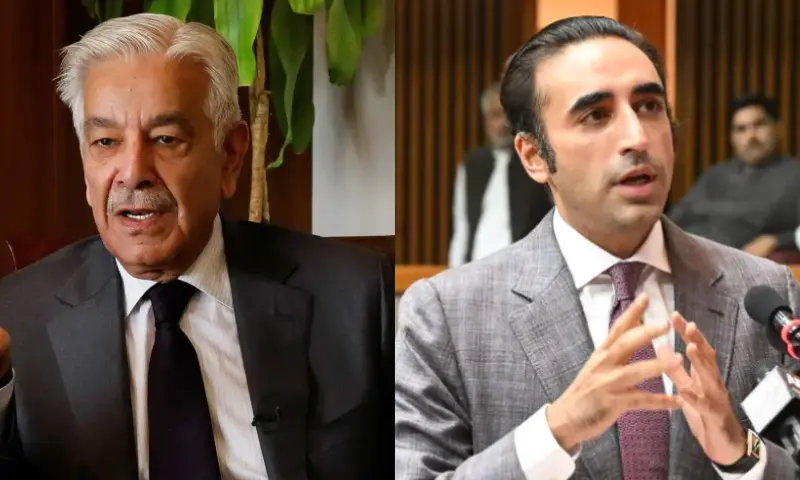
    In the latest from the ongoing wrangling between the ruling PML-N and its ally in the Centre, the PPP, leaders from the latter have said Defence Minister Khawaja Asif’s remarks directed at Bilawal Bhutto-Zardari were “unacceptable” and crossed the party’s “red line”.

    The reaction from PPP Senator Sherry Rehman and MNA Sharmila Faruqui on Sunday came on a Nov 19 post by Asif, in which he shared two video clips of PPP Chairperson Bilawal.

    In the first clip, Bilawal is seen criticising the PTI and its founder, Imran Khan, and in the second one, from his recent address at the Karachi Press Club (KPC), he terms Imran a “political prisoner”.

    “A person becomes the prime minister and is later imprisoned. So I can either accept that every prime minister in the country’s history has been a thief, or I can accept that all prime ministers in our history have been victims of political revenge,” he adds.

    Commenting on the two clips, Asif posted on X: “We believed that the new generation would be better and more principled than ours. Did not know they would turn out to be masters of dishonesty and change colours so remarkably.”

    Reacting to his remarks, Rehman posted on X: “Unacceptable flow of comments from the federal defence minister about the PPP organisation and our leadership, Bilawal Bhutto-Zardari. He has crossed a red line.”

    Similarly, Faruqui said Asif’s “derogatory language”, particularly his “irresponsible remarks” about Bilawal, were unacceptable for the PPP.

    “This is a red line for us.”

    Directly addressing Asif, she went on to say that while everyone had the right to disagree politically, there was a difference between derision and disagreement.

    “As a senior parliamentarian and a federal minister, you are expected to exercise political judgement, seriousness and decorum. Political differences are addressed through reasoned argument, not personal attacks. Remember, words reflect not only a person’s character but also the dignity of their office.”

    The PPP and the PML-N have been trading barbs after Bilawal speech at the KPC on Nov 17. On the occasion, the Bhutto scion addressed the ongoing debate on the creation of new provinces, expressed support for several opposition demands and questioned past decisions and actions taken by the ruling coalition. He also warned of bloodshed in Sindh over the creation of new provinces and called for a “political reset”.

    His remarks drew a strong reaction from senior leaders of the PML-N, Jamaat-i-Islami (JI) and Muttahida Qaumi Movement-Pakistan, who accused him of “political hypocrisy”.

    Asif continued his criticism of Bilawal on Saturday, accusing him of being the “biggest beneficiary and a critic of the system at the same time”.

    “Rank opportunism,” he commented.

    Earlier, he brought the ownership of Bilawal House in Lahore into the political argument.

    In a post on X, the defence minister questioned the ownership and use of Bilawal House, asking: “Can someone disclose the ownership of this property? Who owns it, and who lives there? If this palace-like fortress is being used by anyone, who are they?”

    The PML-N senior leader further questioned whether those occupying properties without having legal title to them could “morally claim any privileged position”, adding that the 250 million people of Pakistan deserved to know the financial and property details of those who considered high status and privilege their entitlement.

    Responding to him, PPP senior leader Nadeem Afzal Chan posted a video showing party workers gathering at the Bilawal House in Lahore, saying the property was the home of every PPP worker. “Show us people entering any other big house in the same way. Uncle… answer the questions, whether you like it or not,” Chan said in his X post, directly addressing the defence minister.

    Separately, the PPP accused the defence minister of attempting to provoke the party into launching personal attacks against the PML-N leadership in retaliation. In a statement posted on X, the PPP said Bilawal had directed party leaders to ignore the defence minister’s remarks and concentrate on issue-based politics.

    The statement, however, warned that the PPP was also familiar with the political controversies surrounding the PML-N leadership, referring to the Panama Papers, Avenfield properties and Al-Azizia Steel Mills cases.

    However, even as the heated exchange of words continued between the two sides, President Asif Ali Zardari and Prime Minister Shehbaz Sharif had decided that all matters would be resolved through dialogue, the Presidency said on Thursday after the two leaders met in Islamabad.

    The two again met on Saturday to discuss the overall political situation.

    After the meeting, Rehman urged the government to focus on people’s problems rather than creating new political fault lines.

    Provocative statements by ministers should be avoided, she said, adding that Bilawal wanted politics to address people’s problems rather than create new divisions.

    “Chairman Bilawal Bhutto-Zardari is looking to prevent bloodshed, not shed it,” she said.

    Source: dawn

  • Veteran journalist Husain Naqi passes away in Lahore

    Veteran journalist Husain Naqi passes away in Lahore

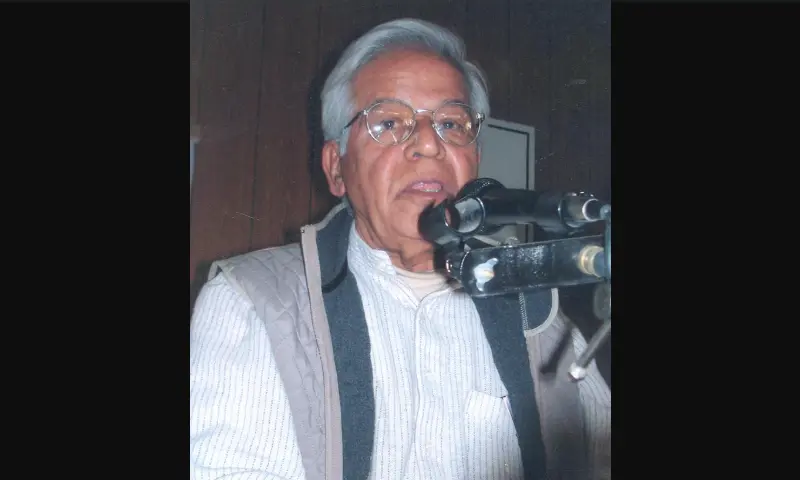
    LAHORE: Veteran journalist and human rights activist Husain Naqi passed away in Lahore on Sunday of a cardiac arrest.

    He was a former editor of The News and had also been associated with the Human Rights Commission of Pakistan (HRCP).

    On Saturday, a day before his passing, Naqi attended a book launch organised by HRCP. Later in the day, at 6pm, he suffered a cardiac attack, after which he was admitted at a private hospital, according to HRCP official Muhammad Ilyas.

    Naqi passed away on Sunday morning at 5am. He left behind three sons.

    President Asif Ali Zardari extended his condolences on Naqi’s passing to the bereaved family, expressing “deep sorrow”, a statement issued by the Presidency said.

    The president paid tribute to Naqi’s “services to journalism, freedom of expression and human rights”, the statement said.

    It further quoted the president as saying: “Husain Naqi played a prominent role in promoting journalism and democratic values. His contributions will always be remembered.”

    The President offers condolences to Hussain Naqi’s family and prays for the forgiveness of the deceased.

    The HRCP also released a statement, saying it “deeply mourns” Naqi’s passing.

    “Over a career spanning more than 70 years, from student leader to newspaper editor to treasurer of HRCP, neither multiple incarcerations nor vindictive acts by the authorities ever weakened his resolve to speak truth to power. Naqi sahib served HRCP in different capacities for three decades and was an active council member at the time of his passing. One of the strongest voices for people’s rights and democracy in Pakistan has gone silent,” the statement said.

    Senator Sherry Rehman expressed her grief on Naqi’s passing in a post on X.

    “His passing signals the end of an era. Naqi Saheb always spoke unflinching truth to power,” she said.

    She said many “cub journalists” had learned at his desk and walked in rallies under his leadership.

    “We often called him the rebel angel of our times, yet he never stoked anger. He sought the right to dissent with respect,” Rehman wrote.

    PTI Secretary General Salman Akram Raja also expressed his condolences on Naqi’s passing, saying that he had met the veteran journalist on Saturday at a book launch at HRCP.

    “My acquaintance and admiration for him spanned decades,” Raja said in a post on X.

    Naming I.A. Rehman, Asma Jahangir and Amin Mughal, he said, “The most precious gems who dreamed of and championed the dignity of human beings and the voices of the poor in Pakistan are leaving us.

    “Their dreams have yet to be realised. Their dreams are the dreams of 250 million people.”

    Who was Hussain Naqi?

    Naqi was born in Lucknow, India before partition. In his autobiography Mujh Se Jo Ho Saka, Naqi said he was perhaps born a year before his officially recorded birthdate, 1936.

    His great-grandfather had moved to Lucknow from a village in what is now Haryana, in the then-undivided Punjab. It was a well-heeled and well-educated family that flourished in Lucknow over the next few generations.

    However, Naqi subtly confronted the conservatism of his traditional family from a very young age. Outside, he was not subtle. He began his student activism in secondary school and started taking on the minor establishments of power at a fairly young age.

    After early schooling and college education in Lucknow, Naqi moved to Karachi in the 1950s, where he subsequently developed into a quintessential student leader.

    As a student in Karachi, Naqi played a key role in several demonstrations and protests. During the 1956 Suez Canal crisis when Egypt was attacked by Israel, France and Britain, Naqi was part of the executive committee of the National Students Federation (NSF). At the time, the NSF organised a march to the British High Commission in Karachi to protest against the attack and was faced with police batons and tear gas.

    As president of the Karachi University’s students union, Naqi made a deal with the university’s vice-chancellor for Naqi to be rusticated for three years instead of three Baloch students who had been rusticated in response to an incident at the hostel.

    Naqi’s activism during his student days was not just centered around protests, but also had to do with improving conditions in the institution. He fought for adding a new campus with better facilities, providing safe transport for girls and ensuring that exams were held on time and not postponed.

    He was a strong advocate for student unions. In an interview published in 2011, he said, “it was the banning of student unions that destroyed campus peace. In our time, student unions were a positive influence. We organised cultural activities. We tolerated diversity. Representatives with various political leanings were able to work together despite their ideological differences.”

    After a few turbulent years in Karachi, Naqi permanently settled down in Lahore — the city that he has long identified with as his own and the city that itself identifies with Naqi as a source of resistance to power.

    As a journalist, Naqi found his first mentor in Javed Bokhari, with whom he worked for a couple of years. “In those days I used to literally live at the PPI office,” he said of the time.

    He ended up working as bureau chief of PPI. However, he eventually had to leave the position following a reporting incident in which he refused to accept a false news of desecration of the Holy Quran.

    Nonetheless, he continued to write for various newspapers, including the Viewpoint, Holiday, Outlook, Frontier Post, Frontier Guardian, Daily Star, Punjab Times and Punjab Punch.

    Naqi consistently campaigned for the preservation and promotion of the Punjabi language in Pakistan, starting the first-ever daily newspaper in the Punjabi language — Sajjan.

    Naqi had also been imprisoned a couple of times because of his outspokenness. In the 2011 interview, he recalled those instances with a sense of humour. “I was lucky to invariably have someone favourably disposed towards me at the jail premises, who made sure that I was not mistreated.”

    Source: dawn

  • 3 TTP-linked terrorists killed in village on outskirts of Peshawar: CTD

    3 TTP-linked terrorists killed in village on outskirts of Peshawar: CTD

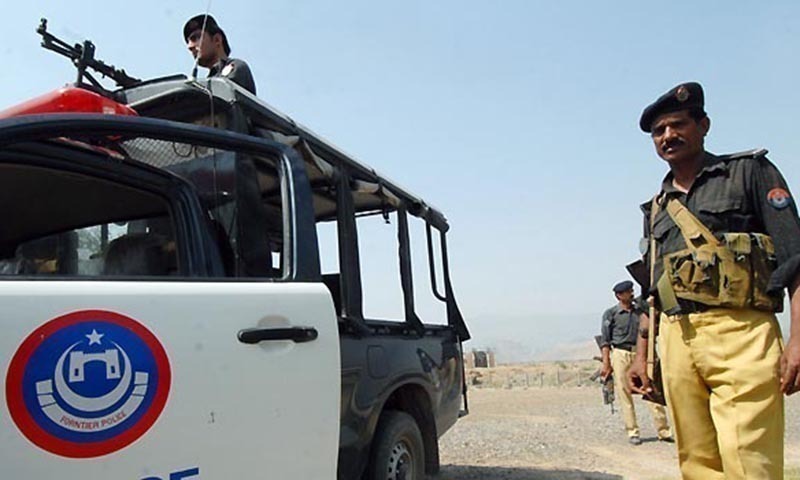
    PESHAWAR: Three terrorists were killed during an exchange of fire with Counter-Terrorism Department (CTD) and military personnel in the Passani village, located on Peshawar’s outskirts, late on Saturday night, the CTD said in a statement on Sunday.

    The statement said the CTD received intelligence about the presence of a group of terrorists belonging to Fitna-al-Khawarij on Passani Road — an area located 23 miles south of Peshawar, falling within the jurisdiction of Mattani police station.

    Fitna-al-Khawarij is a term the state uses for terrorists belonging to the banned Tehreek-i-Taliban Pakistan (TTP).

    The CTD said the terrorists planned to carry out attacks on government installations.

    “Based on the confirmed reports, CTD’s Special Weapons and Tactics Teams (SWAT), along with personnel of the Pakistan Army, equipped with modern weapons, reached the area to arrest the terrorists,” the statement added.

    However, upon seeing law enforcement and security personnel, the terrorists opened fire, to which the teams responded effectively in self-defence, the statement further said.

    Following an exchange of fire, a search operation was launched in the area during which the bodies of three terrorists were found, it said. The CTD identified the terrorists as Abdul Rashid, Saeedullah, and Saeed Nawab — members of the banned TTP.

    The statement added that other terrorists present at the site managed to escape; meanwhile, the teams recovered two Kalashnikovs, a pistol, three hand grenades, five magazines and computerised national identity cards (CNICs) from the slain terrorists.

    A search operation was under way to arrest the escaped terrorists, the statement added.

    As per the CTD statement, KP Inspector General of Police Zulfiqar Hameed and Additional IG CTD Jawad Qamar vowed that terrorists would never be allowed to succeed.

    Prime Minister Shehbaz Sharif lauded security forces for the successful operation, observing that “timely and decisive action” thwarted a “major threat”, state-run APP reported.

    The operations of the security forces against terrorism are a reflection of national resolve and morale, the report quoted him as saying.

    KP continues to actively face terrorist threats. Last week, 43 terrorists were killed during operations conducted in KP, including 35 in Mir Ali, North Waziristan district, and eight in Orakzai district, the military’s media wing said.

    On the other hand, the Pakistan Institute for Conflict and Security Studies (PICSS), an Islamabad-based independent think tank monitoring conflict and security developments, has reported encouraging trends in KP in its monthly assessment for October.

    In mainland KP, PICSS recorded 40 attacks during October, compared with 58 in September, representing a reduction of 31pc. Meanwhile, deaths resulting from these attacks declined from 90 to 38, a decrease of approximately 58pc, while injuries fell from 165 to 19, representing a reduction of 88pc.

    The merged districts of KP recorded 30 attacks during October, compared with 34 in September, and deaths resulting from these attacks decreased from 33 to 25, while injuries increased from 11 to 13, the report said.

    Source: dawn

  • Lahore once again ranks as world’s most polluted major city as AQI crosses 500

    Lahore once again ranks as world’s most polluted major city as AQI crosses 500

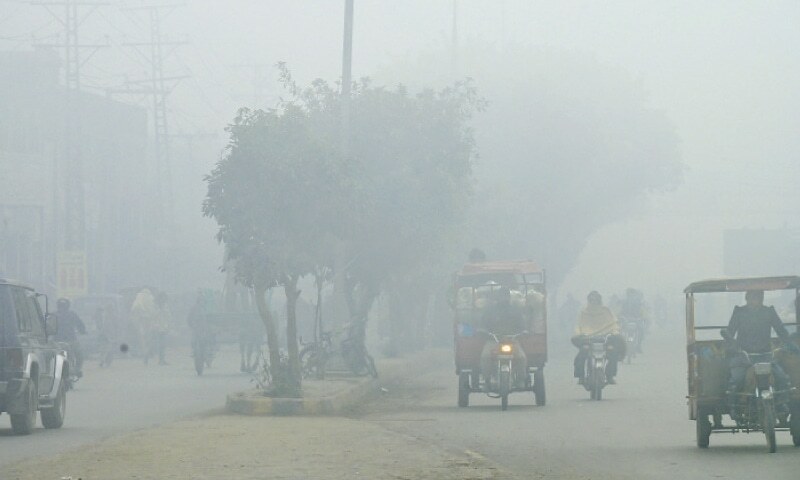
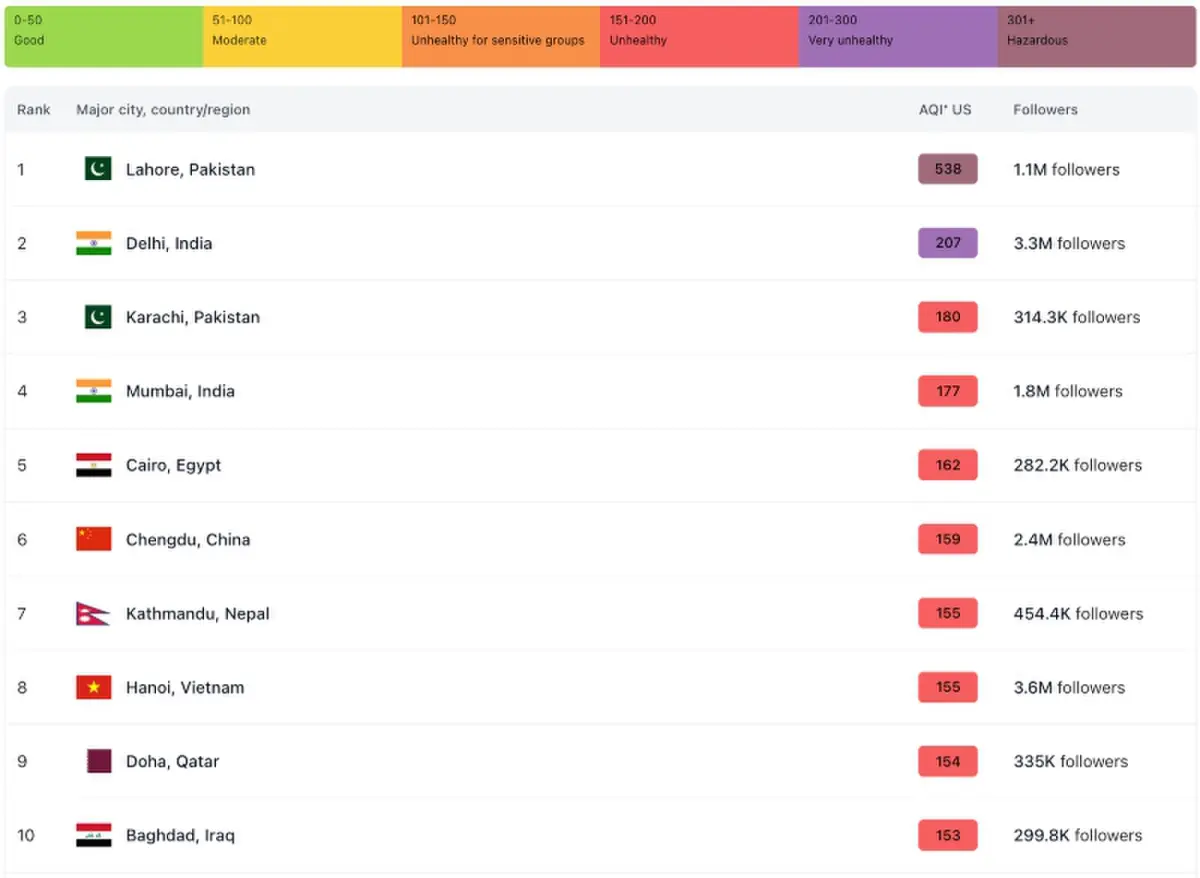
    Lahore topped the list of the world’s most polluted major cities once again on Sunday morning with an hourly air quality index (AQI) reading of over 500, according to real-time air quality data.

    Swiss air quality monitoring platform IQAir’s live global major city ranking placed Lahore first with 538 between 9am and 10am, classifying the quality as ‘hazardous’, indicating extremely polluted conditions and serious health risks for residents.

    It was followed by Delhi with an AQI of 207, Karachi with 180, Mumbai with 177 and Cairo at 162. The ranking showed Lahore’s pollution level to be more than twice that of the second-ranked city, Delhi.

    The deterioration was not confined to the provincial capital.

    IQAir’s live ranking of Pakistani cities on Sunday morning placed eight Punjab cities among the country’s 10 most polluted urban centres.

    Kahna Nau in Lahore district topped the list with an AQI of 606, followed by Lahore at 538, Bahawalpur at 536, Sargodha at 392 and Gujranwala at 347.

    Other cities in the top 10 included Multan, Dera Ghazi Khan, Skardu, Faisalabad and Peshawar.

    IQ Air rankings for the most polluted cities on Nov 22. — Screengrab IQAir
    IQ Air rankings for the most polluted cities on Nov 22. — Screengrab IQAir

    According to global health statistics, air pollution, both outdoor and indoor, is the second-leading risk factor for deaths worldwide, claiming an estimated 8.1 million lives annually. Outdoor particulate matter alone accounts for 4.7m deaths.

    Lahore has consistently ranked as the world’s most polluted major city in the past few weeks. On Saturday evening, it recorded an AQI of 266, showing Lahore’s air quality in the hazardous category.

    On Friday, heavy smog pushed air quality in several Punjab cities into the hazardous category, with Lahore recording an hourly AQI reading of 465 between 7am and 8am.

    Punjab govt intensifies crackdown against smog violations

    Amid the worsening air quality, Punjab’s Environment Protection and Climate Change Department (EPCCD) has intensified its province-wide crackdown against environmental violations, imposing fines amounting to Rs449.5 million, sealing 6,476 premises and carrying out 1,808 demolitions during the first 11 months of 2026.

    According to the latest enforcement figures compiled by the Environment Protection Agency (EPA) Punjab, enforcement teams conducted 187,588 field visits across the province between January 1 and November 21, targeting industrial pollution, non-compliant brick kilns, illegal plastic businesses, commercial establishments and fugitive dust.

    The enforcement drive has also yielded a 60 per cent increase in fines compared with the corresponding period last year, reflecting intensified regulatory action against major sources of pollution.

    Industrial units accounted for the largest share of penalties, with fines reaching Rs231.6 million against Rs108.8m during the same period in 2025.

    Brick kilns attracted Rs183.3m in fines, while penalties against plastic-related violations increased 4.5 times to Rs34.5 million.

    Brick kiln inspections remained a major component of the campaign, with 85,768 visits recorded during the reporting period. Enforcement teams demolished 1,431 units and sealed another 1,018 premises. Industrial enforcement operations involved 50,555 inspections, resulting in 1,525 premises being sealed and 377 demolitions.

    The department has also stepped up enforcement against restaurants and commercial establishments operating without the required suction hoods. A total of 10,766 inspections were conducted, leading to the installation of 4,385 suction hoods and the sealing of 1,287 premises. Significantly, 1,130 suction hoods were installed during November alone.

    The daily enforcement figures for November 21 further illustrated the scale of operations, with teams conducting 1,022 inspections across Punjab and imposing fines of Rs1.87 million.

    The operation resulted in 20 premises being sealed, seven FIRs registered and one brick kiln demolished. Officials also confiscated 390 kilogrammes of plastic bags and oversaw the installation of 72 suction hoods.

    Brick kilns accounted for 499 of the day’s inspections, followed by 275 industrial units, 153 plastic-related inspections and 95 suction-hood inspections. All seven FIRs and the demolition recorded on the day were related to brick kilns.

    Director General Environment Abdullah Nayyar Sheikh said the department was maintaining strict enforcement against all major sources of pollution through continuous monitoring, field inspections and action against non-compliant units. He emphasised that the strategy was aimed at ensuring compliance with environmental laws and preventing pollution at its source.

    EPCCD Secretary Silwat Saeed also stressed the importance of sustained institutional monitoring and effective implementation of environmental regulations to address pollution through a coordinated enforcement approach.

    A day earlier, the Lahore Traffic Police claimed to have intensified enforcement operations against vehicles contributing to air pollution.

    Chief Traffic Officer Syed Abdul Rahim Shirazi on Saturday claimed that the traffic police have issued challan tickets to 14,653 smoke-emitting vehicles.

    Action has also been taken against 10,306 vehicles transporting sand, soil and other materials without covering their loads with tarpaulins. The police have also proceeded against 31,618 unfit and dilapidated vehicles and taken action against 272,760 vehicles for overloading, he said.

    Pakistan’s average PM2.5 concentration stood at 67.3 micrograms per cubic metre in 2025, nearly 14 times the World Health Organisation’s annual guideline of 5 micrograms per cubic metre, according to the 2025 World Air Quality Report.

    This concentration corresponded to an average AQI of 156, placing Pakistan among the world’s most polluted countries.

    Source: dawn

  • Three dead, 36 missing after Indonesia factory fire

    Three dead, 36 missing after Indonesia factory fire

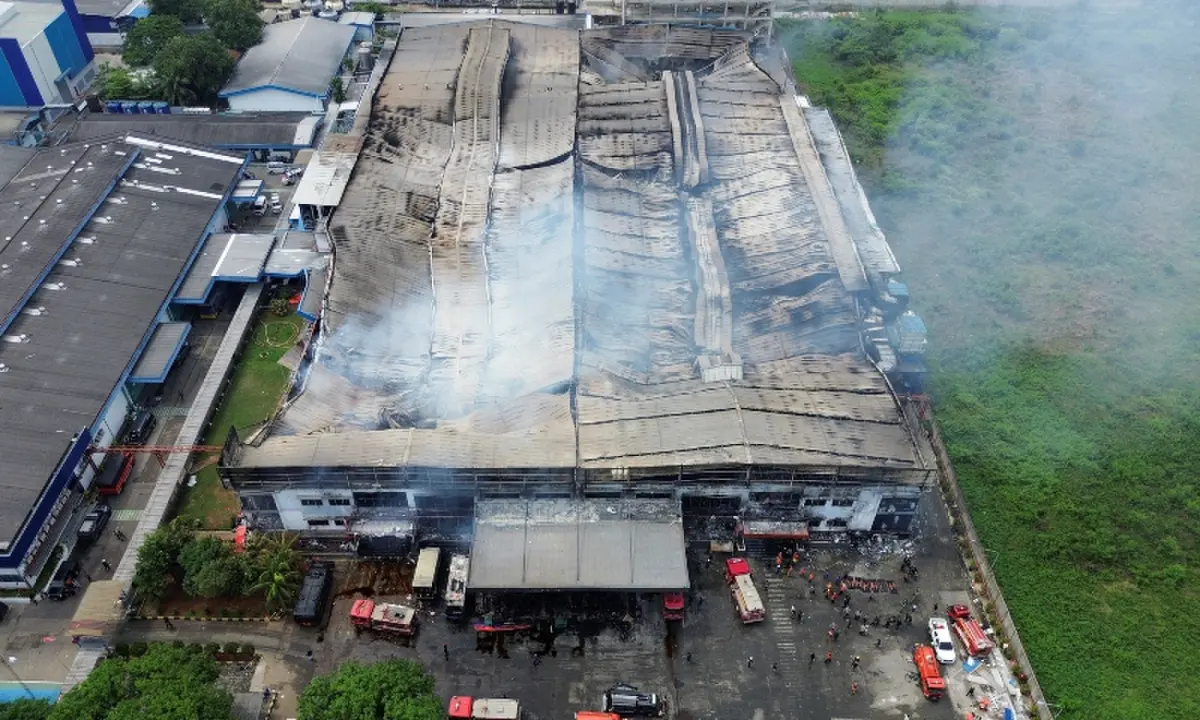
    A fire at a confectionery factory west of Jakarta killed three people and 36 remain missing, an Indonesian rescue official said on Sunday.

    Drone footage showed large parts of the factory destroyed, with the roof collapsed in places and smoke still rising from the complex.

    Photos and videos shared by rescuers also showed officers entering the charred building in search of the missing victims, with small fires still burning in some spots.

    Relatives of the missing victims flocked near the factory’s entrance, seeking updates about their loved ones, footage aired by local broadcasters showed.

    The Fonusa Agung Mulia factory, located in the Serang district around 50 kilometres from the capital, caught fire on Saturday afternoon, local search and rescue agency official Rizky Dwianto said.

    “All elements of the joint SAR (search-and-rescue) team are making maximum effort to locate the victims while prioritising the safety of personnel in the field,” he added.

    Rizky said four people were injured and taken to a nearby hospital and health clinic.

    Firefighters were alerted around 4:30 pm (2:30 pm Pakistan time) on Saturday and found the building already engulfed in flames when they arrived, fire official Tubagus Machfudz told local broadcaster Kompas TV.

    “When we arrived (on location)… a large area was already on fire. So we could not determine whether the company’s protection system was functioning properly or not,” he said.

    Banten province governor Andra Soni told reporters overnight that an estimated 60 people were inside the factory when it caught fire.

    Confectionery maker Fonusa Agung Mulia describes itself on the professional networking platform LinkedIn as a subsidiary of UNIFAM, one of the Southeast Asian nation’s major consumer-food companies.

    The cause of the incident is still under investigation, the local disaster agency said in an Instagram post on Sunday.

    Deadly fires are not uncommon in Indonesia.

    In December last year, a blaze that was likely caused by a drone battery explosion tore through a seven-storey building in Jakarta and killed at least 22 people, police said.

    In 2023, at least 13 people were killed in the country’s east after an explosion at a nickel-processing plant.

    Source: dawn

  • Portuguese foreign minister arrives in Pakistan for official visit: FO

    Portuguese foreign minister arrives in Pakistan for official visit: FO

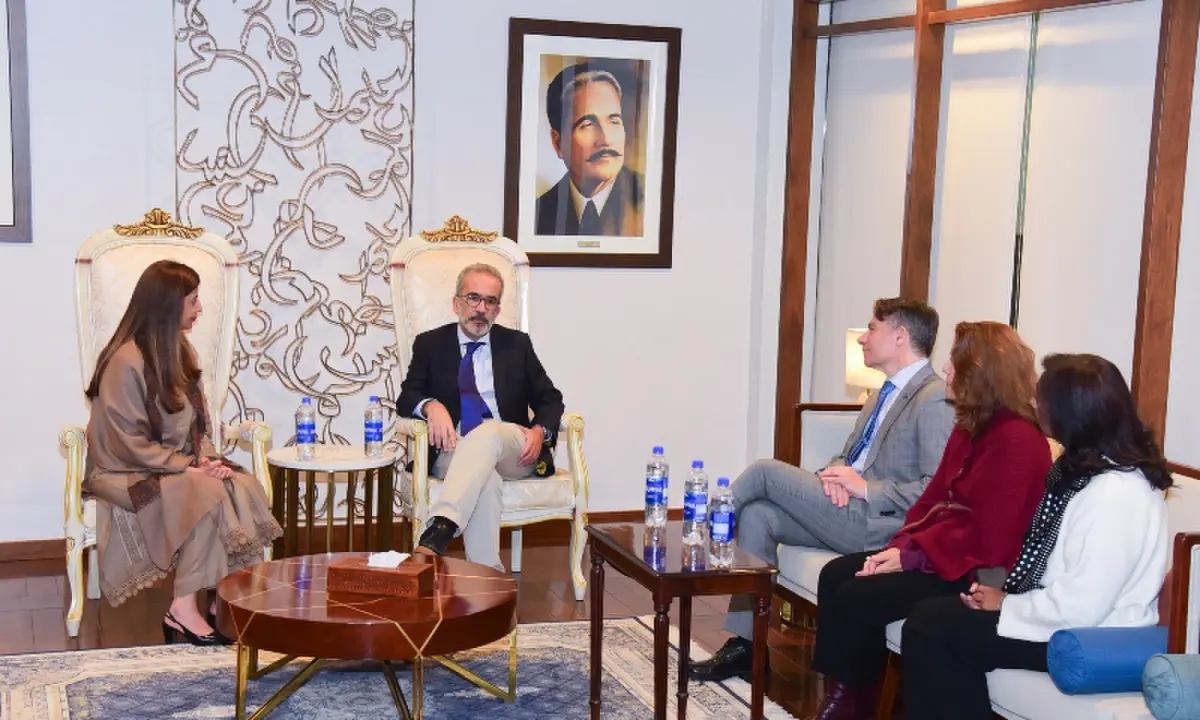
    Minister of State and Foreign Affairs of Portugal Paulo Rangel arrived in Pakistan on Sunday for an official visit, the Foreign Office (FO) said.

    Rangel is visiting Pakistan at the invitation of Deputy Prime Minister and Foreign Minister Ishaq Dar from November 22 to 23. He was received upon arrival by Additional Secretary Europe Ambassador Ayesha Ali.

    According to FO, Rangel will hold delegation-level talks with DPM Dar as well as meetings with Pakistani leadership.

    “He is accompanied by a business delegation for the inaugural Pakistan-Portugal Business Forum,” FO said, expressing hope that the visit will provide an opportunity to review the full spectrum of the bilateral relationship.

    The visit comes as Pakistan and Portugal mark the 77th anniversary of their diplomatic relations, established on Nov 7, 1949, FO spokesperson said in a statement on Saturday.

    The two leaders will review bilateral relations and discuss ways to expand trade and investment.

    “The visit will also feature a Pakistan-Portugal Business Forum. Companies from both countries will hold business-to-business meetings to explore commercial partnerships and investment opportunities in agri-food, renewable energy, pharmaceuticals, information technology and textiles,” the spokesperson had added in his statement.

    Foreign Minister Rangel’s visit will provide an opportunity to build on the longstanding ties between Pakistan and Portugal and to broaden bilateral cooperation across diverse sectors.

    Source: dawn

  • Broken record: UN entry, Mountbatten’s prejudice and the Grand Mufti’s letter

    Broken record: UN entry, Mountbatten’s prejudice and the Grand Mufti’s letter

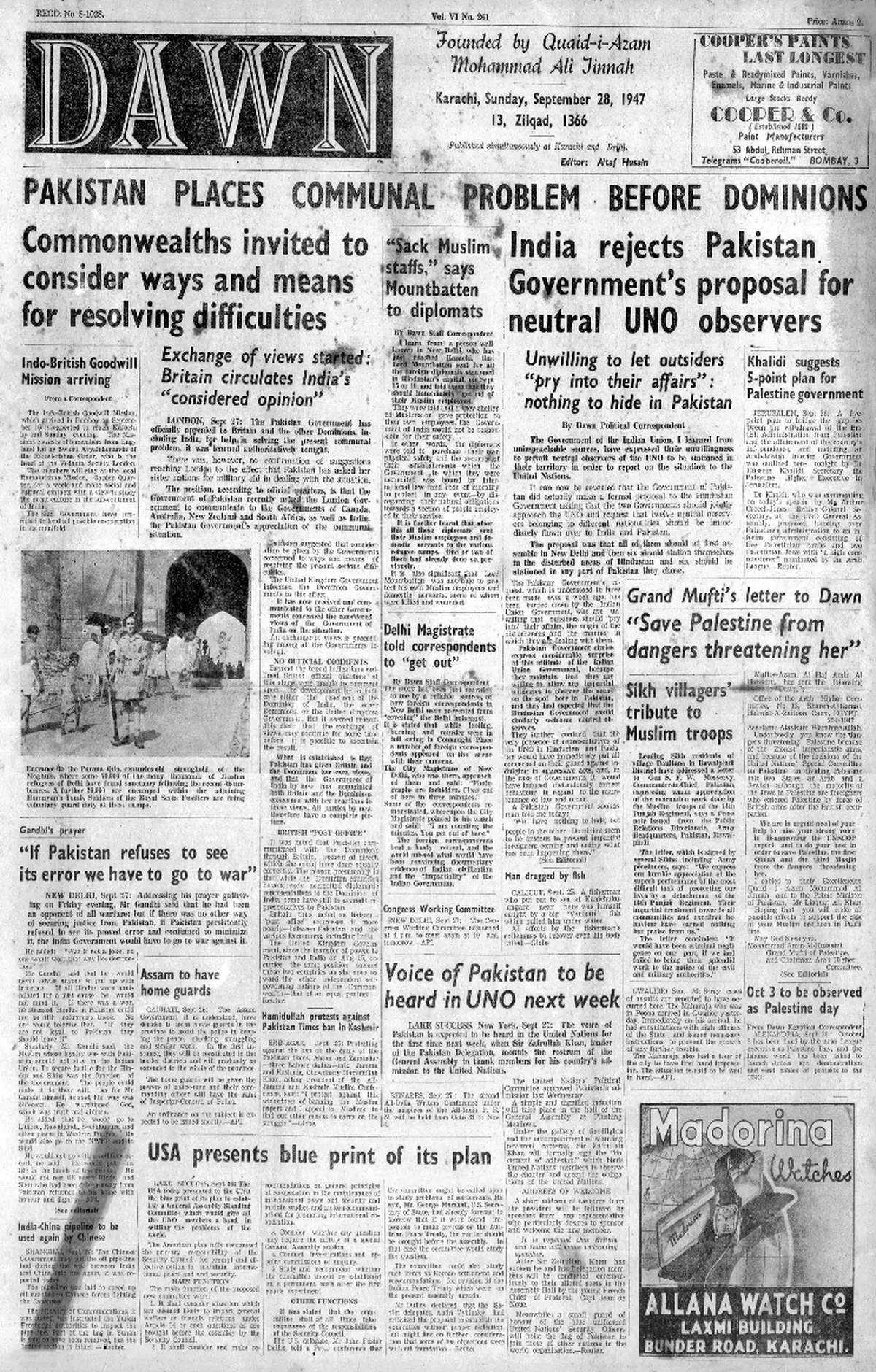
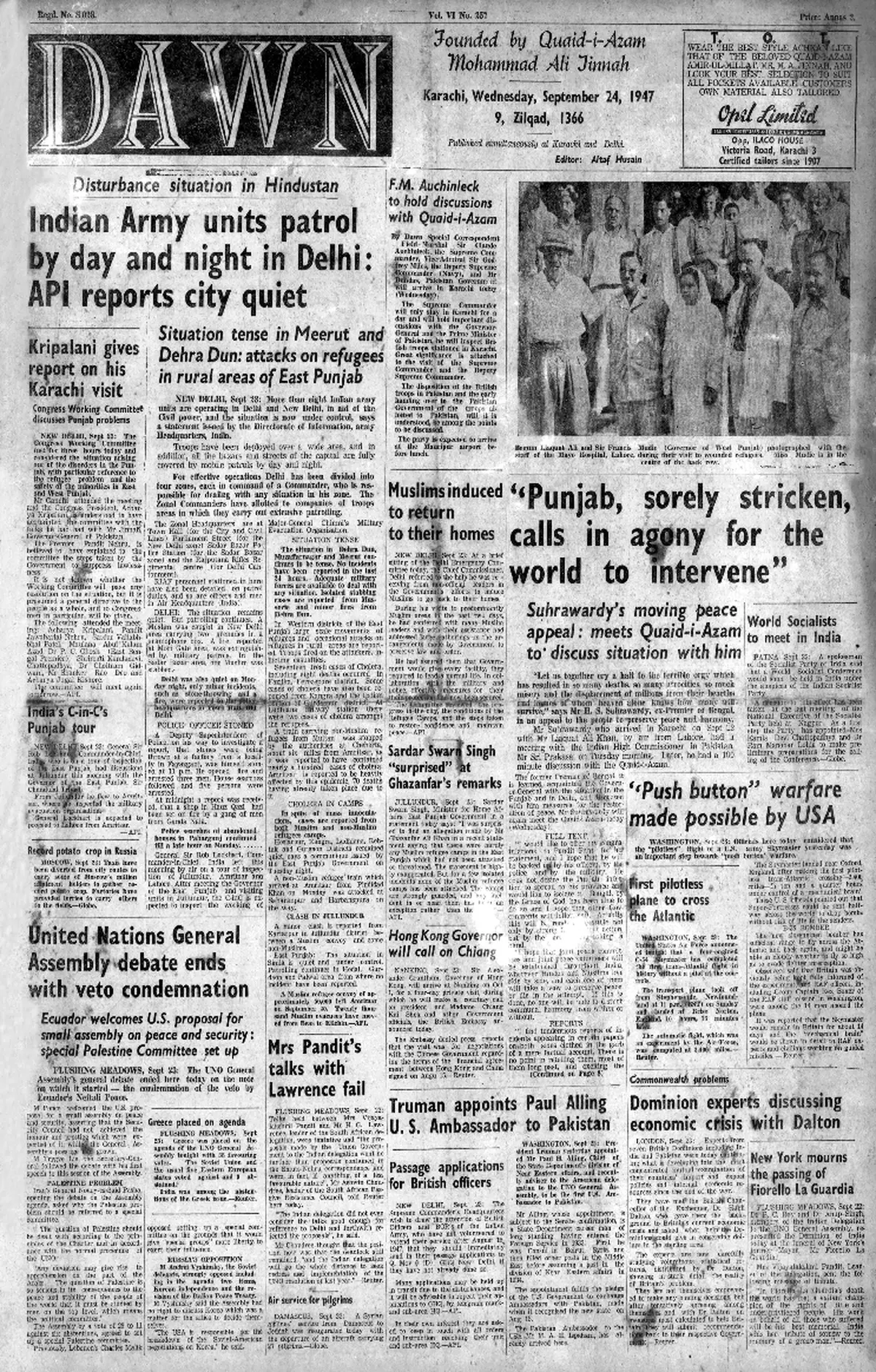
    Pakistan’s long and fruitful association with the United Nations began formally in the last week of September, as its application for UN membership was accepted. In other major developments, Louis Mountbatten was accused of throwing Muslim employees in Delhi under the bus, while the Grand Mufti of Jerusalem, Haj Amin Al Hussaini, issued a fervent appeal through Dawn to highlight Palestine’s plight.

    UN membership

    There were two major diplomatic achievements for Pakistan in the last week of September. The first was the young country’s acceptance as a member of the UN, then known as the United Nations Organisation (UNO). This was no small feat, as membership announced that Pakistan was ready to take its place in the comity of nations.

    ‘Dominion of Pakistan unanimously accepted for UNO membership’, the headline from the Sept 26 edition read. Pakistan received all 35 votes, though an interesting procedural question was raised by the Argentine representative. The report filed from Lake Success, NY (where the UN was based before shifting to its current headquarters in Manhattan in 1951), said: “The Dominion of Pakistan was unanimously recommended for membership in the UNO … by the Political Committee of the General Assembly. The resolution received the committee’s full 35 votes, but only after the Argentine delegate, Senor Jose Arce, objected to the necessity for Pakistan to apply for membership at all.”

    Broken record: UN entry, Mountbatten’s prejudice and the Grand Mufti’s letter

    Of course Senor Arce held no malice towards Pakistan; in fact he wanted to introduce Pakistan as a Charter member (India was already a Charter member, having joined the UN while still a British colony in 1945). As the report pointed out, “it was clear in the course of the debate that nobody was questioning the present status of India as member of the UNO, or the desirability of Pakistan becoming a member. … [The question] was whether a member of the UNO, if split into two separate nations, would create a situation in which two seats in the UNO were automatically available.

    “The Argentine’s case was that either Pakistan and India were both automatically members, or that neither were members until they had been formally admitted.”

    Thankfully the diplomatic debate was resolved amicably, and Pakistan was admitted. It was interesting to note that despite the intense Partition-related violence, the Indian delegation, which was present during the debate, did not oppose Pakistan’s membership. Perhaps, on one level, those were more civil times.

    Washington’s man in Karachi

    Another major diplomatic development during this period was the appointment of America’s first ambassador to Pakistan. As detailed in a report in the Sept 24 edition, US President Harry S. Truman appointed Mr Paul H. Alling as Washington’s first envoy to Pakistan.

    Unlike many of the questionable characters that the current White House has posted at foreign missions, Mr Alling was a seasoned diplomat. Washington’s man in Karachi had sterling credentials, as he was chief of the State Department’s division of Near Eastern affairs, while he had also advised the American delegation to the UNO.

    Broken record: UN entry, Mountbatten’s prejudice and the Grand Mufti’s letter

    Moreover, Mr Alling had served as US Consul in Beirut, Syria as well as other posts in the Middle East. Meanwhile, Pakistan’s first ambassador to the US, tycoon and diplomat Mirza Abol Hassan (M.A.H.) Ispahani, had already arrived in America.

    The appointment of the American ambassador would mark the start of one of Pakistan’s most important — and most complex — foreign relationships.

    Mountbatten’s prejudice?

    Louis Mountbatten, the last British viceroy of India, is known to have had cool relations with Quaid-i-Azam Mohammad Ali Jinnah, while enjoying cordial ties with Pandit Jawaharlal Nehru. ‘Dickie’ Mountbatten was apparently slighted by the fact that the Quaid chose to be the first Governor-General of Pakistan, whereas the Indians readily accepted him for the same post in their country. But did this bitterness turn Mountbatten into a prejudiced man? A report from the Sept 28 edition seems to suggest so.

    Titled ‘Sack Muslim staffs, says Mountbatten to diplomats’, the report says that “Lord Mountbatten sent for all the foreign diplomats stationed in Hindustan’s capital … and told them that they should immediately get rid of their Muslim employees.

    “They were told that if they sheltered Muslims or gave protection to their own employees, the Government of India would not be responsible for their safety.”

    Broken record: UN entry, Mountbatten’s prejudice and the Grand Mufti’s letter

    It added that “all these diplomats sent their Muslim employees and domestic servants to the various refugee camps. … It is also significant that Lord Mountbatten was not able to protect his own Muslim employees and domestic servants, some of whom were killed and wounded.”

    If these reports are true, they would shatter the myth of empire being a benevolent, benign force, and expose it as ruthless and vengeful, even in its dying days.

    Grand Mufti’s letter

    This newspaper’s commitment to the Palestinian cause goes back to the time of Independence. In fact, Haj Amin Al-Hussaini, the Grand Mufti of Al-Quds, had written to Dawn asking the paper to raise awareness about Palestine’s plight.

    As chronicled in the Sept 28 issue, Haj Amin wrote that “Undoubtedly you know the dangers threatening Palestine because of the Zionist imperialistic aims, and because of the decisions of the United Nations’ Special Committee on Palestine in dividing Palestine into two States — an Arab and a Jewish — although the majority of the Jews in Palestine are foreigners who entered Palestine by force of British arms after the British occupation.

    “We are in urgent need of your help to raise your strong voice in disapproving the UNSCOP report and to do your best in order to save Palestine, the first Qiblah and the third Masjid from the dangers threatening her.”

    Haj Amin was a prescient man and could see what was coming for his people. Sadly, 79 years after the Mufti’s impassioned appeal, the people of Palestine continue to suffer from Zionist terrorism.


    With the advantage of hindsight, one has the opportunity to study the historical cycles in a nation’s life. Thanks to this newspaper’s unique, extensive archive of back issues, one can examine the major political, economic and social trends that have shaped Pakistan and the world over the last seven decades and counting. Cliched as it may sound, history repeats itself, and we — as a state and as a polity — largely refuse to learn from it.

    Through this platform, we will look back at the ‘big’ stories that made it to the front pages of Dawn, as well as significant developments tucked away in the inside pages, from the birth of Pakistan onwards, and try to put them in perspective. We will study the critical issues of the week, starting from Aug 14, 1947 and examine the major themes and issues that made it to the paper.

    Source: dawn

  • Echoes of Pakistan’s shared past in Rawalpindi’s neglected temples

    Echoes of Pakistan’s shared past in Rawalpindi’s neglected temples

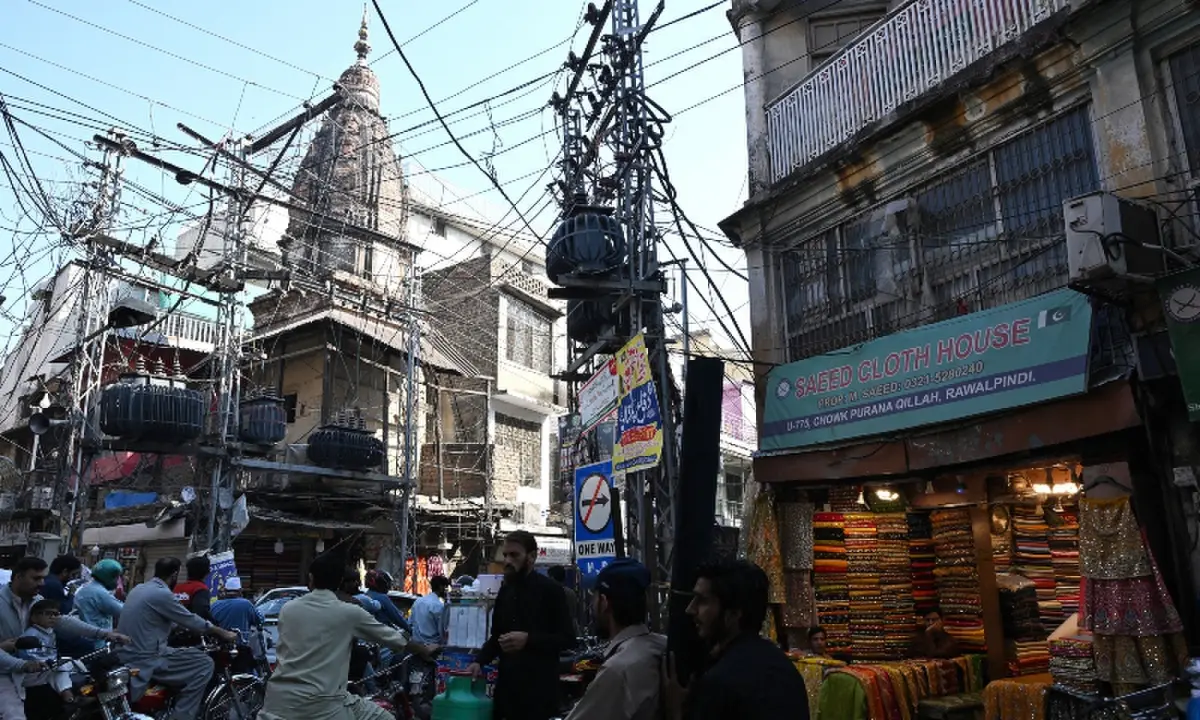
    Emerging through a tangle of electrical wires and advertising billboards in Rawalpindi’s urban sprawl, the towering spire of a Hindu temple is a reminder of the city’s mixed religious past.

    The temple “tells us about a very different time of Rawalpindi’s history when many different diverse communities used to coexist together”, researcher Hassaan Tauseef told AFP.

    Built in the 19th century, according to Tauseef, the facade of the temple in the city’s main commercial Raja Bazaar area is crumbling. Over the honking of motorcycles jostling through the crowded streets, a jewellery maker plies his merchandise from its ground floor.

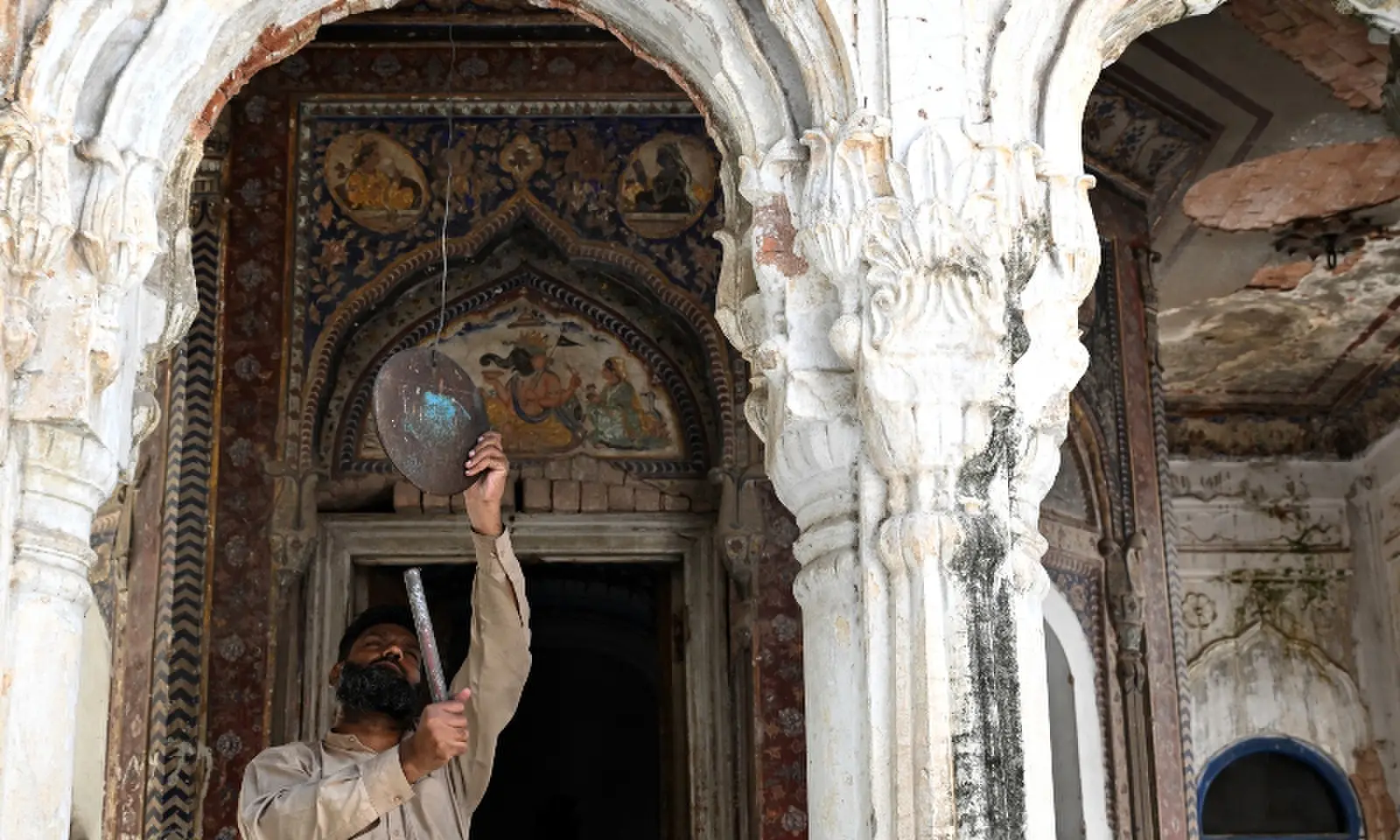
    This photograph taken on September 30, 2026 shows a man ringing the bell at Kalyan Das Temple located inside the premises of Qandeel Secondary School for the Blind, in Kohati Bazar in Rawalpindi. — AFP
    This photograph taken on September 30, 2026 shows a man ringing the bell at Kalyan Das Temple located inside the premises of Qandeel Secondary School for the Blind, in Kohati Bazar in Rawalpindi. — AFP

    The disused shrine is one of Rawalpindi’s 39 surviving Hindu temples, just three of which still serve the city’s dwindling Hindu community, while the others have been converted into homes, shops and other premises, according to architectural and cultural heritage expert Tauseef.

    Before the partition of British-ruled India in 1947, Rawalpindi was a religiously diverse city where non-Muslims made up the majority of the population.

    The bloodshed and mass migrations of partition saw Hindus and Sikhs flee to India and Muslim refugees pour into Pakistan, permanently transforming the city’s demographics.

    Disrepair

    Discrimination against religious minorities runs deep, with a report this year by the Human Rights Commission of Pakistan warning of escalating hate speech and attacks on minority communities.

    At a former Hindu temple in Rawalpindi’s northern Purana Qila area, small trees sprout from cracks in the crumbling walls and original windows have been bricked up.

    Washing swaying on a line outside betrays the temple’s present use as a home. The area surrounding the structure has become a popular space to park motorcycles.

    Many historic Hindu places of worship have fallen into disrepair. In addition to residences, they have also been repurposed as warehouses and schools.

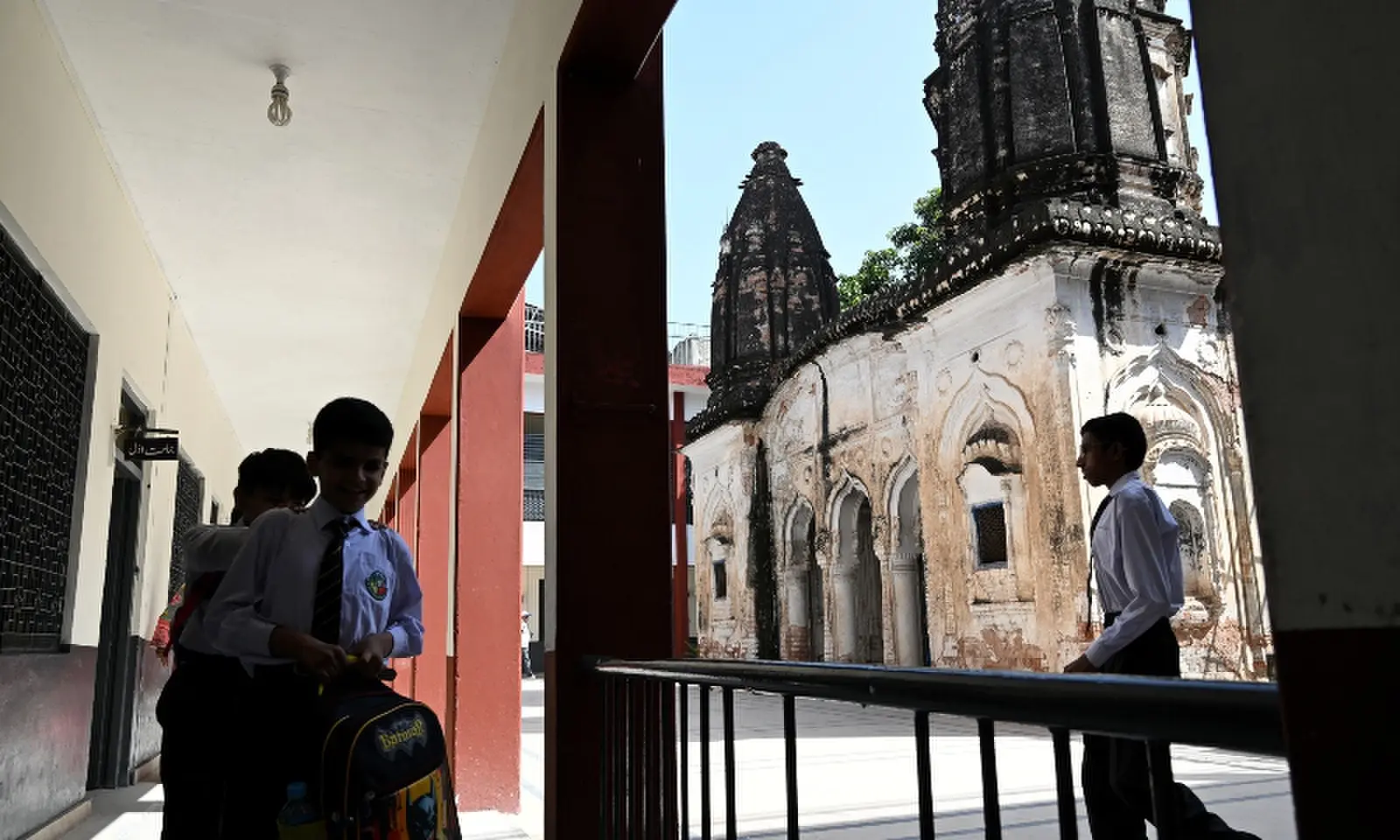
    This photograph taken on September 30, 2026 shows visually impaired children leaving their classroom near Kalyan Das Temple located inside the premises of Qandeel Secondary School for the Blind, in Kohati Bazar in Rawalpindi. — AFP
    This photograph taken on September 30, 2026 shows visually impaired children leaving their classroom near Kalyan Das Temple located inside the premises of Qandeel Secondary School for the Blind, in Kohati Bazar in Rawalpindi. — AFP

    “When the housing shortage became very, very large, the government started allotting a lot of these temples to these families as houses,” Tauseef said.

    The domed Kalyan Das Temple, built in the 19th century, now stands inside the Qandeel school for visually impaired children. On its walls, detailed carvings are still visible.

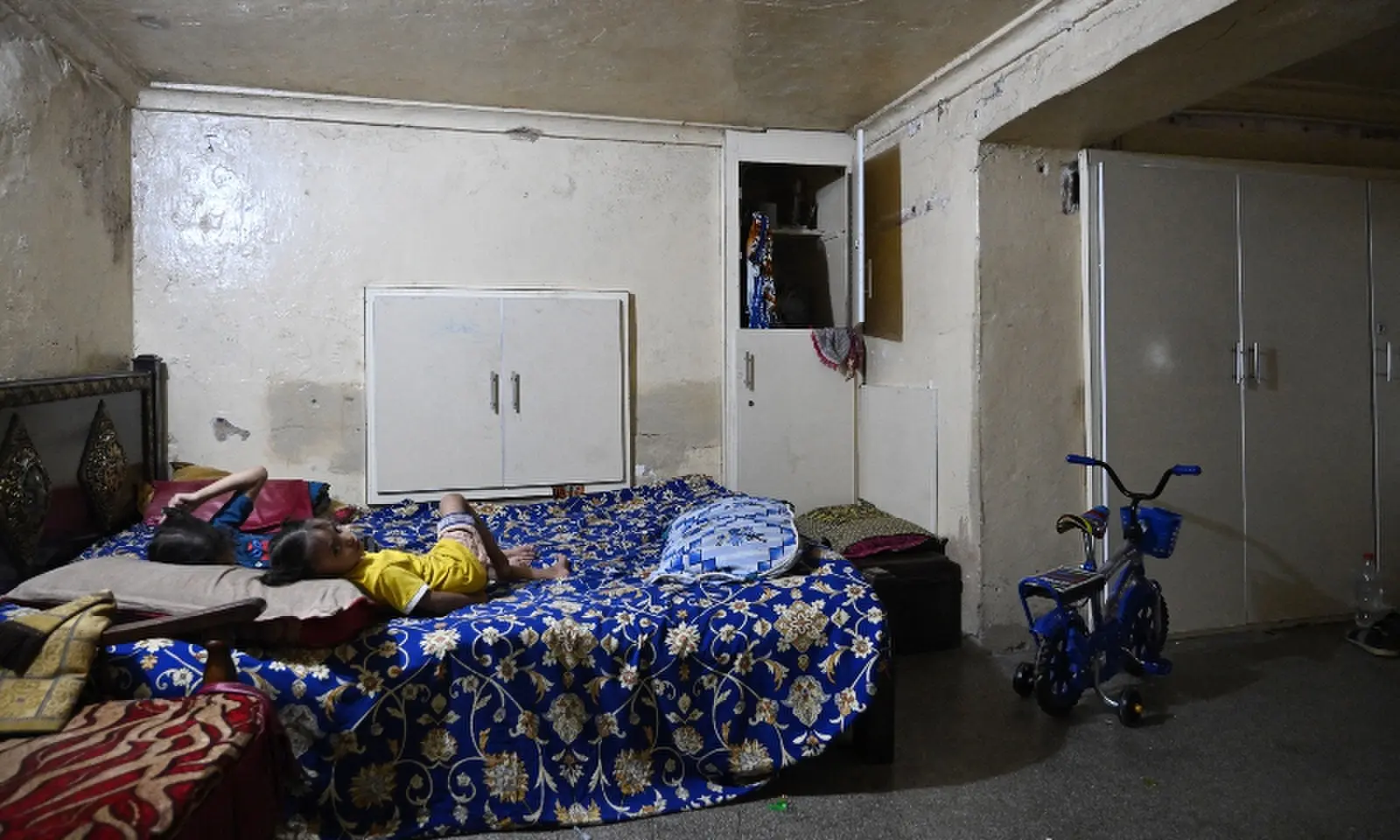
    This photograph taken on September 16, 2026 shows children resting inside a room at a Hindu Temple which is now used as a residence in Rawalpindi. — AFP
    This photograph taken on September 16, 2026 shows children resting inside a room at a Hindu Temple which is now used as a residence in Rawalpindi. — AFP

    Pervaiz Akhtar, the school’s principal, said there was a clear educational and cultural benefit for students by being exposed to Rawalpindi’s religious past.

    “For the young generation, it’s important in the sense that they come to know what the mode of worship in that religion was, what their buildings were like,” he said.

    “As Muslims, we respect all places of worship. So, in that spirit, we show respect to this place as well,” Akhtar added.

    ‘Our brother’

    Rawalpindi’s dwindling Hindu community still hopes life can be returned to their abandoned temples.

    Following the demolition of the Babri mosque in India in 1992, retaliatory riots swept across Pakistan, with mobs attacking Hindu places of worship, including several temples in Rawalpindi.

    Maharishi Valmiki Temple was among those targeted, losing its spire before later being renovated and reopened.

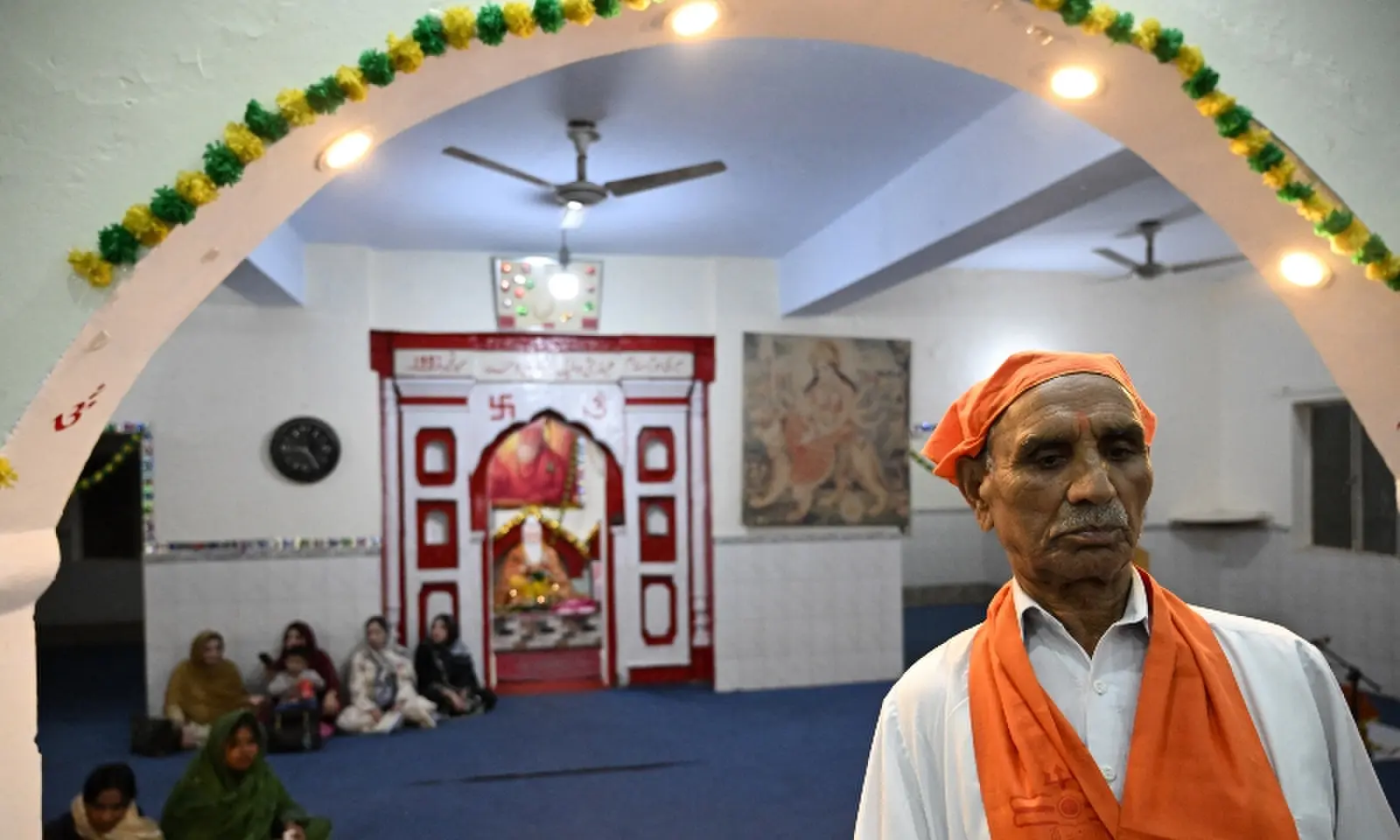
    Speaking of the disused Hindu shrines in Rawalpindi, Mir Chand Khokhar, a 74-year-old priest at the temple, said: “If the government gives them to us, we can make them functional too.”

    This photograph taken on October 25, 2026 shows Hindu priest Mir Chand Khokhar during an interview with AFP at Maharishi Valmiki Temple in Rawalpindi. — AFP
    This photograph taken on October 25, 2026 shows Hindu priest Mir Chand Khokhar during an interview with AFP at Maharishi Valmiki Temple in Rawalpindi. — AFP

    “It reminds us of a very different time, of a much more tolerant time in Rawalpindi,” Tauseef said. “We fail to recognise that the other was once our brother.”

    “These places could become places of storytelling, could become places that raise questions, but also give us answers, and could build empathy in a time when South Asia very, very direly needs this.”

    Source: dawn