Category: dawn news

  • Independent media not as ‘independent’ as it could be: Mehdi Hasan

    Independent media not as ‘independent’ as it could be: Mehdi Hasan

    • US journalist says news gatekeeping has been outsourced to Silicon Valley
    • Says every journalist ‘needs to be’ a content creator now

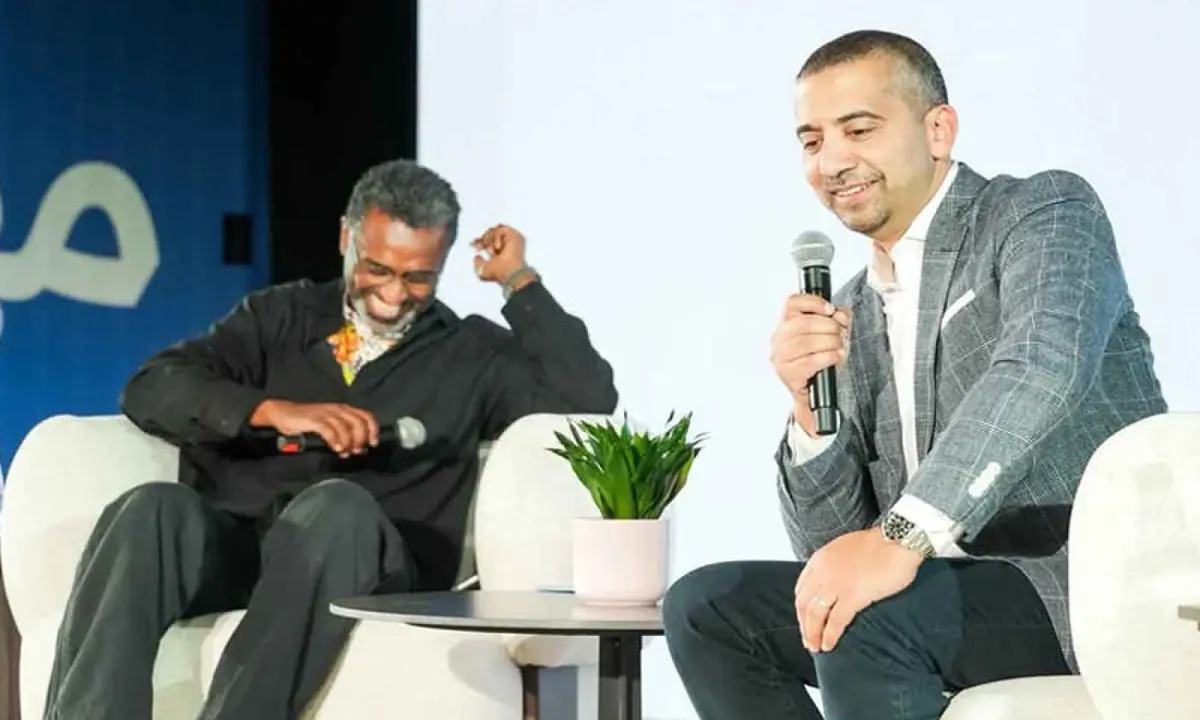
    DOHA: Journalism has undergone a major transformation since the advent of social media and independent news platforms, bringing both opportunities and challenges. These changes were the focus of a talk titled The New Gatekeepers by British-American journalist Mehdi Hasan at the Doha Film Festival.

    Drawing on his experience at mainstream outlets including the BBC, CNN, Al Jazeera, Sky News and MSNBC, Hasan discussed the changing media landscape and his move towards independent journalism through his own media company, Zeteo, after his MSNBC show was cancelled.

    Speaking about news gatekeepers, he said that historically only a handful of people could communicate with mass audiences because billionaires, corporations and governments controlled the technology and resources needed to spread information. That has now changed.

    “It’s good that we have democratised access to the news. Today anyone in this room can go out with a microphone, camera and a WiFi connection and potentially reach more people than a BBC, CNN or an Al Jazeera journalist,” he said.

    However, Mr Hasan stressed he was not opposed to gatekeeping itself, arguing that journalism still needed fact-checking and professional standards. “I am still a journalist, not a YouTuber or content creator. I am still on YouTube, but I do fact-check. The problem with the old gatekeepers was not the gates. It was that they were opening the gates to the powerful and shutting them to the powerless.”

    Citing a Reuters Institute survey, he noted that, for the first time, more people were getting their news from social media than from news websites and apps. “We are already in a brave new world,” he remarked.

    But the democratisation of information had not eliminated gatekeeping; instead, it had transferred much of that power to Silicon Valley, where technology executives such as Elon Musk and Mark Zuckerberg exercise considerable influence.

    Hasan described it as “insane” that platforms controlled by Zuckerberg, including WhatsApp, Instagram, Facebook and Threads, were used by a substantial proportion of the world’s population, with many relying on them for news.

    He warned that algorithms could undermine the news business, as had already happened to numerous publishers.

    Asked whether independent media was truly independent, Hasan acknowledged that it was not as independent as it could be. Although such outlets were often free from corporate, government or billionaire ownership and relied on subscribers rather than advertising, they faced another pressure: “audience capture”.

    “If you are fully funded by your subscribers, then you would tell them what they want to hear,” he said.

    He cited his own experience at Zeteo, where subscribers cancelled their subscriptions during the 2024 US election for diametrically opposed reasons, illustrating the difficulties of maintaining an independent editorial space.

    On whether every journalist now had to become a content creator, Mr Hasan said the two roles had increasingly overlapped. “I think every journalist does have to be a content creator now, which is a double-edged sword. But I don’t think every content creator or YouTuber is a journalist.”

    Addressing the crisis of trust in information, he argued that journalism itself was not responsible for the decline in public confidence. “I don’t think journalism is inherently bad, evil or has lost trust. I think institutions, people and journalistic practices have lost trust. People are craving journalism, facts, evidence, information and news about the world,” he said.

    Mr Hasan also rejected the idea that corporate media was dead, arguing that established organisations remained essential because independent outlets lacked the resources and expertise for large-scale news gathering, foreign coverage and extensive investigative reporting.

    He said he could not undertake the kind of investigative journalism produced by The New York Times due to lack of resources. However, he said, mainstream media had failed audiences in several areas, creating demand for alternative sources of information.

    Agenda, objectivity

    On editorial agendas and objectivity, Mr Hasan admitted that he had his own agenda, arguing that no media organisation was entirely neutral. “I don’t believe that there is any neutral media outlet, but my position is that journalists are allowed to have opinions as long as they are based on facts. I believe in objectivity. Neutrality and objectivity are not the same. I don’t believe you should be neutral between good and evil.”

    He identified another major challenge for independent journalism: audiences’ reluctance to pay for news. Without subscriptions or paywalls, he argued, it was difficult to fund the reporting and information gathering needed to sustain quality journalism.

    Published in Dawn, November 23rd, 2026

    Source: dawn

  • Washington governor calls ICE ‘out of control’ after Seattle airport arrests

    Washington governor calls ICE ‘out of control’ after Seattle airport arrests

    The governor of Washington state called US federal immigration agents “out of control” after they arrested two people at Seattle’s main airport on Saturday.

    Immigration and Customs Enforcement (ICE) officers have conducted raids across the United States, part of President Donald Trump’s immigration crackdown, which has forged ahead despite a rebuke by voters at this month’s midterms.

    Video footage widely shared on social media on Saturday showed two people being apprehended by masked men at an airport jet bridge.

    ICE later confirmed it had detained two people it said had overstayed their visas.

    Washington Governor Bob Ferguson said the agency was “completely and totally out of control”.

    “Like many Americans, I’m outraged by masked agents, who do not identify themselves, dragging people off jetways as they board a flight, creating chaos in our communities,” Ferguson wrote on X.

    “Today’s actions at Seattle-Tacoma International Airport are just the latest example of ICE’s deeply un-American tactics.”

    Ferguson said at a news conference that the ICE agents may have broken a state law limiting facial coverings for law enforcement, and that he was looking into how they accessed the jet bridge.

    The federal immigration agency said its officers “conducted a targeted enforcement operation to arrest Ricardo Larrondo Mendoza, an illegal alien from Mexico who overstayed his visa” on Saturday morning.

    The agency confirmed it had detained a second person whom it said would be charged with assaulting a federal officer, alleging she had thrown hot coffee on an ICE agent.

    “The individual… was identified as Sofia Hernandez Mejia, an illegal alien from Mexico and visa overstay. She was subsequently arrested as well,” ICE posted on X.

    Alaska Airlines, which operated the flight that Mendoza and Mejia tried to board, said on Saturday it was “concerned by this morning’s law enforcement action”.

    “Alaska Airlines is required to comply with applicable laws and regulations when interacting with law enforcement officials” but does not “direct or coordinate immigration enforcement activity”, the company added.

    The Port of Seattle, which operates the airport, said: “We are outraged about this morning’s incident involving ICE and two passengers.”

    This month, Trump appointed Stephen Miller, architect of his hardline immigration policy, as his new chief of staff.

    Miller faced widespread criticism after the deadly shootings of two protesters by immigration agents in Minneapolis in January — incidents that sparked mass demonstrations.

    Source: dawn

  • Any talks with India on terrorism must be ‘evidence-based’, says Musadik Malik

    Any talks with India on terrorism must be ‘evidence-based’, says Musadik Malik

    Federal minister Musadik Malik said on Sunday that any dialogue between Pakistan and India on terrorism must be “based on evidence”.

    Malik is in New Delhi on a three-day trip to attend the SCO Civilisational Dialogue Forum, making him the first Pakistani minister to visit the neighbour since former foreign minister Bilawal Bhutto-Zardari attended an SCO meeting in May 2023.

    Pakistan has repeatedly offered to hold talks with India to resolve outstanding disputes, including the water issue.

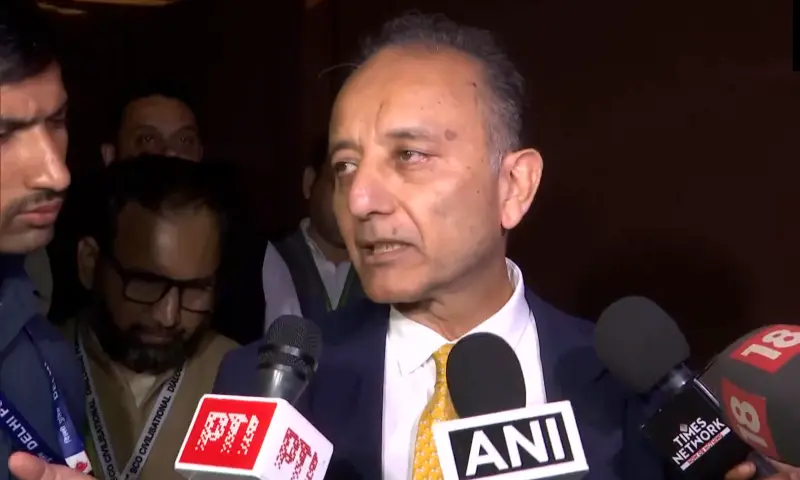
    In video clips shared by India’s ANI news agency on Sunday, Malik responded to queries from Indian media and stressed that he had repeatedly presented Pakistan’s stance before the reporters.

    “I am giving you a stable response that whenever discussions take place, they will be based on evidence, and they will certainly happen,” he affirmed, saying if New Delhi wanted a “lasting solution”.

    “You must also have some issues, [though] our issues are much greater than yours, and we also need a lot of evidence […] Whenever dialogue takes place, it will be based on evidence,” the climate change minister reiterated.

    Malik said Pakistan had repeatedly stated that evidence relating to terrorism could be presented through both bilateral and multilateral forums. “You may bring evidence; we also have evidence that we want to present,” he added.

    India’s foreign minister had said in June 2024 that his country wanted to “find a solution to the issue of years-old cross-border terrorism” with Pakistan. However, a military conflict between the neighbours last year has intensified tensions and escalatory rhetoric from India.

    In May 2025, a four-day confrontation between Pakistan and India was sparked by an attack on tourists in occupied Kashmir’s Pahalgam, which New Delhi, without evidence, linked to Pakistan.

    Islamabad had strongly denied responsibility while calling for a neutral investigation.

    In another clip, Malik noted that India had invited a representative from Pakistan to attend the Shanghai Cooperation Organisation’s (SCO) Civilisational Dialogue Forum, a multilateral event.

    “I am your guest. You invited me to a specific forum; I am present before you. I answered all those questions you asked about this forum,” the minister said, remarking that he had conveyed the “voice of my heart” to the people across the region through the forum.

    Malik stated, “You are today asking me questions for which you did not invite me. When you invite me for that question, I will appear. However, you first ought to invite me and say ‘we want to speak bilaterally with you’.”

    ‘Will speak on IWT when invited to do so’

    The minister was also asked about his remarks on the Indus Waters Treaty (IWT), but said he would comment on the matter when invited to do so.

    “You have currently invited me to speak on topics about which I have already spoken, that when temperatures rise, climate is destroyed, Glofs happen. Glofs and glaciers are blind, they do not know whether to fall on the right or the left,” he said, highlighting the shared threat climate change poses to both neighbours.

    He further said, “You have called me for culture and civilisation [discussions]. I am your guest, you are my host […] You have asked me the same question a 100 times and I have responded to it a 100 times.”

    In his remarks at the SCO forum on Saturday, Malik had termed climate change an “enemy” of civilisations and pointed out its impact on South Asian countries that bore the brunt of climate destruction.

    Water and the IWT remain a contentious issue between Pakistan and India, following New Delhi’s unilateral abeyance of the accord in April last year after the Pahalgam attack, which was followed by the four-day military conflict between the two sides.

    Following India’s move, Pakistan termed any attempt to suspend its water share an “act of war”, noting the IWT had no provision for unilateral suspension. It later argued that New Delhi’s action was a violation of the 1969 Vienna Convention on the Law of Treaties.

    Backing Islamabad’s stance, the Permanent Court of Arbitration (PCA) on Aug 31 ordered New Delhi to uphold the IWT, declaring that the treaty remained fully in force, as India had no justification for ending or suspending the agreement.

    The IWT, brokered by the World Bank in 1960, allocates the three western rivers — Indus, Jhelum and Chenab — largely to Pakistan, and the three eastern rivers — Ravi, Beas and Sutlej — to India.

    The treaty has survived wars, crises, and political tensions for more than six decades and is considered a rare example of durable water-sharing cooperation between the two neighbours.

    Source: dawn

  • More than 2,300 Indian Sikh pilgrims arrive in Pakistan to mark Guru Nanak’s birthday

    More than 2,300 Indian Sikh pilgrims arrive in Pakistan to mark Guru Nanak’s birthday

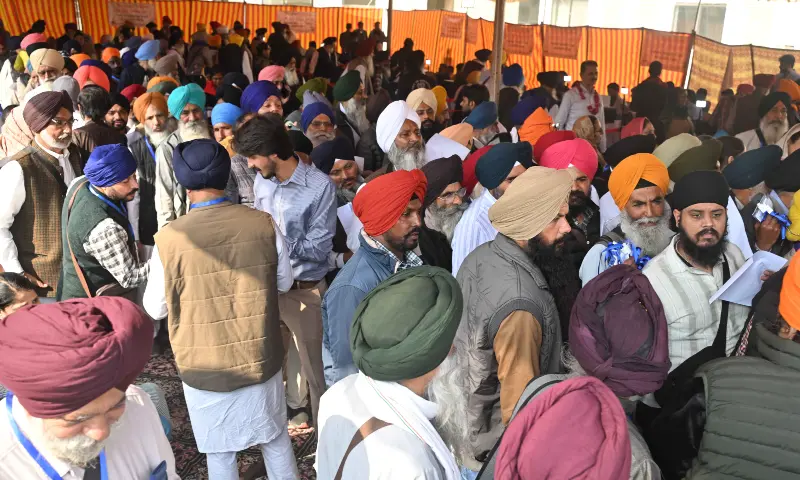
    LAHORE: Over 2,300 Indian Sikh pilgrims arrived in Pakistan through the Wagah Border on Sunday to attend celebrations marking the 557th birth anniversary of Baba Guru Nanak Dev Ji, the founder of Sikhism.

    The visiting pilgrims were received by Evacuee Trust Property Board (ETPB) Chairman Qamar Zaman, Secretary Nasir Mushtaq, Pakistan Sikh Gurdwara Prabandhak Committee (PSGPC) President and Punjab Minorities Minister Sardar Ramesh Singh Arora, the committee’s secretary general Satwant Kaur and other officials at the Wagah border, where the jatha leaders were presented with bouquets.

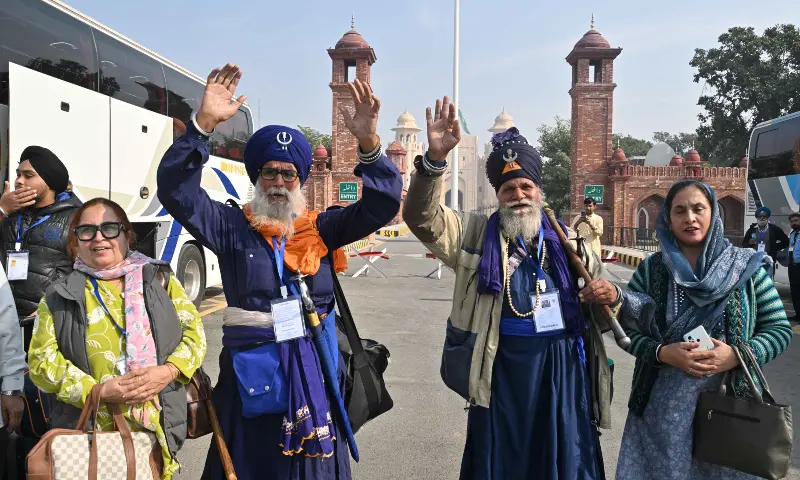
    Indian Sikh pilgrims wave to the camera after arriving in Lahore through the Wagah Border to  attend celebrations marking the 557th birth anniversary of Baba Guru Nanak Dev Ji, on Nov 22. — White Star
    Indian Sikh pilgrims wave to the camera after arriving in Lahore through the Wagah Border to attend celebrations marking the 557th birth anniversary of Baba Guru Nanak Dev Ji, on Nov 22. — White Star

    According to ETPB spokesperson Amir Hashmi, 2,339 Sikh pilgrims arrived from India here on Sunday to take part in the festivities in Nankana Sahib.

    The Pakistan High Commission in New Delhi had reportedly issued around 3,100 visas to Indian Sikhs.

    Special counters were set up at the Wagah Border to facilitate immigration and baggage screening, while Rangers were deployed to ensure security.

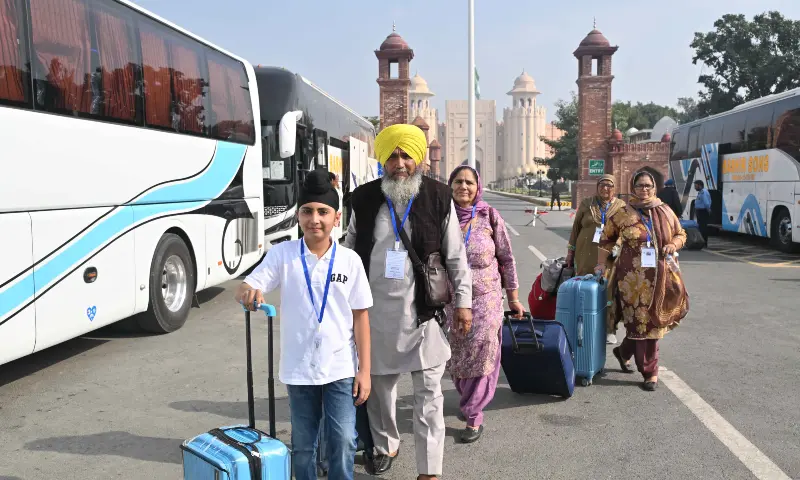
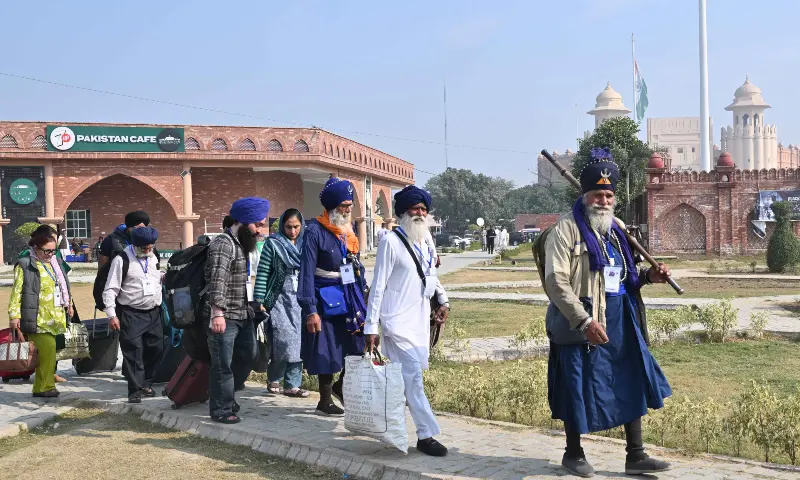
    Indian Sikh pilgrims arrive in Lahore through the Wagah Border to  attend celebrations marking the 557th birth anniversary of Baba Guru Nanak Dev Ji, on Nov 22. — White Star
    Indian Sikh pilgrims arrive in Lahore through the Wagah Border to attend celebrations marking the 557th birth anniversary of Baba Guru Nanak Dev Ji, on Nov 22. — White Star

    The ETPB had also established currency exchange facilities at the border, while its teams promptly issued identity cards and bus tickets to the pilgrims to ensure a smooth onward journey, he added.

    “The pilgrims subsequently left for Nankana Sahib in three separate convoys under tight security to attend the main ceremony on Nov 24 marking Baba Guru Nanak’s birth anniversary at Gurdwara Janam Asthan, his birthplace,” Hashmi said.

    He added that over 20,000 Sikhs — from Pakistan and across the globe — are expected to take part in the formal festivities, which begin today and continue until Nov 24.

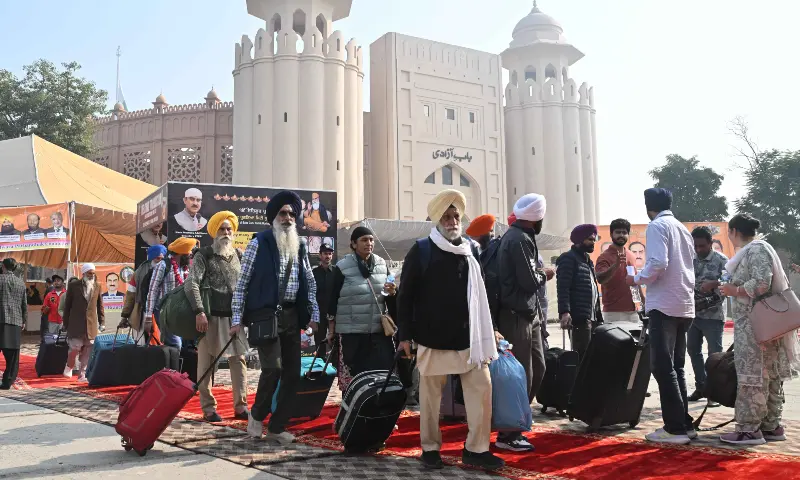
    Indian Sikh pilgrims gather after arriving in Lahore through the Wagah Border to  attend celebrations marking the 557th birth anniversary of Baba Guru Nanak Dev Ji, on Nov 22. — White Star
    Indian Sikh pilgrims gather after arriving in Lahore through the Wagah Border to attend celebrations marking the 557th birth anniversary of Baba Guru Nanak Dev Ji, on Nov 22. — White Star

    Federal Minister for Religious Affairs Sardar Muhammad Yousuf, along with other federal and provincial ministers, will attend the event as special guests.

    The event participants will perform religious rituals, including Bhog and Akhand Path Sahib, followed by a traditional palanquin procession, known as Nagar Kirtan.

    Speaking on the occasion, ETPB Chairman Zaman said the board was making every effort to ensure that the visiting pilgrims faced no inconvenience during their stay in Pakistan.

    He said the Indian Sikh pilgrims would return home with fond memories of love, peace and brotherhood.

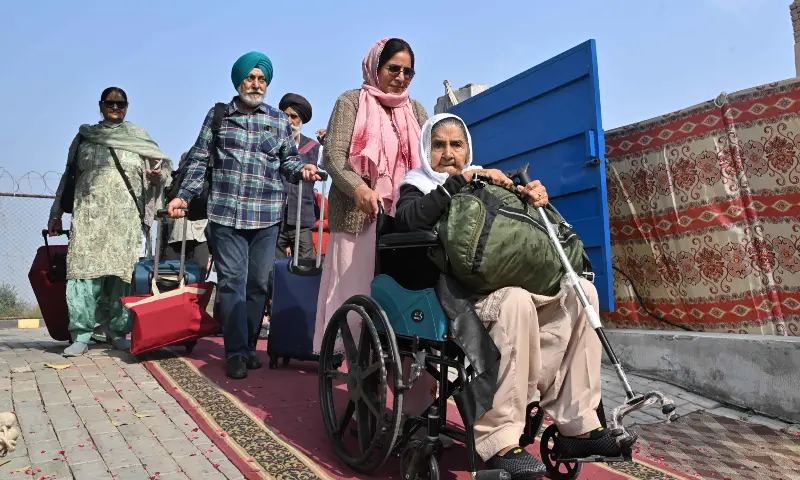
    Indian Sikh pilgrims including a wheelchair-bound woman arrive in Lahore through the Wagah Border to  attend celebrations marking the 557th birth anniversary of Baba Guru Nanak Dev Ji, on Nov 22. — White Star
    Indian Sikh pilgrims including a wheelchair-bound woman arrive in Lahore through the Wagah Border to attend celebrations marking the 557th birth anniversary of Baba Guru Nanak Dev Ji, on Nov 22. — White Star

    Minister Arora urged the Indian government to immediately reopen the Kartarpur Corridor, which provides Sikh pilgrims with access to Gurdwara Darbar Sahib in Kartarpur, one of the holiest sites in Sikhism.

    India suspended movement through the Kartarpur Corridor in May 2025 amid the four-day conflict between the countries.

    Kaldeep Singh Gurgaj, a leader of the Akal Takht authority from India, said the Sikh community shared a deep bond of reverence with Pakistan, where its members were always treated with respect and honour.

    “Our gurdwaras in Pakistan are safe and preserved in their original state,” he said.

    Parmjeet Singh, a leader of a Delhi Gurdwara Management Committee delegation, said Pakistan held special significance for Sikhs as the land associated with their guru.

    “Pakistan is the land of our guru, and we love it very much,” he said.

    Indian Sikh pilgrims arrive in Lahore through the Wagah Border to  attend celebrations marking the 557th birth anniversary of Baba Guru Nanak Dev Ji, on Nov 22. — White Star
    Indian Sikh pilgrims arrive in Lahore through the Wagah Border to attend celebrations marking the 557th birth anniversary of Baba Guru Nanak Dev Ji, on Nov 22. — White Star

    After attending the main ceremony, the Sikh pilgrims will visit Gurdwara Sacha Sauda in Farooqabad on Nov 25 before proceeding to Hassan Abdal, where they will stay overnight at Gurdwara Panja Sahib.

    They will travel to Gurdwara Darbar Sahib in Kartarpur, Narowal, on Nov 27.

    The visiting devotees will then spend Nov 29 and 30 visiting various historic gurdwaras in Lahore before returning to India through the Wagah border by road on Dec 1.

    Sikh pilgrims frequently visit Pakistan to observe events of religious significance. In June, around 600 Sikhs arrived from India to observe the death anniversary of Guru Arjan Dev Ji, known as Jore Mela; before that, about 2,800 visas were issued to pilgrims to celebrate the Baisakhi festival in April.

    Source: dawn

  • IBCC plans fully online attestation from Jan 1, ending office visits and courier submissions

    IBCC plans fully online attestation from Jan 1, ending office visits and courier submissions

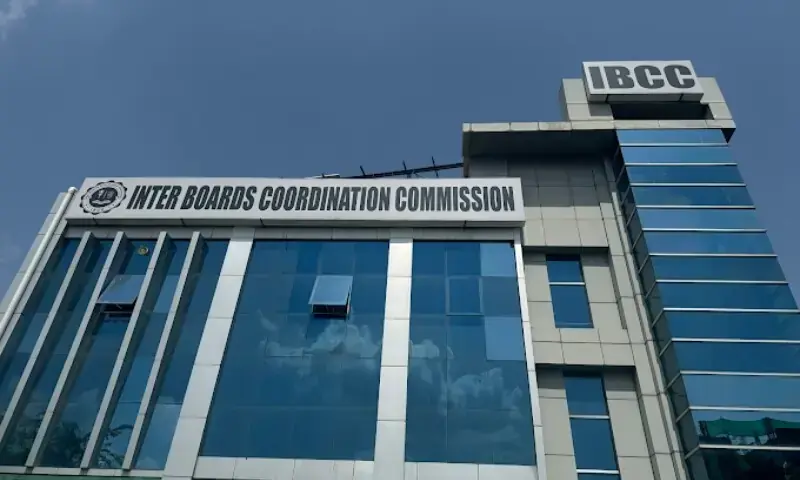
    The Inter Boards Coordination Commission (IBCC) will launch a fully online attestation service on Jan 1, 2027, allowing students to apply for attestation and download their attested documents without visiting an IBCC office or sending documents by courier.

    The decision was taken at a meeting of the IBCC Board of Directors chaired by Executive Director Dr Ghulam Ali Mallah. The service will cover qualifications issued by 29 examination boards across Pakistan, as well as eligible qualifications from madressahs.

    Under the new online service, applicants will submit their documents through the IBCC portal. Once the commission processes and approves an application, the electronically attested document will be available in the applicant’s account to download and print. The new system will eliminate the need for courier delivery in either direction.

    Students needing to submit the same document to several institutions will be able to print multiple copies without paying a separate IBCC attestation fee for each copy. They can use the copies for submissions to universities and, where required for use abroad, to the foreign ministry, subject to its applicable requirements.

    Dr Mallah said the commission had developed the system on the directions of Federal Secretary for Education and Professional Training Nadeem Mahbub, after the IBCC Board of Governors took up the automation of the entire attestation process.

    He said the commission expected the service to benefit an estimated 400,000 to 500,000 students by cutting travel and courier costs and saving them time spent visiting and waiting at IBCC offices. The shift would also reduce the commission’s workload by eliminating the need to receive, handle and dispatch physical documents.

    Source: dawn

  • Oman to supply petroleum products, $200m credit facility to PSO under new agreement

    Oman to supply petroleum products, $200m credit facility to PSO under new agreement

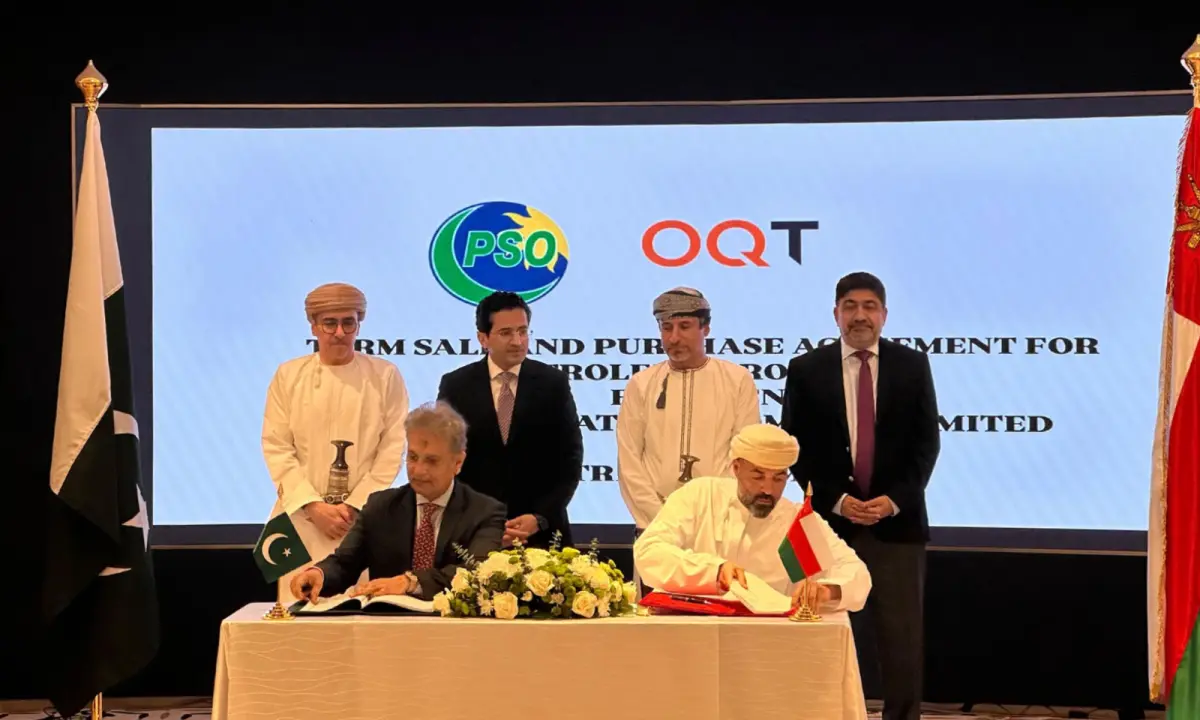
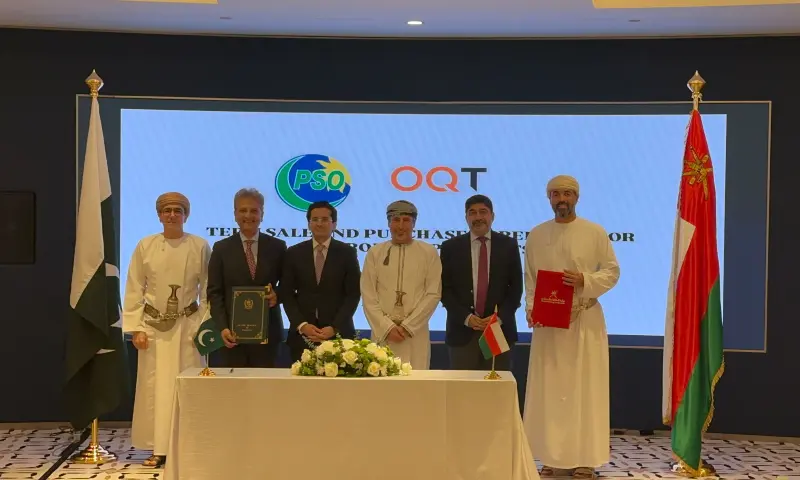
    ISLAMABAD: Pakistan and Oman on Sunday signed an agreement under which the Gulf country’s state-owned OQ Trading would supply petroleum products, as well as a $200 million credit line, to the Pakistan State Oil (PSO).

    This could provide Pakistan with a means to strategically diversify its sourcing of petroleum products as the Strait of Hormuz continues to be choked by the US-Iran conflict into its ninth month.

    According to an announcement from the Petroleum Division, the agreement between the two state-owned entities was signed during Petroleum Minister Ali Pervaiz Malik’s visit to Muscat, where he met with Oman’s Minister of Energy and Minerals Eng. Salim Al Aufi.

    The two sides discussed opportunities for strengthening bilateral cooperation in the oil, gas and minerals sectors.

    During the meeting, both ministers discussed avenues for mutually beneficial cooperation and welcomed the establishment of the Pakistan-Oman Joint Working Group on Oil and Gas. They agreed to make optimal use of this institutional mechanism to further strengthen bilateral engagement and advance cooperation in the energy and mining sector.

    Following the meeting, the two ministers witnessed the signing of a Sale and Purchase Agreement (SPA) for petroleum products between PSO and OQ Trading (OQT), Oman’s global commodity trading company. OQT has also agreed to extend a $200m credit line to PSO to facilitate petroleum purchases.

    Welcoming the agreement, both ministers expressed confidence that its implementation would further strengthen Pakistan-Oman energy ties and support Pakistan’s efforts to enhance energy security through diversification of energy imports.

    “The agreement marks an important milestone in the commercial relationship between the two companies and provides a structured arrangement for petroleum product supplies from OQT to PSO, supporting supply reliability amid continued volatility in regional energy markets,” the Petroleum Division’s statement said.

    It noted that OQT has already established itself as a major supplier of gasoline to PSO, supplying more than 1m tonnes during 2026. The newly signed agreement builds on this established trading relationship and provides a framework for expanding commercial cooperation, the statement added.

    Beyond gasoline, OQT has also strengthened its presence in Pakistan’s liquefied petroleum gas (LPG) market, supplying both state-owned and private sector buyers.

    According to the Petroleum Division, OQT’s LPG supplies to Pakistan are expected to exceed 120,000 metric tonnes by the end of 2026, reflecting the company’s continued commitment to meeting market demand and maintaining energy flows amid regional supply disruptions.

    The meeting and the signing of the agreement underscore the shared commitment of Pakistan and Oman to expanding bilateral energy cooperation, strengthening commercial partnerships and exploring new investment opportunities across the oil, gas and minerals sectors, the statement added.

    Last month, Oman’s Foreign Minister Badr Albusaidi made a two-day visit to Pakistan, meeting its top leadership.

    He attended the eighth session of the Pakistan-Oman Joint Ministerial Commission (JMC), during which both sides emphasised the importance of promoting exchanges of business delegations from both countries to unlock new opportunities for trade, investment and institutional collaboration.

    Oman to supply petroleum products, $200m credit facility to PSO under new agreement

    Source: dawn

  • Naqvi hits back at ‘minister’ for repeated criticism: report

    Naqvi hits back at ‘minister’ for repeated criticism: report

    Interior Minister Mohsin Naqvi has hit back at a federal minister for what he said was repeated criticism against him, Geo News reported on Sunday.

    The news website reported that Naqvi, without naming the minister, claimed the latter had been commenting on him on television almost every day to “gain attention”.

    The report described the remarks as part of an informal conversation with Geo News and further quoted Naqvi as saying that he had been patiently listening to the minister’s statements for the past two-and-a-half years — the tenure of the incumbent government since the 2024 elections.

    “The day I comment on this minister, he will not be able to show his face,” Naqvi warned, according to the outlet.

    Naqvi also defended the businesspeople present at an economic forum who he said were criticised by the minister. He said the attendees were respectable citizens who had served as presidents and office-bearers of chambers of commerce at the federal and city levels, according to the report.

    While the report did not quote him as mentioning any specific details in this connection, Naqvi’s remarks at the Pakistan Economic Summit in Islamabad in July had been making headlines in recent months. Naqvi had whipped up a political storm by calling for creating new administrative units in the country to “reset” the current “system” of governance while speaking at the forum, which was attended by businessmen.

    In his remarks to Geo News, Naqvi stated that the businessmen were also among the country’s highest taxpayers.

    “If these businessmen are so bad, why do you take billions of rupees from them in the name of party funds at every election?” the interior minister was quoted as saying.

    Naqvi’s remarks have been reported a day after Inter-Provincial Coordination Minister Rana Sanaullah questioned the objectives of some of the businesspeople at that July forum.

    In an interview on Geo News programme ‘Jirga’ aired on Saturday, Sanaullah said the “matter got worse in such a way that the debate on provinces began from an economic forum” and Naqvi started the discussion.

    Sanaullah, also Naqvi’s predecessor, contended that there were “some objectionable businessmen sitting among the audience of that economic forum”.

    “It has been their background that in each tenure, they keep on telling the incoming ruler, especially the army chief, that ‘sir, the whole world is looking at you and only you are the saviour,’” Sanaullah said.

    The PML-N leader clarified that he was not referring to the entire business community, but rather “a few people who keep committing crime in business, and here as well”.

    On differing stances among federal cabinet members on the issue of new provinces, Sanaullah contended that politicians could express their opinions, as “regimental discipline” could not be brought into the cabinet.

    Sanaullah stressed that the debate on provinces was “not wrong”, but he contended that the “debate was being entangled with other matters; saying that the system has collapsed; after that some remarks were made about the prime minister, and similarly about politicians contesting elections in so and so manner”.

    The PML-N leader also criticised PPP Chairman Bilawal Bhutto-Zardari for further complicating the situation by referring to various matters in his Nov 17 speech, rather than merely voicing his objection to carving out new administrative units out of Sindh.

    Sanaullah further termed both Bilawal and Naqvi as “sons” of President Asif Ali Zardari, adding that they were “under his discipline”.

    Asked about the independent senator being “under President Zardari’s discipline”, Sanaullah reiterated, “Yes, definitely. He has not disowned him yet. He himself calls him (Naqvi) his son; it is not that we are saying so.”

    Source: dawn

  • Pakistan Shaheens post 313 against India A in heated Rising Stars Asia Cup clash

    Pakistan Shaheens post 313 against India A in heated Rising Stars Asia Cup clash

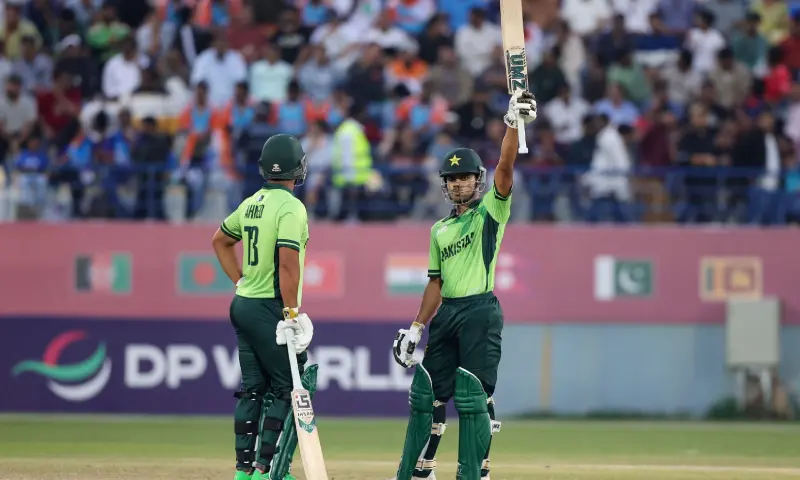
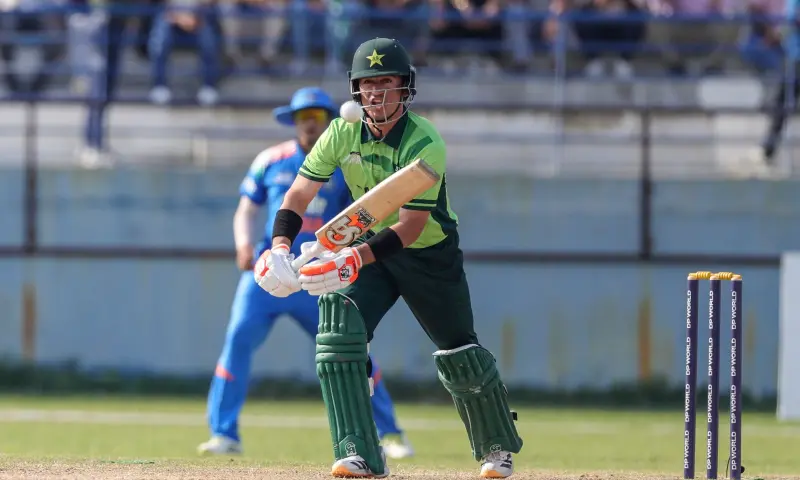
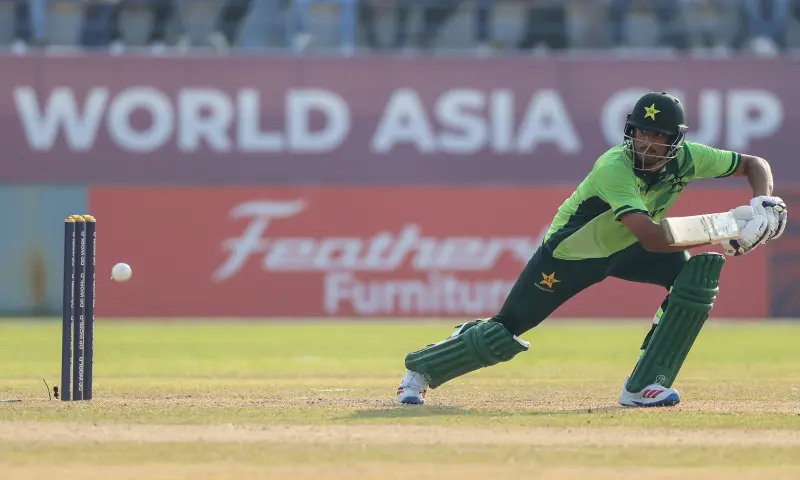
    Pakistan Shaheens made 313 in 49.2 overs after winning a controversial toss and opting to bat against India A in their Asia Cup Rising Stars match here on Sunday, with half-centuries from Maaz Sadaqat, Hasan Nawaz and Farhan Yousaf underpinning their total.

    The toss took an unusual turn when match referee initially called tails after India A captain Tilak Varma flipped the coin on Pakistan captain Abdul Samad’s call of heads.

    Both captains inspected the coin before Samad pointed out the error, prompting the officials to recheck and correct the decision in Pakistan’s favour.

    Samad chose to bat on a pitch both captains described as slightly dry. The sides did not shake hands after the toss, maintaining the protocol observed in recent India-Pakistan encounters.

    Pakistan made a brisk start, with openers Shamyl Hussain and Maaz taking 65 runs off the first seven overs. Shamyl led the attack, striking 33 off 23 balls, including four fours and two sixes, as the pair put India’s pace attack under pressure.

    Harshit Rana, in particular, responded with an aggressive approach, engaging both openers in heated exchanges as they scored freely.

    The verbal contest continued through the powerplay and Rana gave Shamyl an animated send-off after the left-hander was caught by the bowler at short third off Ayush Badoni in the eighth over.

    Rana struck again five balls later, trapping wicketkeeper Rohail Nazir leg-before for a duck to leave Pakistan 67-2.

    Maaz and Hasan Nawaz then steadied the innings with a 54-run stand for the third wicket.

    Maaz Sadaqat plays a shot during the Asia Cup Rising Stars match against India A on Nov 22. — Photo courtesy ACC
    Maaz Sadaqat plays a shot during the Asia Cup Rising Stars match against India A on Nov 22. — Photo courtesy ACC

    Maaz, registering his second consecutive half-century, made 59 off 63 balls, with six fours and a six, before being caught off Suryansh Shedge in the 20th over.

    Hasan took charge, reaching his fifty off 43 deliveries with a six off Vipraj Nigam. He added 65 runs with Abdul Samad, who contributed 28 off 35 balls before being run out in the 31st over following sharp fielding by India captain Rinku Singh and wicketkeeper Kumar Kushagra.

    Hasan was caught by Badoni off Shedge in the 39th over for 79 off 82 balls, an innings featuring five fours and four sixes, with Pakistan on 230-5.

    Hasan Nawaz plays a shot during Asia Cup Rising Stars match against India A on Nov 22. — Photo courtesy ACC
    Hasan Nawaz plays a shot during Asia Cup Rising Stars match against India A on Nov 22. — Photo courtesy ACC

    Farhan Yousaf then struck 56 off 48 balls, hitting four fours and two sixes, while Mohammad Imran added a brisk 23 off 14 deliveries, including two sixes.

    Farhan helped Pakistan cross 300 in the 47th over before being caught by Kushagra off Prince Yadav while attempting a ramp shot.

    Pakistan’s lower order offered little resistance as Prince removed Ali Raza for two to end the innings at 313.

    For India, Rana, Prince, Shedge and Vipraj Nigam claimed two wickets each, while Badoni took one. Rana conceded 77 runs in his 10 overs.

    Source: dawn

  • Some roads reopen, multiple still closed as political parties hold demonstration, rally in Karachi

    Some roads reopen, multiple still closed as political parties hold demonstration, rally in Karachi

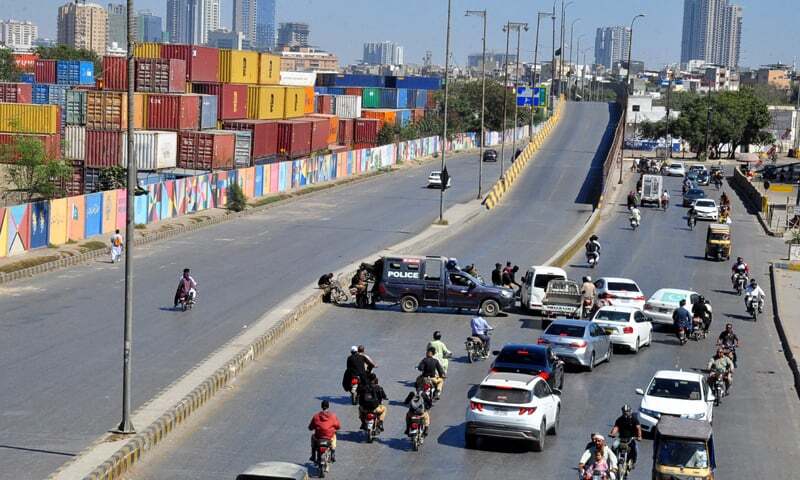
    Multiple roads were closed in Karachi as the Jamiat Ulema-i-Islam-Fazl (JUI-F) staged a demonstration in the city and the Jeay Sindh Rehbar Committee (JSRC) — a conglomerate of four Sindhi nationalist groups — held a rally on Sunday.

    However, two of the closed routes have now been reopened as the JUI-F’s main demonstration at Guru Mandir has ended.


    Routes that remain closed

    • Both sides of Deen Mohammad Wafai Road have been closed to traffic and vehicles are being diverted from MR Kiani Chowrangi towards Thana Gali and from Fawara Chowk towards Zainab Market
    • The stretch of Sharea Faisal that leads to Drigh Road and Karsaz is also closed to traffic. Commuters coming from the airport are being diverted via Rashid Minhas Bridge towards Millennium Mall
    • The stretch of the city’s main artery from Avari Towers towards FTC is also closed for traffic, and vehicles are being diverted from Avari Towers towards Fatima Jinnah Road and Sindh Club

    Reopened roads

    • The route from Askari 4 to Drigh Road has been reopened for traffic
    • The route from Guru Mandir towards Jamshed Road has also been reopened

    The alerts for road closures had cited “security” as the reason, except for the blockade of the route between Guru Mandir and Jamshed Road. The alert for this closure said the road had been blocked due to a planned demonstration by the JUI-F.

    The JUI-F had said in a statement that while its main demonstration would be held at Guru Mandir, protests would also be held at its headquarters, press clubs and other locations across Sindh against the “violation of the sanctity of JUI-F chief Maulana Fazlur Rehman’s residence, the ongoing smear campaign against him, and the conspiracy to divide Sindh”.

    Meanwhile, the JSRC had announced a rally to protest the proposal to create new provinces and divide Sindh.

    A four-member PPP committee began efforts on Friday to persuade nationalist parties to postpone their planned rallies in Karachi, but failed to do so.

    Over the past few months, Interior Minister Mohsin Naqvi has whipped up a political storm since he called for the formation of new administrative units in the country, saying the current “system” of governance had “collapsed” and needed a “reset”.

    The PPP, which is in power in Sindh, has been clear in its stance against carving out any new federating units in the province but has been calling for the creation of a South Punjab province.

    The Muttahida Qaumi Movement-Pakistan, which is an ally of the ruling PML-N along with the PPP in the Centre and in opposition in Sindh, has been insisting on the creation of new provinces and has thrown its weight behind the proposal to hold a referendum on the matter.

    Source: dawn

  • Future wars

    Future wars

    THE four-day military confrontation between India and Pakistan last year and the US-Iran war this year have revealed how today’s wars have become far more complex than the conventional conflicts humanity has experienced over millennia. The days of massed soldiery, mechanised armour, and standardised formations are over. Today’s wars are hybrid and employ every instrument of power a state can muster.

    These wars involve cyberattacks, economic coercion, psychological manipulation through electronic and social media, and cultural invasions.

    Critically, today’s wars employ lethal technologies, which have left traditional battlefield concepts behind. These autonomous weapons are guided by specialised semiconductors, microchips, and sensors.

    The changing nature of war has coincided with the sharp descent of the world order into disarray. Wars and armed conflicts between and within states have broken out in various parts of the world. The pledge that all states had made to the UN Charter to respect each other’s sovereignty and territorial integrity is no longer being honoured.

    Two distinguishing features of today’s warfare are advanced missiles and armed drones, which have transformed the nature of war by enabling high-precision, long-range, and rapid response capabilities.

    In last year’s India-Pakistan war, Pakistan used missiles to down several Indian aircraft flying well beyond visual range. In the US-Iran war this year, both sides relied mostly on missiles guided by infrared sensors and satellite communication rather than conventional confrontation.

    Autonomous weapons lack the capability to understand the context.

    Advanced robotic systems are being employed for intelligence, surveillance, and even targeted strikes. Drones and robotic dogs can provide real-time data, improve combat efficiency, and operate for high-risk functions such as clearance of mines or locating captured personnel. Unarmed aerial vehicles provide real-time intelligence, and are equipped with AI-driven capabilities to analyse data. Targets can be independently tracked and even struck by loitering munitions or suicide drones. Transporting supplies and ammunition entails no life losses thanks to unarmed ground vehicles. Drone swarms can now be trained to carry out coordinated attacks. It’s only a matter of time before humanoid robots are deployed for military roles.

    The spectrum of modern wars employs other technologies as well, such as quantum computing, which solves complex problems faster than classical computers. It ensures unhackable and secure data transmission during conflict situations. Next-generation structural battery composites can store energy for longer periods.

    Future wars will move further away from face-to-face engagement or human-controlled systems. Intelligent autonomous systems will be central to making decisions, often without human intervention. However, this raises some serious ethical questions.

    Autonomous weapons lack the capability to understand the context or apply compassion. There is greater likelihood of violating the laws of war and committing war crimes without assigning accountability. Further, the speed and agility of these technologies could cause conflicts to spiral out of control.

    These technologies will also be used to break an adversary’s morale by targeting its economic assets or supply chains. During the Iran war, for instance, President Trump threatened to destroy Iran’s power grid and bridges, even its civilisation.

    The kind of technologies a nation possesses will now determine the extent of damage that a future war would impose on an adversary’s policy options. The ability of a nation to acquire and em­­ploy modern technologies is thus critical to both wag­-ing future wars and surviving them.

    What makes future wars more frequent and unaccountable is the evolving global ecosystem, where use of force has emerged as the primary arbiter of international relations. Major powers have no qualms about using force illegally, unilaterally, and disproportionately to overpower adversaries.

    In such an uncertain environment, middle and small powers are looking for ways to fend for themselves and make alliances with like-minded countries. This has nudged countries to focus more on R&D for developing not only war-related technologies but also their own digital and satellite-based communication links. That requires a stronger economy, credible information instruments, and creative narrative-building to deter aggression.

    Diplomatic tools must be geared up to avert such complex multidomain future wars. The world needs a new global compact of indivisible security, akin to the UN Charter, to bind states into mutual respect for each other’s sovereignty and territorial integrity. This is the only way to avert the devastating wars of the future.

    The writer is Chairman Sanober Institute and former foreign secretary of Pakistan.

    Published in Dawn, November 22nd, 2026

    Source: dawn