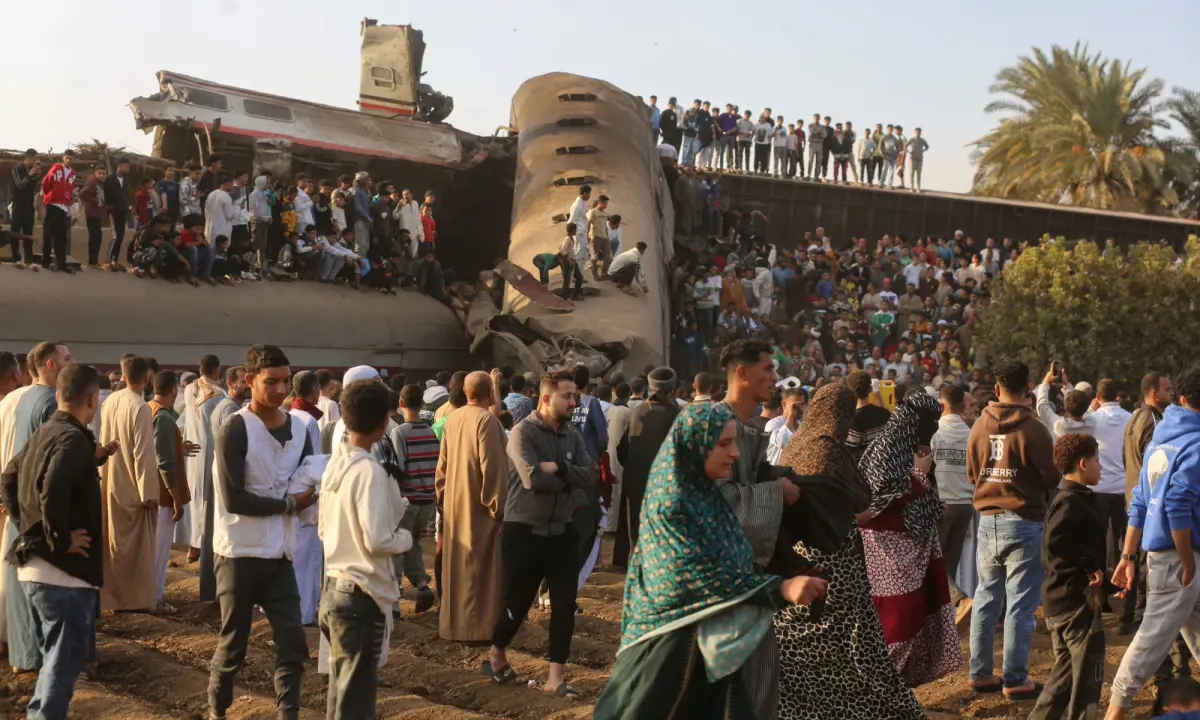
Two trains collided south of the Egyptian capital on Sunday, derailing several carriages, killing four and injuring dozens, according to the authorities.
Egypt’s railway authority said a train travelling from Giza to Fayoum crashed into the rear of another service heading south from Cairo to the city of Aswan.
The health ministry said an initial count put the toll from the crash at four passengers killed, with 88 others currently being treated for injuries in hospitals around the Giza area.
State-owned media had earlier reported 120 people were wounded, without clarifying the degree of injury.
President Abdel Fattah al-Sisi said he was following the accident “with great concern”, and had directed authorities to conduct an urgent investigation to “hold accountable anyone found to have been negligent”.
Emergency crews used cranes to remove the wreckage, the authority said.
Authorities said they had launched an investigation into the cause of the crash, which occurred in Giza’s Al-Ayyat area, the site of Egypt’s worst-ever rail disaster.
In 2002, more than 370 people were killed when a fire swept through a train carrying holiday travellers south of Cairo.
In 2009, multiple train crashes in the area killed dozens.
Egypt’s 110 million people depend heavily on rail transport, but the network — one of the largest in Africa — has suffered repeated deadly accidents.
Over the past decade, Egypt has poured billions of dollars into updating its transport infrastructure, including new highways and high-speed rail lines, but has yet to overhaul much of its ageing rail network.
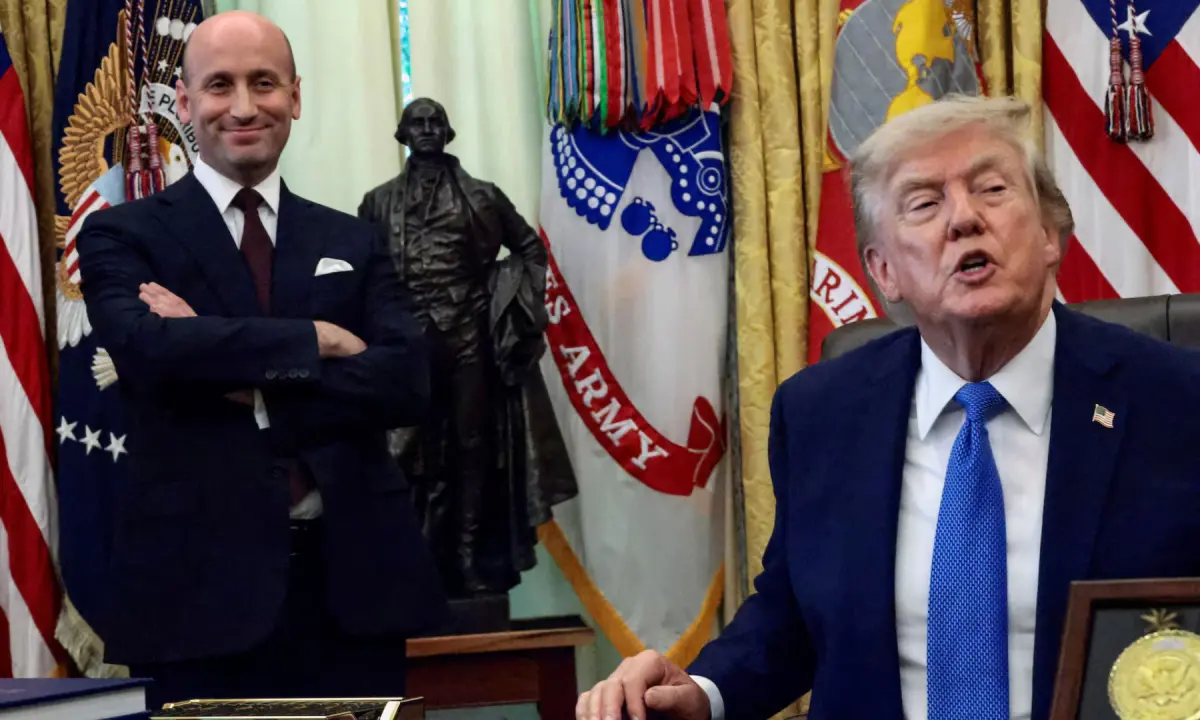
US President Donald Trump’s decision to elevate loyalist Stephen Miller to run his White House indicates that he plans to ramp up confrontation in his final two years in office and block outside political and economic pressures, Trump administration officials and other Republicans say.
Voters delivered a historic rebuke to Republicans in Tuesday’s midterm election, but with Miller as White House chief of staff, the Trump administration is expected to continue its aggressive immigration crackdown, amplify cultural conflicts and give no ground to a Democratic-controlled Congress, say officials and experts who spoke to Reuters.
They say wavering Republicans will face increased pressure to stay in line, while businesses may have a harder time making their case to the White House.
“This signals the administration is going to have a fighting-from-a-bunker approach the last two years,” said Dan Eberhart, a Trump donor and energy executive.
Although Trump has said he can work with Democrats, he has shown a feisty approach since the midterm election results became clear.
On Saturday, he ordered the Justice Department to “look into” Democrats whom he accused of sending “threatening letters” to Republican donors and other Trump allies.
The president also offered the job of White House press secretary to combat sports promoter Dana White.
‘This man saved America’
Miller, 41, marks a sharp contrast with outgoing chief of staff Susie Wiles, a former lobbyist who ran Trump’s 2024 presidential campaign.
Wiles lacked significant Washington experience but was seen as a deft manager of competing interests.
Miller, by contrast, is regarded by allies and foes alike as a combative ideologue with a deep knowledge of the levers of power and an unswerving loyalty to Trump.
“If it wasn’t for President Trump, the United States of America would not exist right now. This man saved America,” Miller said at an event at Trump’s Florida estate on Friday.
Miller joined Trump’s first presidential campaign in 2016 and served throughout his two terms in the White House. He is best known for driving Trump’s aggressive immigration crackdown, which has galvanised Trump’s supporters but alienated many voters.
Only 37 per cent approve of Trump’s handling of immigration, according to an October Reuters/Ipsos poll, down from 50pc when he took office.
Still, four US immigration officials told Reuters that there have been no signs that the administration will let up. “Nothing is changing, same quotas,” said one official, who spoke on condition of anonymity.
Representative Don Bacon of Nebraska, an occasional Trump critic who is retiring, told Reuters that Miller “was in denial” as he and other Republican lawmakers tried to warn him before the election that Trump’s immigration and tariff policies were driving away voters.
“We said, ‘You’re going to give us a bad midterm election,’ and he rejected it,” Bacon said.
‘Doubling down on a failed strategy’
The White House said Miller will continue to deliver “historic successes” in his new role, but Bacon said most of his peers in the House view it as “doubling down on a failed strategy”.
“It’s going over like a lead balloon in most of Congress,” Bacon said of Miller’s appointment.
Miller has also overseen Trump’s executive orders, giving him an expansive understanding of the administrative tools available to the president.
Several people interviewed for this story said they expect the White House to rely on executive orders more extensively rather than working with lawmakers.
Republican legislators will face pressure to stick with Trump through Democratic-led investigations to come, even if they damage the party as a whole.
“Those on Capitol Hill looking to break away from the Trump administration will know that Stephen Miller is not going to sit idly by and watch that happen,“ said Republican strategist Ron Bonjean.
Ending the Mideast war?
As well as the domestic issues he has focused on for most of his career, Miller now will have a greater say in foreign affairs.
Miller opposes prolonging the war with Iran, according to three sources familiar with his thinking who spoke on condition of anonymity, but he strongly supports Israel — potentially putting him at odds with a president who has threatened to resume strikes on Iran and announced he will end aid to Jerusalem.
Miller’s elevation also has unnerved some corporate lobbyists, who worry he will not be as responsive to their issues as Wiles, who cultivated relationships with top executives.
“This will be a big change,” said a senior lobbyist at a Trump-aligned firm who spoke on condition of anonymity.
“Miller is there to focus on political priorities, like immigration and tariffs, stuff Trump cares about, and won’t have the same approach as Susie, who understood policies have unintended consequences.”
Miller’s appointment was met with praise from senior cabinet officials and political supporters, who described him as the fighter they will need in Trump’s final stretch.
“I think Donald Trump has found his wartime consigliere,” Trump ally Roger Stone told Reuters.
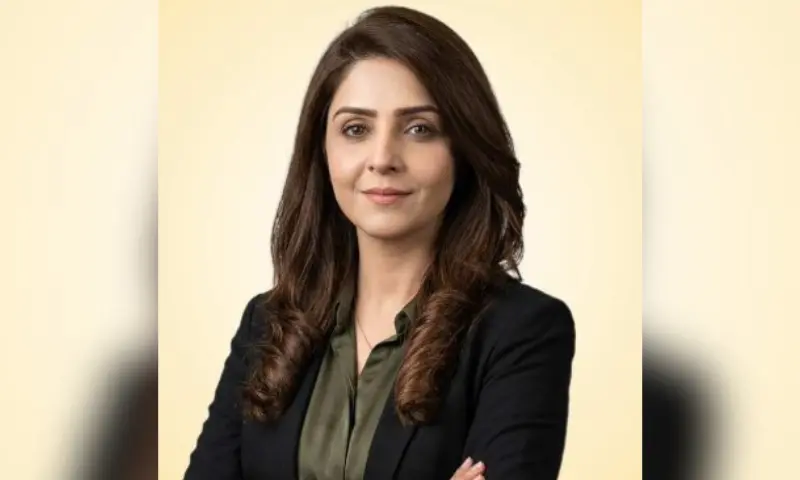
RAWALPINDI: Anchorperson Rabia Ahsan was found shot dead at her home in the Gulshanabad area of Rawalpindi on Sunday, police said.
In a statement, City Police Officer (CPO) Hassan Mushtaq Sukhera said Ahsan’s husband was taken into custody and the suspected weapon was seized.
He added that an investigation has been launched.
CPO Sukhera, along with the senior superintendent of police (SSP) operations and the SSP investigations, arrived at the scene with a team of forensic experts to inspect the crime scene.
As per the statement, a male domestic worker at their house informed the police that the victim’s husband said the gunshot had been fired accidentally.
CPO Sukhera said that Punjab Forensic Science Agency (PFSA) teams were collecting evidence from the scene of the incident, while the body was being taken to the hospital for postmortem examination.
Sukhera said that a case of the incident was being registered, adding that an investigation on merit will be ensured.
While investigation into the motive was under way, First Lady Aseefa Bhutto-Zardari “expressed deep sadness over the killing” and “strongly condemned the violence”.
She called for a thorough, impartial and transparent investigation to establish the facts and ensure that those responsible are held accountable, a statement by the Presidency said.
She also expressed dismay over the “disturbing pattern of killing of another professional woman in the same metropolitan area”.
Aseefa recalled the murder case of Hina Javed, a 45-year-old digital media executive who was found dead at her Rawalpindi residence in August with signs of torture.
“Such incidents demand serious attention and accountability. Women must be able to live and work without fear for their lives,” she stressed.
The First Lady noted that the outcome of the investigation into Hina’s case was still awaited. According to a DNA analysis report, DNA samples of Hina’s domestic servant matched postmortem swabs collected from her body, while her husband’s DNA also matched samples taken from multiple items at the crime scene.
In a subsequent comment, Punjab Chief Minister Maryam Nawaz had noted that “DNA test results and polygraph test suggest that the murder and rape were committed by the servant; however the investigation is ongoing”.
On Oct 29, Aseefa had met with Hina’s family at the Parliament and called for the family’s demand of a judicial commission to be “given due consideration”.
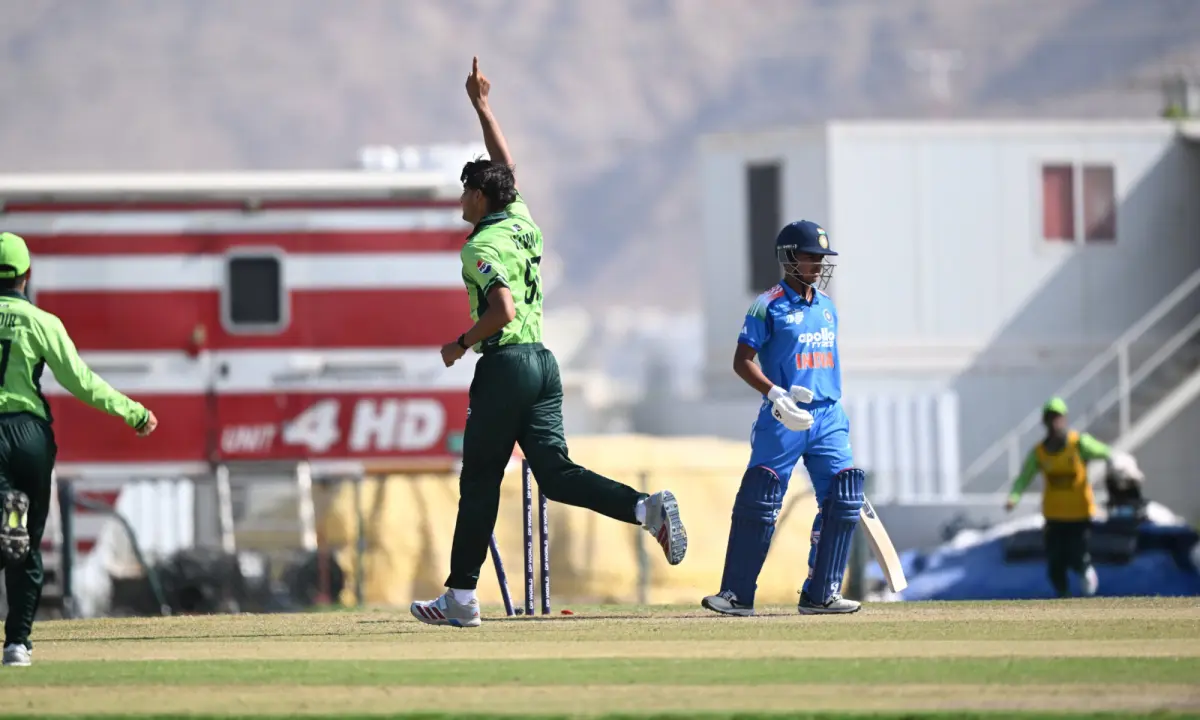
Hamza Zahoor produced a match-winning unbeaten century as Pakistan Under-19 defeated arch-rivals India by three wickets in a thrilling Group ‘A’ encounter of the ACC Men’s Under-19 Asia Cup at the Al Amerat Cricket Ground in Muscat on Sunday.
Chasing 209, Pakistan reached the target in 48.1 overs, finishing on 211 for seven, with Hamza holding his nerve under pressure to steer his side home.
The wicket-keeper-batter remained unbeaten on 100 off 108 balls, striking 10 fours and three sixes, and was named Player of the Match.
Pakistan’s chase, however, was far from straightforward as India’s bowlers made early inroads to reduce them to 61 for five. Hamza then joined Hasnain Abbas Dar, who contributed 38, to revive the innings with a crucial partnership.
With wickets falling at the other end, Hamza showed remarkable composure, combining caution with timely aggression to keep Pakistan on course. He eventually guided the lower order across the finish line with 11 balls to spare, completing a memorable century in the process.
Earlier, India, after electing to bat, were bowled out for 208 in 46.3 overs. Their innings got off to a disastrous start when captain and opener Lakshya Rajesh Raichandani was dismissed for a duck off the second ball.
India slipped further to 22 for three, leaving their middle order under considerable pressure.
Arjun Rajput then mounted a spirited recovery with an outstanding 107 off 85 deliveries, hitting 11 fours and five sixes.
However, the right-hander received little support from the other end as Pakistan’s bowlers maintained pressure and regularly picked up wickets to restrict India to a modest total.
Ali Raza, Rizwanullah and Niqab Shafiq shared the spoils with three wickets apiece, while Mohammad Sayyam claimed one.
The victory takes Pakistan to the top of Group ‘A’ with four points from two matches, having registered back-to-back wins.
India, meanwhile, have two points from as many games, with one victory and one defeat.
Both teams have one group fixture remaining, with the top two sides advancing to the semi-finals.
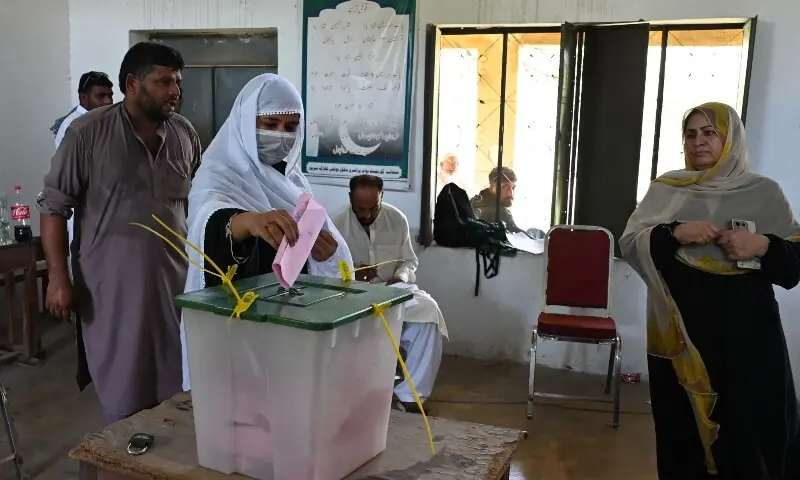
Polling for by-elections in two Punjab constituencies — Gujranwala’s NA-77 and Sahiwal’s PP-203 — concluded on Sunday.
Both seats had fallen vacant after the deaths of their respective lawmakers in September. Polling began at 8am and continued till 5pm, with those present inside the polling stations at that time allowed to cast their votes.
NA-77 fell vacant following the death of five-time MNA Chaudhry Mehmood Bashir Virk on Sept 11 after a prolonged illness. His son, Rashid Basheer Virk, is among the candidates contesting the by-election.
Rashid and 17 other candidates have filed nomination papers to contest the constituency, but opposition parties, including the PTI, PPP and Jamaat-i-Islami (JI), have not opted for the by-election.
While the polling was under way, notices, copies of which are available with Dawn, were issued to Punjab MPA Qudsia Batool, MNA Saira Afzal Tarar and Parliamentary Secretary for Information and Culture Shazia Rizwan for alleged violation of the Code of Conduct after reports emerged on social media that the three had visited various polling stations within NA-77, a statement issued by the office of the provincial election commissioner said.
Notices were also issued over alleged violations of the Code of Conduct to MNA Syeda Nosheen Iftikhar and MPA Hina Arshad Warraich for allegedly visiting polling stations.
The officials were directed to appear at the Election Complex in Gujranwala for an explanation at 3pm.
Chief Election Commissioner Sikander Sultan Raja also visited the provincial election chief’s office, where he was briefed on the polling process in both constituencies, the Election Commission of Pakistan (ECP) said.
Meanwhile, PML-N leader and Punjab Information Minister Azma Bokhari claimed in a post on X that supporters of Markazi Muslim League (PMML) candidate Qazi Ibrahim Gujjar were caught “openly stamping ballots” with the election commission staff present.
On Saturday, ECP took notice of an alleged violation of the Code of Conduct by Information Minister Attaullah Tarar during by-election campaigning in NA-77.
According to the ECP, the minister visited the constituency by helicopter and addressed a campaign event for Rashid, violating a provision in the Code of Conduct, which bars public office holders from participating in campaign activities.
The commission has sought a report from the district monitoring officer and the district returning officer to inquire into the matter. It has also directed the minister to appear before the commission in person.
The ECP also said that the result of the constituency could be withheld until a final decision is made on the matter.
PP-203
In Sahiwal’s PP-203, the by-poll was held following the death of PML-N MPA Chaudhry Muhammad Hanif Jutt. This is the second time that a by-election was held in the constituency after the 2024 general elections.
The seat was initially won by independent candidate Rai Murtaza Iqbal, backed by the PTI, with 55,874 votes against Jutt, who polled 35,163 votes.
However, Iqbal, along with four other PTI-backed parliamentarians, was disqualified and denotified by the ECP following their conviction by an anti-terrorism court in Faisalabad on July 31.
Subsequently, the ECP scheduled a by-election for Nov 23, 2025, which was won by Jutt with 46,820 votes. His closest rival, independent candidate Falik Sher, secured 10,975 votes.
Jutt died of cardiac arrest on Sept 17 this year, necessitating Sunday’s by-election in the constituency.
Around 1,370 polling personnel, including 574 women and 796 men, were deputed at 185 polling stations across the constituency.
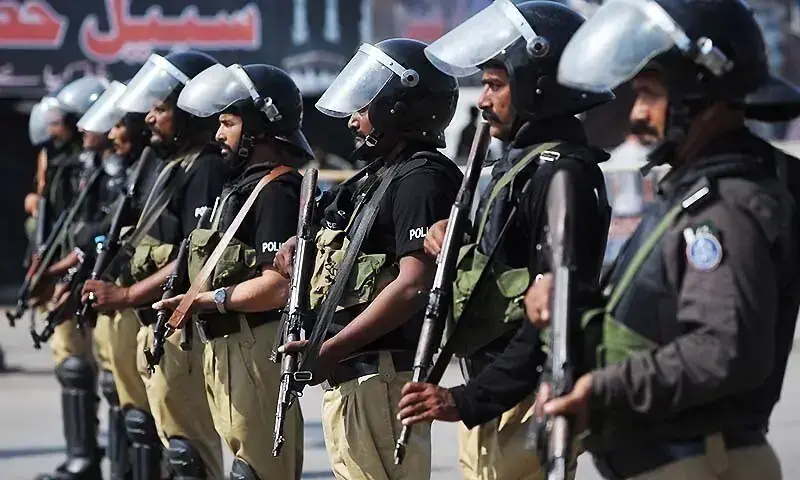
Meanwhile, District Police Officer Usman Tipu said 1,100 personnel had been deployed to ensure security during the by-election.
A total of 185 polling stations had been established in the constituency, including 11 in Category A, 37 in Category B and 137 in Category C.
A comprehensive traffic management plan had also been devised, with more than 65 personnel assigned duties.
Pakistan revived their semi-final hopes in the SAFF Championship with a commanding 3-0 victory over Maldives in their second Group B fixture at the National Football Stadium in Dhaka on Sunday.
A first-half brace from Najeebullah Bettani, alongside an early penalty converted by McKeal Aroon Abdullah, helped Pakistan register their first victory of the tournament and put themselves in a strong position to qualify for the last four.
Pakistan made an aggressive start and took the lead in the fourth minute when they were awarded a penalty.
McKeal Abdullah stepped up and calmly converted from the spot to give the Green Shirts an early advantage.
Pakistan continued to press forward and doubled their lead through Najeebullah, who produced a well-timed finish after Junaid Shah delivered an excellent cross from the left.
Najeebullah made a perfectly timed run into the box, got ahead of his marker and poked the ball home.
The forward then completed his brace with a superb individual effort. With Pakistan defending deep in their own half, the ball was cleared upfield, where Najeebullah brought it under control on the right before unleashing a powerful strike past the helpless Maldives goalkeeper.
Pakistan’s three-goal advantage at half-time reflected their attacking efficiency, with the side making the most of their opportunities to put the contest beyond their opponents.
Despite enjoying slightly more possession, Maldives struggled to translate it into meaningful attacking opportunities.
Pakistan, meanwhile, were more threatening in front of goal, registering 15 shots, including five on target, compared to Maldives’ seven attempts, only one of which tested the goalkeeper.
Both sides pushed for more goals after the interval, but neither could find the breakthrough as the second half ended goalless, leaving Pakistan with a convincing 3-0 victory.
The result marked a significant response from Pakistan following their 3-2 defeat against arch-rivals India in their opening Group B encounter on November 5.
Pakistan had trailed 3-0 at half-time in that match before producing a spirited late comeback.
Najeebullah and Alamgir Ghazi scored in stoppage time to reduce the deficit, but India held on to secure all three points.
The 2026 SAFF Championship, running from Nov 5 to 17 in Bangladesh, features six participating teams divided into two groups. Group ‘B’ comprises Pakistan, India and Maldives, while hosts Bangladesh, Sri Lanka and Bhutan are in Group ‘A’.
The top two teams from each group will advance to the semi-finals.
With their victory over Maldives, Pakistan have moved into a stronger position in the qualification race but must now wait for the outcome of the remaining Group ‘B’ fixture between India and Maldives, scheduled for Nov 11.
Maldives will need a substantial victory over India to overtake Pakistan in the group standings and secure qualification.
Otherwise, Pakistan and India will progress to the semi-finals.
For Pakistan, the emphatic win provides a timely boost after their opening defeat and puts them within touching distance of a place in the last four.
An Aramco building in Riyadh was targeted in an “attempted attack”, the Saudi energy ministry said on Sunday, with eyewitnesses telling AFP the skyscraper sustained damage, after the Saudi-led coalition fighting Houthis said it had intercepted missiles launched by the group.
Aramco facilities and infrastructure have been repeatedly struck by the Houthis rebels in Yemen in recent months, with tankers, refineries, storage areas and the company headquarters all targeted by the group.
The energy ministry said in a statement that “an administrative building belonging to Saudi Aramco in Riyadh was subjected to an attempted attack today”.
“The incident resulted in falling shrapnel that caused minor damage to the building, with no injuries or fatalities reported, thankfully.”
“Aramco tower in KAFD has been targeted, that’s the sure thing,” an eyewitness told AFP, referring to the King Abdullah Financial District. Two other witnesses confirmed seeing damage to the building.
The Houthis seized the Yemeni capital Sanaa in 2014.
A 2022 truce that had paused fighting in the long-running conflict fell apart in July, and Saudi Arabia has since traded blows with the Houthis, who have struck Saudi airports, energy infrastructure and military sites.
KAFD is one of the most visible manifestations of the kingdom’s ongoing economic and social reforms drive, with towering glass skyscrapers, high-end retail outlets and green spaces dotting the area.
The area is home to some of the kingdom’s biggest homegrown companies and blue-chip international firms like Goldman Sachs.
The headquarters of the kingdom’s influential sovereign wealth fund — the Public Investment Fund — and the Saudi stock exchange are also located in the heart of the district.
Targeting the area, which is also home to residential housing and a large metro station with heavy commuter traffic during the morning rush hour, would mark a major escalation in the kingdom’s fight with the Houthis.
Loud explosions heard
The attack came hours after the kingdom’s education ministry announced, late on Saturday, the return of in-person schooling after weeks of remote learning in Riyadh following an earlier wave of strikes.
Coalition spokesperson Turki al-Malki, in a Sunday morning social media post, said that “air defences intercepted and destroyed two ballistic missiles launched by the Houthi terrorist militia towards Riyadh”, as loud explosions were heard in the Saudi capital.
The kingdom has been pressing allies for help as it comes under daily fire from the Houthis that recently seized swathes of the Red Sea coastline from the Yemeni government.
Islamabad, which has two mutual defence pacts with Riyadh, has condemned Houthi attacks multiple times, terming them a grave violation of the kingdom’s sovereignty.
Under the Makkah Defence Alliance, Pakistani, Saudi and Turkish leaders met in Riyadh and agreed to deploy military forces and capabilities rapidly in the kingdom.
Pakistan is providing “whatever support is needed” to defend Saudi Arabia amid the Houthi attacks, the military’s spokesperson Lieutenant General Ahmed Sharif Chaudhry said in mid-October.
However, the Inter-Services Public Relations (ISPR) director general also clarified that all members of the Makkah Defence Alliance were “absolutely clear […] that this alliance has no offensive intent; it is purely defensive”.
The United Nations says more than 1,600 people have been killed and more than 300,000 displaced since fighting resumed in impoverished Yemen.
The fragile 2022 truce fell apart after the Houthis allowed an Iranian plane to land in Yemen’s capital Sanaa in defiance of Saudi control over Yemeni airspace, setting off a spate of attacks.
Later, the Houthis declared a maritime blockade of Saudi Arabia and began hitting its ships, territory and oil facilities, before seizing Yemen’s entire Red Sea coast in a lightning campaign.
The administrative setup in Khyber Pakhtunkhwa plans to establish faceless anti-terrorism courts in the province as part of its initiatives to strengthen the fight against terrorism, according to a briefing by the officials televised on Sunday.
KP Governor Faisal Karim Kundi was also present at the briefing, where KP Secretary Home Amjad Ali Khan outlined several measures planned to step up the fight against terrorism and explained that witnesses in terrorism cases feared coming forward.
“So, we have recently sent the amendment to set up faceless anti-terrorism courts. Through this, not just the protection of witnesses, but that of prosecutors and judges will also be ensured,” he said.
Moreover, he said the administrative setup planned to spend Rs70 billion on the Counter-Terrorism Department and police in a year, in order to increase their capacity.
Talking about dealing with terrorism in the policy domain, Khan noted that in the past there had been a “lack of political ownership” in the fight against terrorism in the province.
“Our armed forces and law enforcement agencies are making sacrifices in the war against terrorism; however, [..] the provincial government was not taking ownership for them.”
The Centre imposed governor’s rule and emergency in KP on October 11, citing the PTI-led provincial government’s “deliberate disengagement” from the fight against terrorism.
Khan stressed the need for a “close liaison” on terrorism between the public, political leadership, and security forces. He further recalled that despite the Centre formulating an Afghan policy, “actions continued to be taken in the province contrary to that policy, leading to confusion among the people.”
He also noted that there was “propaganda against the security forces in attempts to sabotage the counterterrorism efforts in the province”.
The official then spoke of the “insufficient funding” for civil law enforcement agencies, including police and CTD, particularly in the merged districts, where he said only 3.2 per cent of the budget was allocated for security.
He highlighted a shortage of over 10,000 personnel in the police, while also noting the lack of security infrastructure.
“Along with that, in the merged districts, most of the dependence regarding the police force is on former ex-Fata Khasadaars and Levies,” he said, adding that the police personnel did not receive adequate training.
He further highlighted inadequate counter-drone protection, for which the available system was at a capacity of 12pc, noting that terrorists were using drone technology as well, “due to which we are suffering considerable losses”.
He also highlighted the lack of adequate SWAT teams.
“Because of these issues [..] we have suffered significant losses over the past two or three years in which 1,003 personnel of the armed forces were martyred, 627 police personnel, and 808 civilian casualties occurred,” he stated.
Referring to the Centre’s Rs160bn package for uplift of KP, Khan said that the provincial set-up and the federal government were on the same page, expressing hope that “its effects will be seen in the coming days”.
He went on to outline plans to strengthen police capacity in the province, including fortifying sensitive police stations and check posts, extending the Safe City project, and establishing anti-drone systems in Dera Ismail Khan, Lakki Marwat, and Bannu as well as functionalising District Nerve Centres in ten districts.
Updated information will be available to LEAs from the centres, he added.
Under the legal interventions in policing, the official said that faceless ATC courts will be set up.
“Witnesses in terrorism cases are afraid to come forward due to their identity. So we have recently sent the amendment for these faceless courts. Through this measure, witnesses, prosecutors, and judges will have their protection ensured,” he stated.
Detailing the technical abilities of the police, the official said that satellite communication systems were being set up in areas with no prior communication system.
He added that the provincial administration was also deploying AI tools for social media monitoring to counter terrorists’ narrative.
Khan also stressed the need for increased public outreach, including strengthening District Dispute Resolution Councils as well as establishing tribal liaison committees.
“Regular jirgas will be held with notables, regular interaction will occur with the public, and community mobilisation will take place,” he stated.
He also outlined plans for police to be trained in modern technology such as anti-drone systems and sniping. He also recalled the provincial setup’s decision to revise packages for martyred police personnel.
Khan continued: “Kinetic operations will be scaled up so that militancy can be eliminated. In this regard, intelligence-based operations will be enhanced, area sanitisation will be carried out [..], terrorist facilitators will be arrested, and re-verification will also be carried out for people on the fourth schedule to ensure none of them is providing facilitation or support to terrorists.
He also added that the Rapid Response Force will be mobilised. Khan added that the provincial administration also planned to increase the number of police check posts.
He announced that the government was spending Rs70bn on CTD and police annually.
“In this regard, the police are being given Rs59.8bn, of which Rs33.4bn will be for their infrastructure and Rs26.4bn will be for procurement, while Rs10.3bn is being given to the CTD, of which Rs5.4bn is for infrastructure, and Rs4.9bn for procurement.”
He added that police surveillance capacity — at 15pc presently — will be increased to 60pc, while for CTD it will be enhanced by 70pc.
“The police’s counter-aerial threat capacity, which is currently at 1pc, will be taken up to 50pc. Our air strike capability is currently at 18pc and will be increased to 50pc, as well as night fighting capacity, with vehicle armour capacity of the police to be improved by 45pc,” the official said.
He added that “jammer availability was at 40pc but will be increased to 50pc while counter-drone capability — at 52pc presently — will be increased to 60pc.”
Protective gear and vehicle availability will be improved as well, while specialised training will be held in collaboration with the Pakistan Armed Forces.
The official also announced action against smuggling, narcotics, extortion and non-custom-paid vehicles.
“The purpose of all these measures is to provide a safe and secure environment to the people of KP where they can spend their lives, according to their codes and traditions,” Khan concluded.
Since the imposition of the governor’s rule in KP, the provincial administration has vowed to steer the province towards development and eliminate terrorism. Chairing his first apex committee meeting after taking charge of the province, governor Kundi promised to equip police and CTD with resources.
“Whatever weapons you want, whatever you need, we will get them to you. We will not compromise on our police officers and personnel. We will equip them well,” Kundi had said at the meeting.
Last month, he also announced an increase in the compensation packages for police officers martyred or injured in the line of duty.
Governor Kundi calls for ownership of war against terrorism
Speaking at the occasion, Governor Kundi said the provincial government’s priority was to restore peace and strengthen the police force, stressing that development would follow once security was ensured.
He said the police were at the forefront of the war against terrorism and needed to be adequately equipped to carry out their responsibilities. “Until we strengthen and facilitate (the police), how will they fight using just one Kalashnikov and a few bullets?” Kundi asked.
While the government had announced compensation packages for the families of police martyrs and was working on improving police salaries, it would also provide the force with weapons, ammunition and other resources, Kundi stressed during his speech.
“We talk a lot about merged districts, but as far as I know, not a single police line has been created in our merged districts, our former Fata. Look at their police stations, check posts, and facilities,” Kundi highlighted, adding that the government had directed the chief secretary and additional chief secretary to prepare a comprehensive package in this regard.
He said the plan also included solarising and equipping police facilities.
The governor pointed out the “lack of political ownership” previously with regard to the war against terrorism in the province.
“When something happened here, voices always came from the assemblies saying that this is ‘not our war’. We don’t own it,” Kundi said.
He questioned what the families of martyrs would say when political leaders did not take ownership of the war. “For whom did the martyr make this sacrifice? Was it for this soil, this country, or was it made under a specific agenda?” he asserted.
“If I have a gunman who is there for my protection, and I say that I don’t even own this gunman, how will he protect me?” Kundi asked rhetorically.
According to the governor, not owning the war indicated a lack of coordination.
Kundi referred to the security situation in parts of KP, adding that political leaders, including a former chief minister and JUI-F’s Maulana Fazlur Rehman, had acknowledged difficulties in moving freely in certain areas.
“If intelligence-based operations do not take place and the police and security forces do not conduct operations, how will these problems be resolved?” he asked.
Kundi said the current set-up’s stance was “clear” and that decisions and policies would be made in Islamabad rather than “Kabul, Kandahar or Jalalabad”.
The governor alleged that Afghanistan was facilitating India and Israel in using its territory against Pakistan. He referred to reports of drones entering Pakistan, saying some had crossed the border but were intercepted by Pakistani forces. He then criticised the lack of response by the previous government to statements by Afghan ministers threatening to take over Peshawar.
Kundi said Pakistan had repeatedly raised its concerns about Afghan soil being used to facilitate terrorism at international forums through the Foreign Office and the deputy prime minister and foreign minister, but Kabul had not budged an inch on addressing the issue.
“It is very clear that whoever does not accept our state, Constitution and laws cannot be engaged in dialogue. Anyone who takes up arms against the state cannot be offered dialogue; they will be responded to accordingly,” Kundi asserted.
During his speech, the governor stressed the importance of winning public trust, recalling that the province began its journey towards peace in 2008, when it was grappling with suicide bombings, target killings, kidnappings for ransom, among other problems.
He said public support had been crucial to previous military operations and would remain essential to counterterrorism efforts.
“You saw we cleared Swat; the world’s largest displacement occurred at that time, and we rehabilitated the people. People supported us for the operation.”
Reiterating that the government had a zero-tolerance policy towards terrorism, Kundi said the fight against it remained its foremost priority, with development coming afterwards. “You can build roads, large underpasses and even turn the city into a garden, but what is the point if the people themselves are not safe?” he said.
He stressed that people needed to be assured that their children could go to school, college and playgrounds and return safely, while family members could travel to work or conduct business without fear. The governor also called for greater engagement of the province’s large youth population through “positive activities”.
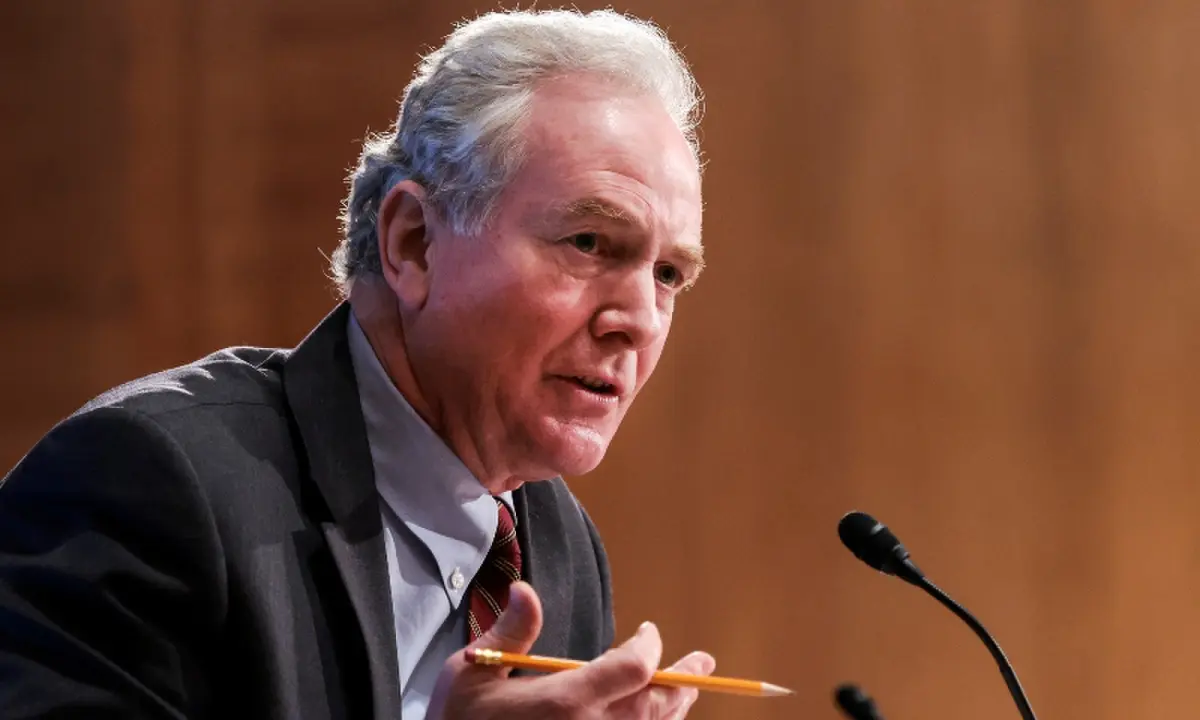
US Democrat Senator Christopher Van Hollen, who has set his sights on contest for the American president’s office in 2028, was born in Karachi.
According to his biography on Maryland Manual Online — a website run by the Maryland state government — he was born in the port city in 1959.
Van Hollen himself spoke of his “special connection” with Pakistan in a clip released on the country’s Independence Day last year.
“I am proud to join you in celebrating Pakistan’s 79th Independence Day. I am fortunate to have a special connection with Pakistan, having been born in Karachi as the son of an American foreign service officer.
“Throughout my life, I have experienced first hand the generosity, the goodness and the determination of the Pakistani people. I am proud to celebrate the strong people-to-people ties between the our two countries […] I look forward to further strengthening the ties of friendship between the Amercians and the Pakistani people,” he said in a short message.
In 2021, Van Hollen had thanked thanked Pakistan among other countries for helping evacuate American nationals and others stranded in Afghanistan following the Taliban takeover of the country.
Apart from Pakistan, the Maryland senator also spent time in India, where he studied at Kodaikanal International School in the Tamil Nadu state. He later studied philosophy at Swarthmore College, followed by his masters in public policy from Harvard University. He earned his Juris Doctor degree from Georgetown University and was admitted to Maryland Bar in 1990.
He is a member of the US Senate since January 2017. Previously, he had also been a member of the US House of Representatives from 2003 to 2017.
Following the Republicans’ thumping defeat in the recently held midterms, Van Hollen was seen as the potential candidate for the Senate majority leader.
However, he put the speculation to rest by telling Fox 5, which is owned by the Fox Broadcasting Company, he had “made clear that I’m not looking to be the next Democratic leader. I’ve been kicking the tires on a 2028 presidential election“.
For one woman interviewed for the 2019 social assessment of Karachi’s planned Yellow Line Bus Rapid Transit (BRT), getting to her job destination meant walking 20 minutes to a road crossing, paying for a rickshaw and then paying again for a bus.
Other women interviewed for the assessment relied on shared three-wheelers that waited to fill up with passengers before leaving. For some, the journey could take two hours each way. Monthly transport costs ranged from Rs3,000 to Rs6,000 in households where incomes of Rs20,000 to Rs30,000 were common.
Fares can eat into an already modest wage. An unreliable connection can make a worker late. A second fare at each end of the journey can make studying at a college or a job across town too expensive a proposition to take up.
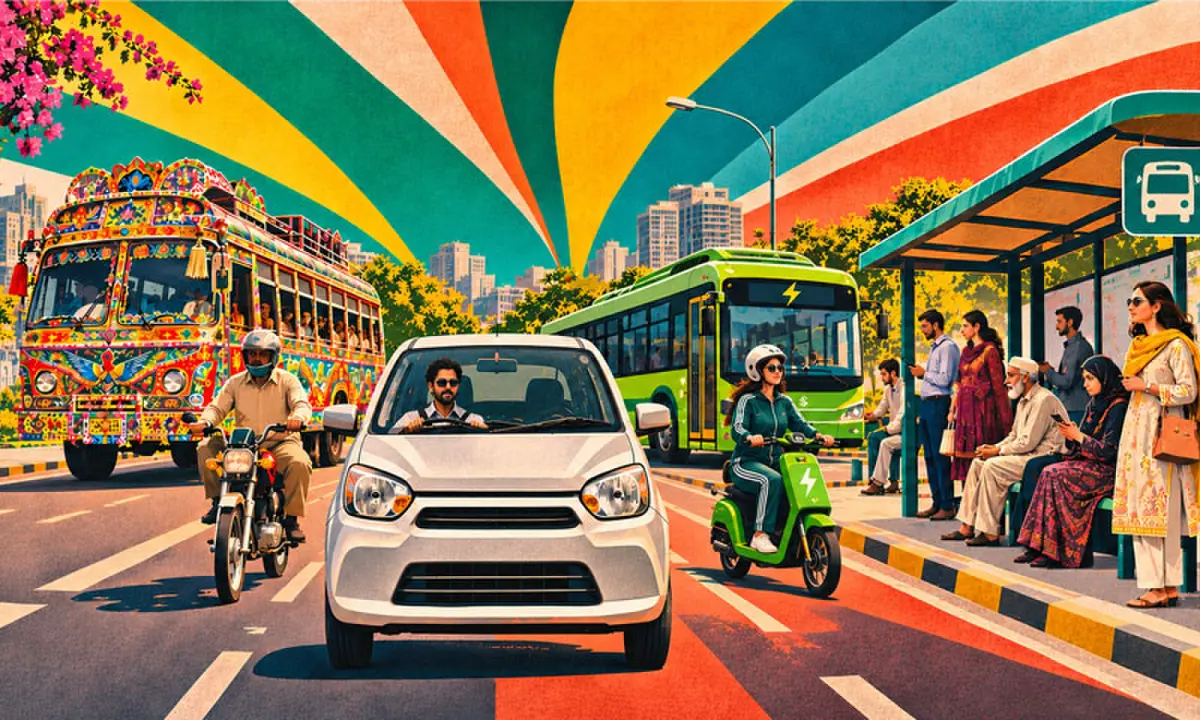
The draft for Pakistan’s Auto Policy 2026-31 revolves around car prices, manufacturers and tariffs. Yet, most households in the country own no car and struggle with the daily cost of commuting. Mobility for work, education and healthcare remains restricted due to unavailability of affordable and safe public transportation choices. How can Pakistan’s auto policy serve the people at large and not just the top decile of households in the country?
THE FAULT IN OUR DRAFTS
In April, when petrol rose by more than Rs137 a litre, governments briefly treated the price of a bus ticket as a cost-of-living issue. Islamabad announced 30 days of free public transport. Punjab’s relief ran for 69 days, with authorities estimating that hundreds of thousands of passengers a day used the free services. The relief ended, but the daily cost of getting to work remained.
Pakistan now has a chance to address some of that cost through its next auto policy. The draft Auto Policy 2026-31 has been okayed by Prime Minister Shehbaz Sharif but is still awaiting final approval as the Ministry of Industries and Production is set to forward the draft policy to the Ministry of Finance, which aims to share it with the International Monetary Fund (IMF) for review.
This policy would reportedly reduce tariffs, open a formal route for commercial used-car imports and expand the role of electric vehicles. These changes could give car buyers more choice. The draft also shapes how buses and two-wheelers are taxed, which vehicles get incentives and where the proceeds of a proposed automobile levy go.
The problem, in my view, is that the debate remains organised around the vehicle and its producer. The household experiences it as a sequence of fares, waits and transfers. An auto policy cannot run provincial bus services, but it can reduce fleet costs and make public support conditional on affordable service. That connects industrial policy to the ability to earn a living.
Those decisions should be judged by what they do for the journeys people make every day. For most Pakistani households, the price of a bus ride is a more immediate concern than the price of a new car.
WHO’S BUYING THE ALTO?
Pakistan’s assemblers sold 155,631 passenger cars in 2025-26. Including separately reported jeeps and pick-ups takes four-wheeler sales to about 206,000. Motorcycle and rickshaw sales totalled roughly 1.97 million.
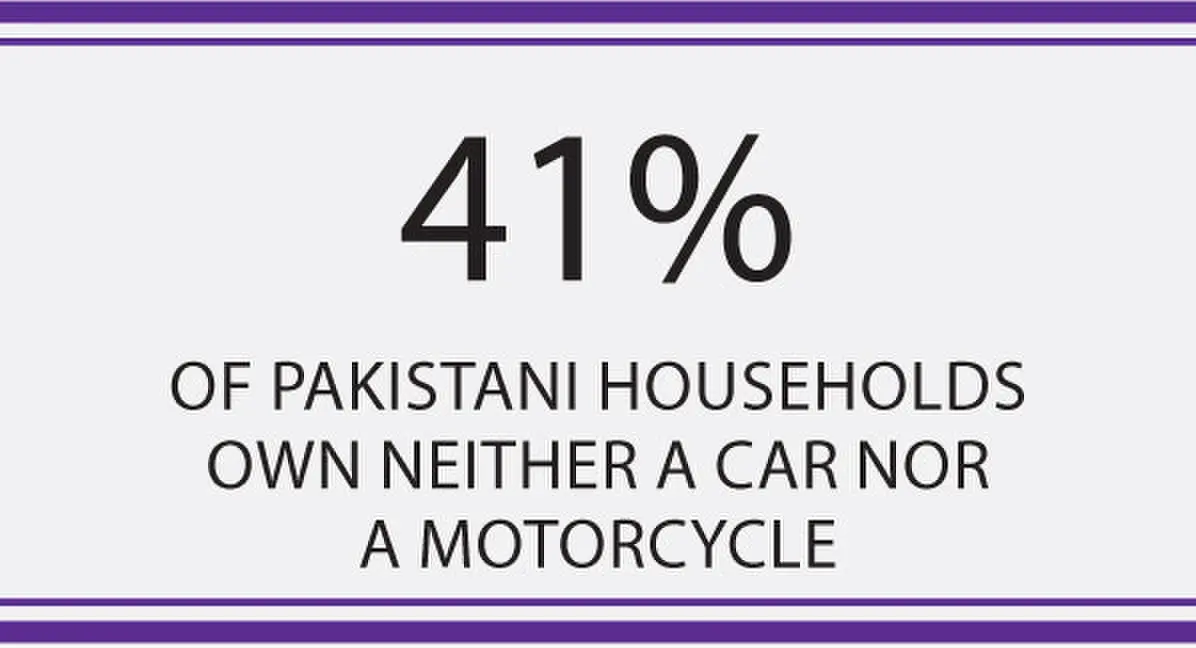
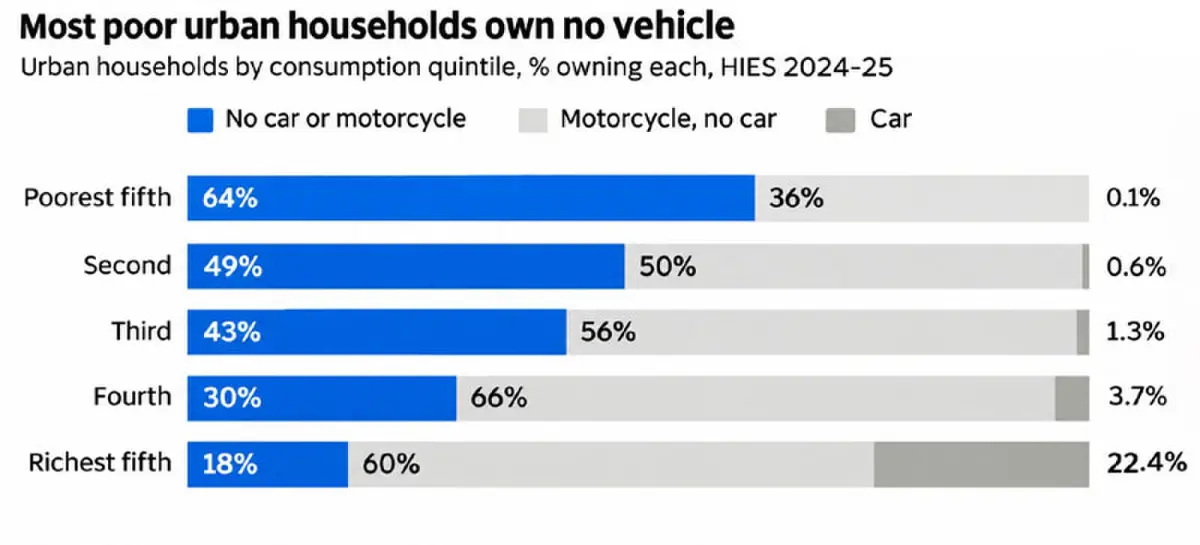
My analysis of the 2024-25 Household Integrated Economic Survey (HIES) shows how differently Pakistanis get around. About 6.6 percent of households own a car and 57 percent own a motorcycle. Roughly 41 percent own neither. Among the poorest fifth of urban households, nearly two-thirds have neither vehicle and only about one in a thousand own a car. Among the richest urban fifth, more than one in five own a car.
A Suzuki Alto VXR lists at about Rs2.99 million. The survey puts average household income at Rs82,179 a month, so the Alto costs more than three years of total income, before a household pays for food, rent or anything else. One reported estimate puts the likely reduction in small-car prices under the Auto Policy draft at around nine percent over five years. Applied to the Alto, that would still leave it costing about 33 months of average household income.
There is a case for bringing those prices down faster.
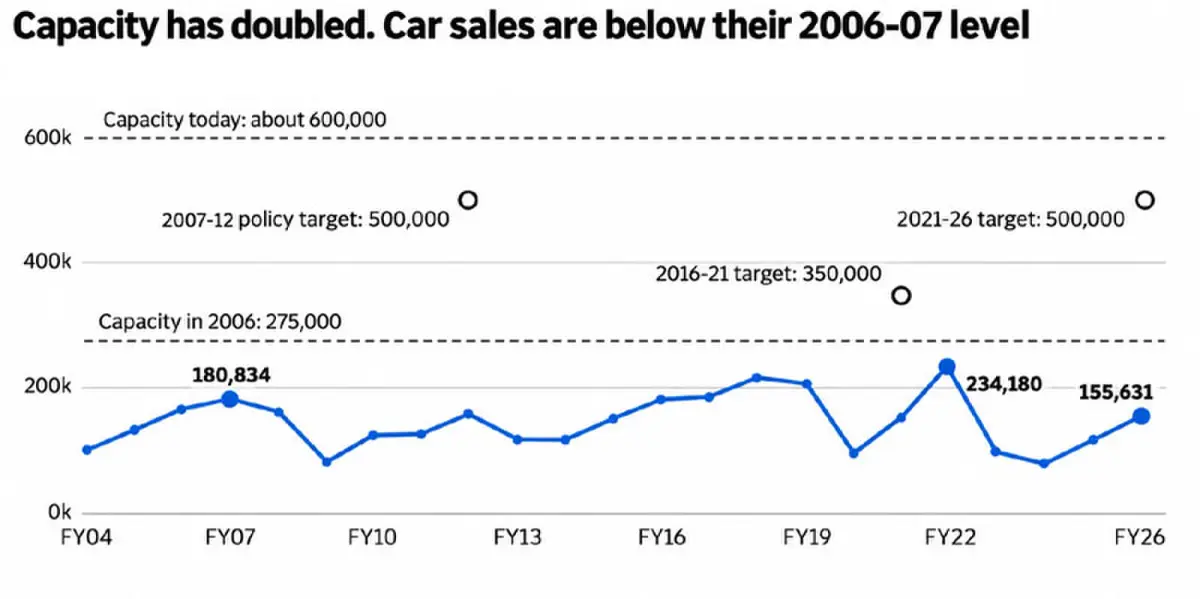
In 2006-07, local assemblers sold 180,834 cars, whereas passenger car sales reached just 155,631 in 2025-26. The figures are imperfectly comparable because classifications have changed and SUVs have become a bigger part of the market. Still, Indus Motors estimates that the industry can assemble about 600,000 vehicles a year and uses roughly 30 percent of that capacity. New manufacturers have entered the market, but factories still have far more capacity than the market can absorb.
The entry of more assemblers does not by itself resolve this. If each operates a small plant behind similar tariff protection, the market can acquire more brands without acquiring the scale or price competition consumers need. Lower duties on finished cars would strengthen the pressure to compete, but duties on imported components also matter. A sensible transition should expose producers to competition while allowing them to obtain inputs at competitive prices.
For some smaller imported cars, one reported tariff schedule keeps customs duty at 50 percent for the first two years and then brings it down in stages to 15 percent by 2030-31. Bringing those cuts forward would put earlier pressure on local producers to compete on price and quality. If the government also wants to discourage fuel-hungry vehicles, it can tax size or fuel use directly.
A cut in customs duty does not translate directly into an equal cut in the showroom price. Exchange rates, other taxes and producer margins impact what the buyer pays. I would judge success by actual prices and product quality, rather than the number of assembly licences issued. A tariff timetable that can repeatedly be deferred offers consumers little assurance.
Although Pakistan’s local car manufacturing capacity has more than doubled since 2006, annual sales (as denoted by the blue line) across the years have remained at a stagnated level | Author’s analysis of data sourced from the PIDE and the Pakistan Automotive Manufacturers Association (Pama)
AN ELECTRIC SOLUTION?
The distribution of electric vehicle incentives deserves the same scrutiny.
Some reported proposals for electric cars include a favourable sales tax rate and a financing ceiling of Rs10 million. If a 17 percentage-point tax preference (the difference between tax rates on electric vehicles as compared to on an internal combustion engine vehicle) is applied to an Rs8 million pre-tax car, the buyer’s tax advantage would be Rs1.36 million.
That is roughly the value of 21 electric-motorcycle subsidies of Rs65,000 each under the Pakistan Accelerated Vehicle Electrification (PAVE) programme. The actual benefit would depend on how the tax is applied and what the government ultimately approves. The comparison shows how much support can go to a single purchase.
Equivalent fiscal support does not mean equal benefits from different vehicles. A higher loan ceiling does little for someone without a down payment or an income that a lender will accept. Eligibility matters as much as the advertised concession.
Electric cars can cut petrol use, especially for people who drive long distances. But a household that cannot finance any private vehicle needs a different kind of help. A bus fare can determine whether someone in that household works at all.
Car ownership remains heavily concentrated among wealthier households, while most urban Pakistanis in the lower income brackets have no personal vehicle | Author’s analysis of HIES 2024-25 data
THE HIDDEN COST OF BEING UNABLE TO TRAVEL
The poorest fifth of Pakistani households spent 4.8 percent of their budgets on transport, compared with 6.7 percent for the richest fifth. In cities, the respective figures are 4.2 and 6.5 percent.
If spending were the measure of need, the figures would suggest transport was a bigger problem for the rich. But consider: a household survey counts the fare someone paid. It has no fare to record when a worker walks to save money, a woman turns down a job she cannot reach safely or a student stays home because college is too far away.
The poorest fifth also spends almost half its budget on food, compared with about 29 percent for the richest fifth. Once food and the estimated rental value of housing are set aside, transport takes up a more similar share of what remains.
The estimated rent includes the value of living in an owner-occupied home, even though no rent changes hands. Removing it from the comparison does not create cash for a bus ticket — it changes the denominator. I read the low transport share as a reason to investigate journeys people cannot make. The expenditure survey alone cannot tell us how many jobs were declined or classes missed.
My analysis puts transport spending for the poorest fifth at about Rs254 per person a month. At Rs20 a ride, that pays for six complete return trips. A World Bank benchmark used in urban transport affordability studies allows for roughly 60 one-way trips a month. Even if someone in the poorest fifth put their entire transport budget towards a bus, they would still be well short of a month’s travel to work or school.
Among poor urban households with at least one earner and neither a car nor a motorcycle, the survey implies about Rs9 in reported in-city fares per earner per working day. People may forget small fares when asked to recall spending over a year. The figures also cannot separate journeys made on foot from those abandoned altogether. Project documents for Karachi’s Red Line BRT estimate that about 40 percent of trips in the city are made on foot or by bicycle. Some people choose to walk or cycle. For others, it may be the only way to avoid paying for several rides on a single journey.
The cost is easier to see against a wage. My analysis of the survey puts median monthly earnings for an urban paid worker at about Rs32,000. At Rs80 each way over 26 working days, the commute costs Rs4,160, or 13 percent of pay. A combination of wagons and rickshaws costing Rs200 a day takes Rs5,200, or more than 16 percent of pay.
At the household level, two earners, each paying Rs20 in both directions over 26 working days, would spend Rs2,080 a month. Against the roughly Rs40,146 monthly budget for the poorest urban households in my analysis, that is just over five percent. At Rs80, the same journeys cost Rs8,320, or about 21 percent. These comparisons use survey-period budgets and illustrative fares, not today’s measured burden. They show why a fare that looks modest per trip can be unaffordable when paid repeatedly.
For women in paid urban work, reported median monthly earnings were about Rs10,000, partly reflecting fewer hours of paid work. A 26-day commute at Rs80 each way would take about 42 percent of that amount. This is an illustration, since a woman earning Rs10,000 may work fewer days. It shows what fares can do to the gains from taking on more work.
Distance can also put education out of reach. In the survey, about 1.3 million girls and young women and 900,000 boys and young men aged five to 24 had never attended school and cited distance as the reason. Where there is a school to go to, a safe, affordable journey can remove one of the barriers to getting there.
Motorcycle ownership only partly solves this problem. A single motorcycle cannot necessarily serve two earners travelling in different directions and children going to school. Nor can we assume that every household member can ride it. Therefore, counting households with a vehicle tells us less than knowing who can use it, when and for which journeys.
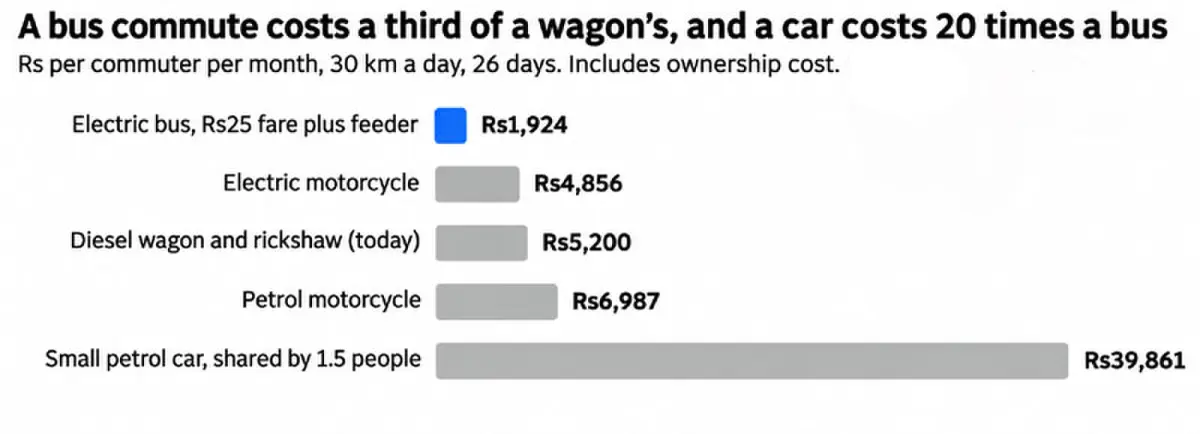
The economics of commuting favours public transport, as demonstrated by this comparison across one month | Author’s analysis of data sourced from the World Bank, PIDE and HIES
A BUS PEOPLE CAN RELY ON
On Lahore’s Orange Line train, about 51 percent of reported journeys were for work and 33 percent for education. In Peshawar, a 2023 account citing TransPeshawar (a public company established by the Government of Khyber Pakhtunkhwa to manage, operate and maintain the Zu Peshawar BRT system) put women at about 30 percent of passengers on the bus rapid transit system, up from an estimated two percent on earlier services.
Other published accounts put the newer figure closer to 20 percent. The new system offered separate entrances and reserved areas, better lighting, station security and more predictable service.
Research in Lahore by economists Robert Garlick, Erica Field and Kate Vyborny offers a closer look at how transport impacts decisions about work. Through a job-search platform, the researchers offered commuting services to women. The offer of women-only transport more than doubled job application rates, while mixed-gender transport produced little response. The study measured applications, not jobs secured. It shows how the commute can deter women before an employer has even seen their names.
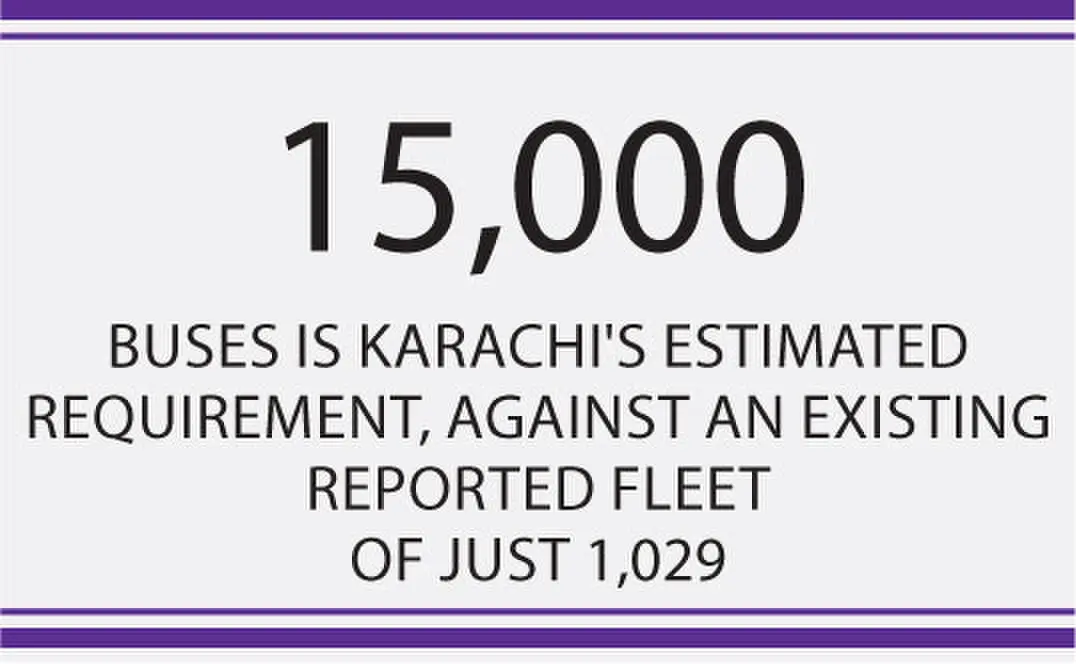
Even a new bus can be difficult to board. Writing in Eos earlier this year, Samina Hassan Laghari and Arif Hasan described Karachi’s electric buses with about 30 seats carrying 70 or 80 people, sometimes more than 100. Women told them they had given up work because of the journey. The city’s bus fleet was reported at 1,029, against an estimated requirement of 15,000.
Building more corridors can help, but people have to reach them. A cheap fare on the main route can lose much of its value if a passenger has to pay for a rickshaw to get to it. A well-lit stop is of limited use to a child who has to cross a dangerous road to reach it. The World Health Organisation (WHO) estimates roughly 28,000 road deaths a year in Pakistan, with pedestrians accounting for a large share. Official reported totals are much lower. Both the walk to the bus and the ride itself belong in a transport plan.
Reliability matters as much as the fare. A daily-wage worker who cannot tell whether a bus will arrive in five minutes or 45 has to leave early or risk losing a shift. Karachi’s Red Line has faced a much longer timetable than originally envisaged. While cities build major corridors, they also need buses running between neighbourhoods, regular departures and connections that people can use without building an hour’s uncertainty into the day.
A dependable service also reduces the unpaid time a worker must allow for delays. Time savings belong in the economic appraisal, even when they produce no additional fare revenue. They should be measured through actual waiting and journey times, rather than assumed whenever a new bus or corridor is announced.
THE COST OF THE COMMUTE
To compare the choices, I modelled the same trip across five modes, with 30 kilometres covered a day, 26 days a month. For private vehicles, the calculation includes ownership and financing costs as well as fuel or electricity. For the bus passenger, it includes a low main fare and some travel to and from the route.
Under these assumptions, monthly costs per commuter are roughly Rs1,900 for a bus, Rs4,900 for an electric motorcycle, Rs5,200 for wagons and rickshaws, Rs7,000 for a petrol motorcycle and Rs39,900 for a small petrol car. The bus estimate includes a Rs25 fare and feeder journeys.
The model assumes petrol at Rs378 a litre, 15 percent vehicle financing and some sharing of private vehicles. These are modelled costs, not quoted monthly instalments. The bus figure is what the passenger pays after public support; it is not the full cost of providing the service.
The difference matters for the country’s import bill as well as the commuter’s wallet. Pakistan spent about $16.9 billion on petroleum imports in fiscal year (FY)26, compared with roughly $2.1 billion on imported vehicle assembly kits. The totals cover different categories, but they give a sense of the scale of dependence on imported fuel. In the model, moving one million daily commuters from motorcycles into small petrol cars would add about Rs394 billion a year to household costs and roughly $440 million to imports, including fuel and vehicles.
Electric motorcycles offer substantial savings where people already ride petrol bikes. In the model, each rupee of public support for electric motorcycles saves households more cash and generally saves more on imports than a rupee spent on buses. A bus reaches people a motorcycle subsidy cannot readily serve, including students, older passengers and households that cannot buy a vehicle. That makes a case for supporting both.
The journey being replaced matters. A bus carrying former wagon passengers has a different effect on imports from one attracting motorists. An electric motorcycle replacing a petrol motorcycle is different from an additional vehicle bought for convenience. My calculations assume those substitutions — they are not a forecast that every subsidised purchase will deliver the same saving. I would assess the programmes against what riders actually stop using.
There is a case for electric buses on routes where charging and electricity supply can support them. In an illustrative comparison, a diesel bus covering 80,000 kilometres a year uses about 18,000 litres of fuel. At the diesel price of Rs395.20 a litre, effective on November 3, that costs about Rs7.1 million. Meanwhile, an electric bus, using about 96,000 units of power at an assumed Rs39.70 per unit, would spend about Rs3.8 million on electricity. The roughly Rs3.3 million difference comes before maintenance, financing and battery costs. A city weighing the higher purchase price should count that annual saving and the reduced exposure to a diesel price spike.
Battery replacements and charging equipment also belong in the calculation. High utilisation helps recover the higher purchase price only if charging arrangements allow buses to run the promised service. Electric buses eliminate exhaust at the roadside, but overall emissions also depend on electricity generation. A national pollution claim needs a separate estimate.
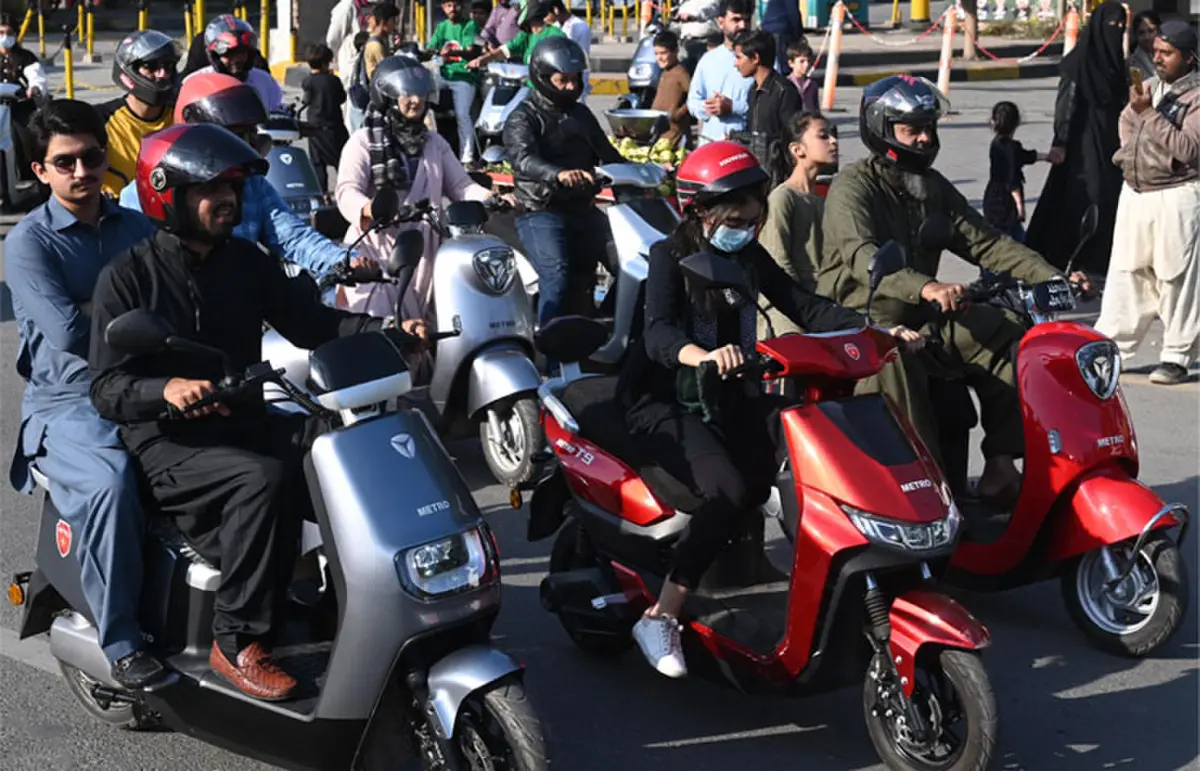
Women and men pictured driving electric bikes in Lahore: electric motorcycles offer substantial savings where people already ride petrol bikes | White Star
HOW MANY BUSES CAN A LEVY BUY?
The Automotive Development Levy (ADL), proposed in the draft for the Auto Policy 2026-31, could raise around Rs232 billion over five years. Its reported uses include export rebates and industrial upgrading. The government should consider putting a share towards public transport and say which proposed uses it would scale back to do so.
Spread evenly, the projected revenue comes to about Rs46 billion a year. In my model, an electric bus running around 70,000 kilometres a year with 800 passenger boardings a day needs about Rs21.5 million in annual public support if borrowing costs 18 percent. At 11 percent, the contribution falls by about Rs5.5 million, to roughly Rs16 million.
At that lower cost, the entire annual levy could support close to 2,900 buses. Using only a share would pay for proportionately fewer. The levy still needs approval and the figures depend on what buses cost, how much operators collect in fares and how many people ride.
The assumptions also deserve scrutiny before anyone commits public money. Eight hundred boardings are not 800 different people: a commuter travelling both ways boards twice. At Rs25 a ride and 312 operating days, 800 daily boardings produce Rs6.24 million in annual fare revenue.
If boardings halve, that revenue falls by Rs3.12 million, while much of the cost of owning the fleet remains. The model also assumes non-fare revenue at 37 percent of fares, which requires testing against actual advertising receipts. The 11 percent financing rate is an assumption rather than a financing commitment. Any interest subsidy must be funded and a guarantee can leave the state liable if repayments fail.
Supporting 15,000 buses on those terms would cost around Rs240 billion a year. That is a recurring public expense. Pakistani households already spend an estimated Rs2.37 trillion a year on transport, according to the household survey. The question for the government is how much of that spending on a better service could save households and which trips people could make if the fare came down or the bus turned up regularly.
Household savings cannot simply be netted against the government’s subsidy bill. A lower fare partly shifts costs from passengers to taxpayers — it does not eliminate them. Nor is all of the Rs2.37 trillion available to finance urban buses. The economic case must rest on savings in fuel and time, safer journeys and better access to work, alongside a credible plan for meeting the recurring budget commitment.
WHAT THE POLICY NEEDS
The policy can start by reconsidering the reported two percent development levy on buses and reviewing duties on electric buses and charging equipment. It can give affordable electric motorcycles and rickshaws greater priority in vehicle incentives. And it can make bus funding conditional on the service that provincial authorities and operators deliver.
Localisation targets also need care. A rule designed around a petrol engine can penalise an electric motorcycle because its battery is imported. I would reward the value actually created in Pakistan, with a transition that allows battery and component suppliers to develop. The aim should be competitive suppliers that can sell beyond one protected domestic market.
For bus funding, that means setting routes, fares and safety standards, then paying operators for running the scheduled service and maintaining the fleet. Provinces would have to pay on time and operators would have to run the promised service. Passengers should be able to see how often buses ran, how long they waited, and how many services were cancelled. Cities should also track who uses the system and ask people which journeys they still cannot make.
A contract can make those obligations enforceable. The province could retain fare revenue and pay an operator for service delivered, with deductions for missed trips and safety failures. That reduces the incentive to overcrowd buses but leaves the province carrying the risk of weak ridership. Payment reserves and dependable budget releases would be necessary — private finance does not remove that obligation. Depots and power connections must be ready when the fleet arrives. I would begin with routes where demand can be tested, publish the results and expand where the service earns continued support.
I would also want a travel survey to test the arguments made here. If low reported spending chiefly reflects short, affordable journeys and incomplete recall, the case for suppressed travel (when individuals do not undertake trips or activities due to barriers or constraints) would weaken. If well-run buses attract few riders, routes and spending should be reconsidered. A policy should allow those findings to change where the next rupee goes.
Pakistan can keep a tally of cars coming off assembly lines. Over the next five years, it should also count how many more people can get to a job, a classroom or a clinic without buying a vehicle.
For a woman making that journey, it comes down to what happens after the 20-minute walk: how long she waits, whether there’s room to get on and how much of her pay she has left when she gets home.
The writer is a macroeconomist and professor of practice at IBA, Karachi. He can be reached at ammar.habib@gmail.com