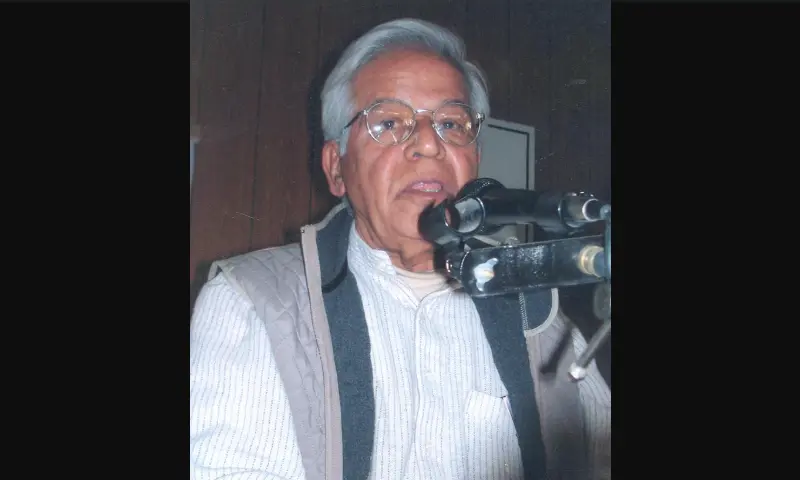
LAHORE: Veteran journalist and human rights activist Husain Naqi passed away in Lahore on Sunday of a cardiac arrest.
He was a former editor of The News and had also been associated with the Human Rights Commission of Pakistan (HRCP).
On Saturday, a day before his passing, Naqi attended a book launch organised by HRCP. Later in the day, at 6pm, he suffered a cardiac attack, after which he was admitted at a private hospital, according to HRCP official Muhammad Ilyas.
Naqi passed away on Sunday morning at 5am. He left behind three sons.
President Asif Ali Zardari extended his condolences on Naqi’s passing to the bereaved family, expressing “deep sorrow”, a statement issued by the Presidency said.
The president paid tribute to Naqi’s “services to journalism, freedom of expression and human rights”, the statement said.
It further quoted the president as saying: “Husain Naqi played a prominent role in promoting journalism and democratic values. His contributions will always be remembered.”
The President offers condolences to Hussain Naqi’s family and prays for the forgiveness of the deceased.
The HRCP also released a statement, saying it “deeply mourns” Naqi’s passing.
“Over a career spanning more than 70 years, from student leader to newspaper editor to treasurer of HRCP, neither multiple incarcerations nor vindictive acts by the authorities ever weakened his resolve to speak truth to power. Naqi sahib served HRCP in different capacities for three decades and was an active council member at the time of his passing. One of the strongest voices for people’s rights and democracy in Pakistan has gone silent,” the statement said.
Senator Sherry Rehman expressed her grief on Naqi’s passing in a post on X.
“His passing signals the end of an era. Naqi Saheb always spoke unflinching truth to power,” she said.
She said many “cub journalists” had learned at his desk and walked in rallies under his leadership.
“We often called him the rebel angel of our times, yet he never stoked anger. He sought the right to dissent with respect,” Rehman wrote.
PTI Secretary General Salman Akram Raja also expressed his condolences on Naqi’s passing, saying that he had met the veteran journalist on Saturday at a book launch at HRCP.
“My acquaintance and admiration for him spanned decades,” Raja said in a post on X.
Naming I.A. Rehman, Asma Jahangir and Amin Mughal, he said, “The most precious gems who dreamed of and championed the dignity of human beings and the voices of the poor in Pakistan are leaving us.
“Their dreams have yet to be realised. Their dreams are the dreams of 250 million people.”
Who was Hussain Naqi?
Naqi was born in Lucknow, India before partition. In his autobiography Mujh Se Jo Ho Saka, Naqi said he was perhaps born a year before his officially recorded birthdate, 1936.
His great-grandfather had moved to Lucknow from a village in what is now Haryana, in the then-undivided Punjab. It was a well-heeled and well-educated family that flourished in Lucknow over the next few generations.
However, Naqi subtly confronted the conservatism of his traditional family from a very young age. Outside, he was not subtle. He began his student activism in secondary school and started taking on the minor establishments of power at a fairly young age.
After early schooling and college education in Lucknow, Naqi moved to Karachi in the 1950s, where he subsequently developed into a quintessential student leader.
As a student in Karachi, Naqi played a key role in several demonstrations and protests. During the 1956 Suez Canal crisis when Egypt was attacked by Israel, France and Britain, Naqi was part of the executive committee of the National Students Federation (NSF). At the time, the NSF organised a march to the British High Commission in Karachi to protest against the attack and was faced with police batons and tear gas.
As president of the Karachi University’s students union, Naqi made a deal with the university’s vice-chancellor for Naqi to be rusticated for three years instead of three Baloch students who had been rusticated in response to an incident at the hostel.
Naqi’s activism during his student days was not just centered around protests, but also had to do with improving conditions in the institution. He fought for adding a new campus with better facilities, providing safe transport for girls and ensuring that exams were held on time and not postponed.
He was a strong advocate for student unions. In an interview published in 2011, he said, “it was the banning of student unions that destroyed campus peace. In our time, student unions were a positive influence. We organised cultural activities. We tolerated diversity. Representatives with various political leanings were able to work together despite their ideological differences.”
After a few turbulent years in Karachi, Naqi permanently settled down in Lahore — the city that he has long identified with as his own and the city that itself identifies with Naqi as a source of resistance to power.
As a journalist, Naqi found his first mentor in Javed Bokhari, with whom he worked for a couple of years. “In those days I used to literally live at the PPI office,” he said of the time.
He ended up working as bureau chief of PPI. However, he eventually had to leave the position following a reporting incident in which he refused to accept a false news of desecration of the Holy Quran.
Nonetheless, he continued to write for various newspapers, including the Viewpoint, Holiday, Outlook, Frontier Post, Frontier Guardian, Daily Star, Punjab Times and Punjab Punch.
Naqi consistently campaigned for the preservation and promotion of the Punjabi language in Pakistan, starting the first-ever daily newspaper in the Punjabi language — Sajjan.
Naqi had also been imprisoned a couple of times because of his outspokenness. In the 2011 interview, he recalled those instances with a sense of humour. “I was lucky to invariably have someone favourably disposed towards me at the jail premises, who made sure that I was not mistreated.”
Source: dawn
Leave a Reply