Anthropic chief executive Dario Amodei on Wednesday denied wanting humanity to give up its free will to AI, calling it “absurd” to attribute the idea to him as rival tech leaders push back.
“No, I do not believe that we should ‘surrender human free will’ to AI systems, and it’s absurd to suggest that I do,” Amodei wrote in a lengthy post on X, a week after Anthropic’s record-setting stock market debut.
“We should never sacrifice legitimacy or self-determination at the altar of efficiency or security,” he added.
Fears that AI tools could slip out of human control have haunted Silicon Valley since a string of incidents this summer, including the hacking of Hugging Face by autonomous AI agents developed by OpenAI.
“We really do earnestly believe AI could kill all humans!” an Anthropic safety lead, Evan Hubinger, wrote in September.
Amodei took aim, without naming names, at “some AI CEOs” who repeat slogans like “AI should be just a tool” but then are not “actually doing anything different in their products.”
On Sunday, Meta’s Chief AI Officer Alexandr Wang wrote on X that “we should not be okay with a ‘handover’ of society to AI.”
OpenAI CEO Sam Altman said earlier this month that if the tradeoff for curing cancer is “you are going to lose all agency and control and voice in the future,” that is “a terrible sales pitch.” Amodei’s post was in response to an article by US outlet Axios on AI debate, though he did not address his previous remarks on the topic.
In February, Amodei told The New York Times that in “life-critical, safety-critical cases, we really want to turn it over” to AI.
And in late 2024, he predicted that AI systems “will be the leaders, and they’ll be ordering humans or other AI systems around.” On Wednesday, he acknowledged that “we may want limits” on recursive self-improvement, or RSI, in which AI models can autonomously create new versions of itself, and that “we don’t expect it to be safe for Claude to build successive frontier models fully autonomously,” without saying where the line should be drawn.
Yet in its IPO filing, Anthropic said that “each new version of a Claude model directly accelerates development of the next,” and that Claude wrote over 90 per cent of the contributions to its codebase in September.
Elon Musk, who has long predicted that superintelligent AI would leave humans “like pet Labradors,” reposted Amodei’s statement with a one-word comment: “interesting.”
THE 31st Conference of the Parties (COP31) took place in the backdrop of geopolitical fragmentation, a rising cost-of-living crisis, tightening of national and international budgets and the imminent threat of a 1.5ºC overshoot.
Despite high stakes, the talks — instead of propelling the agenda forward — highlighted significant gaps in international cooperation and revealed critical areas where progress was stalled, resulting in an underwhelming outcome.
At its core, COP31 faced a leadership vacuum, leaving parties to navigate the negotiations with limited political direction. Turkiye’s presidency for hosting and Australia’s presidency of negotiations were unable to shepherd political compromises for the highest possible ambition. The result was a watered-down draft cover decision with the lowest common denominator that failed to secure consensus and was therefore not adopted.
The lack of ambition was visible across all critical workstreams. The negotiations failed to get a tangible commitment from major emitting countries to ratchet up their 2030 greenhouse gas emission reduction targets in line with the Paris Agreement.
COP31 reaffirmed that multilateralism must endure as the backbone of climate action.
Many nations maintained vague promises without concrete policies or mechanisms to accelerate carbon cuts. This failure underscores the persistent divide between developed and developing countries over responsibility and capacity. Financial pledges for climate adaptation and loss and damage remained grossly insufficient, especially for vulnerable countries grappling with the worst climate impacts.
COP31 did not substantially increase the promised climate finance commitment, nor did it establish clearer mechanisms for operationalising this support. This shortfall deepened the trust deficit between richer and poorer nations and hampered purposeful progress. COP31 made little headway in solidifying a comprehensive loss and damage framework that would provide timely financial assistance to countries suffering from climate-induced disasters.
Despite long-standing calls for compensatory mechanisms, negotiations were bogged down in political disagreements, reflecting the complexities and sensitivities surrounding liability and responsibility.
Although adaptation is a critical pillar of climate action, COP31 showcased a yawning gap between rhetoric and reality. Concrete and enforceable commitments for adaptation planning, funding, and technology transfers failed to materialise.
Perhaps the most glaring omission at COP31 was the absence of decisive action on phasing out fossil fuels. Despite growing scientific consensus on the need to rapidly transition to renewable energy, the conference sidestepped a clear, actionable roadmap away from fossil fuel dependency, highlighting the influence of entrenched economic interests.
While these shortcomings are disappointing, they offer a valuable opportunity for reflection and reform. The failure at COP31 should not be viewed as the collapse of the global climate effort but as an urgent signal that the status quo in multilateral climate negotiations is insufficient to meet the scale and immediacy of the crisis.
This moment calls for re-energising international cooperation, urging countries to bridge their divergent interests and work with renewed transparency and solidarity. It also brings to light that the current voluntary pledging model needs firmer accountability mechanisms for enforcing compliance and incentivising larger, more actionable and ambitious commitments.
The inability to get an overarching political consensus also demonstrates that countries are no longer willing to go along without assurance of financial, technical and policy support needed to adapt and recover. The setbacks also highlight the need to examine new approaches that include civil society, indigenous voices and private-sector leadership for fresh perspectives and urgency into a traditionally slow-moving process.
The weak outcome at COP31 should not cause despair but create a renewed sense of purpose. Sometimes a failure in negotiations is less damaging than weak agreements (like previous COPs) that create a false sense of security. COP31 has forced a reset and serves as a crucial pivot point for rejecting unfair agreements and harnessing the moment to strengthen the spirit of the Paris Agreement, keeping its promise alive and escalating its ambition. The failure of COP31 is in fact a triumph of COP21.
COP31 may have faltered but it reaffirmed the essential truth that multilateralism must endure as the backbone of climate action. The diplomatic disagreements at COP15 in Copenhagen in 2009 resulted in the milestone triumph of COP21 in 2015 in Paris. The failure of COP31 can serve the same turning-point purpose for future COPs and multilateralism.
LET’S be very clear about one thing: this business of cutting the provinces up into “administrative units” has nothing to do with good or bad governance. It is mainly about recentralising control over the state’s resources.
A paper written by three eminent Pakistani academics in 2005 made a related point that is worth revisiting in the present debate. The authors were Ali Cheema, Asim Ijaz Khwaja and Adnan Qadir and the document was published in 2005 as a working paper for Harvard’s Kennedy School of Government. They took a longer view of all attempts to bring in local governments in the country’s history, and came to the following conclusion: “local government empowerment has always been combined with centralisation of political power in the hands of the non-representative centre. The centralisation of political power has undermined representative institutions not only at the level of the centre but also at the level of the provinces.”
Their analysis is especially relevant all over again, as the same gambit to centralise power is being rolled out for the fourth time in our history. They noted that in all such experiments in the past, “[o]ur interpretation is that these reforms have been used as a means for a non-representative centre to gain legitimacy by by-passing the political agents at the provincial and national levels”.
Today almost 30pc of the federal deficit is being financed by provincial resources, and the demand from the centre for more is continuing to grow.
The seventh NFC award agreed to in 2009 and made effective in July 2010 reversed the centralisation of powers and resources that the federal authorities had grown accustomed to over the decades. It was the first time in Pakistan’s history that powers and, more importantly, resources, flowed down from the federal government towards lower tiers of government in such large quantities. And almost immediately, from its very first year of operation, a thrust emerged from the federal authorities to try and undo this.
It began slowly at first. Then in the middle of the decade it achieved its first written form. Here is a brief timeline of how small, subtle changes in how fiscal resources are measured and counted turned into a full-blown programme for reversing the flow of these resources to the provincial governments.
In FY2011, the first year after the seventh NFC award, the federal government “successfully pressed” the provincial governments to run a surplus and not spend all the money being devolved down to them. Then the next year they asked for these surpluses again, but with no Fund programme in force, the provincial governments did not comply.
This changed in 2013 when the IMF made it a prior action for provinces to post a surplus, and provincial deposits with the State Bank leapt from Rs42 billion in June 2013 to Rs257bn by March 2014. This was ratified in the Council of Common Interests, and provincial finance secretaries agreed to continue the practice into 2015. By June 2015 the IMF programme called for written agreement from the provinces to raise their surpluses, as a prior action and a few months later, in September, provincial spending was capped at 6.5 per cent of GDP.
By June 2016, as the programme was winding up with only a few months left in it, the government set up the Fiscal Coordination Committee to ensure that centre and provinces coordinate their spending and surpluses. The very next year, as the Fund programme ran out, provincial governments ramped up their spending, running a deficit of Rs163bn in FY17.
In July 2019 another IMF programme was signed, after replacing finance ministers. This one again made it a prior action to get provinces to run surpluses, and raised the surplus targets from one to 2.7pc of GDP. That agreement was renewed in the two years that followed, and provincial surpluses leapt from Rs77bn in FY20 to Rs314bn in FY21 and Rs351bn in FY22. That was the most troubled programme of Pakistan’s history, with more false starts than any other programme Pakistan had ever signed.
The blowout came in 2024. As part of the bailout in July 2023, the provinces now had to agree not only to post a surplus, but also submit spending plans. Provincial deposits were already netted against government borrowing in the IMF’s targets for the budget deficit and SBP’s net domestic assets, thereby helping the federal government meet its targets under the Fund programme. Most importantly, the targets for provincial surpluses agreed to in that programme rose to Rs1.2 trillion in the first year, rising to Rs1.9tn by FY27.
So in 2011 the provinces left unspent 13.5pc of what they received as a transfer under the NFC award. This figure fell as soon as the Fund programme lapsed, then rose again every time Pakistan entered a Fund programme. Today it stands at 19pc, skyrocketing in the last three years.
Today almost 30pc of the federal deficit is being financed by provincial resources, and the demand from the centre for more is continuing to grow.
In May 2025, for example, provinces were required to put surplus cash into T-bills. Their holdings of federal government debt rose from Rs19bn in June 2025 to Rs1.8tn as of October 2026, though this figure fluctuates a lot with maturities every few months. And then in June 2026, under Article 164 grants, the provinces were made to hand over Rs1.0tn to the federal authorities, or about 12.66pc of each province’s NFC share.
What began as a plea to restrain spending in 2011 slowly grew into a codified demand to run a surplus. Then the targets for these surpluses were raised. Then came requirements to buy government debt paper followed by a reverse flow from province to centre as a “grant” under Article 164. And now they want to dismantle the whole set-up altogether, in the name of governance. The irony here is that it is the governance failures of the federal authorities themselves that have fuelled their hunger for resources from the provincial authorities.
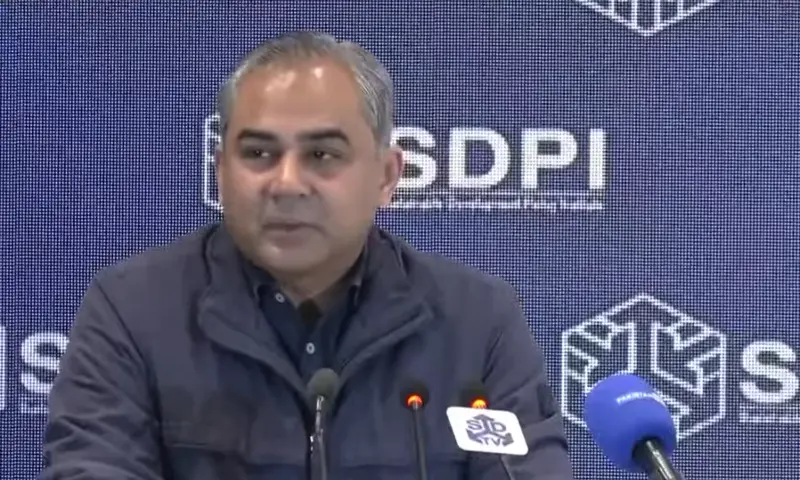
INTERIOR Minister Mohsin Naqvi is right to say that freedom of expression cannot be a licence to promote terrorism, hate speech, incitement to violence or child sexual exploitation.
No responsible media outlet or citizen would argue otherwise. And few would object to curbing such content on social media. Those who spread such material should expect to answer for it under the law. But drawing red lines is only half the job. The state must also show that it respects them. This is where its record raises questions.
There are visible red lines against hate and violence. But there are also invisible ones that journalists and citizens encounter every day when they question powerful quarters or report matters considered inconvenient. Journalists have been picked up, threatened and intimidated for publishing stories that upset those in power.
Media organisations have faced pressure over their editorial choices. Reporters often find themselves working out what they can safely publish and which subjects are best avoided. This has created a vacuum that social media is rapidly filling. So when Mr Naqvi tells journalists they are free to report, and that citizens are free to ask questions, it rings hollow.
Terms such as “anti-state activity”, “misinformation” and “hate speech” are elastic. And when officials interpret them without checks, they become tools for silencing critics. Having a law or a regulator does not make its use legitimate. Enforcement agencies should operate within defined legal limits, give valid and legitimate reasons for their decisions, act in proportion to the harm and be answerable to the courts. The rules should apply equally to everyone, whatever their politics or standing. Otherwise a measure meant to protect citizens ends up policing public debate. The minister’s assurance that dissent, including criticism of the state, will be heard is welcome. But assurances count for little while media organisations and journalists are still being intimidated.
The state must guarantee complete press freedom, subject only to clearly defined constitutional and legal restrictions. A sensible first step would be to bring journalists and their representative bodies, media owners, civil society and relevant state institutions together to agree on what responsible expression means in practice. Such consultations should produce a clear commitment to protect journalists, safeguard editorial independence and prevent the misuse of regulatory powers.
Freedom of expression carries responsibilities. But those responsibilities cannot be imposed on the media alone. The state must also accept its own obligations and allow uncomfortable questions to be asked. Rules against violence and hatred are fair enough. Unwritten and invisible ones against independent journalism are not.
KARACHI: The government raised much less than the amount maturing at Thursday’s treasury bills auction, sticking to its strategy of cutting short-term debt despite strong demand from banks.
The government raised Rs689.5 billion against a target of Rs750bn and maturities of Rs1,317bn. Total bids amounted to Rs2.77 trillion, of which Rs173.6bn was accepted through the auction and Rs515.9bn through non-competitive bids.
Cut-off yields were mixed. The yield on one-month bills fell by 19 basis points to 11.69 per cent, while the yield on six-month bills rose by 10bps to 12.29pc and that on 12-month bills rose by 11bps to 12.52pc. The 12-month return exceeded the 12pc policy rate by 52bps.
The three-month bill attracted the highest bids, at Rs902.8bn, against which the government raised Rs69bn. Its rate remained unchanged at 11.99pc.
Bids for the six-month tenor were the lowest, at Rs483.9bn, with only Rs1bn accepted.
For one-month bills, bids totalled Rs627.5bn, with Rs25bn accepted. For 12-month bills, bids totalled Rs756bn, with Rs78.5bn accepted.
Financial experts said the bidding pattern showed ample liquidity with banks, while the government appeared less interested in short-term borrowing.
The long-term PIBs remain the government’s priority, with outstanding stock now double that of short-term T-bills.
The financial sector believes there is room for another 50bps increase in the policy rate, citing double-digit average inflation over the past four months. The State Bank expects inflation to fall to 5-7pc by the end of FY27.
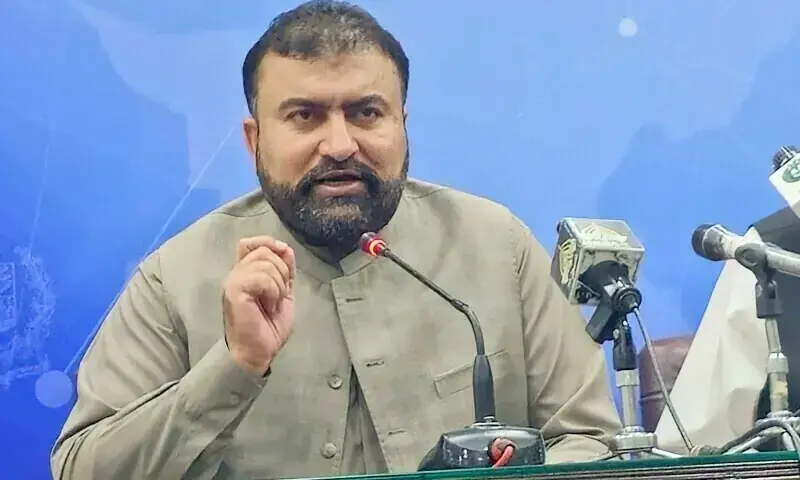
QUETTA: Balochistan Chief Minister Sarfraz Bugti said no leniency will be shown to anyone taking up arms against the state or advocating terrorism, regardless of whether they are men or women.
Addressing participants of the 28th National Security Workshop, Mr Bugti outlined the province’s security situation, governance challenges and development priorities.
Mr Bugti described Balochistan as an inseparable part of Pakistan, maintaining that terrorism cannot be justified in the name of religion or nationalism. While the Constitution allows peaceful protest and freedom of expression, he said those rights carry responsibilities, including loyalty to the state.
He acknowledged that uneven development and deprivation remain challenges in the province, but stressed they must be addressed through democratic means rather than violence or separatism.
Peaceful political dissent and armed resistance cannot be treated the same, he added, noting that no ideology justifies killing innocent people or attacking state institutions.
Turning to the role of young people, Mr Bugti expressed concern over anti-Pakistan elements operating from abroad to influence youth through social media propaganda. He urged students to distinguish online narratives from ground realities and focus on education and constructive national participation.
To support that goal, Mr Bugti said the provincial government is working to ensure equal access to quality education and economic opportunities. Improving living standards, strengthening governance and extending basic facilities to remote areas remain key priorities, he said.
The chief minister added that the sacrifices made by residents and security forces for peace will not go in vain, reaffirming his government’s commitment to maintaining law and order while addressing public grievances.
Chief Secretary Shakeel Qadir Khan also briefed attendees on ongoing development projects and administrative reforms aimed at improving public service delivery.
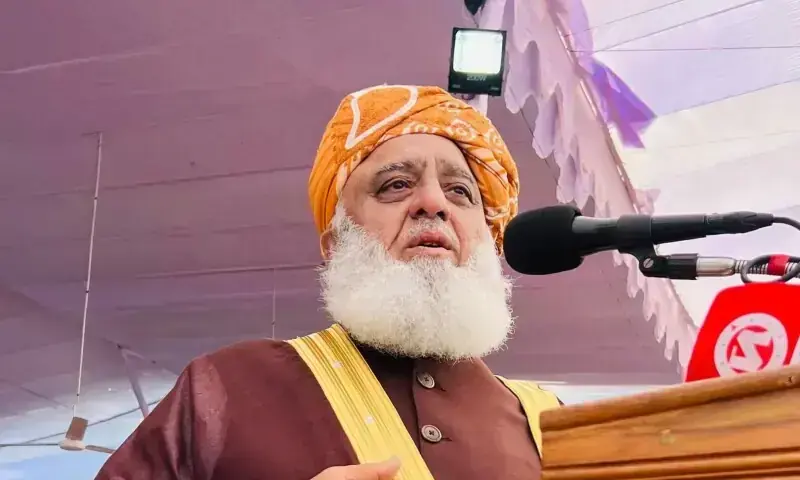
LAHORE: The Lahore High Court on Wednesday sought a report from the capital police chief on a petition challenging the alleged confinement of Jamiat Ulema-i-Islam (JUI-F) chief Maulana Fazlur Rehman to his temporary residence in the city.
Justice Ali Zia Bajwa heard the petition filed by Advocate Chaudhry Abrar Hussain, a member of the JUI-F legal wing.
The lawyer informed the court that Maulana Fazl had been restricted to his residence in Lahore.
The judge observed that if the JUI-F chief had been illegally detained, the matter was serious and whoever was responsible for the unlawful action would have to face the consequences.
Judge warns of consequences if JUI-F chief illegally detained
Justice Bajwa remarked that if Maulana Fazl had been placed under detention, the authorities would have to provide reasons for the action.
Additional Advocate General Farrukh Javed Lodhi told the court that the petitioner-lawyer had met Maulana Fazl the other day. He said a photograph of the meeting had gone viral on social media.
Advocate Hussain said he had been allowed to meet the JUI-F chief after repeatedly requesting the police for permission. He maintained that Maulana Fazl remained under illegal confinement at his residence and was still not allowed to leave the house.
The petitioner contended that the JUI-F chief’s life and liberty were under threat. He sought directions for his recovery.
The judge directed the Capital City Police Officer to submit a detailed report on the matter by Thursday (today).
The JUI-F chief was scheduled to participate in a multiparty conference hosted by the Lahore High Court Bar Association on Tuesday. However, he could not leave his residence in a private housing society on Multan Road due to deployment of a heavy police contingent.
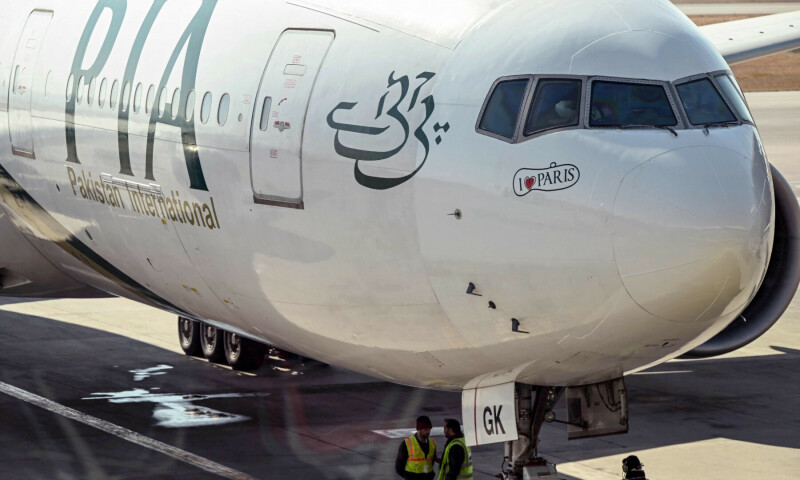
Pakistan International Airlines (PIA) said on Wednesday it will move its UK operations to its own Boeing 777 fleet from Nov 26 after wet-lease partner Norse Atlantic Airways abruptly suspended operations, forcing the cancellation of two flights from London and Manchester.
The development came after Norse Atlantic, a long-haul budget carrier, said its financial situation is “critical” and it requires new financing to meet short-term liquidity needs and continue operating.
Hit by soaring fuel costs caused by disruptions linked to the US-Israeli war against Iran, Norse launched a formal process for a potential sale or merger in July and has said it is in talks with airlines about leasing some Boeing 787 aircraft.
In a statement, PIA said flights PK786 from London Heathrow to Islamabad, scheduled for 7:55pm GMT, and PK710 from Manchester to Lahore, scheduled for 7pm GMT, were cancelled.
“Notice of this operational suspension was communicated to PIA without any prior warning just as passengers were preparing to board their respective flights in London and Manchester,” the airline’s spokesperson said.
“PIA shares in the deep frustration and disappointment of every affected traveller and sincerely apologises for the distress, inconvenience, and disruption caused.”
The statement added that to protect passengers from “any further third-party disruptions and safeguard schedule integrity, PIA is transitioning its UK flight operations directly onto its own dedicated Boeing 777 fleet effective tomorrow” (Thursday).
It is unclear whether the passengers from the two cancelled flights will be accommodated on any other flight.
“It is deeply regrettable that our wet-lease partner suspended operations without advance notice at the very moment boarding was set to commence,” PIA reiterated.
It said it was pursuing the matter with Norse Atlantic Airways at the “highest contractual and executive levels”.
Meanwhile, PIA said it took “decisive action to deploy our own aircraft from tomorrow so our customers can travel with complete confidence in PIA’s service continuity”.
Contingencies have already been put in place and PIA’s schedule will operate normally across all network points, the statement affirmed.
“PIA remains profoundly grateful to its passengers for their patience, cooperation, and understanding during this unexpected situation.”
Passengers seeking immediate assistance regarding rebooking or flight schedules were advised to contact PIA’s 24/7 call centre at +92-21-111-786-786, or reach out to its UK station desks at London Heathrow (Terminal 4) and Manchester Airport, or visit www.piac.com.pk.
PIA was privatised in December last year through an auction. A consortium led by Arif Habib Corporation Limited had won the auction for 75 per cent shares of PIA in December last year, making a winning bid of Rs135 billion. The Arif Habib-led consortium had vowed to transform the loss-making airline through operational restructuring, fleet expansion, and improved customer service.
In October, PIA signed an ACMI (aircraft, crew, maintenance, and insurance) lease agreement with Norse Atlantic Airways to acquire two state-of-the-art Boeing 787-9 Dreamliners, one of which arrived in Islamabad on Nov 1.
A PIA spokesperson at the time said the addition of the Boeing 787-9 Dreamliner would mark the start of the expansion of the airline’s fleet as it aims to meet rising demand.
Following Norse Atlantic’s announcement on Wednesday about its financial situation, its shares plummeted by 76 per cent at 1:03pm GMT. Most of the airline’s market value has already been wiped out this year.
The Norwegian company is now in talks to secure short-term financing, it said in a statement.
“However, there can be no assurances that such discussions will result in a viable solution,” Norse said.
It did not say how long it could still operate without new financing and did not immediately respond to a Reuters request for further details.
The carrier, which does not hedge its jet fuel needs, cut capacity as costs skyrocketed following the outbreak of the US-Iran war in late February. Many other airlines are faced with the same problem, filing for bankruptcy or initiating restructuring proceedings to survive.
“Long-haul, low-cost is most exposed to high fuel costs as demand is subject to a high level of price elasticity. So maybe not a surprise,” aviation analyst James Halstead told Reuters in response to the Norse announcement.
In a separate development on Wednesday, Norway’s Civil Aviation Authority imposed a fine of 8,000 Norwegian crowns ($814) per business day on the airline, citing its failure to pay financial compensation owed to passengers.
Norse’s plight echoes the wider strain on Europe’s smaller, financially weaker carriers.
Analysts warned during the peak summer season that small airlines could struggle to generate enough cash to get through the winter, with some predicting trouble as early as February, when carriers traditionally run short of funds.
Bangladesh Parliament Speaker Hafizuddin Ahmad on Wednesday met with President Asif Ali Zardari and Prime Minister Shehbaz Sharif in Islamabad, where the Pakistani leaders reaffirmed that Islamabad attached “great importance” to its ties with Dhaka.
The parliament speaker, accompanied by a parliamentary delegation, arrived in the country on Monday on a six-day official visit at the special invitation of National Assembly Speaker Sardar Ayaz Sadiq. This is the first official visit to Pakistan by a speaker of the Bangladesh parliament, according to the PM Office (PMO).
On Wednesday, Ahmad and his delegation called on President Zardari at Aiwan-i-Sadr, where the president noted that “Pakistan attaches great importance to its relations with Bangladesh, which are rooted in shared history, common faith and deep cultural and familial affinities”, his office said.
The Bangladeshi delegation included MP Jahrat Adib Chowdhury, chairman of the standing committee on foreign affairs; MPs Humam Quader Chowdhury, Muhammad Nazibur Rahman, Nilufar Chowdhury Moni, and Nasser Rahman; as well as Bangladesh High Commissioner to Pakistan Iqbal Hussain Khan.
On Pakistan’s side, the meeting was attended by Sadiq, Senators Sherry Rehman and Saleem Mandviwalla, MNAs Naveed Qamar and Dr Shazia Sobia Aslam Soomro, along with the convener of the Pakistan-Bangladesh Parliamentary Friendship Group in NA.
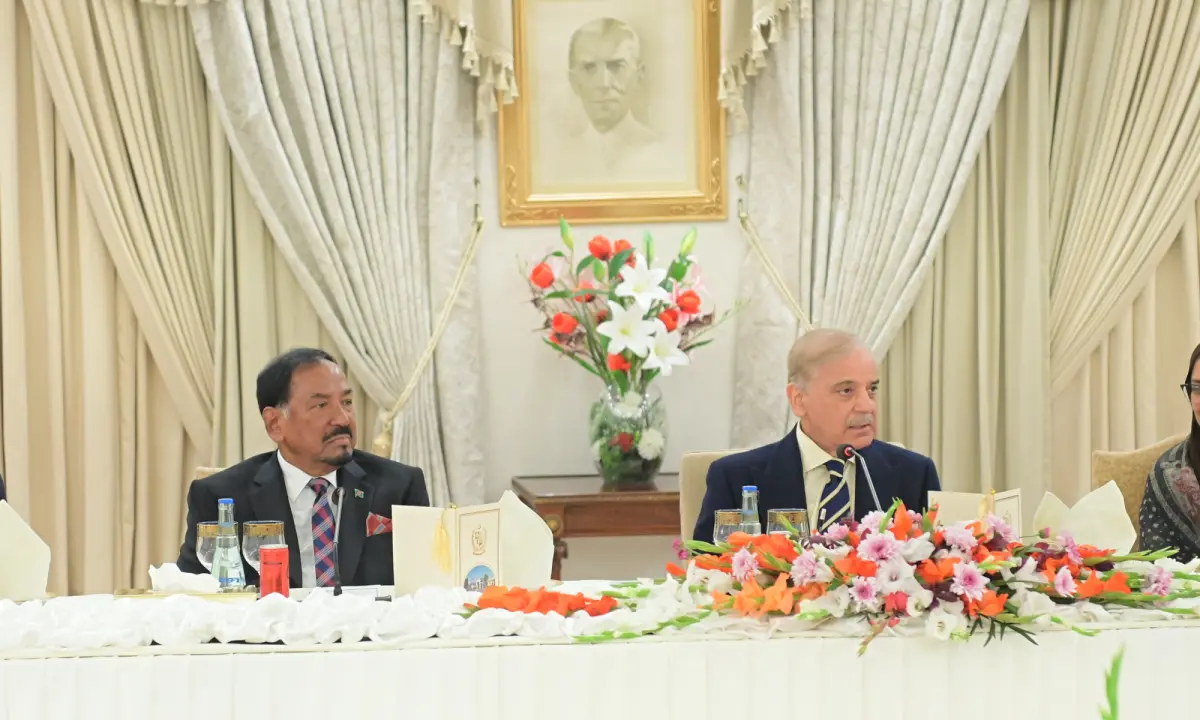
Later, PM Shehbaz hosted a dinner at the PM House in honour of the visiting speaker and members of the parliamentary delegation.
“Welcoming the speaker and his delegation, the prime minister said that Pakistan attaches great importance to its fraternal ties with Bangladesh,” PMO said.
Recalling the shared history and cultural affinities between the two countries, the premier underscored the importance of closer institutional cooperation and stronger people-to-people contacts.
The prime minister noted that the “extensive engagements of the visiting parliamentary delegation in Pakistan indicate a huge scope of collaboration in parliamentary domain”, PMO said.
He emphasised that regular parliamentary exchanges would provide a robust foundation for closer bilateral cooperation across various avenues of mutual interest.
PMO also shared pictures of PM Shehbaz individually meeting the members of the visiting delegation.
‘Pakistan ready to extend defence cooperation with Bangladesh’
During his meeting with the visiting delegation, President Zardari emphasised the need to strengthen Pakistan-Bangladesh relations through expanded parliamentary exchanges, trade and economic cooperation, educational links and people-to-people contacts, calling for a “forward-looking approach based on sovereign equality, mutual respect and mutual benefit”.
He noted the “renewed momentum in bilateral relations, particularly in high-level exchanges, education, trade, culture and people-to-people contacts”, the Presidency said.
The president expressed hope for the early finalisation of around 26 memorandums of understanding (MoUs) “under consideration, which would provide an institutional framework for expanding bilateral cooperation”.
He “reaffirmed Pakistan’s readiness to extend defence cooperation with Bangladesh”, also highlighting the “considerable potential” for cooperation in agriculture, industry, food security, disaster management, digital governance and space research.
On connectivity, President Zardari welcomed the commencement in January of direct flights by Biman Bangladesh Airlines and emphasised the need to increase flight frequency and destinations in view of growing demand. He also called for exploring direct maritime links to facilitate trade and economic cooperation.
Discussing trade and economic relations, the president noted that bilateral trade remained below its potential.
Therefore, he called for effectively utilising existing mechanisms, including the Joint Economic Commission (JEC) and the Joint Working Group on Trade, to explore preferential trade arrangements and advance the priority areas identified during the JEC session held in October last year.
President Zardari noted that ongoing exports of Pakistani rice under the government-to-government agreement could serve as a basis for broader cooperation on food security and the supply of essential commodities.
“Pakistan, in line with Bangladesh’s request, is also ready to provide technical expertise for the refurbishment of sugar plants in Bangladesh,” the Presidency statement read.
President Zardari encouraged greater private-sector engagement across a range of sectors, including textiles, pharmaceuticals, leather, automobiles, construction materials, minerals, chemicals, ceramics and jute.
He offered Pakistan’s assistance in facilitating training for Bangladeshi parliamentary officials at the Pakistan Institute for Parliamentary Services (PIPS) and sharing its institutional expertise in operating a bicameral legislature.
The president expressed Islamabad’s desire to further strengthen parliamentary cooperation with Dhaka, as well as highlighted bilateral cooperation in the education and media sectors.
President Zardari welcomed progress under the China-Bangladesh-Pakistan Trilateral Mechanism, particularly the identification of 12 priority areas of cooperation during the Kunming meeting on June 19, 2025, the statement said.
He appreciated Bangladesh’s humanitarian gesture of hosting over one million Rohingya refugees, reaffirmed Pakistan’s support for their safe, voluntary and dignified return to Myanmar in accordance with international law, and called upon the international community to ensure sustained humanitarian assistance.
The president expressed confidence that Ahmad’s visit would help advance bilateral relations and pave the way for more high-level exchanges between the two countries.
Meanwhile, Ahmad thanked the president for the warm welcome and hospitality extended to him and his delegation, according to the President House.
The speaker conveyed the greetings of Bangladesh President Mirza Fakhrul Islam Alamgir and Prime Minister Tarique Rahman.
The statement stated: “Recalling his personal memories of Pakistan, he underscored the importance of parliamentary diplomacy and expressed his desire to promote closer engagement between the two Parliaments through exchanges and regular institutional interaction.
“He also noted the popularity of Pakistani television dramas in Bangladesh, reflecting the cultural affinity between the peoples of the two countries.”
Relations between Islamabad and Dhaka have improved since the ouster of former Bangladeshi premier Sheikh Hasina, during whose tenure ties between the two countries remained shaky.
In February, Planning Minister Ahsan Iqbal attended the oath-taking ceremony of PM Rahman of the Bangladesh Nationalist Party (BNP).
Sadiq travelled to Dhaka in December 2025 for the funeral of the country’s first female prime minister Khaleda Zia. In August that year, Deputy Prime Minister and Foreign Minister Ishaq Dar had also visited Dhaka and met Yunus.
ISLAMABAD: The National Emergency Operations Centre for Polio Eradication (NEOC) has confirmed the country’s 10th paralytic polio case of the year, with the latest infection from Karak district in Khyber Pakhtunkhwa.
According to an official of the polio programme, the affected child is a 14-month-old girl from the district’s Shnawa Gudi Khel union council.
The case is the first reported from Karak in six years, and the eighth of the year from KP, according to NEOC.
“The case is genetically linked to poliovirus detected in southern KP, where poliovirus circulation has remained intense this year despite an overall transmission reduction in the country,” the official said.
The centre underscored the urgency of consistent vaccination across the country to keep all children protected from lifelong paralysis.
According to the official, Bannu district — which borders Karak — has reported wild poliovirus type 1 (WPV1) in sewage samples for the past eight months, which means that continued virus circulation remains a major risk to children’s wellbeing.
The country’s ninth polio case of the year was reported earlier this month, in KP’s Khyber district. Of the 10 cases reported this year, eight have been reported from KP and two from Sindh.
Pakistan is one of the last two countries in the world, alongside Afghanistan, where polio remains endemic.
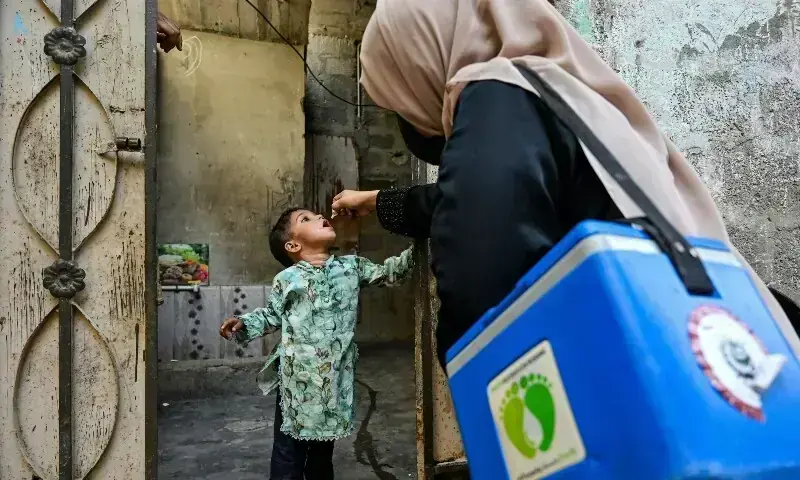
Polio has no cure and can cause lifelong paralysis or even death. It is therefore essential that every child under five receives two drops of the oral polio vaccine during each vaccination campaign.
The vaccine is prequalified by the World Health Organisation (WHO) and has been safely used in 195 countries, including all Muslim-majority countries.
With the help of the vaccine and the efforts of hundreds of thousands of polio workers, Pakistan has reduced polio cases by 99.8pc since the launch of its national eradication programme in 1994. The number of cases has fallen from an estimated 20,000 to 31 in 2025.
The third sub-national polio vaccination campaign of 2026, targeting 97 high-risk districts across the country, was launched in October by the Pakistan Polio Eradication Initiative (PEI). The drive was part of intensified efforts to stop poliovirus transmission and protect children from lifelong paralysis.