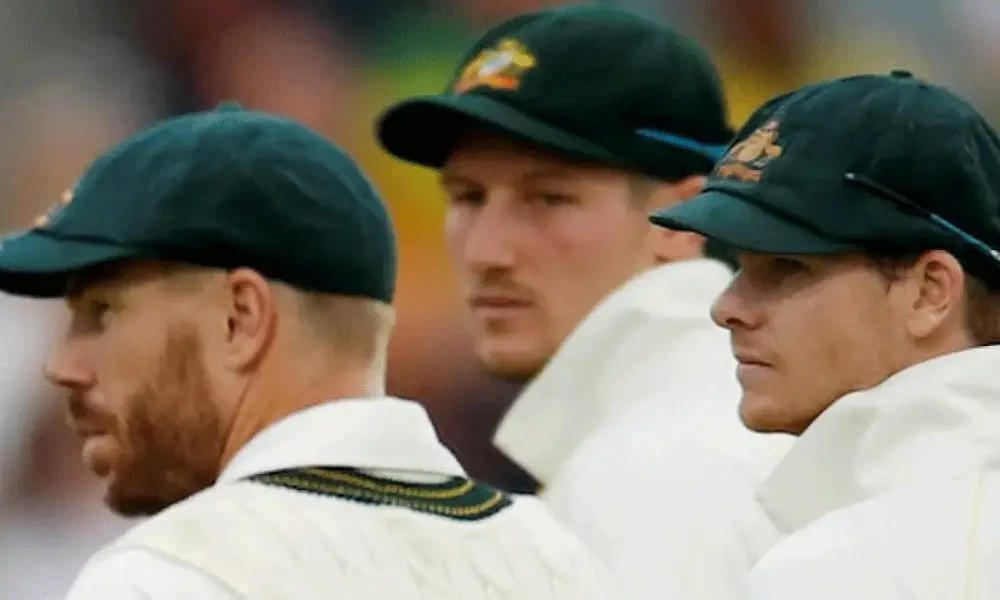
MELBOURNE: Cricket Australia’s (CA) forum into the ball-tampering scandal of 2018 will not determine responsibility or make adverse findings against any individual, according to its terms of reference published on Friday.
The scandal was reignited this month after former Australia batter Usman Khawaja said the whole team had known about the ball-tampering plot during the tour of South Africa, not just the three players found culpable by CA’s integrity unit.
CA announced on November 18 it would open an independent forum for all the players and staff to give their accounts of what happened in 2018 without fear of sanction.
The six-week forum, to be overseen by Australian barrister Fiona McLeod, will be an “information-gathering and listening process”, rather than a disciplinary process, its terms of reference said.
It will not make “any adverse findings about, or determine the responsibility of, any individual”, nor revisit the sanctions previously imposed. There will be no recommendations for retrospective punishment or legal action and participation will be entirely voluntary.
“Its purpose is to support the welfare of those impacted and to provide Participants with an opportunity to be heard and to have their experience acknowledged and understood without fear of retribution or disadvantage,” the terms said.
CA’s investigation in 2018 found only three players culpable – former captain Steve Smith and opening batters David Warner and Cameron Bancroft.
Smith and Warner were banned for 12 months, with Bancroft suspended for nine.
Khawaja’s former teammates Warner, Bancroft and Chadd Sayers have supported his claims that the wider playing group and staff were aware of the ball-tampering.
However, captain Pat Cummins and bowlers Mitchell Starc and Josh Hazlewood have flatly denied any prior knowledge.
CA backed Cummins to remain captain of the test and one-day international sides last week and rejected any suggestion his integrity had been compromised amid the renewed furore.
The scope of CA’s forum will include “ball-management practices” by the men’s team during all four tests of the South Africa tour and not just the Newlands test where Australia’s ball-tampering was exposed.
It will also include the conduct and scope of CA’s investigation in 2018.
CA said a report into the forum would be published in full and it would respond within 30 days.
“This forum is the best opportunity for people to speak and be heard, and for CA to listen and learn,” CA chairman David Boon said in a statement.
Akash Deep struck twice either side of an Anshul Kamboj wicket as India fought back in the second session of the second Test to leave New Zealand 131 for four at tea on day one in Christchurch on Friday.
India took three wickets in the session at Hagley Oval after New Zealand resumed on 77 for one after lunch, having been put in to bat by India captain Shubman Gill.
New Zealand number five Daryl Mitchell was six not out, with wicketkeeper Tom Blundell on eight at the break.
Home captain Tom Latham shrugged off poor form with the bat to score 59 before Deep had the opener caught behind early in the second session.
New Zealand number three Henry Nicholls was caught for 16 at deep backward square leg in a soft dismissal in the next over, having attempted to slog Kamboj.
Deep returned to have Rachin Ravindra caught behind for a duck as New Zealand lost three wickets for no runs.
New Zealand’s opening partnership survived until the last ball of the first session when Devon Conway fell lbw for 31, becoming debutant paceman Gurnoor Brar’s first Test wicket.
WELLINGTON: New Zealand’s ruling centre-right coalition has narrowly missed winning a parliamentary majority, final election results showed on Friday, leaving Prime Minister Christopher Luxon needing the support of the centrist Opportunity Party to remain in power.
If Luxon cannot reach either a coalition or confidence-and-supply deal, and any negotiations between other parties fail to produce a majority government, New Zealand will have to hold fresh elections.
Electoral Commission results showed the coalition with 65 seats, one seat short of a majority in the 130-seat parliament.
“New Zealanders need a government that is stable, that works together and will last for the full term,” Luxon told a news conference.
“Kiwis won’t thank us for rushing to an agreement that falls apart or for sending them back to the polls.”
Luxon’s centre-right National Party secured 40 seats in the November 7 election, and its junior coalition partners ACT and New Zealand First won 13 seats and 12 seats, respectively.
Labour, the largest opposition party, won 36 seats.
New entrant to parliament Opportunity won seven seats, and its leader Qiulae Wong said on Friday she would negotiate with National as the party with the largest number of seats.
“I don’t think anybody can rule anything out at this stage because we haven’t had any discussions,” Wong told a press conference, adding all options were on the table including being on the crossbenches.
“We are going to do everything we can to make sure that there is a stable government,” she said.
Opportunity’s platform includes stronger climate commitments, a ban on bottom-trawling fishing, tighter competition rules and a more interventionist approach to public investment, policies that cut against parts of the coalition’s agenda.
ACT Party leader David Seymour said government formation could happen “quite rapidly” if the parties involved worked together to come to an agreement.
“The government can be formed if the coalition is prepared to work with Opportunity at some level,” he said in an interview with 1News.
The results show a centre-left coalition of Labour, the Green Party and Te Pati Maori would not be able to form a government, even with the support of Opportunity.
However, if NZ First were to strike a deal with the centre-left parties — as it did with Labour after the 2017 election — they could form a coalition government.
The New Zealand dollar , which hit a 17-year low against the US dollar this week, strengthened slightly after the announcement of the election results.
Earlier this month, preliminary results from the Electoral Commission had shown the ruling coalition with a majority of two seats. The final tally includes special votes, which include those from people voting overseas or outside their electorate, and typically skew left.
The Electoral Commission said there were 2,931,604 votes cast, of which 484,865 were special votes.
SYDNEY: Australia on Friday placed counterterrorism financing sanctions on two people it said orchestrated antisemitic arson attacks in Sydney and Melbourne on behalf of Iran.
Zohair Hassib and Kazem Hamad used a “complex chain of proxies” to attack a kosher restaurant in Sydney and the Adass Israel Synagogue in Melbourne in 2024, Foreign Minister Penny Wong said in a statement.
In August 2025, Australia ordered Iran’s ambassador to leave the country, the first expulsion of its kind since World War Two. It also suspended operations at its Tehran embassy and listed the Islamic Revolutionary Guard Corps (IRGC) as a terrorist organisation.
Wong said the new counterterrorism financing sanctions would restrict the individuals’ access to funds and disrupt their ability to recruit, plan and conduct attacks.
“These sanctions are an important step in disrupting the IRGC’s ability to conduct attacks against Australians and Australian interests,” Wong said.
Gold prices rose on Friday, rebounding from a more than one-year low touched earlier this week, as a US holiday lull calmed AI-driven market jitters and eased selling pressure on bullion.
Spot gold climbed 1.6% to $3,622.91 per ounce by 0247 GMT after hitting its lowest level since September 2025 on Wednesday, following hot US inflation data that cemented interest-rate-hike bets.
Bullion was up about 2.7% so far this week.
US gold futures for December delivery gained 2.6% to $3,621.10.
“Although gold has attempted to stabilise following its recent losses, investors remain cautious. US holidays could limit selling pressure on gold as the selloff in technology stocks and the asset liquidations pause,” said Ross Maxwell, chief strategy officer, VT Markets.
“However, the timing of any recovery will depend heavily on the direction of real interest rates, the US dollar and investment flows.”
Asian shares were set to end a bruising month on a steadier note as a holiday lull offered some respite from AI jitters.
Wall Street was closed on Thursday for the Thanksgiving holiday.
The US economy grew much faster than initially expected in the third quarter, data showed on Wednesday, while inflation accelerated in October, reinforcing expectations that the Fed will raise interest rates next month and again in early 2027.
The US central bank raised rates for the first time in three years in September.
Higher interest rates increase the opportunity cost of holding non-yielding bullion.
Meanwhile, China’s net gold imports via Hong Kong in October rose 1.6% from the previous month, hitting their highest level since April, Hong Kong Census and Statistics Department data showed on Thursday.
Among other metals, spot silver climbed 4.6% to $43.40, platinum gained 2.6% to $1,323.78, and palladium rose 3.3% to $901.50. All three metals were on track for weekly gains.
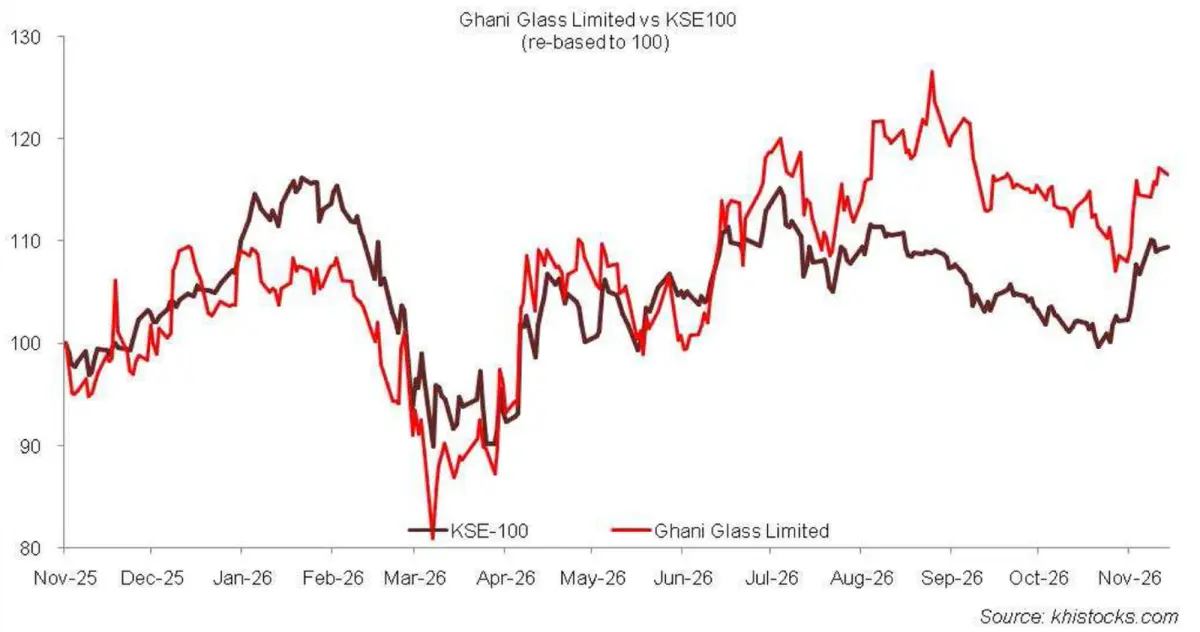
Ghani Glass Limited (PSX: GHGL) was incorporated in Pakistan as a limited liability company in 1992. GHGL is a company of Ghani Group which carries over 50 years of rich experience in the local and global markets.
The company’s principal business is the manufacturing and sale of glass containers, float glass and value-added glass. GHGL caters to the needs of diverse industries such as pharmaceutical, food and beverages, R&D and other value-added industries. Besides catering to the needs of local market, GHGL exports to over 26 countries globally.
Pattern of Shareholding
As of June 30, 2026, the company has a total of 999.715 million shares outstanding which are held by 4796 shareholders. Directors, CEO, their spouse and minor children have the majority stake of 49.27 percent in the company followed by local general public holding 40.45 percent shares.
Other companies account for 5.81 percent shares of GHGL while Modarabas & Mutual funds hold 2.038 percent shares.. The remaining shares are held by other categories of shareholders.
Historical Performance (2021-26)
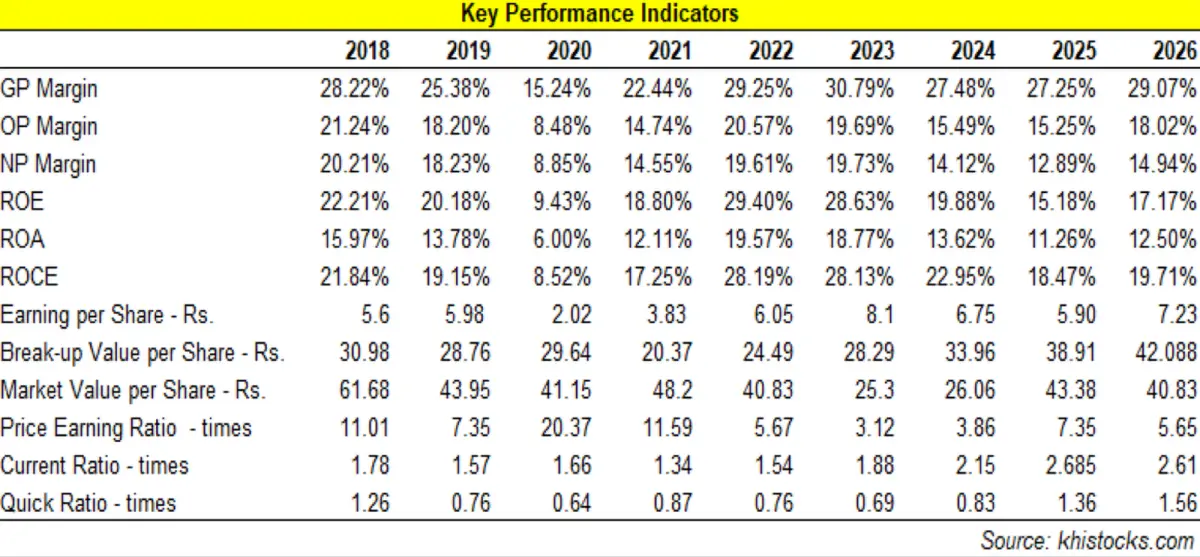
Over the period under consideration, GHGL’s topline posted a dip only in 2025. Conversely, its bottomline plunged in 2024 and 2025. GHGL’s margins significantly rebounded in 2021 and 2022. In the subsequent year, operating margin receded, while gross and net margins continued their uphill ride.
In 2024 and 2025, all the margins dropped followed by a recovery in 2026. The detailed performance review of the period under consideration is given below.
The two years after COVID-19 were characterized by robust growth momentum.
The topline magnified by 25.59 percent in 2021 to clock in at Rs. 21,470.56 million and 43.58 percent year-on-year in 2022 to clock in at Rs. 30,827.26 million with GP margin touching 22.44 percent and 29.25 percent respectively in 2021 and 2022. It is to be noted that the operating expense which slid in 2020 started popping up in 2021 and 2022 particularly on the back of freight and forwarding charges, payroll expense as well as sales promotion expense.
Other expense also grew on account of higher provisioning done for WWF and WPFF.
The company, however, made net exchange losses in both the years. Other income did exceptionally well in both 2021 and 2022 mainly on the back of profit on Islamic saving accounts and scrap sales.
While the company booked reversal on credit loss against trade debts in 2021, it again booked provision worth Rs. 96.53 million in 2022 which mainly accounted for expected credit loss charged on balance due from Ghani Value Glass limited, a related party of GHGL.
The share of profit from its associate company RAK Ghani also dropped in both the years. Finance cost of GHGL amplified in 2021 by over 300 percent year-on-year and then dropped by 13 percent year-on-year in 2022. The hefty increase in finance cost in 2021 was due to unwinding effect of GIDC payable to SNGPL.
The bottomline of GHCL grew by a stunning 106.53 percent and 93.44 percent year-on-year to clock in at Rs.3.12 billion and Rs.6.04 billion respectively in 2021 and 2022. EPS clocked in at Rs.3.83 in 2021 and Rs.6.05 in 2022. NP margin also staggeringly spiraled to clock in at 14.55 percent and 19.61 percent in 2021 and 2022 respectively.
In 2023, GHGL posted 33.12 percent year-on-year rise in its topline which clocked in at Rs.41,038.48 millon. This came on the back of both higher local and export sales recorded during the year.
During the year, the company faced various challenges owing to political and economic upheaval in the country. The devastating floods at the onset of the year added to ado, creating immense supply chain disruptions for the company as it mostly sources its raw materials locally.
GHGL passed on the impact of high indigenous inflation and high fuel and power charges on to its consumers, resulting in GP margin of 30.79 percent in 2023. In absolute terms, gross profit strengthened by 40.16 percent in 2023.
Administrative expense surged by 98.38 percent in 2023 due to expansion of GHGL’s workforce from 2480 employees in 2022 to 2962 employees in 2023 which drove up the payroll expense.
The company also engaged in bigger CSR initiatives and donated generously to Ghani Foundation Trust which also greatly contributed in driving up its administrative expense in 2023. Distribution expense magnified by 63.44 percent in 2023 on the back of elevated freight & forwarding charges, payroll expense, commission expense as well as sales promotion charges incurred during the year.
The company made hefty exchange gain on its export sales in 2023 due to Pak Rupee depreciation. This resulted in 14.17 percent lower other expense recorded in 2023 despite higher profit related provisioning done during the year.
Lower scrap sales and profit on saving accounts culminated into 5.1 percent thinner other income recorded by the company in 2023. Operating profit multiplied by 27.4 percent in 2023, however, OP margin leveled down to 19.69 percent. Lower unwinding effect of GIDC resulted in 4.25 percent lower finance cost incurred by GHGL in 2023.
Furthermore, share of profit from an associated company, RAK Ghani Glass LLC magnified by 2758 percent in 2023. This resulted in 33.95 percent escalation in GHGL’s net profit which clocked in at Rs.8096.95 million in 2023 with EPS of Rs.8.1 and NP margin of 19.73 percent.
In 2024, GHGL posted 16.45 percent year-on-year growth in its topline which clocked in at Rs.47,790.46 million. Due to lower demand and shut down of plant on account of scheduled repair & maintenance, the company’s production dropped by 10 percent in 2024 (see the graph of installed capacity versus actual production).
Cost of sales mounted by 22 percent in 2024 on the back of elevated cost of energy and other raw materials. Gross profit ticked up by 3.93 percent in 2024, however, GP margin ticked down to 27.48 percent. Administrative expense surged by 13.83 percent in 2024 due to higher payroll expense as well as hefty donations granted during the year.
Distribution expense surged by 23.22 percent in 2024 mainly due to higher freight & forwarding as well as travelling & conveyance charges incurred during the year. Other expense multiplied by 50.45 percent due to higher profit related provisioning and no exchange gain recorded during the year.
Other income also dipped by 42.91 percent in 2024 due to lower profit on saving accounts, lesser scrap sales and no reversal booked on provisioning done for obsolete stock-in-trade during the year. Operating profit eroded by 8.35 percent in 2024 with OP margin ticking down to 15.49 percent.
Finance cost surged by 75.63 percent in 2024 which mainly comprised of bank charges and exchange loss incurred during the year. Share of profit of an associate company, RAK Ghani Glass LLC, also surged by 62 percent in 2024.
Nevertheless, GHGL posted 16.63 percent year-on-year plunge in its bottomline which clocked in at Rs.6750.22 million in 2024. This translated into EPS of Rs.6.75 and NP margin of 14.12 percent.
In 2025, GHGL’s topline slid by 4.20 percent to clock in at Rs.45,783.04 million. The decline mainly came on the back of lower export sales. Cost of sales dropped by 3.89 percent in 2025.
Gross profit slumped by 5 percent in 2025 with GP margin slightly dropping to 27.25 percent. Lesser legal & professional charges, travelling & conveyance expense and utility charges resulted in 0.36 percent slide in distribution expense in 2025.
Conversely, administrative expense ticked up by 8.85 percent in 2025 due to inflationary pressure and workforce expansion from 2813 employees in 2024 to 2971 employees in 2025.
Lesser profit related provisioning was the reason behind 6.32 percent decline in other expense in 2025. Conversely, other income mounted by 31.21 percent in 2025 due to higher scrap sales and exchange gain.
As against the last three years where the company booked impairment on its financial assets, in 2025, it recorded reversal worth Rs.150.62 million. GHGL posted 5.74 percent erosion in its operating profit in 2025 with OP margin clocking in at 15.25 percent.
Finance cost shrank by 48 percent in 2025, however, it largely comprised of bank charges. Share of profit of an associate company, RAK Ghani Glass LLC dwindled by 34.40 percent in 2025. GHGL’s net profit shrank by 12.56 percent to clock in at Rs.5902.28 million in 2025. This translated into EPS of Rs.5.90 and NP margin of 12.89 percent in 2025.
After registering a plunge in its topline and bottomline in 2025, GHGL posted 5.62 percent uptick in its net sales in 2026 which clocked in at Rs.48,355.11 million. Topline growth was supported by robust local sales in 2026. Conversely, export sales drastically fell during the year.
Superior local sales and efficient sales mix resulted in 12.71 percent growth in gross profit in 2026. GP margin jumped up to 29 percent in 2026. Administrative expense multiplied by 10.12 percent in 2026 due to higher payroll expense as the company expanded its workforce from 2971 employees in 2025 to 3020 employees in 2026.
Radical contraction in export sales squeezed distribution expense by 15.58 percent in 2026. Other expense surged by 40 percent in 2026 due to increased profit related provisioning and exchange loss. Reversal of impairment booked on financial assets grew by 38.93 percent in 2026. Other income also strengthened by 36.65 percent in 2026 due to massive increase in profit on saving accounts.
GHGL posted 24.87 percent stronger operating profit in 2026 with OP margin rising to 18 percent. Finance cost tumbled by 67.81 percent in 2026 due to lower lease liabilities and thinner bank charges. Share of profit of associated company, RAK Ghani Glass LLC (a limited liability company registered with the Ras Al Khaimah Investment Authority in the UAE) also shrank by 17.29 percent in 2026. Net profit improved by 22.43 percent to clock in at Rs.7226.12 million in 2026. This translated into EPS of Rs.7.23 and NP margin of 14.94 percent in 2026.
Recent Performance (1QFY27)
During the first quarter of FY27, GHGL’s net sales ticked up by 2.32 percent to clock in at Rs.10,224.283 million. Gross profit strengthened by 49.49 percent during the period under review with GP margin clocking in at 30.87 percent versus 21.13 percent in 1QFY26. This speaks volumes of the improvement in the company’s cost structure and product economics. With lean demand from its major export markets, the company has been lately focusing on expanding its wings in the local market.
Administrative and distribution expense surged by 17.97 percent and 16 percent respectively during the period under review due to inflationary pressure, higher fuel charges and greater market penetration. Increased provisioning done for WWF and WPPF appears to have pushed up other expense by 62.63 percent in 1QFY27.
Conversely, other income dipped by 20.91 percent in 1QFY27 apparently due to lesser dividend income and thinner profit on bank deposits.
Operating profit multiplied by 82.70 percent in 1QFY27 with OP margin clocking in at 16.90 percent versus 9.47 percent in 1QFY26. Finance cost dwindled by 51.59 percent in 1QFY27 due to lesser outstanding liabilities. Share of profit of associate also weakened by 33.59 percent in 1QFY27.
GHGL posted net profit of Rs.1109.514 million in 1QFY27, up 57 percent year-on-year. This translated into EPS of Rs.1.11 and NP margin of 10.85 percent in 1QFY27 versus EPS of Rs.0.71 and NP margin of 7.10 percent recorded in 1QFY26.
Future Outlook
The company is striving to achieve operational efficiency in order to reduce its cost and improve its margins and profitability. In this quest, GHGL has already upgraded its furnace to attain narrow neck press and blow (NNPB) production of glass bottles in the future. This will not only lead to increased production speed, lesser energy utilization, lesser raw material and other cost per unit but will greatly add value to its customers by improving the quality of products.
Besides, the company has also installed state-of-the-art machinery to enhance its effectiveness of its production processes and to provide added value to its customers.
On the flipside, the ongoing war in the Middle East has severely affected the glass industry by inflating the fuel cost. Since, glass industry heavily relies on energy intensive processes; it is facing acute cost pressure.
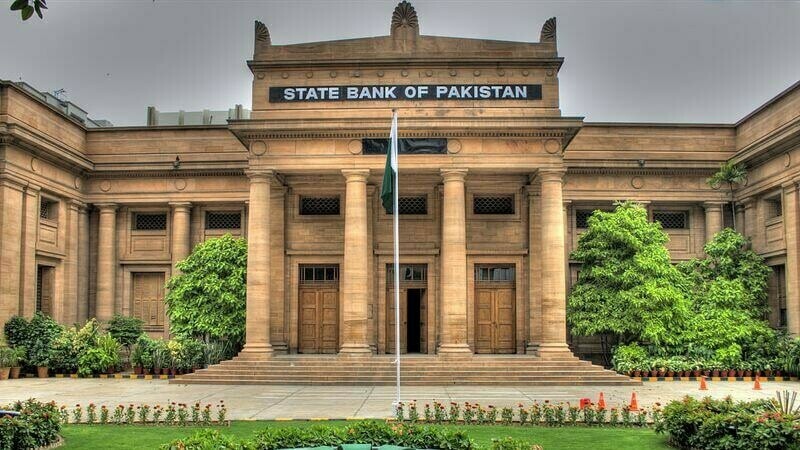
Pakistan may be deindustrialising before it has properly industrialised. The State Bank of Pakistan (SBP), in its annual report for FY26, raises an important concern about the direction in which the country’s economy is heading.
The space has highlighted many times that manufacturing has largely stagnated. At the same time, it can be seen that the reliance on services is increasing, which could be partly because of struggling manufacturing. The concern that the central bank highlights is that the transition is happening at a relatively low level of income and productivity, and at a time when the country needs jobs more than ever.
Historically, it is seen that developing economies have moved from agriculture to manufacturing and eventually towards services as their incomes and productivity have risen. Manufacturing has played a central role in this transition, particularly in East Asian economies, by absorbing surplus agricultural labour, generating exports, attracting investment, and facilitating technological advancement. Pakistan, however, appears to have largely bypassed this phase.
According to the SBP, manufacturing’s share in GDP has declined over the past three decades, while labour has gradually moved from agriculture towards services. However, this movement has largely been towards activities such as wholesale and retail trade, transport, construction, and real estate. These sectors provide employment but have limited scope of productive gains compared to manufacturing and modern tradable services.
There is nothing inherently wrong with an economy becoming more services oriented. The problem lies in the kind of services that are expanding. Pakistan’s better performance in the services sector is driven by real estate. As a result, structural weakness are increasingly visible in the labour market.
The country’s relationship between economic growth and employment generation has weakened considerably over time. SBP estimates Pakistan’s employment elasticity at just 0.11 during 2000–2025, compared to earlier estimates of 0.2 during 2000–2018 and 0.6 during 1972–1978. In simple terms, economic growth is generating proportionately fewer jobs.
Employment elasticity has also declined in countries such as China and Vietnam. However, in these economies, the decline has been associated with technological advancement, greater capital investment, and rising labour productivity.
The country’s export performance tells a similar story. As per SBP’s report, Pakistan’s exports as a percentage of GDP declined from an average of 16.3 percent during the 1990s to 9.5 percent during 2016–2025. Over the same periods, the average for lower-middle-income countries increased from 16.6 percent to 21 percent. Pakistan has become less export-oriented while many of its peers have become more integrated into the global economy.The export basket, too, has changed little. Pakistan remains heavily dependent on textiles and agricultural products, with limited diversification into more sophisticated goods. Weak integration into global value chains has further restricted opportunities for technological upgrading, knowledge transfer, and better-paying jobs.
Why has Pakistan struggled to industrialise? Frequent policy changes, an uneven tax system, poor infrastructure, limited investment in technology and skills, and repeated economic crises have made industries less competitive. Businesses have often found it more profitable to serve protected domestic markets or invest in sectors like real estate than to manufacture goods for export.
Can the growing IT sector fill this gap? While the growth of Pakistan’s IT sector is encouraging, its ability to generate employment on a large scale remains limited. As the central bank points out, high-productivity services such as IT and finance primarily employ skilled workers and cannot absorb the country’s large pool of low-skilled labour. Manufacturing, therefore, remains important for job creation.
And the window for traditional industrialisation may also be narrowing. With automation and AI, cheap labour is no longer enough to attract industrial investment. Skills, technology, and better infrastructure matter increasingly more.
Pakistan may not be able to follow the same path as East Asian economies, but manufacturing remains important for exports and job creation. While the recent recovery in large-scale manufacturing is encouraging, a few quarters of growth do not necessarily mean that the industry is back on its feet. Therefore, the debate needs to move beyond macroeconomic stability and GDP growth: Where that growth is coming from and whether it is creating productive jobs and raising incomes.
LAHORE: The Punjab Revenue Authority (PRA) has stepped up its enforcement drive against business establishments that have failed to install or properly use the Electronic Invoice Monitoring System (e-IMS).
Special monitoring operations are under way across the Lahore, Gujranwala, Sargodha, Rawalpindi and Multan divisions. During these checks, enforcement officers issued show-cause notices to more than 65 business operators for violating e-IMS requirements.
A PRA spokesperson said legal action will be taken against businesses found manipulating sales records, issuing fake receipts or attempting to evade taxes. Operators have also been directed to provide computerised receipts to customers and to maintain accurate, transparent tax records. Those who fail to install the system will face heavy penalties under the applicable laws.
The spokesperson added that the digital monitoring system is designed to curb tax evasion and bring greater transparency to revenue collection. The authority has urged all business operators to comply with tax laws and ensure e-IMS is properly installed and used.
Consumers can also play a role: QR codes printed on computerised receipts allow customers to verify the tax charged on their bills in real time.
KARACHI: Pakistan Customs’ Marine Enforcement Unit in Gwadar has seized a boat carrying 40,000 liters of smuggled high-speed diesel off the Balochistan coast. Customs valued the seizure, along with the boat, at around Rs40 million.
Officials said the unit acted on intelligence about fuel being smuggled by sea. It tracked and pursued the vessel for more than 72 hours through rough sea conditions before intercepting it.
The boat, identified as Al-Behar-e-Amber, was taken into custody along with its cargo. Customs said legal proceedings had been initiated against those involved under the relevant laws. The department did not disclose how many people had been arrested or where the fuel came from.
Officials said the seizure was part of ongoing anti-smuggling operations by the Marine Enforcement Units at Gwadar and Gadani to curb the illegal trade in petroleum products along the coast.
ISLAMABAD: The District and Sessions Court on Thursday reserved its verdict on an appeal challenging the decision of the judicial magistrate in a case registered against the wife of a senior Federal Investigation Agency (FIA) officer and another person in connection with the death of a 13-year-old domestic worker under mysterious circumstances at her residence.
Additional District and Session Judge Raja Asif reserved its judgment after hearing arguments on a petition filed by defence counsel challenging the order of Judicial Magistrate Naima Iffat in a case registered against accused Afshan, wife of FIA Director, and Qari Ali Raza, in connection with the death of domestic worker Fatima Asghar, who died due to alleged physical torture.
Defence counsel Akmal Khan alleged that in this case the Judicial Magistrate had become an Investigating Officer (IO). He also alleged contradictions in the Judicial Magistrate’s decision.
He said that the defence has two major objections in the appeal. Our first objection is that our evidence was not brought on record and second, that the Judicial Magistrate exceeded her jurisdiction.
The defence counsel further maintained that the magistrate had directed the application of provisions of the Child Labour Act and other relevant laws, despite the fact that the deceased girl was the niece of an FIA officer and the case did not fall under the category of child labour.
He also alleged that the police were repeatedly approaching the court for orders because they had failed to obtain statements according to their wishes.
Special Prosecutor Wajid Munir objected to the application, pleading with the court to reject the plea. He said that this is a case of the torture and killing of an 11-year-and-11-month-old girl. Munir said that the judicial magistrate acted in a supervisory capacity and that the area magistrate had issued the order strictly within her legal authority.
He further maintained that the police investigation was progressing in the right direction. The court, after hearing arguments from both sides, reserved its verdict.
According to the written order of the Judicial Magistrate, the FIR stated that the complainant, the child’s father, handed her over to the accused family three years ago for education; the record lacked material to verify this claim. The record shows that the case is registered under Section 302 PPC. The medical evidence prima facie indicates that the deceased sustained multiple injuries and died allegedly as a consequence of physical torture, it says.
The order says that the investigating officer revealed that the husband of the female accused and the child’s father are maternal cousins, and that the child had been living in the household for three years, playing with the other children and performing tasks for the accused female.
It says that the court directed the IO to determine the exact age of the deceased at the time she was handed over to the accused.
The court also ordered the IO to verify the alleged relationship between the complainant and the accused family, and to ascertain whether any actual arrangement regarding her education, maintenance, or welfare was made.
Furthermore, the court directed an inquiry into whether the child was engaged in domestic work or employed in any capacity, including any child labour or exploitation. The IO must determine whether the father received any financial consideration or benefit, and whether he knowingly permitted her engagement in domestic work, with his potential involvement under Section 328-A PPC to be examined, it observed.
The court explicitly directed the IO to consider the applicability of Sections 328 and 328-A of the Pakistan Penal Code, along with Section 3 of the Islamabad Capital Territory Domestic Workers Act, 2022.