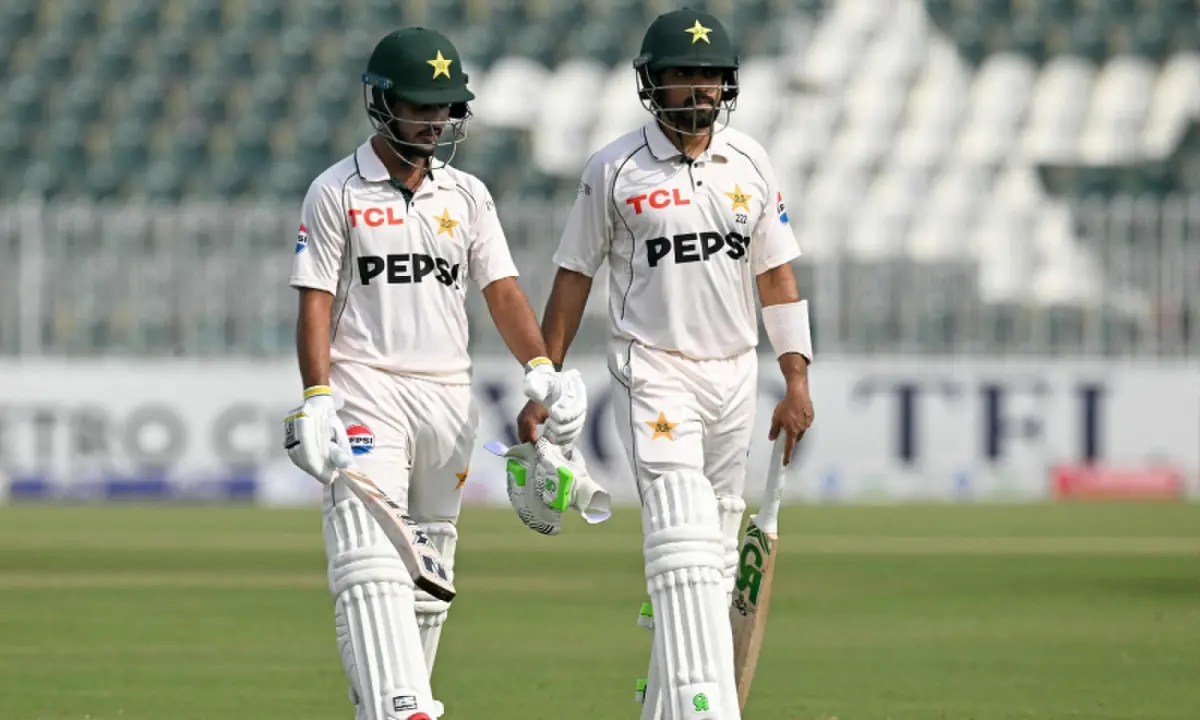
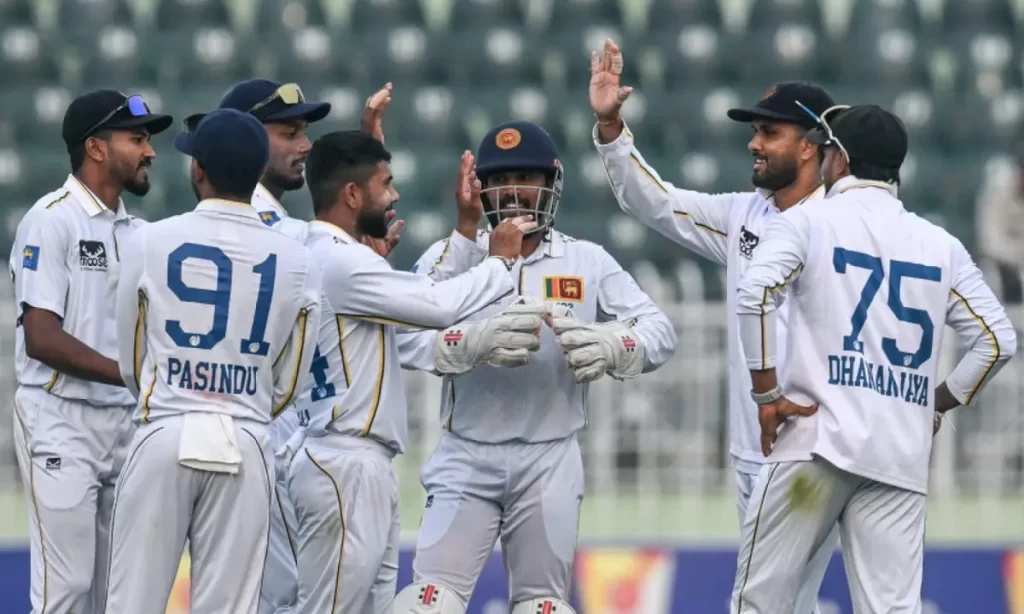
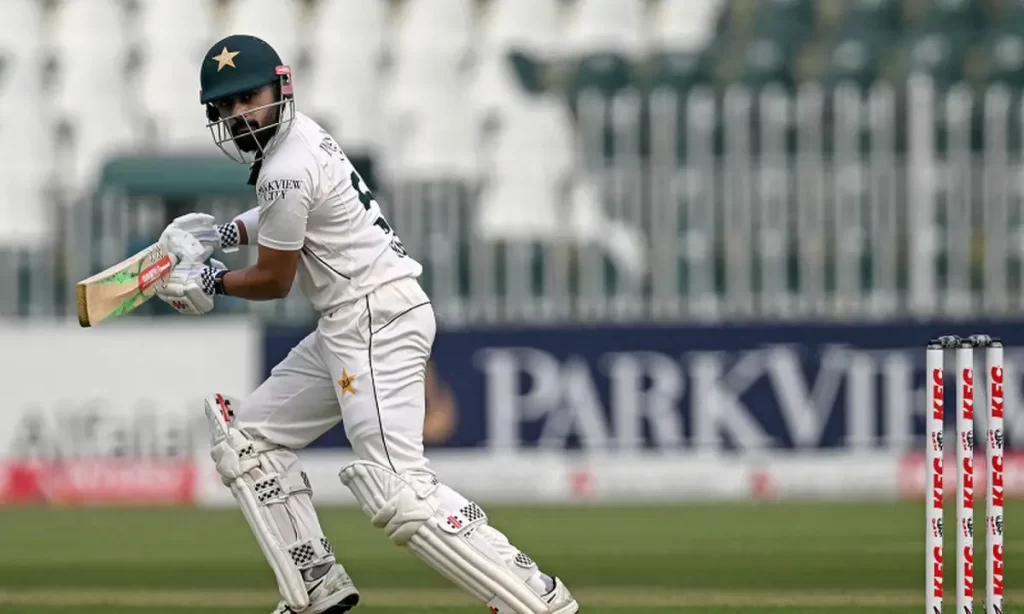
Captain Babar Azam and two debutants were among four batters to hit half-centuries as Pakistan reached 281-5 on day one of the first Test against Sri Lanka on Monday.
Opener Tayyab Arif scored an impressive 57 and Mohammad Taha a patient 51 — both playing their first Test — while Azam hit 50, with Sri Lanka’s decision to bowl on what appeared to be a green pitch in Rawalpindi seemed to backfire.
Saud Shakeel was unbeaten on 57 when bad light stopped play 15 minutes before schedule, with Ghazi Ghori seven not out.
Sri Lanka’s decision to go with a pace quartet and without a frontline spinner could also prove costly, with the pitch not offering much to the fast bowlers.
Asitha Fernando was the pick of bowlers with 2-64.
Azam looked in good touch but still failed to score an elusive century, and was dismissed by Dilshan Madushanka after the lunch break.
He hit seven fours in his 58-ball innings.
Azam has now gone 41 innings without a Test century, his last coming against New Zealand in Karachi in December 2022.
Salman Agha made 16 before giving Sri Lankan wicketkeeper Kusal Mendis his fourth catch of the innings.
Arif said Pakistan has done well under the conditions.
“We have played good and positive cricket considering the conditions,” said Arif.
“I have played a lot with some of these players so I was supported well and I am happy on scoring a half century.”
Arif put on a confident 86-run opening stand with Azan Awais (30) as Sri Lanka’s pace bowlers struggled to break through.
The 20-year-old, playing his maiden first-class season, cracked nine boundaries and a six in his impressive 51-ball knock.
Sri Lanka had to wait until the 16th over for a breakthrough, when Milan Rathnayaka had Awais caught behind by Mendis.
Fernando found an edge off Arif’s bat to Mendis, making it 90-2.
Sri Lankan bowling coach Ryan van Niekerk wasn’t happy.
“Probably not satisfied as bowling first and with the seamers we have we should have taken a couple of more wickets,” said Niekerk.
“But bowlers pulling it back in the last session was good.”
All-rounder Arafat Minhas and pace bowler Saqib Khan are also making Test debuts for Pakistan.
The second and final Test is in Lahore from November 17.
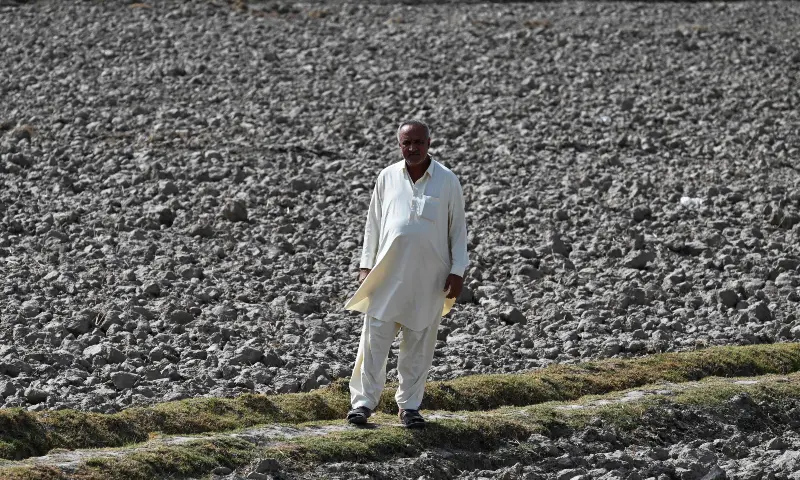
In a village nestled in rice fields, Abdul Hafeez Khoso remembers the vast industrial zones he saw in Germany when he visited to file a pioneering climate legal case.
“They’re spreading pollution: up in the sky there are no borders, it can affect anywhere,” the 43-year-old said, describing areas far larger than his village of 800 people.
“This is a problem for the whole world — that is why it should be resolved at the global level.”
Khoso and 38 other farmers from Sindh who were devastated by “apocalyptic” flooding in 2022 are suing German energy firm RWE and cement maker Heidelberg Materials in a rare bid to make big polluters pay damages for climate impacts.
The companies are being targeted not over specific operations in Pakistan, but because of their climate-warming emissions. They are headquartered in Germany, where a recent legal case opened the door to such suits.
The litigation argues that the companies’ emissions contributed to climate change and turbo-charged rain that wiped out their crops, livestock and homes.
“The year 2022 was an apocalyptic scene — not even our elders had ever witnessed such weather,” Khoso, who lives in the district of Jacobabad with his wife and toddler, told AFP.
“We had nothing left.”
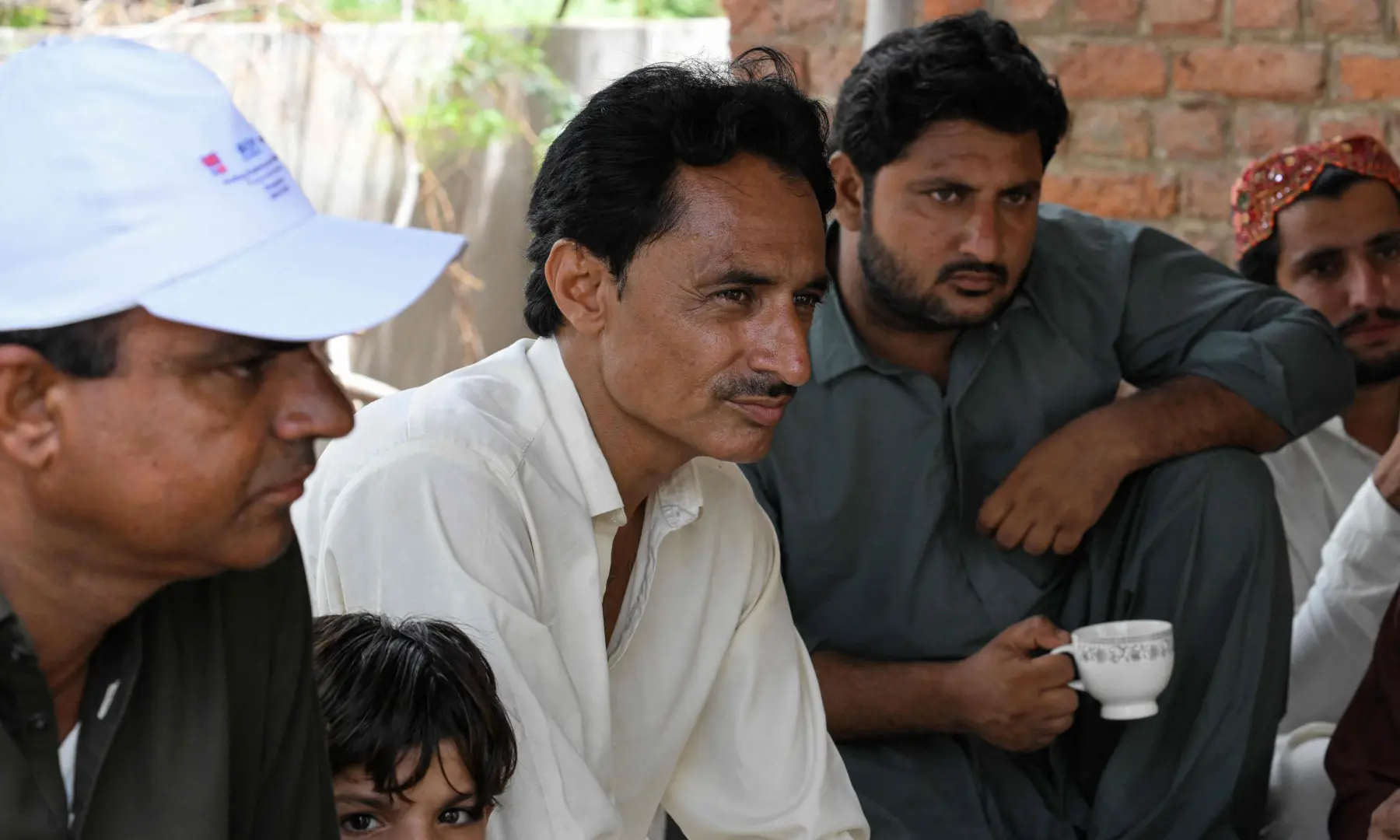
This photograph taken on July 29, 2026 shows Abdul Hafeez Khoso (C), one of the 39 farmers pursuing a climate lawsuit in Heidelberg for climate-warming emissions and over losses incurred during the 2022 floods, speaking with villagers at Jacobabad in Sindh. — AFP
Both firms, which the plaintiffs estimate contributed 0.68 per cent and 0.12pc to global industrial emissions respectively, deny wrongdoing.
Khoso’s case is backed by Pakistani and European organisations hoping to win compensation and build on nascent but vigorous international efforts to extract climate damages from corporations.
“We always blame natural disasters, and sometimes we blame God, but science tells us that climate change is increasing the risks and intensity of extreme weather events,” said Mir Keerio, a development expert at HANDS Welfare Foundation, which mobilised communities for the lawsuit.
“Those who have contributed significantly to this crisis must be held accountable … we realised we must take our fight for climate justice to the major polluters.”
Debt and damages
Climate litigation is a growing field globally, but action has so far largely targeted governments, with only a handful of firms such as Shell and cement maker Holcim facing suits for climate disaster compensations.
Lawyers say a ruling requiring a company to pay out compensation proportionate to its greenhouse gas emissions would mark a major breakthrough.
Germany’s judiciary moved towards that principle last year in a case brought by a Peruvian farmer, also against RWE.
His compensation claim was rejected, but the courts left the door open to holding emitters liable.
Roda Verheyen, a German lawyer involved in both cases, told AFP the farmers’ lawsuit builds on that ruling and further accuses companies of “wrongful behaviour”.
“Large companies knew about the general impacts of climate change since the 1960s,” said Verheyen.
“They should have exercised due diligence and actually at least tried to reduce emissions, which they didn’t do enough.”
The lawsuit also draws on research documenting farmers’ losses in the floods, which hit a third of the country, killed 1,700 and affected 30 million.
Munawar Khatoon, a rare female landowner in a conservative area, said the floods struck just before the wheat harvest, submerging seeds and wiping out her family’s main source of income.
“We worry about how the next generation will manage to live if this continues,” the 43-year-old told AFP in her village Usman Samtio. “Now when the rainy season comes, we feel fear.”
In nearby Dadu district, litigant Abdul Khalique Laghari said the floods affected the region for years.
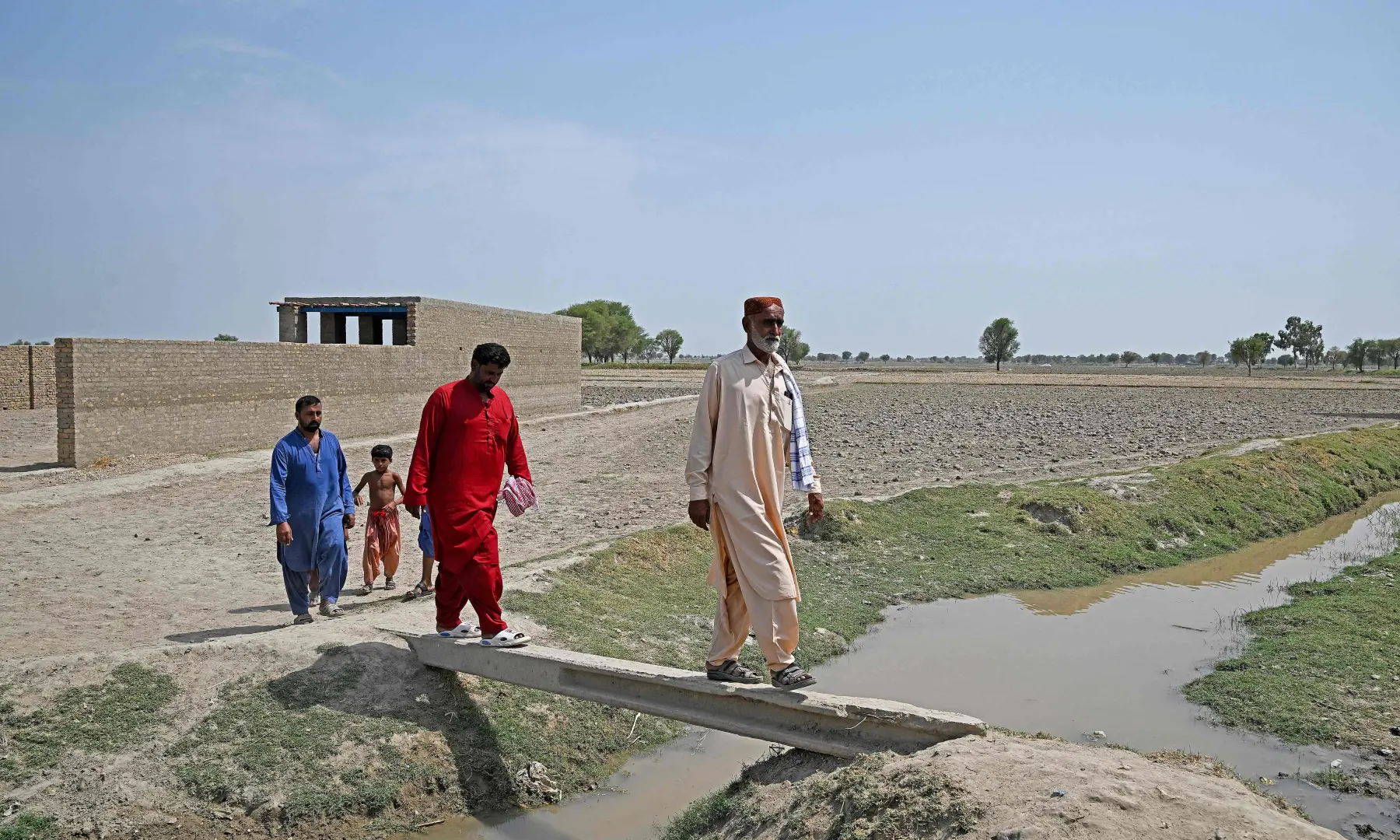
This photograph taken on July 27, 2026 shows Abdul Khalique Laghari (R), one of the 39 farmers pursuing a climate lawsuit in Heidelberg for climate-warming emissions and over losses incurred during the 2022 floods, walking across his agricultural field at Baid Sharif village in Dadu district. — AFP
“To this day, we are unable to repay our debt,” said the 55-year-old, who estimates he lost $14,000 in assets including his house, 40 acres (16 hectares) of crops and livestock.
“When we wake in the morning, we start getting calls from the people we owe money to,” he said, pointing to crumbling walls and the remnants of flood-damaged houses.
“This has caused us serious mental harm.”
‘For justice’
RWE and Heidelberg Materials both call the claims in the suit “unfounded”.
Heidelberg Materials told AFP its operations were compliant with German laws and that firms could not be expected to retroactively face different standards.
RWE referred AFP to a statement describing the lawsuit as “yet another attempt to shift climate policy demands to German courtrooms”.
“It would be a contradiction in terms if the state allowed CO2 emissions, regulated them by law and even demanded them in some cases, but at the same time allowed retroactive civil liability for them,” it said.
Even if the case succeeds, an uphill battle remains for millions across Pakistan, ranked among the countries most affected by climate change despite contributing less than one per cent of global emissions.
The case will be considered in a civil process likely to take years. But for the litigants, the attempt is worth it.
“This case is for justice,” said Khatoon. “We hold these companies responsible for our destruction.”
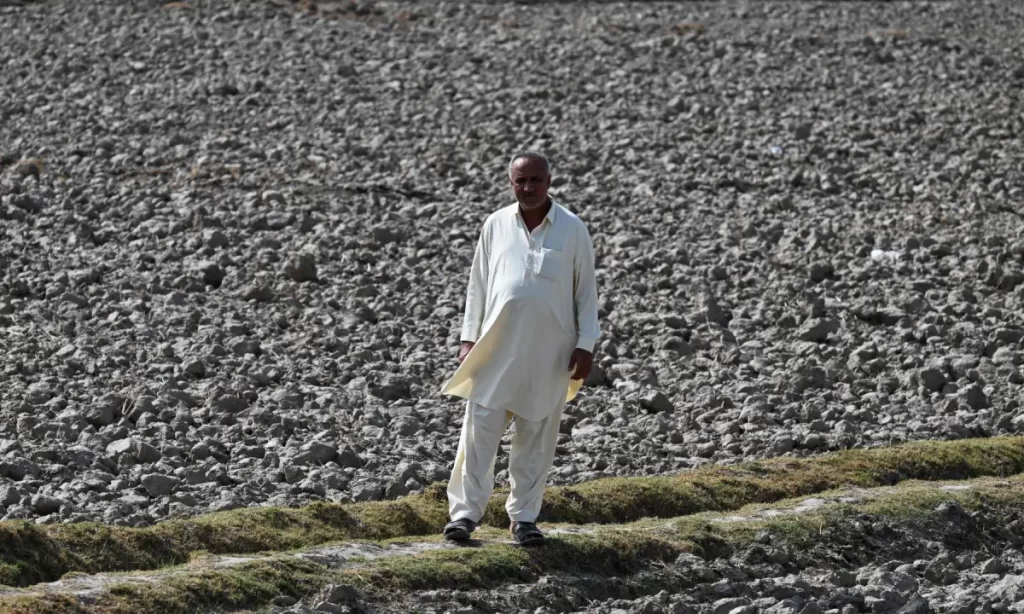
Header image: This photograph taken on July 27, 2026 shows Gul Hassan Babar, one of the 39 farmers pursuing a climate lawsuit in Heidelberg against German energy firm RWE and cement producer Heidelberg Material for climate-warming emissions and over losses incurred during the 2022 floods, walking across his agricultural field at Baid Sharif village in Dadu district. — AFP
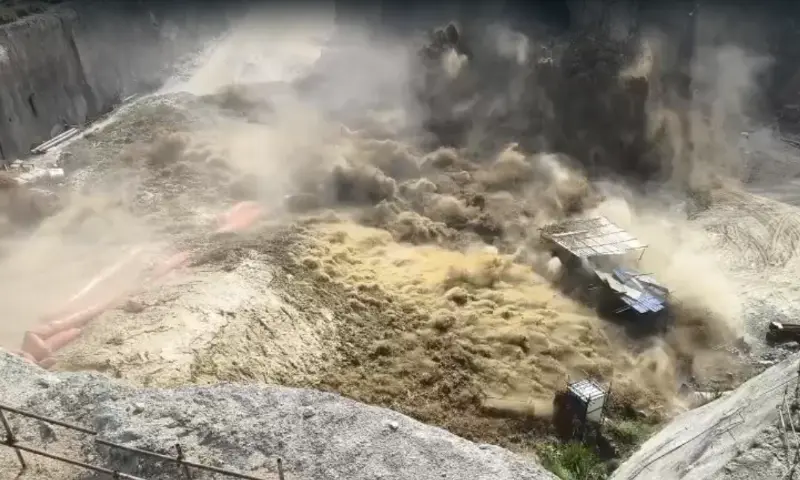
SWABI: A rock mass collapsed at the Tarbela Dam 5th Extension Project (T-5) construction site on Monday, causing a surge of water to enter nearby work areas, said the Water and Power Development Authority (Wapda).
An emergency was declared following the collapse; construction work was suspended and workers were directed to move to safer areas. However, no loss of life was reported in the incident.
In a statement, Wapda said that water entered the under-construction power house area and a tunnel of the T-5 project after a weak rock mass collapsed during excavation work, prompting the evacuation of workers.
The authority said the incident occurred during excavation of the 2nd Bench Connecting Tunnel, when the collapse allowed water from the Intake Pit to enter the tunnel and power house area.
“All workers were immediately evacuated safely,” the statement said, adding that the water from the Intake Pit had been completely drained and no further water was entering the downstream work sites.
Wapda said dewatering work at the under-construction power house had also started.
Authorities were assessing whether the tunnel, power house and other structures in the working area had sustained any damage, Deputy Commissioner Haripur Waseem Ahmed said, quoting officials of the T-5 project.
Senior Wapda officers, the project engineer and the contractor were assessing the situation to address any challenges to the T-5 project, the statement added.
The authority also dismissed reports circulating about the collapse of the T-5 tunnel, saying the main tunnel, under-construction power house, tailrace culvert and switchyard had not been damaged.
It further said there had been no injuries or loss of life among the workforce.
There is no threat of flooding or inundation in areas downstream of Tarbela at present, a senior district administration official said.
Meanwhile, Swabi Deputy Commissioner Nasarullah Khan said that additional water had been released from Tarbela Dam due to “unavoidable” reasons and was expected to increase the flow and level of water in the Indus River.
“All citizens are requested to take precautionary measures and completely avoid bathing, swimming and boating in the Indus River to prevent any untoward incident,” he said.
The deputy commissioner also urged the public to ensure their own safety and that of their families and follow public safety notices.
“Citizens should not pay heed to rumours and should visit our official page for authentic information,” Khan added.
Earlier in July, a government-constituted inquiry committee held all three key stakeholders — the contractor, consultant and employer (Wapda) — responsible for the cofferdam collapse at the 1,530MW T-5 Project, citing post-contract unauthorised design changes as one of the main reasons for the incident.
The collapse contributed to at least a two-year delay and more than 285 per cent cost escalation in the project, whose cost has risen from Rs82 billion to Rs317bn.
The project, which involves $700 million in loans from the World Bank and the Asian Infrastructure Investment Bank, was scheduled for completion by the end of June 2028, instead of 2026, before Monday’s incident.
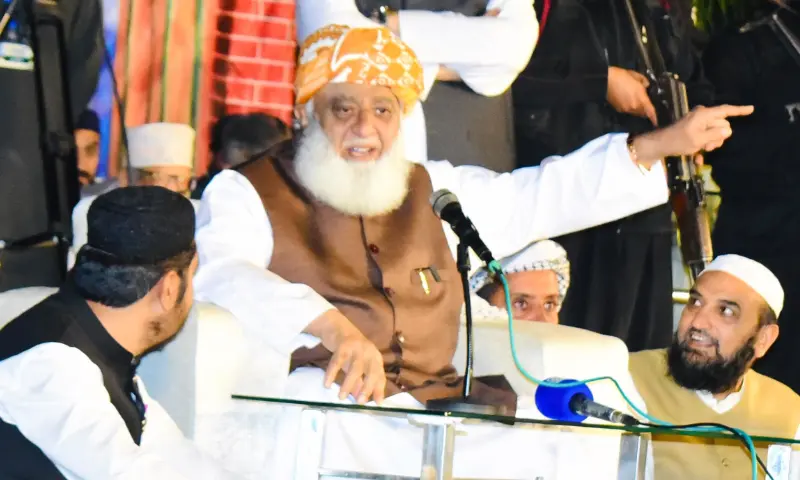
ISLAMABAD: The Tehreek Tahafuz-i-Ayeen Pakistan (TTAP) on Monday hinted at starting a movement against the incumbent government, with hopes that Jamiat Ulema-i-Islam-Fazl (JUI-F) chief Maulana Fazlur Rehman may lead it.
Last week, opposition leaders and JUI-F agreed to strengthen their alliance and parliamentary coordination amid recent tensions between the latter and the federal government.
Fazl has been critical of the federal government over the imposition of governor’s rule in Khyber Pakhtunkhwa. He has accused the Centre of reneging on its commitments amid his efforts to mediate between the federal and KP governments.
Since mid-October, the veteran politician and key federal ministers have also made harsh remarks against each other, after Fazl accused the Centre of depriving the provinces of their rights.
Speaking to Dawn, TTAP spokesperson Akhundzada Hussain Ahmed Yousufzai warned that it had become apparent that JUI-F would “meet the same fate as PTI”.
“It is a war between democratic and undemocratic powers and TTAP will stand by the democratic people,” the TTAP spokesperson said, adding: “We will always support those who are being suppressed.”
Replying to a question, Yousufzai said that during a recent meeting between JUI-F Senator Kamran Murtaza and TTAP leaders, it was agreed in principle to gather on one platform.
“It was also decided that soon we will hold a multiparty conference (MPC), so a movement can be started against the government after that.
“We hope that Maulana Fazlur Rehman will be one of the figures who will be leading the movement,“ he said.
On Oct 16, without naming anyone, Interior Minister Mohsin Naqvi had claimed that a “head of a party” was “extremely upset over being denied a role in the new setup in KP and not getting the governorship”.
The next day, Defence Minister Khawaja Asif and State Minister for Interior Tallal Chaudhry rebuked Fazl directly, who later clarified his criticism was aimed at policies, not state institutions.
In his response the next day, the interior minister explained his participation and went on to assail the JUI-F for “continuously crossing the line” and accused it of “extracting wealth from the state”.
On Friday, JUI-F staged protests in different parts of Sindh and Balochistan, decrying what it called a “coordinated character assassination campaign” against its leader.
The JUI-F chief had hinted at launching street agitation while addressing a workers’ convention in Mansehra earlier this month.
Fazl urged workers to stand firmly with him as he prepared to launch a street agitation. “I see you as the strongest force in the country. You must stand firm against oppression and adversity, as activists of no other party dare to stand up at this critical juncture,” he said at the event.
‘Political dialogue, not personal attacks’
In a separate statement, the TTAP claimed that “disgraceful, derogatory and baseless allegations were being levelled against a distinguished religious scholar, senior politician and respected national political figure”, terming the allegations as “deeply regrettable, shameful and highly condemnable”.
“Political differences are the beauty of any democratic society; however, targeting someone’s honour, dignity, character and family under the pretext of political disagreement is not only contrary to religious, moral and social traditions but also pushes politics further into the depths of hatred, discord and division.
“Differences of opinion must be addressed through arguments, logic and political dialogue rather than character assassination, slander and personal attacks. Such a disgraceful and organised campaign must be stopped immediately, and those involved must abandon this reprehensible practice,“ it stated.
The opposition alliance also paid tribute to the JUI-F chief for his stance against the governor’s rule and emergency in KP.
The statement said that the important constitutional and democratic questions raised by Fazl and his party on the matter should be addressed by the government through “reason, constitutional arguments and the rule of law instead of resorting to character assassination and pressure tactics”.
“No political leader can be compelled to abandon a principled position through pressure, threats or organised character assassination.”
“Measures such as governor’s rule and emergency in KP are contrary to the spirit of provincial autonomy, the people’s mandate and parliamentary democracy, raising serious constitutional and democratic questions,” the statement said.
“The TTAP will vigorously oppose these measures at every constitutional, political, parliamentary and legal forum and continue to highlight their constitutional and democratic implications before the public,“ it stated.
In its statement, the TTAP also expressed “deep concern and regret” over the suspension of hearings by the Peshawar High Court (PHC) in cases filed under Article 199 of the Constitution following the decision of the Federal Constitutional Court (FCC).
The statement said that closing the doors of justice to citizens and political workers who had approached the PHC was “extremely alarming”.
It emphasised that the fundamental responsibility of the judiciary was to protect citizens’ fundamental rights and examine state actions in the light of the Constitution and the law.
It demanded that the complete medical reports of PTI founder Imran Khan and his wife, Bushra Bibi — following the medical tests conducted at Adiala jail yesterday — be made public immediately to address the concerns and apprehensions surrounding their health.
The TTAP also demanded that the government ensure full and immediate implementation of the Supreme Court’s decision regarding Imran’s transfer to Shifa International Hospital and the provision of medical treatment in the presence of his personal physicians.
RAWALPINDI: A local court on Monday granted police two-day physical remand of Ahsan, the husband of anchorperson Rabia Ahsan, who was shot dead at home in the Gulshanabad area a day earlier.
Rabia, who previously co-hosted a current affairs show alongside senior journalists Amir Mateen and Rauf Klasra, was found with a gunshot wound below her neck, City Police Officer (CPO) Hassan Sukhera told reporters on Sunday. Her husband was taken into custody following a complaint filed by her brother.
A first information report was registered at Saddar Beruni police station under Section 302 (premeditated murder) of the Pakistan Penal Code (PPC) and Section 2-A of the Punjab Arms Amendment Ordinance, 2015 on Sunday.
On Monday, the suspect was presented before Area Magistrate Talat Waheed by police, who sought physical custody for further investigation.
After hearing the police request, the magistrate approved a two-day physical remand of the suspect, allowing investigators to interrogate him and pursue further investigation into the circumstances surrounding the anchorperson’s death.
Following the court’s order, police took the suspect into custody for further investigation. Ahsan, who is the primary suspect in the case, will remain in police custody for two days.
The judge directed police to produce the suspect at the expiry of the remand period.
A day earlier, police said that a male domestic worker at their house informed them that the victim’s husband claimed the gunshot had been fired accidentally.
First Lady Aseefa Bhutto-Zardari had “expressed deep sadness over the killing” and called for a thorough, impartial and transparent investigation to establish the facts and ensure that those responsible were held accountable.
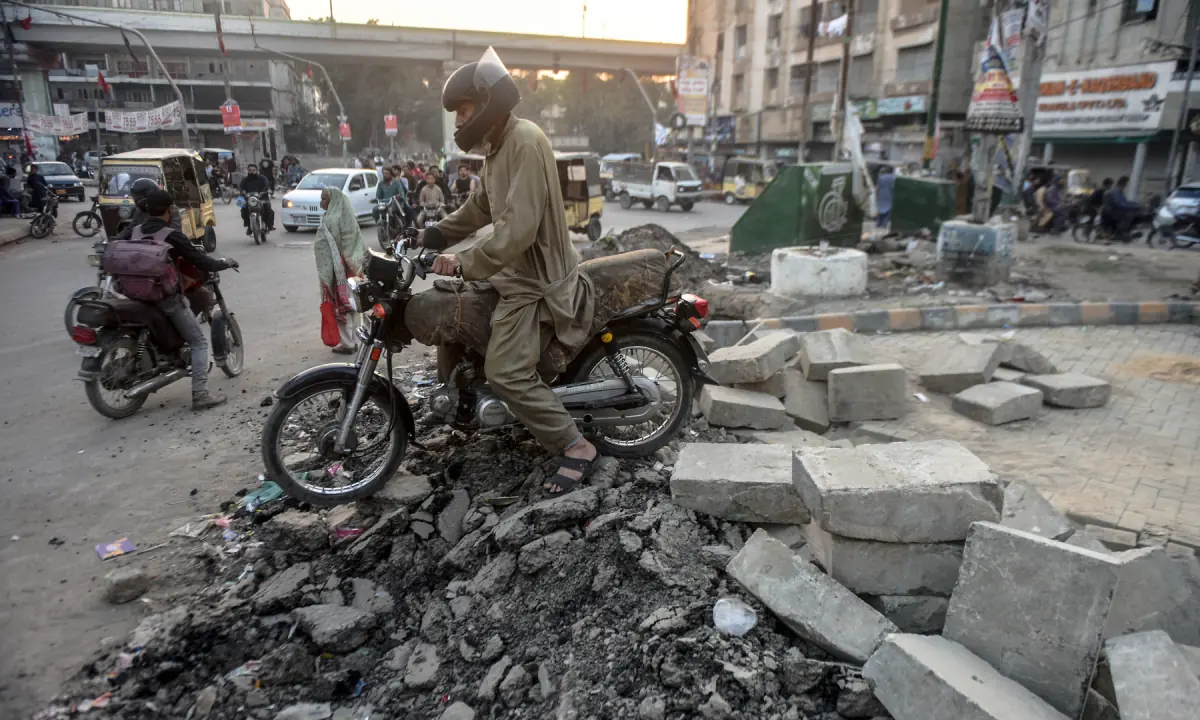
For thousands of Karachi’s industrial workers, the daily commute is less about distance and more about endurance. Muhammad Ali leaves his Baloch Colony home an hour before his 8am shift at a SITE area pharmaceutical plant. While he can zip 14 kilometres to Nazimabad in 15 minutes via the Karsaz corridor, the final 6km crawl to his factory takes twice as long, choked by potholes and gridlock. Across town in the Korangi Industrial Area, refinery worker Ishtiaq Ali loses four hours a day to public transport navigating endless construction and broken roads.
In Pakistan’s largest industrial city, crumbling infrastructure and traffic bottlenecks have turned the simple act of going to work into an exhausting daily ordeal.
The strain is not felt by workers alone. Every day, fleets of heavy vehicles transporting raw materials and finished goods through Karachi’s industrial zones – from SITE and Korangi to Landhi, North Karachi, and Federal B Area – are trapped in hours of gridlock.
For the thousands of enterprises powering the nation’s economy, these dilapidated roads are more than a nuisance; they are a direct hit to the bottom line, bleeding capital through inflated fuel bills, damaged cargo, and costly delays.
Dilapidated roads are inflicting huge financial losses on industrialists through rising fuel costs, longer travel time
But commuting is only one of the problems confronting the city’s industrial zones. Poor sanitation, water shortages, ineffective waste-disposal systems and deteriorating drainage networks have added to the difficulties faced by businesses and workers. Yet the condition of the infrastructure serving these industrial hubs raises questions about whether essential public services are keeping pace with their economic importance.
Earlier last month, the situation compelled Karachi’s industrial, business and trade community to come together and openly voice concerns over, what they described as, the economic cost of civic mismanagement that is driving up production costs and undermining competitiveness.
At a meeting, representatives of Karachi-based trade bodies and industrial town associations questioned how the country’s commercial capital that contributes around 67pc of federal revenue and 54pc of national exports “continues to suffer from crumbling roads, acute water shortages, unreliable utilities, deteriorating sewerage and rampant street crime”.
The condition of the infrastructure serving the industrial hubs raises questions about whether essential public services are keeping pace with their economic importance.
While calling for an urgent, coordinated drive to “rescue Karachi from its deepening civic and economic crisis”, Zubair Motiwala, the chairman of Businessmen Group, has made it clear that their criticism was not aimed at creating any political or administrative controversy, but it was for a liveable, secure and economically competitive Karachi.
However, an industrialist, who attended the meeting but doesn’t want to be named, says that the participants openly expressed their frustration with the PPP administration in the province and lamented that despite ruling Sindh for the past 18 years, the party has ignored the infrastructure that is still in a shambles.
“The seriousness of the provincial government can be gauged from the fact that it had, in December 2025, approved over Rs9 billion for urgent road repairs and infrastructure maintenance in Karachi’s industrial areas, but even after 10 months, the work remains incomplete or has not even begun.”
The industrialist was referring to the allocation for the uplift of industrial areas by Sindh Chief Minister Murad Ali Shah.Recently, Korangi Industrial Trading Estate CEO Saleemuz Zaman highlighted the urgent need for sewerage and infrastructure improvements in areas adjoining the main roads of his industrial estate at the groundbreaking ceremony of the project to improve infrastructure. “The infrastructure challenges are so extensive that the Rs2bn allocation is insufficient to address all the requirements,” he told the participants in the ceremony.
Karachi Mayor Murtaza Wahab assured the KATI members that the government would further increase the allocation in the next financial year as it knew the provision of quality roads, improved drainage systems and modern infrastructure would not only facilitate industrialists but also strengthen commercial activities, create employment opportunities and contribute to the national economy.
Industrialists have identified institutional incompetence, weak accountability and administrative failures as basic reasons behind the city’s longstanding problems like road conditions, traffic diversions, water supply, drainage and waste disposal. They call for timely completion of projects, improved coordination among the relevant authorities and oversight for effective service delivery.
In the words of KATI’s Deputy Patron-in-Chief Zubair Chhaya, the city’s industrialists need a coordinated and apolitical campaign to resolve worsening civic and economic issues where the priority must be implementation and accountability.
Although the Sindh government is taking measures to resolve the chronic issues, until there is timely progress on the infrastructure projects, workers will continue to face lengthy commutes and industries will continue to experience cost and time overruns in transporting raw materials and finished goods.
Published in Dawn, The Business and Finance Weekly, November 9th, 2026
ISLAMABAD: The Drug Regulatory Authority of Pakistan (Drap) has urged consumers to use its Mehfooz Dawa application to verify the authenticity and prices of medicines as part of its efforts to curb the sale of counterfeit drugs.
About 800 pharmaceutical companies and more than 90,000 medicines were registered with Drap, Sajid Shah, a spokesperson for the Ministry of National Health Services, told Dawn.
Shah said Drap had set up a 2D barcode system that allows consumers to scan medicine packs and ensure they receive safe, high-quality and effective products.
The centralised track-and-trace system for pharmaceutical products distributed across Pakistan became operational on October 9, he added.
Furthermore, according to the spokesperson, the system will enable authorities to track medicine supply chains and make it easier to recall products in case of complaints or quality issues. People with smartphones will also be able to scan barcodes to view product details and prices.
The idea of introducing a barcode system was first proposed in 2015. It was approved by the federal cabinet in 2017; however, bureaucratic delays prevented its implementation.
Earlier, Federal Health Minister Mustafa Kamal, taking notice of the delay, announced that the system would be launched as soon as possible.
Earlier this year, Drap had set October 1 as the cut-off date for launching the barcode system to curb the sale of counterfeit and expired medicines and eradicate black marketing.
Shah said the Ministry of National Health Services was “dedicated” to ensuring that citizens had access to high-quality and effective therapeutic products.
Women’s football in Pakistan has seen more milestones in 2026 than in a long time. In January, the country’s first women’s national futsal team took part in the South Asian Football Federation (SAFF) Futsal Championships in Bangkok.
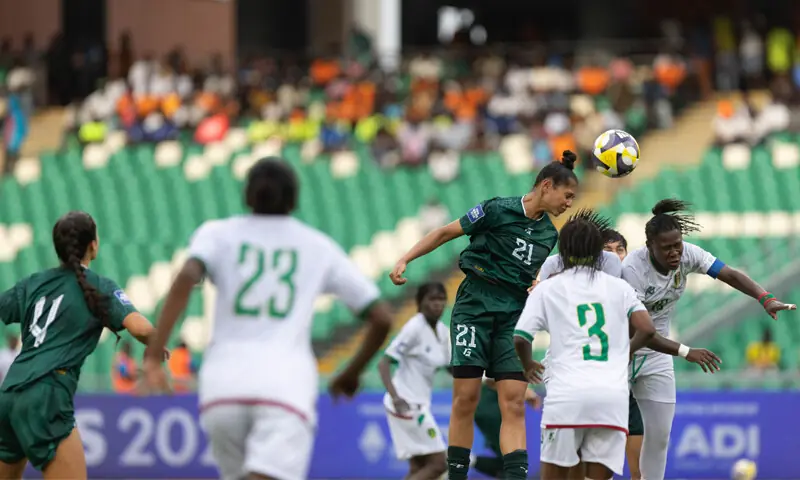
In April, the women’s football team made its historic debut at the FIFA Series in Côte d’Ivoire. In October, Pakistan and Iran signed a three-year memorandum of understanding to boost cooperation in football and futsal for youth, women and men.
Just before that, in September, the Pakistan Football Federation (PFF) finalised its Women’s Football Strategy 2026-30, a five-year plan for the game. This writer spoke to players, coaches and PFF officials to understand both the promise of the strategy and the challenges that may stand in its way.
Part of the new activity stems from a change of leadership at the PFF. The president’s election in May 2025 marked a turning point for Pakistani football after years of governance trouble, during which a FIFA-appointed Normalisation Committee ran the federation’s affairs.
Even so, advancing the women’s game will not be easy. According to the World Economic Forum’s Global Gender Gap Index 2026, Pakistan remains among the countries with the lowest gender parity in the world. That wider inequality matters: securing domestic resources for women’s football may prove even harder than it is for the men’s game.
The strategy
The strategy is promising. Beyond strengthening leadership and giving the women’s national team more competitive opportunities, it identifies three development priorities: getting more girls into football academies and clubs, expanding and strengthening domestic competitions, and building a nationwide system for identifying and developing talent.
To widen participation, the PFF plans a nationwide grassroots programme through schools, clubs and academies, with age-based competitions for girls between seven and 15.
The focus, it says, will be on “fun, fundamentals and inclusion”. The federation also intends to hold District and Regional Youth Club Championships (U-17), with the best teams qualifying for national events, as well as City-Based Schools Championships in at least three major cities.
A tiered women’s league at district, provincial and national levels would then provide regular matches, help spot talent and raise standards. This would be paired with a National Talent Identification Framework, under which trained scouts would pick out promising players at district, regional and national events and track their progress in a central database.
Where the game stands
The problems the strategy seeks to address are well known. Interviews pointed to three main bottlenecks: too few chances to play, unclear routes to higher levels of competition, and poor preparation and irregular fixtures for the national team.
Few chances to play
The shortage of play is not limited to football. One report suggests children in Pakistan get less time for play at school than their counterparts elsewhere in South Asia. At a recent training of 57 master trainers organised by the PFF under its Football in Schools initiative, fewer than 20pc came from girls’ schools.
Outside school, football and futsal compete with property developers and other sports for scarce space. Where grounds are available, boys are often given priority. Women’s sport also ranks low among social priorities and still meets disapproval in many quarters.
“For a young girl, external voices are so loud, it’s hard to stand in your own space,” a former national player said.
No clear pathway
Even for girls who play at school, in academies or at clubs, the road ahead is murky, and parents may feel the time and money are being wasted.
“Parents often ask, ‘khel kar kya karay gee?’” the same player recalled.
Without a visible competitive ladder, coaches have to get creative to keep players, and their families, motivated. They lean on the few national competitions that exist and the chance of university sports scholarships.
“All of my girls want to play at the highest level that Pakistan has to offer,” said a youth women’s coach.
Talented younger girls are sometimes moved into older age groups, where they face physically more developed senior women. That can spur some on, but others lose heart when ambition collides with physical reality.
Results over development
Players picked for the national team get inconsistent coaching. Training tends to be dictated by ad hoc international fixtures, and players rarely get the chance to train and play together regularly, leaving them short of the match experience and cohesion needed at the international level.
A parallel and equally opaque route exists for diaspora players, who live and train abroad and are brought into the national side without necessarily featuring in domestic competitions or camps. This leaves domestic players unsure how selections are made and what they must do to progress.
“The only consistency is the inconsistency of how things are done.” — former national player
From strategy to action
The strategy begins to tackle some of these problems. But it is an ambitious agenda with no clear resource allocation or budget, which raises doubts about delivery. Experience suggests that available funds will decide which activities get priority.
To ensure implementation is guided by evidence and players’ needs, rather than the interests of particular lobbies, the PFF should pick a handful of practical priorities for the first phase. Three stand out.
First, bring continuity and predictability to governance and competition. The PFF should publish an annual calendar of domestic events across youth, men’s and women’s categories. A reliable calendar would let players, coaches, clubs and families plan ahead, and show that the federation is committed to regular competition.
Second, communicate better and be more transparent. The PFF should update its website, make sure the FIFA Connect platform works properly, and align messaging among its officials. Regular social media updates would also help nurture the emerging women’s football ecosystem and make it easier for stakeholders to understand what the federation is doing and how to take part.
Third, set up youth national teams for girls. These would create a pipeline to the senior side and give younger players something to aim for. Coaches should be properly trained, and international safeguarding principles must be upheld at all times.
Better senior coaching and clearer recruitment routes for the national team, including trained scouts and more systematic links with diaspora players, could lift Pakistan’s international performance. But such long-term gains rest on a strong foundation: more girls playing regularly, with real chances to develop. The immediate focus should be on building the game from the bottom up.
“We want to ensure that more girls play football from a young age,” a PFF official said.
The hurdles facing girls also differ across urban, semi-urban and rural settings. The social barriers for a girl in rural Pano Aqil are not the same as the access problems confronting one in inner-city Orangi or Saddar. The PFF’s outreach must recognise this and ensure opportunities are distributed fairly.
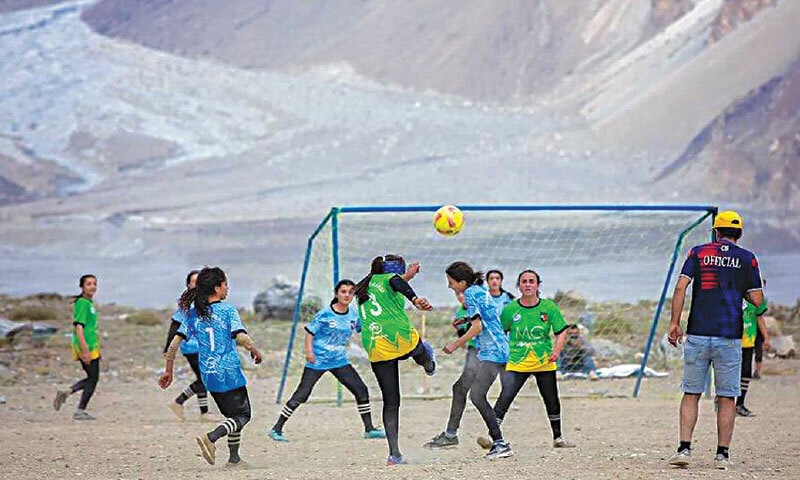
Players in action during a Gilgit-Baltistan Girls Football League match in Passu, Hunza in 2022.
The missing link: a league
Management, coaches and players all identify the same gap: there is no proper development structure built around an established women’s league. The strategy addresses this directly. The PFF’s SHE League (under-23) and SHE League Juniors (under-15), played in Islamabad in October, show the federation is trying to build some structure. But details on the design and frequency of the competitions remain thin.
A well-run league does more than produce a winner. It gives players regular matches, helps coaches assess performance, and provides a framework for developing and identifying talent. What role the PFF should play in organising, regulating and supporting women’s club football is still an open question. Neighbouring countries offer different models.
The Bangladesh Football Federation (BFF) has relied on a national women’s league of roughly 11 clubs. Reports have raised concerns about its competitiveness, including claims that the concentration of national team players at one better-resourced club has put other clubs off.
The BFF’s licensing rules also require men’s clubs to have a youth women’s team in official competitions, a requirement that can link club football to national-team development if properly implemented and monitored.
The All India Football Federation (AIFF) has a more tiered system, with the Indian Women’s League (IWL) at the top, a second division, and U-15 and U-17 leagues.
State and regional competitions add further levels at which players and teams can progress. In September 2026, the AIFF announced a 15-year partnership with Capri Sports to strengthen the IWL and IWL 2.
Here, the federation organises and regulates competitions, clubs manage their teams, and a commercial partner is expected to develop the league’s revenue potential.
The Football Federation of the Islamic Republic of Iran (FFIRI) plays a direct role in organising and regulating women’s club football. The league has three divisions and is run by the Iran Football League Organization, which operates under the FFIRI, placing domestic competition within a wider framework for player development and talent identification.
However, restrictions on spectators and media coverage limit the visibility, and commercial potential, of the women’s game.
These examples show the range of choices open to the PFF as it defines its own role and those of clubs and commercial partners. Several questions must be answered first.
Does it have the capacity to oversee or run such a league? What would it cost, and how would it be financed? Which clubs would take part, and what resources could they draw on? Should there be youth and premier divisions? How would players’ health and safety be ensured?
Answering these will take time. In the interim, clubs and regional associations must register with FIFA Connect, organise women’s matches and keep raising public awareness.
The women’s game cannot be left to the PFF alone. Players, parents, clubs, academies, private-sector funders, men’s clubs and affiliated associations all have a part to play.
Turning ambition into progress
Regular leagues for youth, women and men are essential to expanding competition and building a sustainable football ecosystem. Initiatives such as the SHE League, FIFA Connect and Football in Schools can help identify stakeholders and sharpen coaching skills. But they cannot substitute for sustained institutional commitment from the PFF.
Until the federation shows that women’s football is a priority, and that the priority will last, these initiatives may not be enough to repair the trust eroded among generations of Pakistani players and coaches by repeated governance breakdowns.
As one former player put it: “The only consistency is the inconsistency of how things are done.”
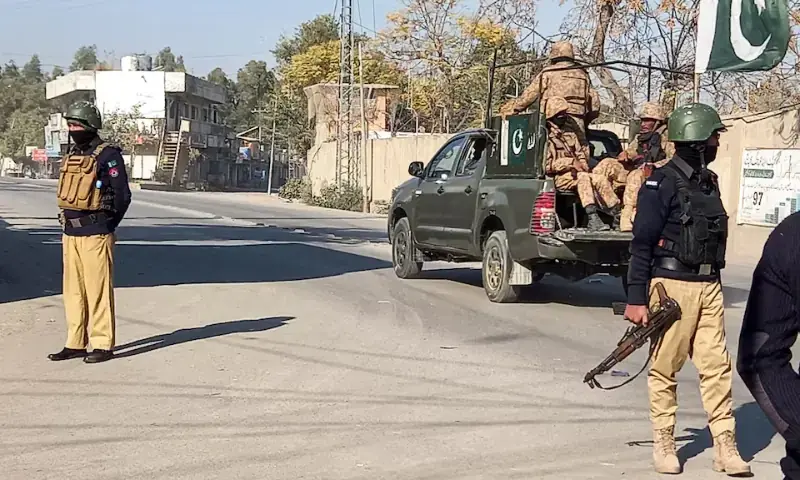
Security forces conducted an intelligence-based operation (IBO) in Muzak village, on the southern outskirts of Mir Ali in North Waziristan, Khyber Pakhtunkhwa, neutralising two terrorist hideouts, the military’s media wing said on Monday.
During the operation, troops “sanitised” the hideouts belonging to the India-sponsored Fitna al-Khawarij, the military’s media wing said.
Fitna al Khawarij is a term the state uses for terrorists belonging to the banned Tehreek-i-Taliban Pakistan.
According to the Inter-Services Public Relations (ISPR), security forces recovered a huge cache of prepared improvised explosive devices (IEDs), explosive preparation material, weapons, and ammunition from hideouts, which were established inside mosques.
The statement added that the terrorists had “deliberately established hideouts in Masajid to store explosive materials and also were running torture cells there,” observing that, “this reprehensible desecration of places of worship by Indian proxy Fitna Al Khwarij serves yet another clear evidence of their utter disregard of fundamental teachings of Islam.”
ISPR maintained that the terrorists, who it had said were facilitated by the Afghan Taliban, had no connection with Islam and their “perverted interpretation and misuse of our great religion is unacceptable and fully rejected by proud and righteous people of KP and Pakistan”.
Moreover, a sanitisation operation was “being conducted by brave soldiers of Pakistan security forces to eliminate any other Indian-sponsored terrorist hideouts in the area,” ISPR said.
“Relentless counter-terrorism campaign under vision Azm-i-Istehkam by security forces and law enforcement agencies of Pakistan will continue at full pace to wipe out [the] menace of foreign-sponsored and supported terrorism from the country.”
President Asif Ali Zardari paid tribute to the security forces for the successful IBO, praising their “professionalism”.
“Using mosques to store explosives and as centres of violence is a blatant violation of Islam’s fundamental teachings,” he said on X.
“Terrorist elements operating with the support of the Afghan Taliban have no connection to Islam. Arbitrary interpretations and misuse of religion are unacceptable,” the president stressed.
Meanwhile, KP Governor Faisal Karim Kundi described the incident as “deeply distressing” while also praising the security forces for the successful IBO, Pakistan TV reported.
The governor also called for “intensified” IBOs to restore peace across KP and reaffirmed his support for security forces in their efforts to bring lasting peace to the province, Pakistan TV stated.
KP and Balochistan have been witnessing terrorist attacks and security challenges for a long time.
The country’s security environment continued to show considerable volatility from October 30 to November 5, 2026, with renewed terrorist activity in parts of KP and the former tribal districts, alongside intensified counterterrorism operations and changing patterns of militant violence, according to Pakistan Institute for Conflict and Security Studies (PICSS).
Per the latest PICSS Weekly Insight, 49 militant attacks were recorded nationwide during the reporting period, compared with 31 in the preceding week. These incidents resulted in 25 fatalities and 21 injuries.
On October 8, security forces killed nine terrorists in an IBO in North Waziristan, while a day earlier, 18 terrorists were eliminated in separate engagements in KP and Balochistan.
US President Donald Trump cast doubt on renewed fighting with Iran, telling CNN it was “highly unlikely”, ahead of a meeting with mediator Qatar’s prime minister on Monday.
Trump has threatened to resume strikes in recent weeks, with US media reports suggesting that hostilities could restart after last Tuesday’s midterm elections.
The president told CNN in an interview on Sunday that renewed fighting was “highly unlikely,” but warned that his decision “depends on whether or not they sign a very strong agreement.”
“I would if necessary, but we hit them really hard. I hit them so hard. You don’t know how hard I hit them,” he said.
Trump is scheduled to meet Qatar’s Prime Minister Sheikh Mohammed bin Abdulrahman Al Thani, who is also the country’s foreign minister, at the White House on Monday.
The meeting will be Trump’s first with a foreign leader since a massive midterm loss that saw his Republican Party lose control of Congress.
Iranian Foreign Minister Abbas Araghchi suggested on Sunday that peace talks had been paused while the political fallout of the vote was being assessed.
“For the past few days, there has been no more travel (by mediators), and the reason for this is the shock that the election results in the United States have caused to everyone,” Araghchi told state television.
“We now have to see how long it will take for them to digest these results, in order to determine how we are going to move forward,” he added.
‘They had enough’
Trump has acknowledged that the highly unpopular war on Iran — which began with US-Israeli strikes in late February — was at least partially responsible for the Republicans’ defeat.
Araghchi said on Monday that the US president “clearly recognises that the vast majority of Americans are disgusted with Israel.”
“Americans are evidently sick and tired of Israel bamboozling US administrations into forever wars,” Araghchi said on X. “They had enough. So has our region.”
In Sunday’s CNN interview, Trump once again suggested that the economic pressure Iran is under will force its leaders into accepting the United States’ terms.
“They’re a failing nation. It just came out, you saw this year, 301 per cent inflation,” Trump claimed.
“They’re withering away financially. We’ve hit them militarily. We could finish them off.”
Iran’s official figures put inflation at nearly 90pc year-on-year in September.
Iranian state television said the island of Qeshm in the Strait of Hormuz was attacked overnight on Sunday, hours after the official IRNA news agency reported two explosions there.
Various regional powers, including Qatar and Pakistan, have been trying for months without success to bring a definitive halt to the war.
Outright fighting has largely subsided, but Iran continues in its efforts to blockade the Strait of Hormuz, vital to global energy supplies, while the US Navy maintains its own counterblockade of Iranian ports.