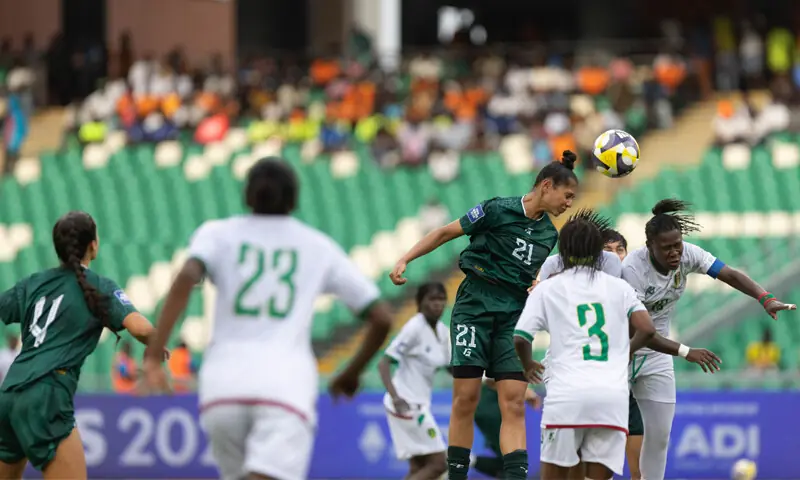
Women’s football in Pakistan has seen more milestones in 2026 than in a long time. In January, the country’s first women’s national futsal team took part in the South Asian Football Federation (SAFF) Futsal Championships in Bangkok.
In April, the women’s football team made its historic debut at the FIFA Series in Côte d’Ivoire. In October, Pakistan and Iran signed a three-year memorandum of understanding to boost cooperation in football and futsal for youth, women and men.
Just before that, in September, the Pakistan Football Federation (PFF) finalised its Women’s Football Strategy 2026-30, a five-year plan for the game. This writer spoke to players, coaches and PFF officials to understand both the promise of the strategy and the challenges that may stand in its way.
Part of the new activity stems from a change of leadership at the PFF. The president’s election in May 2025 marked a turning point for Pakistani football after years of governance trouble, during which a FIFA-appointed Normalisation Committee ran the federation’s affairs.
Even so, advancing the women’s game will not be easy. According to the World Economic Forum’s Global Gender Gap Index 2026, Pakistan remains among the countries with the lowest gender parity in the world. That wider inequality matters: securing domestic resources for women’s football may prove even harder than it is for the men’s game.
The strategy
The strategy is promising. Beyond strengthening leadership and giving the women’s national team more competitive opportunities, it identifies three development priorities: getting more girls into football academies and clubs, expanding and strengthening domestic competitions, and building a nationwide system for identifying and developing talent.
To widen participation, the PFF plans a nationwide grassroots programme through schools, clubs and academies, with age-based competitions for girls between seven and 15.
The focus, it says, will be on “fun, fundamentals and inclusion”. The federation also intends to hold District and Regional Youth Club Championships (U-17), with the best teams qualifying for national events, as well as City-Based Schools Championships in at least three major cities.
A tiered women’s league at district, provincial and national levels would then provide regular matches, help spot talent and raise standards. This would be paired with a National Talent Identification Framework, under which trained scouts would pick out promising players at district, regional and national events and track their progress in a central database.
Where the game stands
The problems the strategy seeks to address are well known. Interviews pointed to three main bottlenecks: too few chances to play, unclear routes to higher levels of competition, and poor preparation and irregular fixtures for the national team.
Few chances to play
The shortage of play is not limited to football. One report suggests children in Pakistan get less time for play at school than their counterparts elsewhere in South Asia. At a recent training of 57 master trainers organised by the PFF under its Football in Schools initiative, fewer than 20pc came from girls’ schools.
Outside school, football and futsal compete with property developers and other sports for scarce space. Where grounds are available, boys are often given priority. Women’s sport also ranks low among social priorities and still meets disapproval in many quarters.
“For a young girl, external voices are so loud, it’s hard to stand in your own space,” a former national player said.
No clear pathway
Even for girls who play at school, in academies or at clubs, the road ahead is murky, and parents may feel the time and money are being wasted.
“Parents often ask, ‘khel kar kya karay gee?’” the same player recalled.
Without a visible competitive ladder, coaches have to get creative to keep players, and their families, motivated. They lean on the few national competitions that exist and the chance of university sports scholarships.
“All of my girls want to play at the highest level that Pakistan has to offer,” said a youth women’s coach.
Talented younger girls are sometimes moved into older age groups, where they face physically more developed senior women. That can spur some on, but others lose heart when ambition collides with physical reality.
Results over development
Players picked for the national team get inconsistent coaching. Training tends to be dictated by ad hoc international fixtures, and players rarely get the chance to train and play together regularly, leaving them short of the match experience and cohesion needed at the international level.
A parallel and equally opaque route exists for diaspora players, who live and train abroad and are brought into the national side without necessarily featuring in domestic competitions or camps. This leaves domestic players unsure how selections are made and what they must do to progress.
“The only consistency is the inconsistency of how things are done.” — former national player
From strategy to action
The strategy begins to tackle some of these problems. But it is an ambitious agenda with no clear resource allocation or budget, which raises doubts about delivery. Experience suggests that available funds will decide which activities get priority.
To ensure implementation is guided by evidence and players’ needs, rather than the interests of particular lobbies, the PFF should pick a handful of practical priorities for the first phase. Three stand out.
First, bring continuity and predictability to governance and competition. The PFF should publish an annual calendar of domestic events across youth, men’s and women’s categories. A reliable calendar would let players, coaches, clubs and families plan ahead, and show that the federation is committed to regular competition.
Second, communicate better and be more transparent. The PFF should update its website, make sure the FIFA Connect platform works properly, and align messaging among its officials. Regular social media updates would also help nurture the emerging women’s football ecosystem and make it easier for stakeholders to understand what the federation is doing and how to take part.
Third, set up youth national teams for girls. These would create a pipeline to the senior side and give younger players something to aim for. Coaches should be properly trained, and international safeguarding principles must be upheld at all times.
Better senior coaching and clearer recruitment routes for the national team, including trained scouts and more systematic links with diaspora players, could lift Pakistan’s international performance. But such long-term gains rest on a strong foundation: more girls playing regularly, with real chances to develop. The immediate focus should be on building the game from the bottom up.
“We want to ensure that more girls play football from a young age,” a PFF official said.
The hurdles facing girls also differ across urban, semi-urban and rural settings. The social barriers for a girl in rural Pano Aqil are not the same as the access problems confronting one in inner-city Orangi or Saddar. The PFF’s outreach must recognise this and ensure opportunities are distributed fairly.
The missing link: a league
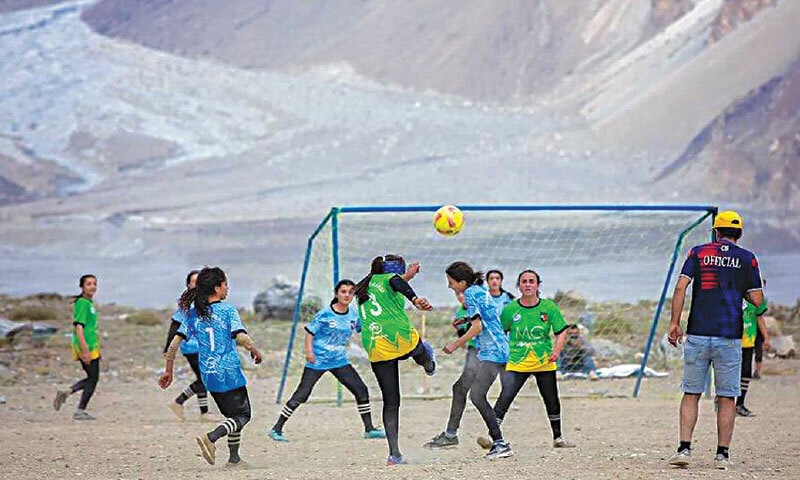
Management, coaches and players all identify the same gap: there is no proper development structure built around an established women’s league. The strategy addresses this directly. The PFF’s SHE League (under-23) and SHE League Juniors (under-15), played in Islamabad in October, show the federation is trying to build some structure. But details on the design and frequency of the competitions remain thin.
A well-run league does more than produce a winner. It gives players regular matches, helps coaches assess performance, and provides a framework for developing and identifying talent. What role the PFF should play in organising, regulating and supporting women’s club football is still an open question. Neighbouring countries offer different models.
The Bangladesh Football Federation (BFF) has relied on a national women’s league of roughly 11 clubs. Reports have raised concerns about its competitiveness, including claims that the concentration of national team players at one better-resourced club has put other clubs off.
The BFF’s licensing rules also require men’s clubs to have a youth women’s team in official competitions, a requirement that can link club football to national-team development if properly implemented and monitored.
The All India Football Federation (AIFF) has a more tiered system, with the Indian Women’s League (IWL) at the top, a second division, and U-15 and U-17 leagues.
State and regional competitions add further levels at which players and teams can progress. In September 2026, the AIFF announced a 15-year partnership with Capri Sports to strengthen the IWL and IWL 2.
Here, the federation organises and regulates competitions, clubs manage their teams, and a commercial partner is expected to develop the league’s revenue potential.
The Football Federation of the Islamic Republic of Iran (FFIRI) plays a direct role in organising and regulating women’s club football. The league has three divisions and is run by the Iran Football League Organization, which operates under the FFIRI, placing domestic competition within a wider framework for player development and talent identification.
However, restrictions on spectators and media coverage limit the visibility, and commercial potential, of the women’s game.
These examples show the range of choices open to the PFF as it defines its own role and those of clubs and commercial partners. Several questions must be answered first.
Does it have the capacity to oversee or run such a league? What would it cost, and how would it be financed? Which clubs would take part, and what resources could they draw on? Should there be youth and premier divisions? How would players’ health and safety be ensured?
Answering these will take time. In the interim, clubs and regional associations must register with FIFA Connect, organise women’s matches and keep raising public awareness.
The women’s game cannot be left to the PFF alone. Players, parents, clubs, academies, private-sector funders, men’s clubs and affiliated associations all have a part to play.
Turning ambition into progress
Regular leagues for youth, women and men are essential to expanding competition and building a sustainable football ecosystem. Initiatives such as the SHE League, FIFA Connect and Football in Schools can help identify stakeholders and sharpen coaching skills. But they cannot substitute for sustained institutional commitment from the PFF.
Until the federation shows that women’s football is a priority, and that the priority will last, these initiatives may not be enough to repair the trust eroded among generations of Pakistani players and coaches by repeated governance breakdowns.
As one former player put it: “The only consistency is the inconsistency of how things are done.”
Perhaps it is time that changed.
Source: dawn
Leave a Reply