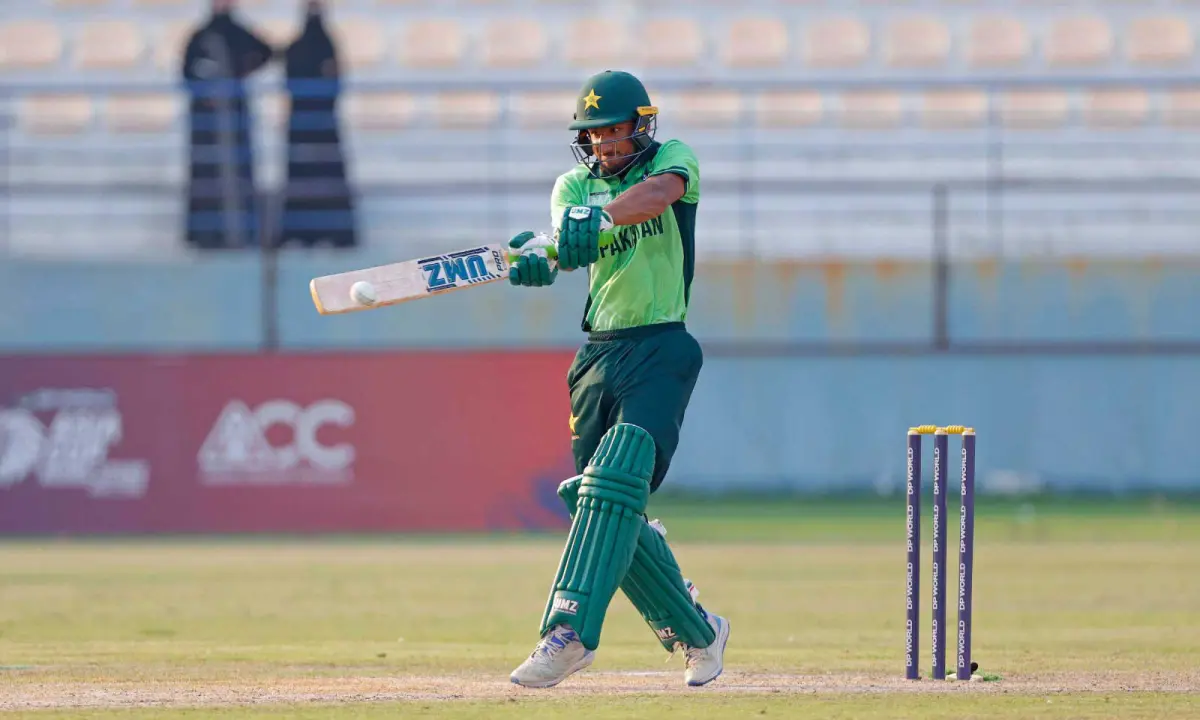
An unbeaten half-century by Rohail Nazir, followed by a devastating bowling display, helped Pakistan Shaheens defeat Nepal by 96 runs in their final Group ‘B’ match of the Asia Cup Rising Stars at the University of Doha for Science and Technology on Tuesday.
The defending champions remained unbeaten in the tournament, winning all three of their group matches to qualify for the semi-finals, where they will face Bangladesh A on Nov 27.
Batting first, Pakistan Shaheens were in trouble at 66-6 in 16.5 overs before wicket-keeper-batter Rohail steadied the innings with an unbeaten 64 off 83 balls, hitting four fours and three sixes.
After Hasan Nawaz fell for 28 off 59 balls, leaving the Shaheens at 88-7, Rohail added 70 runs for the eighth wicket with Ahmed Daniyal, who scored 16 off 35 balls, to help his side reach 168 before being bowled out in 42 overs.
For Nepal, Rashid Khan claimed five wickets for 39 runs, while Abhishesh Gautam took two.
Nepal’s chase got off to a disastrous start as Muhammad Imran and Mohammad Hasnain reduced them to 15-4 inside six overs. Hasnain struck twice in successive deliveries to dismiss Ishan Pandey and Lokesh Bam without scoring.
Left-arm spinner Sufyan Moqim then claimed three wickets as Nepal slumped to 59-9. Mayan Yadav offered some resistance with a top score of 41 off 50 balls but was trapped leg-before by Maaz Sadaqat as Nepal were dismissed for 72 in 17.3 overs.
Hasnain and Sufyan took three wickets each for 21 and 17 runs respectively, while Imran claimed two for 29.
Rohail was named player of the match for his match-winning innings.
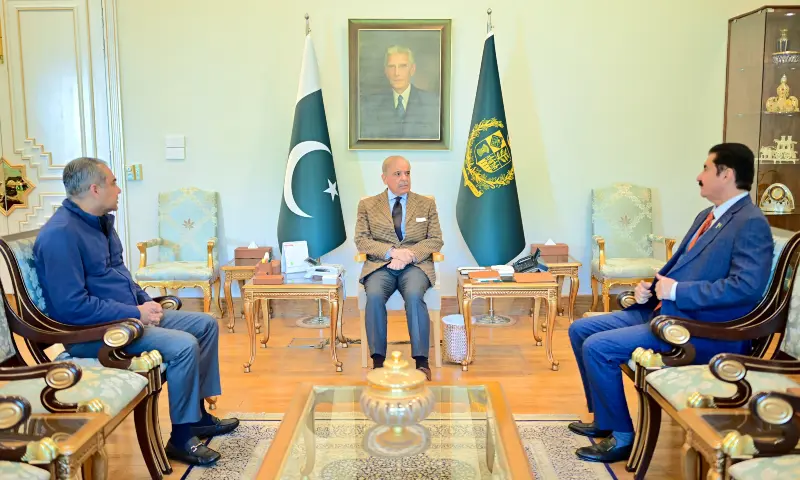
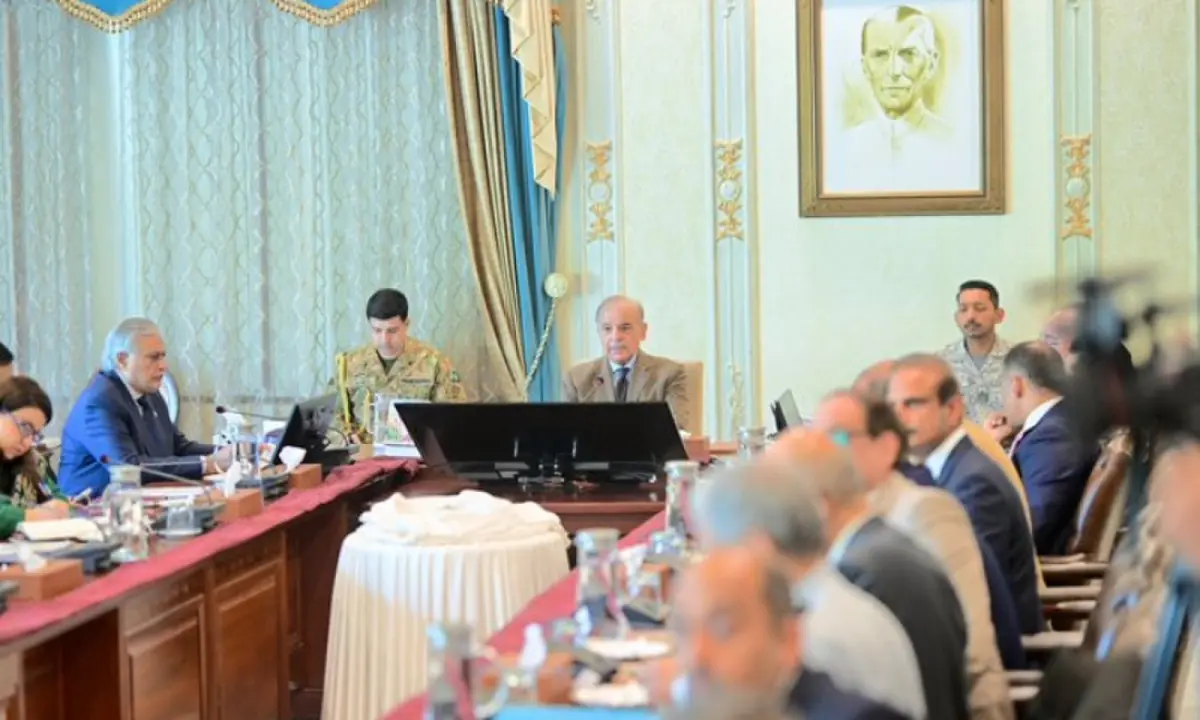
Prime Minister Shehbaz Sharif on Tuesday assured KP Governor Faisal Karim Kundi of all possible cooperation on behalf of the federal government for the complete eradication of terrorism, durable peace and the welfare of the public in the province.
The premier made these remarks as he met with Kundi in Islamabad on Tuesday, according to a statement by the Prime Minister’s Office (PMO).
During the meeting, he said that the sacrifices of the security forces and KP police in the war against terrorism in the province would not go in vain.
The federal government would continue to “fully support the implementation of the decisions taken at the apex committee meeting to completely eliminate terrorism”, he was quoted as saying.
He reaffirmed the federal government’s commitment to providing full support for the development of KP and the welfare of its people, saying that all possible resources would be mobilised to provide them with healthcare, education and other basic facilities, according to the PMO.
The premier directed that special attention be given to improving social development indicators in KP, including healthcare and education.
He said that attention would also be given to promoting sports facilities in the province and providing young people with opportunities for constructive activities, the PMO added.
Meanwhile, Governor Kundi briefed the prime minister on the ongoing efforts by himself and the KP Advisory Council to improve law and order in the province.
Separately, Kundi also met with President Asif Ali Zardari, a statement by the President’s Office said, where he briefed the president on the situation following Oct 11, particularly the security situation.
The meetings come weeks after the Centre imposed emergency and governor’s rule in KP on Oct 11, citing the provincial government’s “deliberate disengagement” from the fight against terrorism. The decisions were also endorsed by the Parliament amid protests by the opposition.
On Oct 22, PM Shehbaz also chaired a meeting of the federal apex committee in Peshawar. He had vowed to take tough decisions, while reaffirming the Centre’s commitment to bringing peace to terrorism-hit districts in the province.
Last week, Chief of Defence Forces and Chief of Army Staff Field Marshal Asim Munir also reaffirmed the security forces “unwavering resolve” to decisively eliminate terrorism and preserve peace and stability of KP in close coordination with law enforcement agencies.
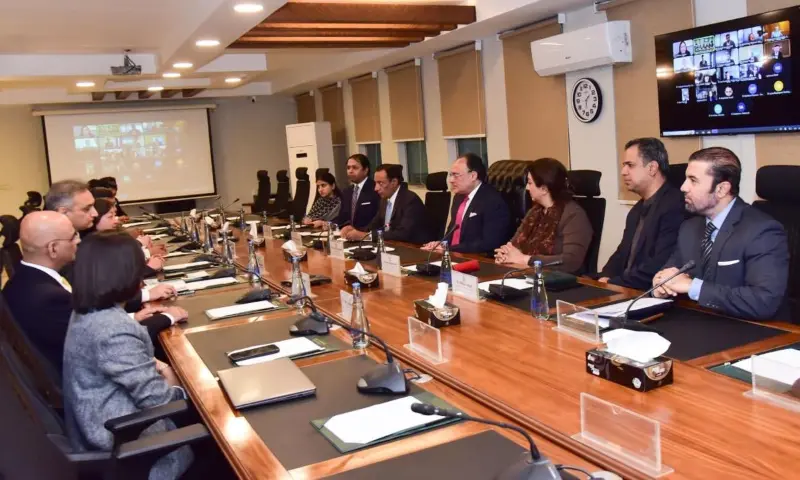
ISLAMABAD: The government on Tuesday selected a consortium of three foreign banks to arrange a $500 million trade finance facility, backed by the Multilateral Investment Guarantee Agency (MIGA), a member of the World Bank Group.
“Following a competitive selection process and receipt of bids from nine international financial institutions, the Finance Division, Government of Pakistan, has selected the following banks as financing partners for the facility,” the Ministry of Finance said in a statement.
The banks included Commerzbank, JP Morgan and Standard Chartered Bank. It added that this facility opened new avenues for international financing.
According to the ministry, the decision was taken in a virtual meeting held by Finance Minister Muhammad Aurangzeb with the senior leadership of a consortium of international banks and representatives of the agency.
The banks were selected on the basis of the most competitive financing terms offered to the government, it said.
“The one-year facility, renewable on a rolling 1+1+1 basis, will support the financing of essential imports and trade-related expenditures,” the statement said.
It noted that the transaction marked the government’s first-ever credit enhancement transaction with MIGA under its Trade Finance programme, while also representing the first-ever participation of Commerzbank and JP Morgan in commercial lending to the government.
“The strong response and participation from international financial institutions reflect growing confidence in Pakistan’s improving economic outlook and progress towards sustainable growth,” the ministry said, expressing the government’s appreciation for the interest shown by all participating institutions and its gratitude “for their time, effort and engagement throughout the process”.
It said the transaction marked an important step towards “mobilising private international capital through multilateral risk-mitigation instruments, diversifying external financing sources and exploring innovative financing structures, while maintaining prudent debt management and fiscal responsibility”.
The ministry said the government would work closely with MIGA and the selected banks to advance the transaction towards its timely execution, looking forward to building strong and lasting relationships.
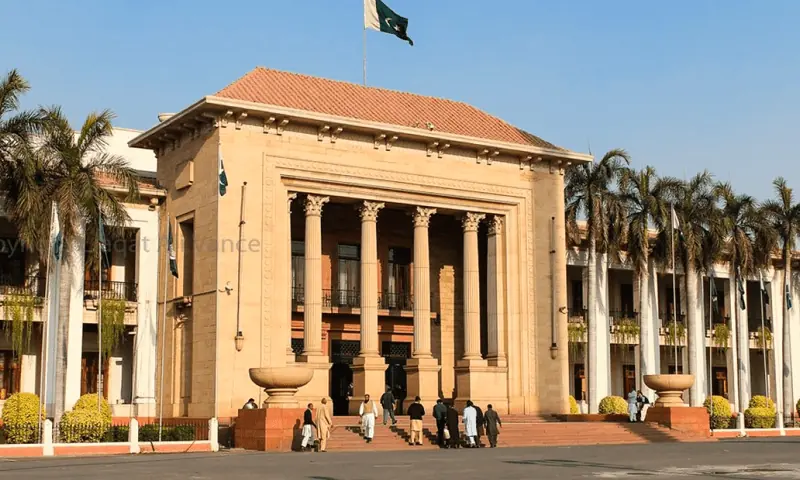
LAHORE: The Punjab Assembly on Tuesday unanimously passed a resolution demanding legislation to make the punishment harsher under Section 298-A (use of derogatory remarks, etc, in respect of holy personages) of the Pakistan Penal Code (PPC).
Currently, Section 298-A provides “imprisonment of either description for a term which may extend to three years”, or fine, or both as punishment for “whoever by words, either spoken or written, or by visible representation, or by any imputation, innuendo or insinuation, directly or indirectly, defiles the sacred name of any wife (Ummul Mumineen) or members of the family (Ahl-i-bait) of the Holy Prophet (peace be upon him), or any of the righteous Caliphs (Khulafa-i-Rashideen) or companions (Sahaaba) of the Holy Prophet”.
The resolution, moved in the House by opposition MPA Rana Aurangzaib, contended that the existing penalty was “insufficient” for such an act which “hurts religious sentiments”.
The House urged the federal government to move on the matter on a “priority basis” and enact legislation needed to increase the penalty under Section 298-A.
It also called on the federal government to ensure effective lawmaking and implementation to uphold respect for religious sanctities and to maintain social peace and harmony.
In August 2023, Parliament passed the Criminal Law (Amendment) Bill 2023 to increase the punishment under Section 298-A from three years of imprisonment to at least 10 years in jail.
However, then-president Arif Alvi returned the bill to Parliament.
The Human Rights Commission of Pakistan had noted that the bill would have made it “more difficult for the accused to obtain statutory bail, which will now be granted at the discretion of the court rather than as a legal right”.
It observed that “in general, blasphemy cases are often lodged by the police under pressure from far-right clerics or complainants with personal vendettas or to stem the risk of mob violence following mere allegations of blasphemy”.
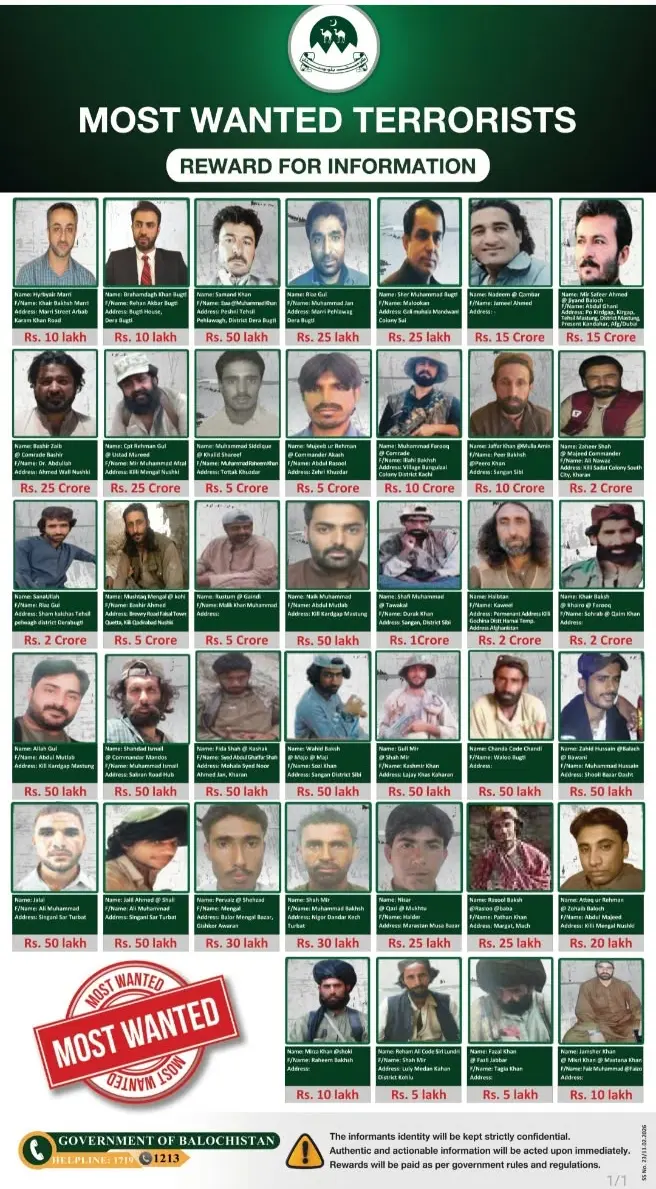
QUETTA: The Balochistan government has announced rewards ranging from Rs500,000 to Rs250 million for providing authentic information about most-wanted terrorists in the province.
According to an official advertisement issued by the provincial government, a reward of Rs250m has been fixed for information about Bashir Zeb of the banned Balochistan Liberation Army and Abdul Rehman alias Rehman Gul.
Similar rewards have been fixed for other wanted persons depending on their status.
List of most-wanted terrorists and respective rewards on information regarding them issued by the provincial government. — via Saleem Shahid
The government said the list has been issued as part of its efforts to maintain law and order and eliminate terrorism in the province.
Balochistan Home Affairs Adviser Babar Yousafzai affirmed that the provincial government was determined to eradicate terrorism and protect the lives and properties of citizens.
The list of most-wanted terrorists and the announcement of rewards were, therefore, part of the ongoing government measures against terrorism.
Yousafzai stressed that public cooperation was of utmost importance in the war against terrorism.
The adviser appealed to the public to contact the relevant institutions of the government if they had any authentic information regarding the wanted terrorists.
He said the identity of informants would be kept anonymous, and immediate action would be taken against the terrorists. Payment of rewards would be made according to the rules and regulations fixed by the government.
Pakistan has seen a surge in terrorism, especially in Khyber Pakhtunkhwa and Balochistan, since the banned Tehreek-i-Taliban Pakistan ended its ceasefire deal with the government in November 2022, vowing to increase attacks.
While Pakistan recorded fewer militant attacks from Nov 6 to 12, fatalities and injuries increased sharply, “highlighting the changing intensity and continued volatility of militant threat across the country”, according to the Pakistan Institute for Conflict and Security Studies.
Balochistan recorded 13 attacks, resulting in eight deaths and 19 injuries, while KP “remained the principal centre of violence” with 16 attacks and 44 fatalities.
A hundred members of the legal fraternity and civil society have called for the 26th and 27th Constitutional Amendments to be repealed, reacting to remarks by PPP Chairman Bilawal Bhutto-Zardari, whose party had made their enactment possible.
The 26th and 27th Amendments, enacted in October 2024 and November 2025 respectively, were passed by both houses of the Parliament amid outcry from the PTI-led opposition.
Last week, Bilawal — a strong advocate for both Amendments when they were passed — said the 27th Amendment was “passed neither through political consensus nor mutual agreement; it was passed with brute majority”, and that the previous one did have mutual agreement.
He also questioned the current status of the judiciary, particularly in the wake of the 27th Amendment, noting that resignations of senior judges followed the legislation.
Later, the PPP chairman clarified that he was “not disowning” the 27th Amendment, but rather noting that it did not enjoy the same “unanimous consensus” as the 18th Amendment and the 1973 Constitution.
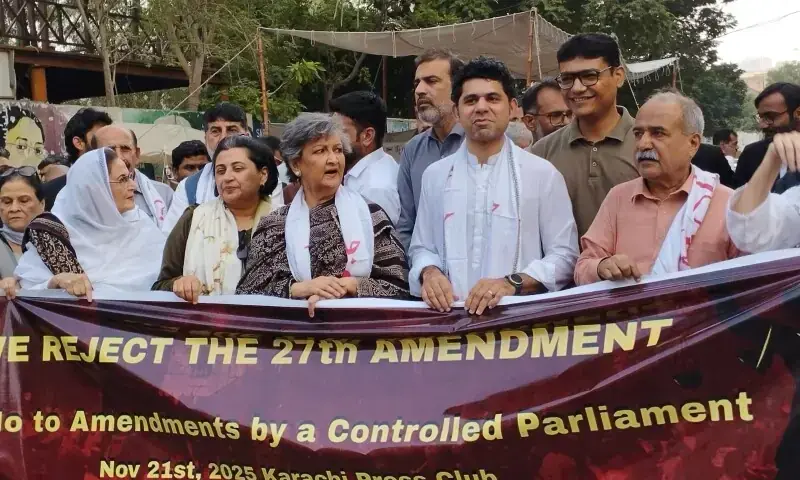
In an open letter on Tuesday, 100 individuals — mostly lawyers and also including activists and academics — called for both the 26th and 27th Amendments to be repealed.
“Pakistan’s constitutional order belongs to its people. It cannot be seized by a majority that its own members admit was never theirs to wield,” read the letter, also signed by retired Supreme Court Justice Mansoor Ali Shah.
The letter recalled that Bilawal “admitted that the 27th Amendment was passed neither through political consensus nor through agreement, but a ‘brute majority’”.
It demanded that the “constitutional order that existed prior to the 26th Amendment must be restored”, adding that any future reform of the judiciary must come through an “open and consultative process”.
The 26th Amendment carved a constitutional bench out of the SC, with its members chosen by a reconstituted Judicial Commission of Pakistan (JCP) in which judges no longer held a majority.
A year later, the 27th Amendment turned those benches into an entirely separate court, the Federal Constitutional Court (FCC), which is said to have effectively dethroned the SC as the country’s highest judicial forum.
It also made significant changes to the judicial system and the military’s chain of command, and granted immunities to government officials. Two of the SC’s senior-most judges, including Shah, resigned in protest the day it became law.
Tuesday’s letter also called for reserved seats in the legislative houses to be returned to their “lawful claimants”, in an apparent reference to the opposition.
The PTI was deprived of its reserved seats in the 2024 elections following the revocation of its electoral symbol.
Although an SC bench declared the PTI eligible for the seats, the order was not implemented and later overturned by the constitutional bench created via the 26th Amendment, which handed them to the coalition parties that challenged the 2024 ruling.
“The government cannot continue exercising parliamentary authority derived from a process that the governing coalition’s own leadership has now publicly called into question,” Tuesday’s letter read.
“These seats must be restored to their rightful claimants through the appropriate legal and constitutional mechanism,” it added.
The letter noted that Bilawal “described the way the opposition was stripped of its reserved seats as ‘a joke’ and said the treasury benches had simply put those seats ‘in their pockets’”.
“Most damning of all, he accused the ruling government of amending the Constitution using seats that are ‘not yours’,” the document added.
The signatories pointed out that these words came “from the government’s key coalition partner whose votes were required to pass both the 26th and 27th Amendments”.
It continued: “The treasury benches face a question they can no longer evade. Their own coalition partner says reserved seats were taken by parties that had no right to them.
“On what constitutional, legal or moral basis does the government then keep claiming the numbers through which the 26th and 27th Amendments were passed?”
The lawyers and activists noted that a two-thirds majority was the safeguard the Constitution demands so that “it cannot be changed without the genuine and lawful representation of the people’s will”.
However, a majority “made up with seats that were unjustly denied to the opposition is not the majority the Constitution demands”, they contended.
“An amendment passed on that basis holds no constitutional, legal, or democratic validity. An amendment passed without a legitimate two-thirds majority is void from its very inception,” the letter asserted.
It further said that these questions applied directly to the FCC, which “owes its existence wholly to the 27th Amendment”.
“Its jurisdiction, its composition and its authority all come from a constitutional change whose legitimacy is now openly repudiated by the very people who brought it into being.
“A court cannot rise higher than its source. An institution whose authors cannot defend how it was built has no foundation left to stand on,” the lawyer said.
“Pakistan has witnessed far too many admissions of wrongdoing that have led to no consequences,” the letter observed, noting that leaders acknowledge violations at press conferences, express reservations, and then “allow the very arrangements they condemn to continue unchanged”.
“This cycle must end. The question is no longer simply whether a wrong was committed, but whether consequences and meaningful action will follow.”
The signatories stressed this was a “moment to begin repairing the grave damage caused to the judiciary and the constitutional order”.
“Those in power have a choice. They can either continue to cling to an illegitimate majority or they can correct course.”
Prime Minister Shehbaz Sharif was informed on Tuesday that separate sales tax zones were being established in the country’s four major taxpayer units — Karachi, Lahore, Islamabad and Multan — to improve collection.
According to a statement from the Prime Minister’s Office (PMO), the development was shared during a weekly review meeting concerning the Federal Board of Revenue (FBR) in Islamabad.
The move comes as the government has decided to reverse the functional integration of sales tax and income tax collection after 17 years, acknowledging that the sales tax revenue gap has widened to Rs3.4 trillion amid weak enforcement and poor revenue collection.
The statement released on Tuesday said that the meeting was also informed that work was underway to establish a modern cargo tracking system to address the sales tax gap and curb smuggling.
The system would digitally track the movement of goods from loading to delivery and comprise an electronic consignment note, a risk management system, field enforcement and an analytics dashboard, the statement said.
A steering committee with provincial representation was also being formed to oversee the system’s implementation, the PMO said.
The meeting was further informed that the FBR was establishing an office at Karachi’s Korangi Industrial Estate to provide services to local industrialists at their doorstep.
According to the PMO, PM Shehbaz directed authorities to expedite customs clearance, immigration and other operations at the country’s airports and make smart scanning systems operational at all international airports.
The meeting was informed that smart scanning systems were being installed at major international airports with the support of relevant agencies. The systems would automatically direct passengers’ baggage to the green or red channels.
The prime minister expressed the hope that the FBR chairman’s recent visits to Karachi and Lahore and meetings with local traders and industrialists would yield positive results for trade, exports and investment.
The meeting was informed that an audit of oil marketing companies’ bonded warehouses, conducted on the prime minister’s directives, had uncovered irregularities amounting to Rs24.4 billion. Recoveries were being made through legal procedures, the statement said.
It added that PM Shehbaz directed authorities to take action and make recoveries without discrimination.
The meeting was further informed that the Indus Collectorate had begun operations at bridges over the Indus River across the country. The enforcement collectorate, which had 856 staff members, had seized illegal goods worth Rs1.849bn in 302 operations so far, the statement said.
Regarding Pakistan Revenue Automation Limited (PRAL), the meeting was informed that additional security features had been incorporated into several software systems to ensure data integrity. Departmental action was also being taken against FBR officers who had previously issued unauthorised consumption certificates under the FATA/PATA tax exemption, the statement said.
In 2009, the government transferred the administration of sales tax and federal excise duty from Customs to the Inland Revenue Service (IRS) as part of a World Bank-backed reform aimed at integrating tax administration.
However, after 17 years of integration, the sales tax revenue gap has widened to an estimated Rs3.4tr, compared with Rs2tr for income tax, raising questions about the effectiveness of the arrangement.
Under the new arrangement, specialised officers will handle sales tax and income tax separately, while both will continue to be administered within the IRS rather than through separate services.
THE collapse of climate negotiations at COP31 in Antalya recently is a stark reminder of a world disinclined to cooperate for the common good. The first climate conference to end without a deal since the 2009 Copenhagen Summit, COP31 succumbed to entrenched divisions among the delegates.
The main sticking point was the phasing out of fossil fuels, which was not mentioned in the draft agreement because of pressure from the petro-states including Saudi Arabia and Russia. This omission was rejected by the EU, Britain, and some small, climate-vulnerable states, which rightly hold fossil fuels responsible for global warming. Another stumbling block was the lack of commitment to providing climate finance.
Ironically, many of the countries that opposed the deal for not including the transition away from fossil fuels, refused to move forward on earlier pledges to provide and mobilise funding for poor climate-vulnerable countries. It has been noted, in fact, that many of the latter prefer funds over curbs on fossil fuels at this stage, given their need to rehabilitate lives already impacted by climate change and build infrastructure strong enough to withstand future shocks. This may have been one reason why some vulnerable countries curtailed their objections to the draft deal.
Day by day, the climate question is assuming greater urgency. Indeed, nature has been unrelenting against the backdrop of COP31. While Pakistan was largely spared the onrush of swelling rivers this year, Nepal witnessed a tragedy when a massive glacier collapse led to the flooding of vast tracts of land, killing hundreds. Heatwaves in Europe reportedly killed over 50,000 people last summer, while wildfires in Spain and France forced thousands of families from their homes.
“Every additional fraction of a degree and additional year of warming above 1.5°C raises the risk of irreversible changes […] along with devastating human impacts,” warns the UN’s main environmental agency in its latest Emissions Gap report. The need for cooperation and consensus on tackling climate change has never been greater.
Luckily, the failure of COP31 does not spell the end of climate diplomacy. International regimes built over years to combat a danger that knows no borders are too far advanced to come undone because an agreement was not reached in Antalya. But time is running out.
Given national interests and the nature of geopolitics, absolute consensus may be hard to forge. However, smaller regional initiatives, where countries — especially of the developing world — share green technology and other climate-friendly solutions can be pursued. These countries — which pollute the least but bear the brunt of global warming — have every right to ask for funds from the world’s chief polluters. The question is whether they have the will to safeguard their future through collective action.
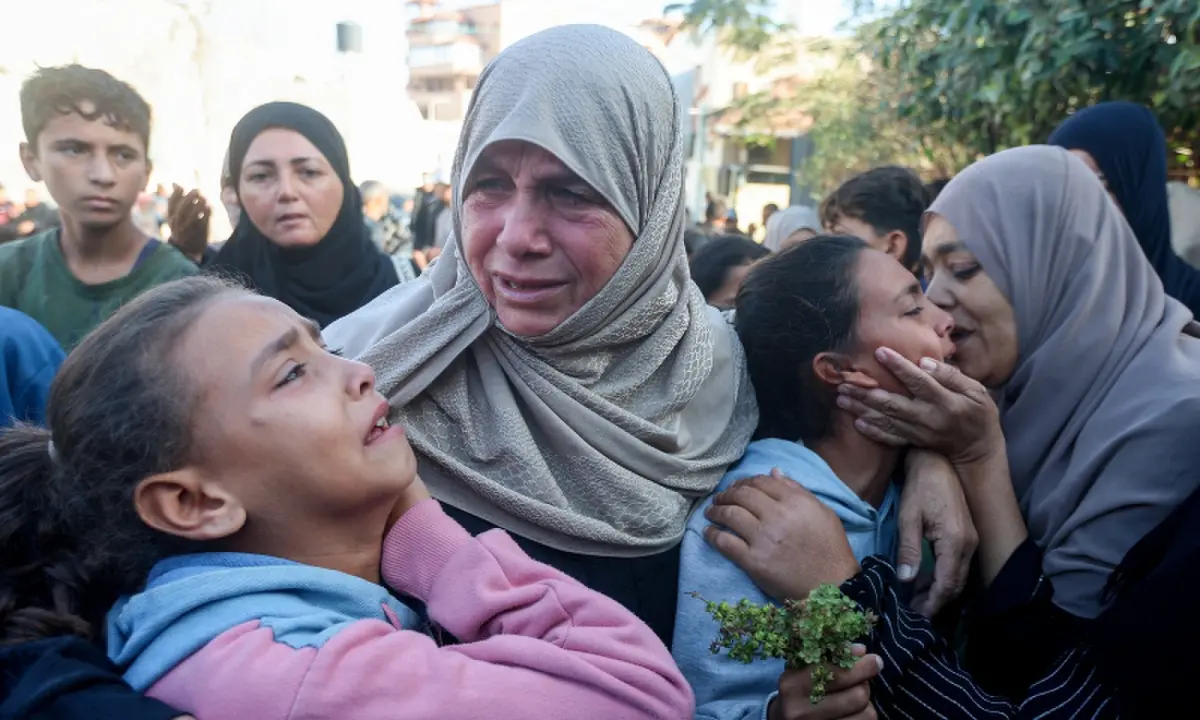
Israeli airstrikes in Gaza on Tuesday killed seven people, including Hamas’s director of internal security, Palestinian officials in the territory told AFP, despite a ceasefire in place since last year.
Israel’s military said it had struck a senior Hamas official.
Gaza’s interior ministry said an airstrike in Gaza City killed Brigadier General Naeem Abu Nahal, director-general of the Internal Security Service.
Mahmoud Bassal, spokesman for Gaza’s civil defence agency, told AFP that several other people were in critical condition following the same strike in Gaza City’s Rimal neighbourhood.
The strike comes as talks are underway in Israel to form a new government after October legislative elections produced no clear winner.
Centrist Gadi Eisenkot wants to form a coalition to end caretaker prime minister Benjamin Netanyahu’s long tenure.
But Netanyahu, who has staked his reputation on ensuring security for Israel after the Hamas attack of October 7, 2023, remains in charge of military operations while negotiations continue.
Police station strike
Bassal said earlier on Tuesday that three people, including a 17-year-old, had been killed in a separate Israeli airstrike near Gaza City.
Three more were also killed in a third airstrike on a police station in the Al-Mawasi area in southern Gaza, he added.
Gaza’s police force said two policemen aged 23 and 33 were among the dead.
It condemned the strike as “part of an ongoing campaign targeting the police apparatus”.
Israel’s military said it “struck terrorists in the area” of the police station, but did not confirm the strike that killed the 17-year-old.
Israel and Hamas regularly accuse each other of violating the ceasefire that came into effect in October 2025, after two years of war triggered by the October 2023 attack.
More than 1,650 Palestinians have been killed since the start of the truce, according to an AFP tally based on data from the Gaza health ministry.
In the same period, the Israeli military says seven of its soldiers have been killed, as well as one civilian contractor. Most of Gaza’s population of 2.1 million live displaced in tents or makeshift shelters in the territory, where Israel’s military says it controls more than 60 per cent of the land.
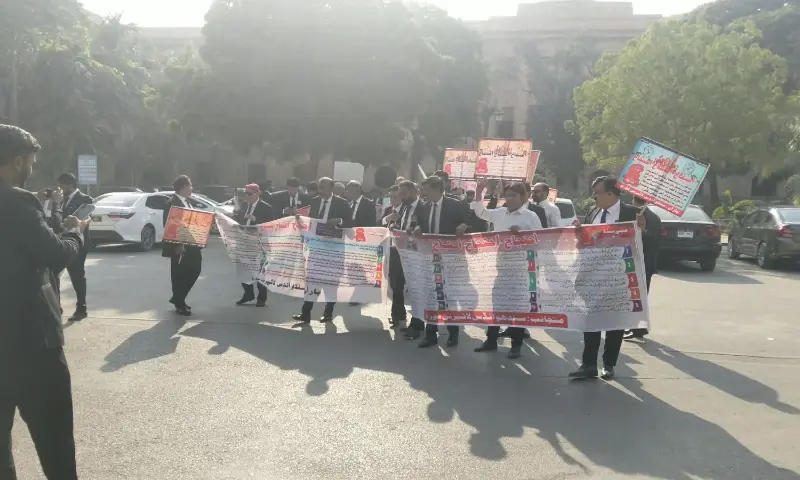
KARACHI: Commuters in Karachi’s Saddar area faced traffic congestion and inconvenience on Tuesday after authorities closed roads around the PIDC junction in response to a sit-in call by the Sindh Indus Lawyers Forum (SILF).
In an alert issued at 1:16pm, Karachi Traffic Police said both roads from PIDC Chowk towards the State Life Building, as well as Dr Ziauddin Ahmed Road, were closed to traffic.
As an alternative route, traffic was diverted from PIDC Chowk towards Club Road and from the State Life Building towards Beaumont Road.
According to a statement issued by SILF, lawyers staged a sit-in outside the Sindh High Court. The forum has put forward 16 demands under the banner of ‘Sindh Demands’, including opposition to the division of Sindh and the Jalalpur Canal.
The protest call comes as the debate over a “system reset” in the country has intensified over the past few months. In July, Interior Minister Mohsin Naqvi stirred a political storm by calling for the creation of new administrative units, arguing that the current system of governance had “collapsed” and needed a “reset”.
The PML-N-led federal government has insisted on holding a referendum across the country on the establishment of new provinces or administrative units.
However, the suggestion has faced severe backlash from its ally PPP, with party chairman Bilawal Bhutto-Zardari saying that any “forced” attempt to divide provinces, particularly Sindh, could lead to bloodshed.
“[SILF’s] demands also include opposition to constitutional amendments and the proposed amendment,” the forum’s statement said, in an apparent reference to the 26th and 27th constitutional amendments.
Moreover, SILF’s demands, according to its statement, include stopping alleged irregularities in Sindh Public Service Commission and alleged government intervention in lawyers’ bars.
“Corporate farming and mining in Karoonjhar mountain should be stopped and political prisoners should be released,” SILF said.
On Sunday, a large number of people from across Sindh took to the streets of Karachi in a rally organised by the Jeay Sindh Rahbar Committee, an alliance of four nationalist parties, to protest against any plan for the creation of new provinces or administrative units in Sindh.