IMAGINE a woman in Islamabad arriving at a government office to pay a fee. She has the money, but no bank account and no smartphone of her own. The counter no longer accepts cash. The official points her towards a QR code. She asks someone nearby to make the payment for her. The payment goes through, but she has had to depend on a stranger to make it.
This is a hypothetical situation, but it captures a problem beneath the government’s plan to make Islamabad cashless by the end of December. Do people have the means to participate? And what happens to those who do not?
There are good reasons to encourage digital payments. They can make transactions easier to trace, reduce delays and help bring economic activity into the formal system. Raast and other payment infrastructure can make this possible at a scale that cash cannot. But encouraging digital payments is different from withdrawing cash before people have a workable alternative. That distinction matters.
The Pakistan Bureau of Statistics’ Household Integrated Economic Survey 2024-25 puts the gap in perspective. Internet use among individuals stands at 57 per cent, falling to 49pc in rural areas, compared with 69pc in urban areas. Only half the population owns a mobile phone. Ownership is 69pc among men and 39pc among women. These figures do not tell us how many people can use a banking application, but they do show how uneven access to the basic tools of a cashless economy remains.
People should not be turned away from a government office because they cannot make a digital payment.
The gap is even wider when we look at access to financial services. According to the World Bank’s Global Findex 2025, based on 2024 data, only 12pc of women in Pakistan have an account, compared with 42pc of men. Digital payment use stands at 13pc for women and 40pc for men. Among the poorest 40pc of adults, only 9pc made digital payments, compared with 33pc among the wealthiest 60pc.
For someone with a bank account, a smartphone and reliable internet, cashless payments may simply be more convenient. Someone paying in cash, living on an irregular income, sharing a phone or unfamiliar with digital interfaces may experience the same change as an additional expense. They may have to travel to an agent, pay a fee or ask someone else to make the transaction. They may also be unable to pay when a system is unavailable. The fact that everyone is being asked to use the same system does not mean everyone is equally able to use it.
This becomes a more serious concern when the state makes digital payment the only option. From Dec 1, Islamabad’s ICT administration and CDA departments are expected to stop accepting cash. What will happen to someone who has no bank account or cannot use a digital application? Will there be assisted payment facilities? What happens during a network outage, a failed transfer or a disputed transaction? People should not be turned away from a government office because they cannot make a digital payment.
Access is only part of the issue. A cashless economy also changes the information generated by ordinary transactions. A digital payment can create a record of who paid whom, how much and when. Depending on the system, it may also be linked to a location or other identifying information. Over time, these records can reveal patterns of work, movement, consumption and association.
Of course, this does not mean government departments can simply access everyone’s financial records. That depends on the legal powers they have and the arrangements governing access to the information. But as more everyday activity moves onto digital payment systems, these questions become harder to ignore.
Pakistan’s wider digital transformation makes this concern more immediate. Government departments are developing systems to exchange data, while digital identity and AI-assisted services are becoming part of policy discussions. Much of the promise of these systems lies in bringing information from different sources together. But that also creates the possibility of using information beyond the reason it was originally collected. Data generated to complete a payment should not become available for unrelated profiling or decision-making simply because it is technically possible to combine datasets.
This raises some basic questions. Who can access transaction data, and for what purpose? How long is it kept? What safeguards apply when banks, payment providers and public bodies are involved? Can individuals find out if their information has been misused and seek a remedy? Pakistan has sectoral financial regulations and legal protections, but it still lacks an enacted, comprehensive personal data protection law. As the amount of financial information being generated grows, the absence of clear and enforceable rules becomes harder to justify.
The government should measure Cashless Islamabad by more than the number of merchants displaying QR codes. It needs to establish who is being left out and provide assisted, low-cost ways to pay. Cash or another accessible alternative should remain available where digital access cannot reasonably be assumed, particularly for essential public services. A policy deadline cannot substitute for evidence that these arrangements actually work. There should also be clear procedures for failed transactions, refunds and complaints. Access to payment data must be limited by law and purpose, with proper audit trails and independent oversight.
Moving towards digital payments may help document economic activity and make transactions easier. But before making cash unavailable, the government needs to ask a more basic question: can people actually use the alternatives being offered to them?
The state is changing more than the way citizens pay. It is changing the conditions on which they participate in public and economic life. That change should make participation easier, not leave people behind because of their income, gender, location or access to technology.
The writer is a technology lawyer specialising in data protection.
• Core committee briefed on jailed founder’s instructions to expand political alliance • PPP urges PTI to first prove its role as effective opposition before seeking wider cooperation
ISLAMABAD: The PTI’s core committee was informed that incarcerated party founder Imran Khan wanted it to expand its political alliance and reach out to JUI-F chief Maulana Fazlur Rehman and other opposition parties to build a broader front.
Meanwhile, the PPP played down the PTI’s invitation to join a new alliance, urging the latter to first demonstrate its role as the main opposition party inside and outside parliament.
The instructions were conveyed to the core committee during an overnight meeting that began on Monday. Lawyer Latif Khosa briefed members on his meeting with Mr Khan and his wife, Bushra Bibi, at Adiala jail on Nov 11. Another of Mr Khan’s lawyers, Salman Safdar, was also present during the meeting with the couple.
In a statement issued on Tuesday after the core committee meeting, the PTI said Mr Khan had expressed “complete confidence” in the opposition leadership and directed the party to expand its political alliance.
New provinces
Mr Khosa also briefed the core committee, chaired by PTI Chairman Barrister Gohar Ali Khan, on Mr Khan’s instructions regarding the creation of new provinces.
The committee was told that Mr Khan wanted the matter to be “deliberated upon in detail at the forthcoming meeting of PTI’s parliamentary party”. Recommendations would subsequently be presented to him for a decision, the statement said.
The committee expressed serious concern over Mr Khan’s health and demanded implementation of the Supreme Court’s Aug 18 order directing authorities to transfer him to Shifa International Hospital in Islamabad.
It also called for the implementation of judicial orders concerning Bushra Bibi’s medical treatment.
Referring to a recent letter written by Mr Khan to top judges, the committee urged the judiciary to take immediate notice of his concerns and ensure access to personal physicians for a comprehensive medical examination and treatment.
The core committee condemned the continued detention of Sohail Afridi, who has been rendered non-functional as Khyber Pakhtunkhwa chief minister following the imposition of governor’s rule, and other PTI lawmakers.
It criticised the extension of detention orders under Section 3 of the Maintenance of Public Order (MPO) against elected representatives and political workers.
The committee appealed to the Federal Constitutional Court and its chief justice to modify the existing stay order concerning Section 3 of the MPO and provide relief to political leaders and workers who had been granted bail by the Peshawar High Court before Nov 5 but whose release orders remained unimplemented because of the stay.
It also decided to observe Nov 26 as “Martyrs’ Day” to commemorate those killed during the 2024 protests.
‘Opposition’s role’
Meanwhile, PPP General Secretary Nayyer Hussain Bukhari said the party had not decided to withdraw from the federal government, although the possibility could be considered at a meeting of its Central Executive Committee in light of prevailing circumstances.
He said President Asif Ali Zardari had always prioritised political reconciliation and consensus, but the PPP was also paying a “political price” for being part of the government.
Mr Bukhari said the PTI had yet to respond to PPP Chairman Bilawal Bhutto-Zardari’s invitation to return to parliamentary standing committees. He said the PTI was neither visible as an effective opposition in parliament nor outside it and should present a clear political agenda instead of merely raising slogans.
On the issue of new provinces, he said the PPP wanted both the PML-N and the PTI to clearly announce their positions. He questioned the silence of PML-N President Nawaz Sharif, Prime Minister Shehbaz Sharif and Punjab Chief Minister Maryam Nawaz, saying statements by PML-N ministers also reflected confusion and inconsistency.
He noted that the PTI also maintained that the creation of new provinces was part of its manifesto.
THE killing of television anchor Rabia Ahsan in Rawalpindi this month revives a question Pakistan has yet to answer: how can we better protect women from those who threaten them?
In August, digital media executive Hina Javed was found murdered. Last year, the killing of teenager Sana Yousaf in Islamabad and the shooting of a couple in Balochistan for choosing each other provoked public outrage.
Though circumstances differ, the deaths show women may pay with their lives for asserting their independence or defying the expectations of others.
As the world observes the International Day for the Elimination of Violence against Women today, Pakistan must also remember those whose suffering never makes headlines.
According to the Human Rights Commission of Pakistan, at least 470 women were killed in the name of so-called honour in 2025. Rights group Sahil recorded 3,172 cases of gender-based violence in the first half of 2026.
These figures do not capture the abuse hidden by fear, financial dependence and pressure to protect family reputations. For many women, violence is not a lone incident but a prolonged pattern of intimidation, control and isolation, endured behind closed doors with little outside help.
Each high-profile killing brings grief, condemnation and demands for justice. But outrage fades while the failures that allow violence to flourish remain.
Hina Javed’s case illustrates this: nearly three months after her death, her trial has yet to begin, though police have submitted the investigation report. For women facing threats from husbands, relatives or rejected suitors, delays send a frightening message. Many hesitate to seek help, fearing that complaints will be dismissed as family disputes or that reporting abuse will provoke further retaliation.
This year’s UN campaign calls for justice, protection for survivors and an end to impunity — goals that will remain elusive in Pakistan unless laws against violence are effectively enforced. Complaints must be taken seriously; repeated threats and stalking must trigger prompt police intervention; and investigations must proceed without political or family pressure. Officers must be trained to recognise escalating danger, particularly where earlier assaults, death threats or access to weapons are involved, and to connect women at risk with emergency protection rather than send them home.
Women need accessible shelters, legal aid and financial support that make leaving an abusive situation a realistic option. Schools, families and community leaders must challenge the notion that women’s choices can sully someone’s ‘honour’.
The test for Pakistan lies not in how loudly it mourns a murdered woman, but whether it acts to protect the next one while she is still alive.
ISLAMABAD: The Executive Board of the International Monetary Fund (IMF) is expected to approve on Dec 11 the disbursement of about $1.21 billion to Pakistan under two concurrent programmes — the $7bn Extended Fund Facility (EFF) and the $1.4bn Resilience and Sustainability Facility (RSF).
The approval would mark the completion of the fourth review under the EFF and the third under the RSF.
Upon approval, Pakistan will have access to about $1bn (760 million Special Drawing Rights, or SDRs) under the EFF and about $210m (154m SDRs) under the RSF, bringing total disbursements under the two arrangements to about $5.7bn.
The two sides had reached a staff-level agreement (SLA) in the first week of October. Both programmes — the 37-month EFF and the 28-month RSF — are scheduled to conclude by September 2027.
The IMF staff had acknowledged in the SLA that programme implementation under the EFF remained broadly on track despite a challenging external environment.
It also noted Pakistan’s strong commitment to preserving macroeconomic stability, strengthening public finances, keeping inflation within the State Bank of Pakistan’s target range on a sustained basis, enhancing energy sector viability and strengthening social protection.
The IMF team, led by Iva Petrova, had also completed the 2026 Article IV consultation, a regular assessment of the country’s economic performance and policies, alongside the fourth review under the EFF and the third under the RSF during discussions held from Sept 23 to Oct 7.
The IMF staff had noted that, supported by the EFF, the authorities had successfully navigated the impact of the Middle East conflict and strong policies helped preserve macroeconomic stability.
Real GDP growth reached four per cent in the first three quarters of FY26. Although higher energy prices and supply disruptions subsequently weakened growth momentum somewhat, the IMF estimated full-year growth at 3.6pc.
The Fund had also noted that the current account remained broadly balanced in FY26, supported by strong remittances, while gross foreign exchange reserves rose to about $21.5bn by end-September.
Sovereign credit rating upgrades and renewed access to international financial markets also pointed to stronger policy credibility.
Nevertheless, the Fund highlighted considerable risks, particularly those arising from geopolitical tensions, volatile energy prices, tighter global financial conditions and trade disruptions.
The two sides had agreed that maintaining sound macroeconomic policies was critical to safeguarding stability amid continued vulnerability to external shocks.
In this regard, policy priorities would continue to include maintaining fiscal discipline through steadfast implementation of the FY27 budget, anchored by an underlying primary surplus of 2pc of GDP and supported by tax policy and revenue administration measures to place public debt on a sustainable downward trajectory.
In 2018, the world turned its microscope on Pakistan’s financial system. Placed on the Financial Action Task Force’s (FATF) “gray list”, the country was thrust into a frantic race to prove it could secure its financial system against the flow of illicit capital. It was a moment of national urgency, defined by rigorous audits and a desperate need to reclaim international legitimacy in a landscape shadowed by allegations of money laundering and terror financing.
The decision sent shockwaves through the country’s financial system and the resulting restrictions battered the economy.
Yet, even as policymakers were scrambling to bolster the defences of the nation’s financial system, vulnerabilities in the internal systems of Deutsche Bank’s Pakistan operations were complicating the fight against illicit money flows.
The global banking giant’s own assessment had classified Pakistan as a “restricted” high-risk country, subjecting businesses connected to it to additional checks and limitations. An internal report cited Pakistan’s “terrorism and Taliban links” and proximity to Iran as key reasons for the classification. Bank documents, however, show a history of overlooked alerts and bypassed regulations, and in some instances, an inability to identify who was truly moving the money in this “restricted country”.
These internal records are part of over 15 million internal Deutsche Bank files leaked to the journalists Josy Joseph and Khadija Sharife. The records span many of the bank’s most sensitive departments: financial crime, sanctions monitoring, internal auditing, and the units responsible for deciding whether risky clients stay or go. This report is part of Inside Deutsche Bank, a months-long investigation of the leak involving over 200 journalists from more than 50 countries.
The records reviewed by Dawn do not necessarily establish that suspicious or illicit transactions passed through the bank. What they reveal, however, is that while Pakistan was under intense international scrutiny over its financial controls, one of the world’s largest banks, while operating within the territory, struggled to distinguish customers from non-customers, monitor financial transactions and implement safeguards against financial crime.
The Pakistan operation
Deutsche Bank has held a commercial banking license in Pakistan since 1962. It processes hundreds of millions of dollars’ worth of transactions into, out of and within the country every year. It currently employs close to 100 staff in its Karachi and Lahore branches, offering Pakistan-based clients a “wide range of corporate and investment bank products and services, including foreign exchange, fixed income sales and trading, cash management, trade finance and treasury solutions for corporates”.
Over the years, the bank’s internal controls against financial crime have been found wanting in multiple jurisdictions across the world. It has paid billions of dollars in fines and settlements over interest-rate manipulation, failures to prevent money laundering and other misconduct.
In Pakistan, however, its small yet significant operation has maintained an image of respectability, not once being named in any scandal or accused of involvement in financial irregularities.
According to internal documents, Pakistan has been one of the most active countries in Deutsche Bank’s global trade finance business. In 2016, it ranked third by the number of letters of credit handled by the bank, behind only China and India. That year, Deutsche Bank processed an estimated €872 million in incoming funds and €255 million in outgoing funds for Pakistan.
Across its global network, the bank exchanged around 187,000 incoming and 174,000 outgoing cross-border payment instructions involving Pakistan in the same period. About six in 10 were in US dollars.
Locally, the bank’s operations were relatively small and largely hands-on. An internal Deutsche Bank Pakistan spreadsheet dated December 2019 shows its local teams dealt with an average of about 4,560 items a day across cash counters, cheque clearing, payment orders and electronic payments. None of these was fully automated, according to the document.
The spreadsheet also recorded more than 14,000 daily reviews of transactions flagged by sanctions screening, illustrating the substantial compliance workload the bank faced alongside its routine operations.
Local compliance challenges
In October 2019, the State Bank of Pakistan (SBP) introduced key requirements under its Trade-Based Money Laundering (TBML) framework and ordered banks to implement them with immediate effect. However, after feedback from some banks on implementation challenges, the regulator extended the deadline to September 30, 2020.
The framework, seen by Dawn, came on the heels of pressure from the FATF and aimed to strengthen “trade-related Anti-Money Laundering/Combating Financing of Terrorism (AML/CFT) regime and restrict possible misuse of banking channels”. It was part of a broader overhaul of processes relating to financial institutions.
Yet, internal records show Deutsche Bank Pakistan failed to implement two essential safeguards months after the September 2020 deadline: a price due diligence mechanism to identify artificially inflated or undervalued trade transactions; and an automated Management Information System (MIS) to monitor suspicious activity across its vast transaction volume.
“DB Pakistan Trade Finance has not fulfilled the SBP’s Trade Based Money Laundering (TBML) Framework requirements on implementation of a price due diligence mechanism and an automated MIS tool,” Khurram Amanullah, the bank’s principal auditor for Pakistan, wrote in an email on July 30, 2021, almost 10 months after the SBP’s revised deadline.
The email was addressed to Markus Weick, who was part of the bank’s Trade Finance Product Management team in Germany. At least a dozen other bank staff were copied.
According to Amanullah, “DB Pakistan Trade Finance spent excessive time in deciding whether to implement the relevant system in-house or outsourced to external vendor. (Lack of Diligence).”
Amanullah and Weick did not respond to requests for comment.
This wasn’t the first time the bank had flagged shortcomings in its trade finance processes in Pakistan. An earlier group audit, published in 2017, into Deutsche Bank Pakistan’s operations in 2016 had flagged similar concerns, stating: “Trade Finance Operations (TFO) does not always check whether underlying goods (HS Codes) for letter of credit (LC) transactions meet local requirements. In addition, Trade Product Management do not fully document expected client trade flows required to monitor [anti-money laundering] risk and identify potential red flags (GTB Due Diligence policy requirement).”
This was almost three years before the SBP ordered banks to address such risks. Yet it seems nothing had been done to mitigate them even by July 2021.
Whose money? Who knows
Beyond trade finance protocols, the 2017 audit report flagged another discovery: “DB Pakistan does not perform transaction filtering (sanction screening) for manual domestic cheque payments (€4.6bn in 2016) and a subset of local bank payments made through DBDC (global app).”
All banks in Pakistan are required to cross-check their clients against sanctions lists — such as the United Nations Security Council Consolidated Sanctions List and the National Counter Terrorism Authority Proscribed Persons List — and report any irregularities to the Financial Monitoring Unit, Pakistan’s central financial intelligence unit.
A banker with over two decades of experience in the compliance departments of various Pakistani banks told Dawn that the SBP requires banks to screen all active clients against these lists every month. “The lists are frequently updated, sometimes even within hours, so it’s common practice to perform the screening regularly,” he explained.
The 2017 audit report identified the risk that “DB Pakistan may process transactions with sanctioned/embargo counterparties or jurisdictions without detection.” The bank was clearly wary that some suspicious transactions may have escaped detection, especially considering the number of transactions and the quantum of funds involved.
This was against the Deutsche Bank Group’s own Embargo Policy, which mandates that “all transactions resulting in the transfer of assets or which instruct the transfer of assets are to be filtered against the applicable embargo lists prior to leaving DB Group, or subject to further processing within DB Group, to ensure DB Group does not process transactions with sanctioned designations”.
In 2016, the report noted, the matter had been escalated by the Pakistan operations staff to senior management, but the former were advised ”not to do anything further” because “… a system flag was due to be implemented across the group”.
This wasn’t the first time the bank had faced such a situation in the region. In 2015, according to the audit report, Deutsche Bank had paid a $258 million fine “as a result of sanction breaches for transactions in embargoed Middle East territories”. The report detailed that Deutsche Bank Pakistan had processed 76,821 unfiltered cheques worth €4.6 billion — €3.5 billion in deposits and €1.1 billion in payments — in 2016 alone. “The majority (circa €2.9bn of deposits) relates to one high-risk client, which is in the process of being off-boarded,” said the report. The audit report was silent on who this high-risk client was and why they were being off-boarded.
Another audit report from 2020 on Deutsche Bank Pakistan’s anti-financial crime functions noted that not a single Suspicious Activity Report or Suspicious Transaction Report was generated by the bank between July 2019 and June 2020 — a highly unusual occurrence given the volume of transactions the bank was handling. Banks must file such reports to legal and regulatory authorities whenever their internal compliance checks detect potential money laundering, terror financing or other financial crime.
Confusion over KYC function
In September 2019, Chiara Monaco from the anti-financial crime unit at Deutsche Bank’s headquarters in Frankfurt emailed bank staff in Pakistan to flag a concern regarding “certain sub-accounts in Pakistan belonging to customers not KYC’ed”.
KYC stands for “Know Your Customer” or “Know Your Client”. This is the information-gathering process by which a bank checks who you are, works out what you use your account for, and decides how risky you are as a customer. Banks need it to meet anti-money laundering (AML) and Combating the Financing of Terrorism (CFT) rules.
In another email the next day, Monaco wrote: “We found 1000s of subaccounts in Pakistan without KYC, opened for custody purposes and belonging to clients of State Street Bank and Bank of NY Mellon.”
“Can you please help [us] to fully understand the business model, the setup and background behind these accounts. They have not been KYC’ed,” she added.
The emails triggered a debate among the bank’s personnel regarding the nature of these accounts and whether they were subject to KYC regulations. Custody is a banking service where a bank holds and protects financial assets — stocks, bonds, securities and the like — on behalf of clients. In this instance, the “sub-accounts” referred to Special Convertible Rupee Accounts (SCRA) maintained by Deutsche Bank Pakistan for two major international financial institutions, both based in the United States.
An SCRA account, introduced by the Securities and Exchange Commission of Pakistan (SECP) in 2008, is a kind of specialised, repatriable bank account that allows non-resident investors, foreign nationals and overseas Pakistanis to trade freely in local capital markets.
The sub-accounts in question held money in the form of securities or treasury bonds belonging to other investors, many of whom never dealt with Deutsche Bank or its Pakistan operations directly.
“The local AML/CFT Regulations of State Bank of Pakistan require due diligence/KYC to be performed on the customers’ of the bank, where such underlying accounts do not fall under the definition of customers as per the regulations,” Zeeshan Waheed, the head of the compliance and anti-financial crime unit in Pakistan, wrote back. He added, “very recently we had a review being conducted by the Central Bank’s Inspection team and they had gone through the business model of DB Pakistan for Security Services and its operations, where they had not highlighted any concern/observation from an ML/TF risk point of view or overall controls with respect to compliance of local AML/CFT Regulations”.
A year earlier, the SBP had issued an update to its AML/CFT Regulations explicitly defining a “customer” as “any person having a relationship with the bank, such as holding deposits, placing money with the bank/DFI, availing financial services, locker facilities, safe deposit facilities, or custodial services”.
Under these regulations (Paras 7-9), banks are required to apply customer due diligence measures for all customers, including “identifying and verifying beneficial owners through reliable sources; understanding ownership/control structures for legal persons; and verifying senior managing officials where no controlling owner is identified”.
Moreover, according to the Anti-Money Laundering Act, 2010, a beneficial owner is defined as a “natural person who ultimately owns or controls a customer or the natural person on whose behalf a transaction is being conducted”.
The same law also provides a framework for due diligence as follows:
identify the customer and verify the customer’s identity on the basis of documents, data or information obtained from reliable and independent sources;
identify the beneficial owner and take reasonable measures to verify the beneficial owner’s identity on the basis of documents, data or information obtained from reliable sources and be satisfied that it knows who the beneficial owner is;
understand and, as appropriate, obtain information on the purpose and intended nature of the business relationship; and
monitor the business relationship on an ongoing basis.
Dawn reached out to Monaco and Waheed for comment, but did not hear back. Three bankers, who spoke to Dawn on condition of anonymity, said that the SBP requires banks to conduct customer due diligence (CDD) in these cases. “KYC/CDD requirements apply, although the precise extent of due diligence on each underlying investor depends on the account structure, customer relationship and applicable regulatory requirements,” one banker with over two decades of experience in compliance explained to Dawn via email. “Under Regulation R-2 of the SBP AML/CFT/CPF Regulations, banks must conduct CDD in accordance with the Anti-Money Laundering Act, 2010.”
Deutsche Bank Pakistan, the emails show, vacillated on whether the beneficiaries of custodial accounts were in fact its customers, despite the fact that the SBP and other banks did apply KYC requirements to such accounts.
The debate lasted more than two months before the issue was closed.
As of last year, Deutsche Bank Pakistan held Rs 143.63 billion in government securities and shares, as per its published financial statement. According to the statement, the bank does not treat these as its own assets. Until 2019 at least, it apparently did not know who the actual owners of these assets were.
The documents reviewed by Dawn do not make clear if the 2019 Trade-Based Money Laundering compliance framework and KYC disputes were ultimately resolved, whether any corrective measures addressed the concerns raised by senior compliance officials, or whether the deficiencies identified by auditors in 2021 were ever fully remedied.
Each of the audit reports reviewed by Dawn recommended short-term and long-term measures to be adopted by Deutsche Bank Pakistan to mitigate the risks flagged. It remains unclear whether these were implemented.
It also remains unclear whether any of these issues were taken up by the SBP as part of its annual audits. Despite repeated reminders, the SBP did not respond to a detailed questionnaire sent by Dawn.
In a summary response to over a dozen questions from Dawn, Deutsche Bank stated: “We do not comment on potential, former or existing client relationships.
“Deutsche Bank takes its obligations to prevent financial crime seriously and maintains controls designed to comply with applicable anti-money laundering, sanctions and other regulatory requirements.”
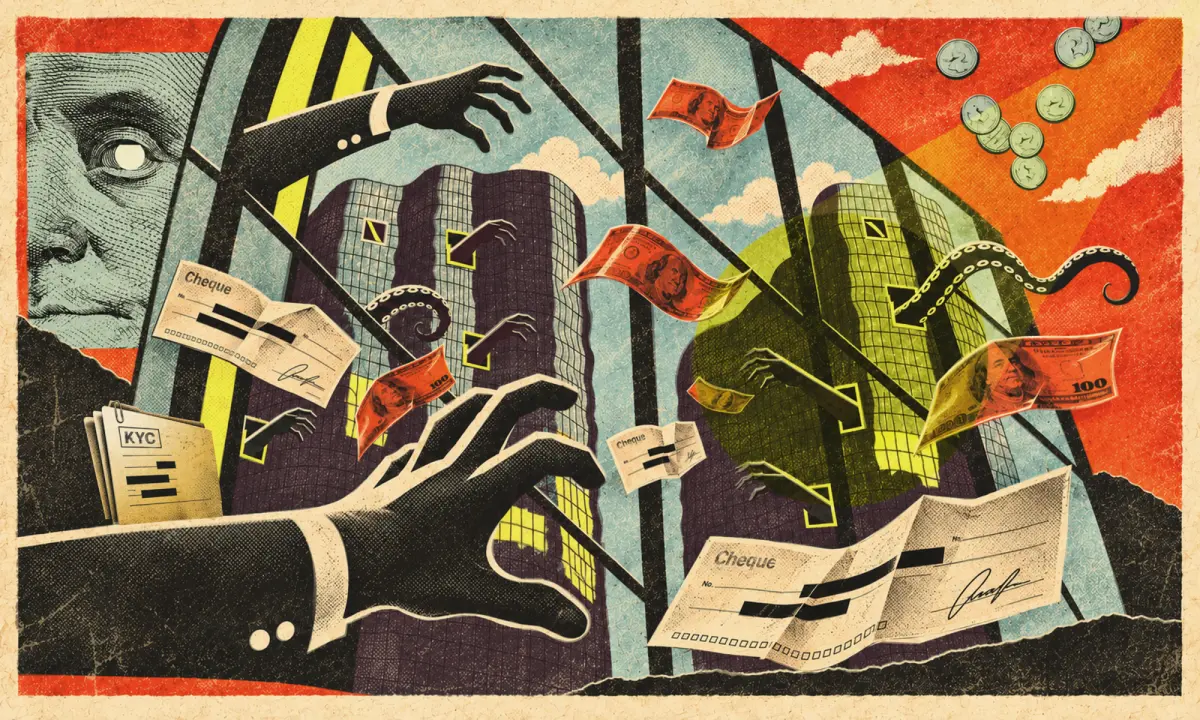
Editing by Roman Gautam/Himal Southasian; Header art by Mohsin Alam/Dawn
The Inside Deutsche Bank investigation was coordinated by Barracuda Media in South Africa, with technical support from the Data and Research Center (DARC) in Germany.
Forty-year-old Zeeshan Ali became the first Pakistani astronaut to enter orbit on Wednesday, after China’s Shenzhou-24 spacecraft entered its preset orbit following liftoff from the Jiuquan Satellite Launch Centre.
The launch of the spacecraft, which used a Long March-2F rocket, took place at 8:18am Beijing Time (5:18am Pakistan Time). Prior to that, a send-off ceremony was held for three astronauts, who comprise the mission’s crew, at the launch centre before they entered the spacecraft capsule.
Shortly after the liftoff, an official at the Jiuquan Satellite Launch Centre announced that the spacecraft had been sent to the preset orbit.
“The spacecraft is functioning well. I declare the Shenzhou-24 launch mission a complete success,” he said.
Planning Minister Ahsan Iqbal, who is in China, witnessed the send-off and the mission’s launch.
Later, he posted on X: “As Shenzhou-24 lifts off this morning, Nov 25, carrying Zeeshan Ali, Pakistan’s first astronaut, a new era begins for Pakistan’s space programme. With him, the Pakistani flag rises into orbit, lifting the hopes and aspirations of 260 million Pakistanis for technological advancement and space exploration. From highways to information super highways to skyways, Pakistan-China friendship and CPEC rises higher than the skies.
“This is Pakistan’s URAAN (flight) into space, and it is only the beginning of a brighter and more glorious future.”
The Shenzhou-24 spacecraft is bound for China’s Tiangong space station, and when the spacecraft docks with it, Ali will also become the first foreign national to board it.
China’s Tang Hongbo is commanding the mission, with Wu Yi serving as mission pilot and Ali as payload specialist.
Ali is expected to spend around a week in space, conducting various experiments alongside the Chinese crew. The China Manned Space Agency (CMSA) said the crew will conduct around 90 experiments during the mission.
The agency said the mission’s objectives included conducting an orbital rotation with the crew of the earlier Shenzhou-23 mission, carrying out routine operations and maintenance of the space station, and continuing space science research, including experiments involving space payloads.
‘Carrying hopes of 250m Pakistanis’
Earlier in April, Zeeshan Ali and Khurram Daud were chosen from Pakistan to start training in China. Pakistan’s space agency Suparco and CMSA signed a cooperation agreement in February 2025, under which two Pakistanis were to train in China, with one joining a mission on the Tiangong space station operated by Beijing.
Eventually, Ali was chosen to join the Chinese mission.
Speaking at a press briefing in Jiayuguan on Tuesday, Ali said he was “deeply grateful” to the Chinese government for helping “us realise our dream of going into space”.
He said he arrived at the Astronaut Centre of China a few months ago, carrying with him the hopes of 250 million Pakistani people.
Ali said he believed that “what comes after this flight matters more than the flight itself”.
“This mission is not a finish line; it is a launch pad. And I hope the next chapter of China-Pakistan space cooperation will grow from one astronaut, one flight to multiple joint flights, to the Moon, Mars and beyond.”
Addressing Pakistanis, he said: “I now feel the true weight of the words of our Prime Minister Shehbaz Sharif, when he told me that we were about to write a new chapter in Pakistan’s history. I want to assure you that I am not flying for myself. I carry the name of Pakistan on my shoulders, the hopes of 250 million Pakistanis.
“To every child who is watching while I am in orbit, just look up at the sky and remember that I am up there with your dreams.”
In his message to his family, he said: “I want to say that I will travel farther from home than ever before. But I promise you one thing: whenever I look back at the Earth for the first time, I will always search for the light of our home before I look at anything else. No matter how far I fly, we will still share the same Moon, and I will still be looking back at the same Earth.”
Stay at Tiangong
China’s self-built station, named Tiangong or Celestial Palace in Chinese, has been fully operational since late 2022. It can host up to six astronauts during handovers when an arriving three-person crew overlaps with the departing crew.
This time, the handover will be different.
Shenzhou-23 commander Zhu Yangzhu will stay on to support Beijing’s study of how the human body copes in space — a crucial step towards a planned crewed mission to the moon and a potential journey to Mars. The rest of the Shenzhou-23 crew will depart Tiangong alongside Ali.
Zhu, who will stay for a year, will hold the record for the longest single stay in orbit by a Chinese astronaut by the time he leaves.
ISLAMABAD: To meet a long-postponed structural benchmark of the International Monetary Fund (IMF), the federal cabinet on Tuesday approved the deregulation of the sugar sector, an end to its export subsidies and free movement among the provinces.
The cabinet approved the ‘National Policy for Deregulation of Sugar Sector’ through circulation while Prime Minister Shehbaz Sharif “recused himself from the sugar sector related decisions” owing to his immediate family’s sugar business, informed sources told Dawn.
The decision came after the government allowed the export of more than 400,000 tonnes of sugar on Friday, in addition to 200,000 tonnes already exported a few months ago.
The IMF has continuously pushed for a policy ending the government’s role in sugar sector operations, from sugarcane crop prices to sugar production and import-export, leaving it to market forces. The fund also minutely remained engaged with the terms and conditions of a ministerial committee which finalised the sugar deregulation policy.
Pakistan was in breach of the structural benchmark of the IMF since June 2026 and its approval was mandatory for scheduling the IMF executive board meeting, now set for Dec 11.
The policy approval was hampered by Sindh’s virtual veto, although three other provinces had already consented to the draft. After hectic backdoor negotiations, the Sindh government finally cleared the policy on Nov 21 after securing certain amendments.
The policy was finalised by a ministerial committee led by Power Minister Awais Leghari. The committee also includes the ministers for finance, food security and economic affairs; the premier’s adviser for industries; the chairman of the Federal Board of Revenue (FBR); secretaries of concerned ministries and provincial chief secretaries, as well as other stakeholders.
Being a structural benchmark of the IMF, the timeline for the completion of the process was June 30, 2026. The fund proposed revised Terms of Reference (ToRs) on July 31, 2025 for incorporation in the ToRs of the committee, which were agreed to by the prime minister, official records seen by Dawn suggested.
The Ministry of Industries and Production, on the IMF’s directions, “inserted some amendments and shared the said draft policy with the IMF” by the end of August, which were fine-tuned by the fund again on Oct 1. It was insisted that the Sindh government’s agreement was necessary for completion of the structural benchmark.
The policy provides a predictable mechanism for imports and exports with a complete end to export subsidies, the cabinet was told. There will be no restrictions on the inter-provincial movement of sugar, and transitional arrangements have been provided for the current crushing season.
At the input stage, the government has removed restrictions on planting zones and cane varieties, providing freedom to cane producers to sell their crop to any buyer and mills to sell their product. The sugarcane price has now been left to market forces to determine, but there will be a negative list of banned sugar varieties.
At the processing stage, there will be no restriction on the establishment of new mills or capacity approvals for mills; the millers will have the freedom to choose raw material sources and take market-based production decisions. Price controls by the governments will come to an end.
For creating an enabling environment for smooth transition, the deregulation policy provides certain safeguards to the farmers in the shape of third-party validation of weighing scales, sucrose testing framework and interest payments by millers on the late payment of sugarcane dues.
The sugarcane cess has been promised for effective use of research, as well as easy access to credit for farmers and millers, along with farm mechanisation schemes going ahead.
The policy, nevertheless, retains the government’s right to maintain buffer sugar stocks and take measures to access correct and timely information on sugarcane crop, sugar production and market availability. It will also encourage working towards mandating ethanol blending and providing a fair and competitive market.
The Collectorate of Customs (CoC) (airports) in Karachi foiled a narcotics smuggling attempt and seized 900 grams of marijuana during routine scanning at the International Mail Office (IMO), Pakistan Customs said on Tuesday.
During routine scanning, Customs staff intercepted a “suspicious parcel” originating from Canada’s Ontario and destined for Multan, the statement said.
“The parcel was declared as ‘Books (Gift)’. However, physical examination by Preventive Officer Muhammad Shah Jahan revealed boxes of chocolates and cereals, within which the 900 grams of marijuana was concealed,” the press release said.
The seized marijuana was valued at approximately Rs. 27.25 million, Pakistan Customs said.
The consignment was shifted to the Directorate of Enforcement and Compliance (DEC) headquarters at Jinnah International Airport for further necessary proceedings.
A first information report (FIR) has been registered in the case and further legal proceedings were underway, Pakistan Customs said.
“Reflecting continued vigilance, Pakistan Customs remains committed to curbing narcotics smuggling and safeguarding public welfare.”
Riyadh’s tallest skyscraper was struck for the second time in days on Tuesday, injuring 11 people, as the coalition fighting Houthis denounced a “terrorist attack”.
The building, which was also attacked last Thursday, is one of several high-profile targets hit since hostilities with the Houthis restarted in July.
Saudi Arabia’s Civil Defence reported Tuesday’s injuries and posted a picture of the landmark tower housing the headquarters of the Saudi Public Investment Fund (PIF).
The image showed some damage to the building about halfway up the facade, similar to the impact from a strike on the same tower on Nov 19, which caused damage but no injuries.
Reuters could not immediately determine when the image was taken or the extent of the further damage from the latest strike.
Saudi Civil Defence said the 11 people injured included two Saudi citizens, four Egyptian nationals, three Nepalese nationals and two Indian nationals.
“Relevant authorities responded to the incident immediately, implementing all established protocols and measures for handling such situations, and taking the necessary steps to ensure the safety of lives and property,” the Arabic statement said.
“One of the towers in the financial centre was targeted in a cowardly terrorist attack,” coalition spokesperson Turki al-Malki said in a social media post, without naming the building.
Standing 385 metres high, the PIF tower is the most prominent landmark of King Abdullah Financial District (KAFD), a showcase for Saudi Arabia’s economic ambitions.
A witness told AFP that a vehicle fitted with a speaker had warned pedestrians in the area to take cover on Tuesday. No warning was sent to mobile phones about any threats to the capital.
Afterwards, police cars blocked some entrances to the gleaming financial district. With imposing skyscrapers, luxury shops and green spaces, the district also hosts the headquarters of the Saudi stock exchange along with multinationals such as Goldman Sachs.
An attack on the PIF is symbolic as the fund is driving efforts to diversify the oil-reliant Saudi economy — a project that has been complicated by the Middle East war and Houthi strikes.
The Houthis, who control much of western Yemen including the capital Sanaa, have been firing at Saudi airports, oil infrastructure and office buildings since Yemen’s frozen civil war reignited in July in a knock-on from the US-Iran war.
The attacks have caused the cancellation of most international flights to Riyadh, and forced Saudi Arabia to postpone or cancel major international events, including soccer’s AFC Asian Cup.
Such cowardly attacks undermine peace efforts: Pakistan
Pakistan strongly condemned the “terrorist attack carried out today by the Houthi militia”, the Foreign Office said.
In a statement, FO said Islamabad denounced “such cowardly attacks, which endanger civilians and civilian infrastructure, heighten regional tensions and undermine efforts to restore peace and stability”.
“Pakistan stands in full solidarity with Saudi Arabia in the face of these attacks. The Kingdom has every right to defend its territory and protect its citizens and residents,” FO affirmed.
It expressed Pakistan’s deep sympathies with those injured and their families and wished them swift and full recovery. FO also commended the Saudi authorities for their “prompt response” and the steps taken to protect lives and property.
Islamabad has condemned Houthi attacks repeatedly, including on international platforms, and termed them a grave violation of the kingdom’s sovereignty.
Under the Makkah Defence Alliance, Pakistani, Saudi and Turkish leaders met in Riyadh in October and agreed to deploy military forces and capabilities rapidly in the kingdom.
Pakistan is providing “whatever support is needed” to defend Saudi Arabia amid the Houthi attacks, the military’s spokesperson Lieutenant General Ahmed Sharif Chaudhry said later that month.
‘26 killed in Yemen attack’
On the ground in Yemen, the war has caused a major humanitarian crisis, with hundreds of thousands of people displaced from their homes since July.
The Houthis have seized swathes of territory, forcing forces aligned with the internationally recognised government to stage a major retreat this month.
The Saudi-led military coalition has been striking Houthi targets in the impoverished country.
On Tuesday, local officials said a coalition airstrike on buses and trucks killed 26 people in Lahj province. On the other hand, government forces blamed the Houthis for the attack.
As the conflict shows no sign of slowing, Britain sanctioned the Houthis and four of its top officials “for deliberately attempting to undermine stability” on Tuesday.
The measures include an asset freeze against the group and an asset freeze and travel ban on four figures, including security and intelligence head Abdul Hakim Hashem Ali al-Khaiwani, and interior affairs official Abdulkarim Amir al-Din Hussein al-Houthi.
The Saudi-led coalition intervened in Yemen in early 2015, after the Houthis had captured the capital Sanaa and sent the internationally recognised government fleeing to Aden.
The war left hundreds of thousands dead and triggered a humanitarian catastrophe before an uneasy ceasefire went into effect in 2022.
Technology shares led a market retreat on Tuesday as caution returned after Jensen Huang’s extraordinary return to AI giant Nvidia days after he was forced to resign, with investors bracing for further volatility in a key sector driving economic growth worldwide.
A day after Huang’s reinstatement as CEO drove Nvidia shares up more than 30 per cent, adding more than $900 billion to the firm’s market value, the euphoria dissipated as its stock lost almost 9pc mid-session.
Fellow tech behemoth and AI giant Anthropic also slumped, giving up around 12pc to $77.19, below its $83 price for last week’s IPO.
Monday aside, AI stocks had already sold off sharply throughout November on worries about profitability and the vast sums pumped into the sector.
Overall, the tech-heavy Nasdaq shed 2.3pc and the broader-based S&P 500 lost 1.1pc, while the Dow was just into the green around 1700 GMT (10pm PKT).
Europe’s main stock markets, which feature far fewer tech companies than their Asian and US rivals, finished a handful of percentage points lower after jumping on Monday in line with Wall Street.
Away from the tech sector, French pharmaceutical giant Sanofi revealed it would buy the US biopharma group Insmed, a specialist in respiratory treatments, for $41bn as it races to bulk up its development pipeline of new drugs.
Sanofi’s share price closed up almost 10pc following the news.
Huang had resigned less than two weeks ago over extramarital affairs, reportedly with an alleged Chinese spy as well as a senior Nvidia executive before US President Donald Trump noisily declared he should be brought back.
“Jensen’s return takes away one of the biggest unknowns hanging over the AI trade,” said Charu Chanana, an investment strategist at Saxo Markets.
“He is not just Nvidia’s CEO; he is arguably the biggest salesman for the entire AI ecosystem. His relationships with customers, suppliers and capital providers are difficult to replicate,” she said.
But “Jensen Huang alone cannot support the AI trade in the long term,” said Kathleen Brooks, research director at XTB.
“Nvidia’s stock price decline on Tuesday is to be expected after such a large rally in the previous session,” she added.
Analysts were in broad agreement that Huang’s return did not mean an end to probes or the uncertainty that has clouded the AI trade for six months.
The company remains under scrutiny from investigators including at the FBI and on Capitol Hill for allegedly helping Chinese firms gain access to Nvidia’s top-line chips.
Monday’s Wall Street surge had propelled Asian markets earlier on Tuesday, with Taipei surging 9pc higher as chip titans TSMC and MediaTek added nearly 10pc each.
Seoul piled on more than 6pc thanks to strong gains in fellow chip giants SK Hynix and Samsung, and Tokyo rose nearly 4pc, led by a 12.5pc jump for semiconductor tester Advantest.