ISLAMABAD: The Federal Constitutional Court (FCC) held that prefabricated industrial structures cannot be excluded from the scope of the terms “plant”, “capital goods” or “capital equipment” merely because they are described as buildings, classified outside the machinery chapters, or are not mechanically attached to production machinery.
Eligibility turns upon their demonstrated industrial function and compliance with the governing statutory description and prescribed conditions. Mere location within an industrial undertaking or Special Economic Zone does not confer exemption upon ordinary accommodation or unrelated civil construction.
The judgment authored by Chief Justice Amin-ud-Din Khan dismissed the federation and FBR appeals against the Sindh High Court judgment. The Court also allowed the Orient Material’s petition and set aside the Lahore High Court decision.
The FCC declared the Office Memorandums dated 22.01.2021 and 02.03.2021 as without lawful authority insofar as they categorically exclude qualifying prefabricated industrial structures or require mechanical linkage as a condition of eligibility.
Thematters before the FCC arose from divergent High Court judgments concerning exemption or concession on imported prefabricated industrial structures. The Revenue Division filed appeals against the Sindh High Court judgment dated 16.11.2010, which allowed the respondent companies’ (Aisha Steel Mills Limited and others) claims for concession under Serial No.21 of S.R.O. 575(I)/2006, to import prefabricated structures for a steel rolling mill at Bin Qasim, Karachi.
Whereas, M/s Orient Material (Private) Limited challenged the Lahore High Courtjudgment dated 14.05.2026, which upheld the FBR decision to deny the claimed exemption under PCT heading 9917(2) for prefabricated steel structures imported for its ceramic manufacturing unit in the Faisalabad Special Economic Zone.
The judgment said that the SHC’s conclusion in the matters concerning Aisha Steel Mills Limited is legally sustainable. The reasoning in Aisha Steel Mills Ltd. v. Federation of Pakistan, 2011 PTD 569, supports the same approach: eligibility depends upon the governing definition, the structure’s demonstrated industrial function and compliance with the prescribed conditions, rather than its designation alone. The relaxation of the local-manufacture condition through S.R.O. 554(I)/2008 and S.R.O. 1226(I)/2008 must be applied where the prescribed requirements are met. A notification’s beneficial character does not, by itself, render it retrospective. Entitlement is governed by the notification in force on the relevant statutory date under section 30 or, where applicable, section 30A of the Customs Act, 1969. Applying a notification already operative on that date is prospective application, even if the contract was concluded or the letter of credit established before its issuance.
The judgment said that Orient’s claim is governed by the SEZ Act: section 2 provides overriding effect; section 3(e) defines “capital equipment”; section 34 distinguishes statutory entitlements from additional benefits; section 35 protects incentives; and section 37(a), as applicable to the imports concerned, grants a conditional one-time import exemption. Read with the relevant fiscal provisions, this framework requires the Revenue to grant the concession upon fulfilment of the prescribed conditions and precludes its refusal on grounds unsupported by law. The Lahore High Court erred in denying Orient’s claim to an existing concession for want of approval under section 34(2), which concerns additional benefits. Although any verification by the Board of Investment required by law remains necessary, approval for an additional incentive cannot be imposed as a condition of an existing statutory exemption.
ISLAMABAD: A leading coal supplier has warned that an interim stay order restraining the implementation of a competitively awarded long-term coal procurement contract for Huaneng Shandong Ruyi (Pakistan) Energy (HSR) could impose an additional financial burden of USD10.83 million annually on electricity consumers, sources close to Chairman NEPRA told Business Recorder.
In a representation submitted to the National Electric Power Regulatory Authority (NEPRA) and the Central Power Purchasing Agency-Guarantee (CPPA-G), the supplier has urged the two power-sector entities to take measures to protect the outcome of the competitive bidding process and prevent additional fuel costs from being passed on to consumers.
The company stated that the recent HSR tender had secured a coal price discount of USD5.66 per metric ton against the API4 index, compared with the previous long-term agreement discount of USD2.05 per ton.
With HSR’s annual coal consumption estimated at three million metric tons, any reversion to the previous discount would increase procurement costs by USD3.61 per ton, translating into an additional annual burden of approximately USD10.83 million.
The supplier argued that the additional cost would ultimately be reflected in fuel cost adjustments and electricity tariffs, leaving consumers to bear the financial consequences of the litigation.
According to the representation, the interim stay order was passed on November 6, 2026, by a Civil Court, Islamabad-West, in proceedings initiated against HSR’s long-term coal procurement tender. The supplier maintained that the stay had been granted ex parte, before NEPRA and CPPA-G, which are also defendants in the case, were heard.
It argued that an interim stay was not a final adjudication and that commercial grievances arising from a bidding process should be examined on the basis of procurement records rather than at the expense of electricity consumers.
The company further contended that the prudence of fuel procurement by a generation licensee, its treatment under the Fuel Cost Component and related tariff determinations fall within NEPRA’s regulatory jurisdiction under the Regulation of Generation, Transmission and Distribution of Electric Power Act, 1997.
The representation also raised concerns about fuel security at HSR’s 1,320MW Sahiwal coal-fired power plant, which depends on imported coal.
It said any delay in finalising the new long-term coal supply arrangement could create uncertainty regarding fuel availability. In the interim, the available options would either be an extension of the existing contract at the lower discount of USD2.05 per ton or purchases from the spot market, both of which could increase costs for consumers.
The supplier warned that any generation shortfall at the Sahiwal plant, located in northern Pakistan, could further constrain electricity generation and push up system costs, particularly amid the ongoing LNG force majeure situation.
It also cautioned that allowing civil litigation to interrupt competitively tendered procurement could establish an undesirable precedent for the power sector, exposing future procurement exercises to similar delays and uncertainty and discouraging suppliers from participating in competitive bidding.
The company has requested NEPRA and CPPA-G to formally take cognizance of the estimated USD10.83 million annual additional burden and take appropriate measures to protect the competitive procurement outcome and consumer interests.
Among its proposals, it has urged the authorities, subject to any order of a competent court, to allow HSR to proceed with the new long-term coal procurement contract at the tendered discount of USD5.66 per metric ton.
Alternatively, it proposed that any extension of the existing year’s contract should be allowed at the newly achieved discount, with an equal allocation of the supply quantity among suppliers to ensure cost efficiency, supply diversity and reliability.
The company has also called upon NEPRA and CPPA-G to contest the litigation through their own legal counsel and seek vacation of the interim stay before the competent appellate forum, including on the question of the civil court’s jurisdiction over matters falling within NEPRA’s regulatory domain.
It further suggested that appropriate directions may be sought from the Islamabad High Court to prevent civil litigation from disrupting regulated procurement processes in the power sector in future.
JIUQUAN: China’s Shenzhou-24 space flight launched successfully on Wednesday morning, with its three-man crew including a Pakistani national, who will be the first foreign astronaut to board the Tiangong space station.
Using a Long March-2F rocket, the spacecraft took off at 8:18 a.m. (0018 GMT) from the Jiuquan Satellite Launch Centre in northwest China.
Zeeshan Ali, a 40-year-old pilot who will become the first Pakistani in orbit, will work as a payload specialist and is set to stay at the station for 5 to 10 days, conducting experiments.
He is accompanied by Chinese commander Tang Hongbo and flight engineer Wu Yi.
China is promoting Tiangong as a hub for international cooperation while the NASA-led International Space Station faces possible retirement by 2030.
To prepare for the flight, Ali trained for seven months in Beijing, during which he underwent intensive Chinese-language classes, learning Chinese songs and reading Chinese poetry. He also practised calligraphy and played table tennis.
“I’m not flying for myself. I carry the name of Pakistan on my shoulder,” Ali told reporters on Tuesday.
BEIJING: The first foreign astronaut on a Chinese space mission said on Tuesday that he will be carrying “the hopes of 250 million Pakistanis” when he blasts off from the Gobi Desert on Wednesday.
Beijing has poured billions into the Chinese space programme, whose prized Tiangong space station is stewarded by teams of three astronauts, typically rotated every six months.
The Shenzhou-24 mission is set to lift off at 8:18 am (0018 GMT) on Wednesday from the Jiuquan launch centre in northwest China, China Manned Space Agency (CMSA) spokesman Zhang Jingbo told a news conference on Tuesday.
Muhammad Zeeshan Ali, a Pakistan Air Force pilot and payload specialist, will be the first foreign astronaut to fly on a Chinese space mission and also the first non-Chinese to board the Tiangong space station.
“I carry the name of Pakistan on my shoulder, the hopes of 250 million Pakistanis,” Ali told a separate news conference held later to introduce the crew.
“To every child who is watching while I’m in orbit, just look up at the sky and remember that I am up there with your dreams,” he said in English, following other remarks in Urdu and fluent Mandarin.
Ali will join a short orbital flight expected to last around five days before returning with the Shenzhou-23 spaceship, which docked at the Tiangong in May.
Pakistani officials welcomed Ali’s selection as a significant step in relations between Islamabad and Beijing, which have blossomed in recent years.
Pakistani Information Minister Attaullah Tarar described the mission as a “source of joy and pride for the entire nation”.
“China and Pakistan are all-weather strategic cooperative partners,” Chinese foreign ministry spokesman Guo Jiakun told a regular briefing on Tuesday.
Pakistan Planning Minister Ahsan Iqbal said the mission underscored the trust and “iron brotherhood” between the two countries.
Ali is not the first Pakistani in space, with Monaco-based polar adventurer Namira Salim having flown on Virgin Galactic’s Galactic 04 mission in October 2023.
China was excluded from the International Space Station (ISS) in 2011 when the United States banned NASA from collaborating with Beijing.
This prompted the Asian giant to invest heavily in its own space activities, landing a probe on the far side of the Moon in 2019 and a rover on Mars in 2021.
China successfully landed a reusable rocket for the first time in July, according to its space agency, marking a major step in its space ambitions and in reducing launch costs.
China is aiming to land astronauts on the Moon before 2030, a race in which the United States is also competing with its Artemis programme.
Back to Earth
The crew currently aboard the Tiangong space station is headed by 40-year-old Zhu Yangzhu, Lai Ka-ying and Zhang Zhiyuan, also 40.
Lai is Hong Kong’s first astronaut and the only woman currently aboard.
After the new, all-male crew reaches the Tiangong, Pakistan’s Ali will return to Earth alongside Lai and Zhang.
Zhu will remain on board to complete China’s first full-year stay in space — a key test of endurance critical for future lunar and potentially deep-space ambitions.
Zhu will be accompanied for the next six-month Tiangong rotation by 51-year-old space veteran Tang Hongbo and Wu Yi, in his late thirties and making his first voyage to space.
The Long March-2F rocket that will carry the crew into space will soon be filled with propellant, the CMSA’s Zhang said on Tuesday morning.
The crew is in good condition and the space station is functioning normally, meeting all requirements for the mission, he said.
Good Luck Industries Limited (PSX: GIL) was incorporated in Pakistan as a public limited company in 1967. The company is engaged in the milling of wheat and all kinds of grains. The main products of GIL are maida (all-purpose flour), fine flour, bran and mill flour (chakki atta).
Pattern of Shareholding
As of June 30, 2026, GIL had a total of 300,000 shares outstanding which were held by 79 shareholders. Individuals represent the largest shareholder category of GIL with 59.87 percent shares followed by directors, CEO, their spouse and minor children having a stake of 40.11 percent in GIL. The remaining 0.02 percent shares are held by NIT and ICP.
Financial Performance (2021-26)
Over the period under consideration, GIL’s topline plunged only in 2025. However, its bottomline took a slide twice i.e. in 2023 and 2024. The company’s margins show a cyclical trend. Gross margin registered its optimum level in 2025 while operating and net margins peaked in 2022. The detailed performance review of the period under consideration is given below.
After dipping in 2020, GIL’s net sales revived in 2021, boasting 39 percent year-on-year growth to clock in at Rs.1195.26 million. All the product categories performed well during the year with maida making the highest contribution to the net sales followed by katta packing.
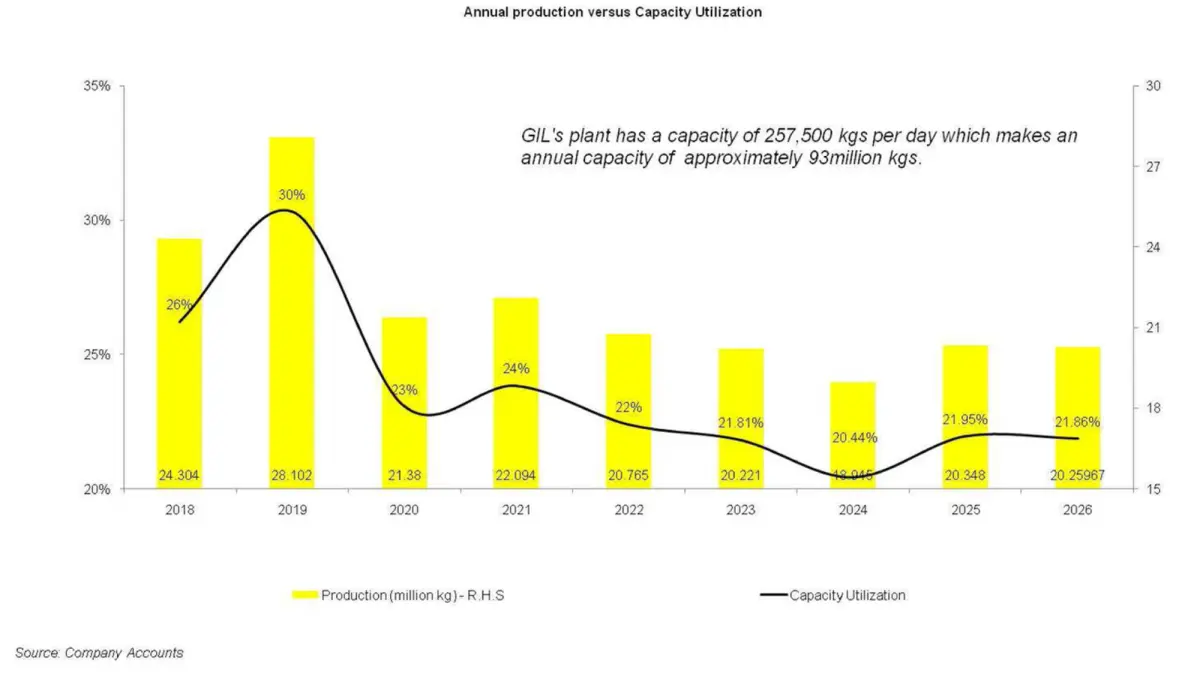
GIL’s production grew by 3.3 percent in 2021 with capacity utilization standing at 24 percent. This translated into annual production of 22.094 million kgs in 2021.
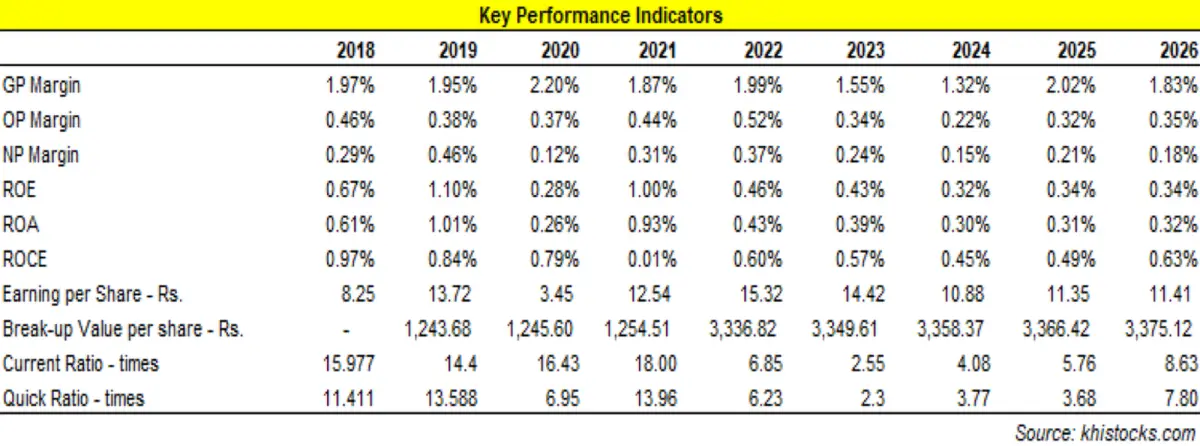
Cost of sales grew by 39.50 percent year-on-year. Gross profit enhanced by 17.66 percent year-on-year in 2021, however, GP margin marched down to 1.87 percent from 2.20 percent in the previous year. This was due to higher support price of wheat especially in Sind and Baluchistan where it jacked up to Rs.2200 per 40 kg.
Operating expense spiked by 6.80 percent year-on-year due to higher payroll expense on account of inflation while number of employees stayed intact at 41. Operating profit rebounded by 67.80 percent year-on-year in 2021 with OP margin clocking in at 0.44 percent versus 0.37 percent in the previous year. Finance cost (bank charges) escalated by 28 percent year-on-year. Tax effect of depreciation allowance resulted in 27.53 percent year-on-year plunge in tax charge for the year. Consequently, net profit magnified by 263.31 percent year-on-year in 2021 to clock in at Rs.3.76 million. This resulted in NP margin of 0.31 percent and EPS of Rs.12.54 in 2021 as against NP margin of 0.12 percent and EPS of Rs.3.45 registered in 2020.
In 2022, GIL net sales grew by a marginal 3.35 percent year-on-year to clock in at Rs.1235.29 million. The decline in the net sales of atta largely offset the higher turnover of other categories. GIL’s production slid by 6 percent year-on-year to 20.765 million kgs in 2022. This translated into capacity utilization of 22 percent – the lowest since 2018.
Cost of sales inched up by 3.22 percent, resulting in 10 percent higher gross profit recorded in 2022. GP margin also slightly grew to 2 percent in 2022. Operating expense escalated by 6.75 percent year-on-year in 2022 on account of inflation and rise in employee headcount to 44. Operating profit burgeoned by 19.87 percent year-on-year with OP margin slightly ticking up to 0.52 percent in 2022.
Finance cost/bank charges hiked by 21.77 percent year-on-year in 2022. Net profit picked up by 22.16 percent year-on-year in 2022 in clock in at Rs.4.60 million with NP margin of 0.37 percent and EPS of Rs.15.32 – the highest among all the years under consideration.
The monsoon floods greatly affected the agricultural output of the country during the first half of the year. This created immense shortage of wheat. The Sind government raised the minimum support price to an exorbitant level of Rs.4000 per 40 kg to encourage the growers. However, this resulted in unprecedented level of food inflation in the country.
GIL’s production slid by 2.6 percent in 2023 to clock in at 20.221 million kgs. This resulted in capacity utilization of 21.81 percent. GIL’s net sales grew by 43.32 percent year; however, GP margin fell to 1.55 percent despite 11.52 percent rise in gross profit in 2023.
High inflation and transportation charges pushed operating expense up by 18.81 percent year-on-year in 2023. This squeezed the operating profit by 4.25 percent year-on-year with OP margin sinking to 0.34 percent in 2023.
Finance cost measured up by 3.69 percent year-on-year in 2023. This resulted in 5.80 percent thinner bottomline in 2023. Net profit stood at Rs.4.33 million in 2023 with NP margin of 0.24 percent and EPS of Rs.14.42.
In 2024, GIL’s topline grew by 22.40 percent to clock in at Rs.2166.95 million. This mainly came on the back of higher prices of wheat purchased from Food Department and open market. During the year, the company’s production volume stood at 18.945 million kgs, down 6.3 percent year-on-year. This translated into the lowest ever capacity utilization of 20.44 percent recorded in 2024.
Unprecedented spike in the prices of electricity, transportation as well as other related items resulted in 22.69 percent surge in cost of sales in 2024. In absolute terms, gross profit ticked up by 4.33 percent in 2024, however, GP margin slumped to its multiyear low level of 1.32 percent. Operating expense escalated by 19.82 percent in 2024 particularly due to higher payroll expense which was the result of inflation and increase in workforce from 42 employees in 2023 to 46 employees in 2024.
Operating profit tapered off by 22.48 percent in 2024 with OP margin sliding down to 0.22 percent. Finance cost mounted by 24.73 percent in 2024. GIL recorded 24.65 percent decline in its net profit in 2024 which clocked in at Rs.3.263 million with EPS of Rs.10.88 and NP margin of 0.15 percent.
In 2025, GIL recorded 25.86 percent year-on-year deterioration in its topline which clocked in at Rs.1606.64 million. This was due to decreased rate of wheat in the open market which led the company to align its prices. Reduced commodity prices also enabled the company to record 26.38 percent lower cost of sales in 2025. This translated into 13.50 percent uptick in gross profit with GP margin ticking up to 2 percent.
Operating expense surged by 17.14 percent in 2025 due to inflationary pressure. GIL also recorded other income of Rs.2.76 million in 2025, up 50.55 percent year-on-year. This largely included profit on bank deposits followed by reversal of provision booked for ECL.
Higher profit related provisioning resulted in 10.24 percent spike in other expense in 2025. Operating profit improved by 9.13 percent in 2025 with OP margin ticking up to 0.32 percent. Finance cost (bank charges) escalated by 86.14 percent in 2025. GIL recorded 4.36 percent uptick in its net profit which clocked in at Rs.3.405 million in 2025. This translated into EPS of Rs.11.35 and NP margin of 0.21 percent in 2025.
In 2026, GIL’s net sales grew by 18.83 percent to clock in at Rs.1909.18 million. The growth largely came on the back of increased revenue from atta, katta packing and bran while revenue from maida slid in 2026. The increase in the rate of wheat purchases from the open market pushed the company to increase the prices of wheat products during the year.
Cost of sales also increased by 19 percent in 2026 due to higher price of wheat and inflationary pressure. GIL recorded 8 percent uptick in its gross profit in 2026 with GP margin slightly dipping to 1.83 percent.
Administrative expense plunged by 3.35 percent in 2026 due to lower payroll expense and fee & subscription charges incurred during the year. Number of employees was reduced from 46 in 2025 to 42 in 2026.
Lower provisioning done for WWF resulted in 19.57 percent drop in other expense in 2026. Other income also deteriorated by 78.50 percent in 2026 due to thinner profit on bank deposits and no reversal of allowance booked for ECL recorded during the year.
GIL’s operating profit strengthened by 30.28 percent in 2026 with OP margin slightly inching up to 0.35 percent. 114.76 percent spike in finance cost in 2026 encompassed bank charges as the company is non-geared. Net profit inched up by 0.55 percent to clock in at Rs.3.424 million in 2026. This translated into EPS of Rs.11.41 and NP margin of 0.18 percent in 2026.
Recent Performance (1QFY27)
During the first quarter of FY27, GIL recorded a staggering 91.26 percent year-on-year growth in its topline which clocked in at Rs.639.90 million. This largely came on the back of higher price of wheat in the open market which pushed the company to increase the prices of its products.
Cost of sales also mounted by 94.43 percent in 1QFY27 due to elevated wheat prices. This suppressed the gross profit by 6.75 percent in 1QFY27 with GP margin falling down to 1.53 percent from 3.13 percent in 1QFY26.
Administrative expense also dwindled by 2.28 percent in 1QFY27 likely due to workforce rationalization. Lesser provisioning done for WWF appears to be the cause of 84.81 percent decline in other expense in 1QFY27. Other income strengthened by 83.14 percent in 1QFY27 due to higher return on bank deposits.
GIL recorded 63.32 percent stronger operating profit in 1QFY27 with OP margin clocking in at 0.48 percent versus 0.56 percent in 1QFY26. Finance cost (bank charges) surged by 108.74 percent in 1QFY27.
GIL registered net profit of Rs.4.232 million in 1QFY27, up 109.33 percent year-on-year. This translated into EPS of Rs.14.11 and NP margin of 0.66 percent in 1QFY27 versus EPS of Rs.6.74 and NP margin of 0.60 percent recorded in 1QFY26.
Future Outlook
The future outlook for GIL will largely depend on wheat price movements, the availability of local supplies and the company’s ability to maintain its margins amid rising input and operating costs.
The recently announced National wheat policy has set an indicative wheat price of Rs.4500 per 40 kg for the 2027 crop. This will provide greater visibility to the farmers and encourage cultivation. The government’s plan to maintain strategic wheat reserves of up to six million tons alongside arrangements for additional imports if required will help maintain adequate supply in the local market and keep a check on excessive price volatility in the open market.
On the downside, insufficient water supply, unfavorable weather conditions and the pace of wheat sowing could restrict the supplies and push procurement prices up.
Given GIL’s established presence in the Karachi’s flour landscape and provided its diverse range of wheat products, its revenue prospects are bright. However, improvement in margins and earnings will depend on cost management, procurement mix and operational efficiency.
ISLAMABAD: The Federal Board of Revenue (FBR) has formally introduced a comprehensive faceless appeals mechanism for income tax disputes, under which appeals will be electronically allocated to Commissioners (Appeals) whose identities will remain concealed from taxpayers, their representatives and tax officials.
Through amendments to the Income Tax Rules, 2002, the FBR has inserted a new Chapter XIXA, titled “Faceless Appeals”, following the earlier publication of draft amendments through S.R.O. 2136(I)/2026 dated November 18, 2026.
The amendments have been notified through S.R.O. 2276(I)/2026 issued on Tuesday.
Under the new framework, an Appeals Wing will be established within the National Faceless Centre, comprising as many Appellate Units as the FBR considers necessary. Each unit will be headed by a Commissioner (Appeals) and will operate under the administrative control of Member (Legal) Inland Revenue.
A significant safeguard introduced under the framework is that the Director General, Chief Commissioner or any other authority of the Centre will not be allowed to exercise control over, or issue directions to, a Commissioner (Appeals) regarding the hearing or decision of an appeal. Furthermore, an officer who conducted the audit, assessment or quality-control function in a case, or passed the disputed order, will not be allowed to hear or decide the appeal.
All appeals under section 127 of the Income Tax Ordinance, 2001, covered by the new arrangement will be filed electronically through the FBR’s e-portal. Upon successful filing, the system will automatically generate a unique appeal number and allocate the case to an Appellate Unit or Commissioner (Appeals) through a random, dynamic and automated allocation algorithm. The identity of the Commissioner (Appeals) handling the case will remain anonymous throughout the proceedings, including in the final appellate order.
The FBR or the Centre will also be authorised to transfer or reallocate pending appeals between Appellate Units to ensure workload distribution, efficiency and impartiality. However, once a hearing has commenced, a case cannot be transferred unless reasons are recorded in writing. In such circumstances, the appellant will have the right to request a fresh hearing.
The new rules require all notices, requisitions, written submissions, arguments, rejoinders and evidence to be exchanged exclusively through the electronic portal. Physical appearances of taxpayers, departmental representatives and their authorised representatives before the Commissioner (Appeals) will not be permitted.
The appeals will be heard through video conferencing or secure digital communication links. Interestingly, the face of the Commissioner (Appeals) will not be shown during the hearing and the officer’s voice will be electronically modulated to conceal his or her identity. All proceedings will be recorded and digitally archived as part of the electronic appeal record. Taxpayers will also have the option to seek a decision on the basis of written submissions instead of participating in a video hearing.
A significant facilitation for taxpayers is that those without internet access will be able to request assistance from the nearest unit of the Field Operations Wing to attend an e-hearing through its designated e-hearing room. The concerned unit will facilitate the taxpayer on the scheduled date and time.
The framework also provides a specific procedure for stay applications against recovery of tax. Applications for stay of recovery under section 128(1A) or 128(1AA) will be filed electronically and fixed for e-hearing within the time prescribed under the existing rules. The respondent tax authority will be heard before the Commissioner (Appeals) decides the application, and the decision will be communicated electronically to the taxpayer, respondent and Field Operations Wing on the day it is issued.
Another important feature is the introduction of digitally authenticated appellate orders. Every order, decision, direction or notice will be generated through the FBR’s computerized system and carry a Digital Identification Number (DIN), without displaying the name, designation or signature of the Commissioner (Appeals).
The final appellate order, specifying the amount of tax upheld, will be simultaneously communicated electronically to the appellant, respondent Commissioner and Field Operations Wing. Any subsequent appeal before the Appellate Tribunal under section 131 will identify the disputed decision through its appeal number and DIN instead of the name of the Commissioner (Appeals).
The rules also provide that where a taxpayer is unable to file an appeal, application or reply within the prescribed time due to technical failure of the e-portal, confirmed by the FBR, such failure will constitute sufficient cause for the purposes of condonation of delay under section 127(6).
The notification further clarifies that appeals already pending before a Commissioner (Appeals) when the new system becomes applicable will continue before that Commissioner unless the FBR directs their transfer to the Centre. In case of transfer, the electronic record will be transmitted and proceedings will resume from the stage already reached.
The framework will apply to appeals against orders passed by authorities of the Centre and other tax authorities in respect of persons, classes of persons, orders or classes of orders specified by the FBR through a separate notification.
Importantly, the new Chapter will come into force on a date to be separately notified by the FBR, which may prescribe different commencement dates for different categories of appeals. The notification also preserves the statutory option of an aggrieved taxpayer to file an appeal directly before the Appellate Tribunal under the relevant proviso to section 127(1), the FBR added.
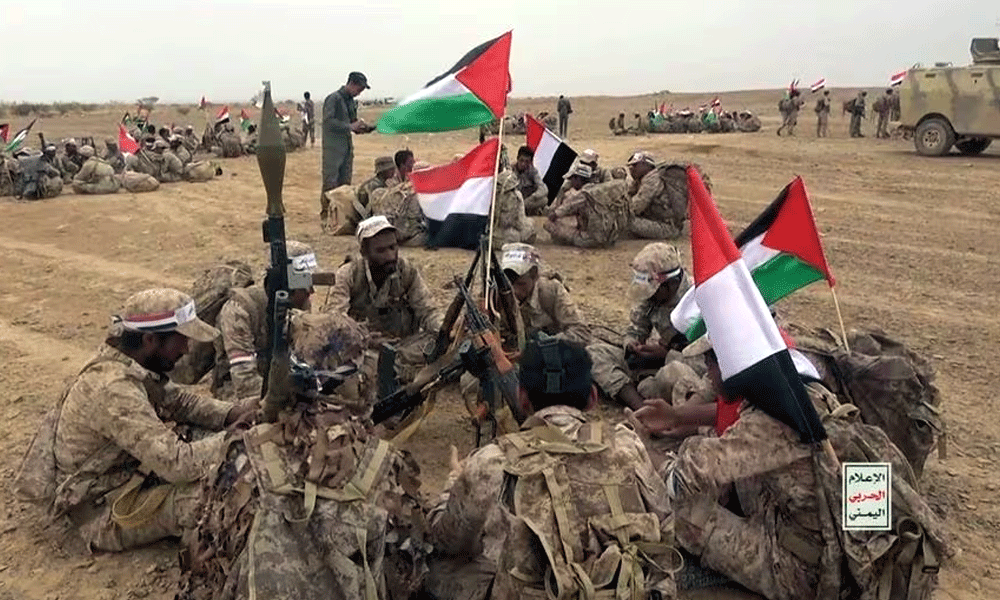
RIYADH: Yemen’s armed forces said Tuesday that Houthi fighters were ready to attack the internationally recognised government’s stronghold of Aden, vowing to head off any potential assault.
“Yes, Houthi forces are about 60 kilometres (40 miles) from the city. We take that seriously, and we are ready for it,” said military spokesman Colonel Majid al-Nuzaili during a briefing.
“They are now ready to attack. We have made our preparations to defend Aden”.
The comments come on the heels of recent advances by the Houthis this month, as the Yemeni government pulled back its forces from areas near the Red Sea to reinforce troops “where current circumstances require”, with securing Aden and nearby provinces taking priority.
On November 15, six Yemeni sources told AFP the Houthis had seized control of the Al-Maqatirah and Al-Madaribah districts and positioned themselves 60 kilometres from the southern city.
“The situation is not where we want it to be. But it’s not as dire as reported,” Nuzaili insisted.
“Taking Aden is a hypothetical situation. It will not happen,” he said. “Our forces and our government will make sure that Aden is not at risk.”
On Tuesday, Yemen’s leader Rashad al-Alimi — the head of the country’s presidential council — struck a defiant tone in the face of the Houthi threat.
“We trust in the ability of the Yemeni people and their armed forces to end the Houthi threat, no matter how the front lines shift,” he wrote in a post on X.
The Houthis have repeatedly struck the city of Aden in recent weeks, including an assault on October 15 that targeted the presidential palace and left four people dead, according to government military sources.
The Iran-backed group previously launched an unsuccessful bid to seize Aden early in the war in 2015.
Yemen’s internationally recognised government has been based in Aden since it was driven from the capital Sanaa by the Houthis in 2014.
Yemen, embroiled in more than a decade of civil war, was sucked into the wider US-Iran conflict in July when a truce between the Houthis and the Saudi-backed government unravelled.
Since then, the fighting has left more than 1,600 people dead and over 300,000 displaced in the country, the poorest on the Arabian Peninsula, according to the latest UN toll.
ISLAMABAD: National Electric Power Regulatory Authority (NEPRA) on Tuesday questioned sponsors of three 50MWp solar power projects over their requests for modification of previously determined tariffs, particularly with regard to the Commercial Operation Date (COD), Interest During Construction (IDC) and Return on Equity During Construction (ROEDC).
The three companies—Medrian Energy Limited, HNDS Energy Limited and Helios Power Limited—have filed separate petitions seeking amendments to their tariff determinations issued on February 21, 2020.
NEPRA had determined a levelised tariff of Rs5.6988 per kWh (US cents 3.6684 per kWh) for the three projects.
During the hearing, Authority Members Amina Ahmed, Maqsood Anwar Khan and Ghulamullah Shaikh raised a series of questions with representatives of the project sponsors and the Central Power Purchasing Agency-Guarantee (CPPA-G) over the justification for the requested relief and its potential financial implications for electricity consumers.
The project sponsors maintained that they were seeking similar relief already extended to certain other power companies, arguing that delays in land acquisition and other project-related difficulties had prevented them from commencing construction within the originally envisaged timeframe.
They explained that the entire feasibility study of the projects had to be revised because of difficulties in acquiring land for the proposed sites, which affected the construction schedule.
The petitioners have requested NEPRA to withdraw the ten-month construction period linked to the Financial Close (FC) date of February 19, 2021, and instead allow the period to commence from the Construction Start Date (CSD) of June 14, 2022, as stipulated in the Energy Purchase Agreement (EPA).
They argued that tariff implementation and subsequent adjustments of IDC and ROEDC should be aligned with the actual commencement of construction and relevant project agreements.
The CPPA-G representative, however, maintained that the agency had taken action to ensure that the financial burden arising from delays was not passed on to electricity consumers.
He explained that the project companies had initially approached the Alternative Energy Development Board (AEDB) and the Government of Sindh, citing events of default and force majeure circumstances. Consequently, CPPA-G could not issue termination notices while those issues remained unresolved.
“After the issues of the power companies were sorted out with AEDB and the Sindh Government, CPPA-G issued notices of termination,” he added.
Member (Law) Ghulamullah Shaikh questioned the project sponsors whether NEPRA had made it clear in its original tariff determinations that delays in construction would not carry any financial implications for consumers.
A representative of the project companies acknowledged that the language of the original tariff determination conveyed the interpretation pointed out by the Authority members. However, he maintained that the companies could not commence construction because they did not have possession of the required project sites.
Under their petitions, the sponsors have sought modification of the reference tariff determinations to provide for a maximum construction period of ten months commencing from the Construction Start Date, as defined in the EPA.
They also requested that IDC at COD be calculated on the basis of actual debt drawdowns, within the overall debt approved by NEPRA, during the revised ten-month construction period.
Similarly, they have sought adjustment of ROEDC at COD based on actual equity injections, within the overall equity approved by the Authority, during the same period.
The petitions further seek a day-for-day extension of the permitted construction period to account for force majeure events.
Anthropic’s shares dropped below their $83 initial public offering price and were on course to erase close to $200 billion in market value on Tuesday, a striking reversal just days after the Claude developer’s record-breaking Nasdaq debut.
The stock was last down 12.6% at $76.6, extending a steep retreat from its $111.50 opening price on November 19.
It had closed 17% above the IPO price in its debut trading session but has since been swept up in a broader technology selloff that pushed the S&P 500 and the Dow into confirmed correction territory the previous week.
Anthropic’s rapid reversal has added to concerns about stretched AI valuations and the vast sums being poured into computing infrastructure, with rising interest rates threatening to push those costs even higher. As the first frontier AI company to go public, Anthropic is widely seen as a proxy for the sector.
“If we do see a slowdown in the data-center buildout, then that obviously can impact the speed at which Anthropic can develop and therefore future revenue and therefore its valuation,” said Fiona Cincotta, senior market analyst at StoneX.
Anthropic missed out on a broad Wall Street rally driven by AI-related stocks after Nvidia reinstated Jensen Huang as chief executive on Monday.
Anthropic is not alone among blockbuster technology IPOs in quickly surrendering early gains and falling below its offer price. SpaceX, whose $85.7 billion June listing was the world’s biggest before Anthropic, took about a month to fall below its offer price.
In 2012, Facebook, now Meta Platforms, slipped below its offer price on its second trading day.
The comparisons show that a swift loss of an IPO premium is not unprecedented even for highly anticipated listings, and that an early break below the offer price is not necessarily a guide to longer-term performance.
“Like most IPOs, it probably came in overpriced and it is now the real price discovery as to what the true value should be,” said Peter Andersen, founder of Andersen Capital Management.
After touching $2 trillion in valuation on debut day, Anthropic was last trading at a $1.5 trillion valuation, which is about 40 times its sales over the last 12 months.
Key risks
With Anthropic’s shares now testing their IPO price, attention is turning to risks that could determine where the stock goes next, including insider selling, pressure from open-weight models and a potential slowdown in data-center investments.
Anthropic’s IPO lock-up provisions allow certain employees and insiders to sell portions of their holdings from the first trading day, with further staggered releases tied to earnings announcements.
CEO Dario Amodei and President Daniela Amodei sold more than 3.37 million shares worth over $280 million each to the IPO’s underwriters a day after the debut, according to a filing late on Monday.
Anthropic’s underwriters also exercised their option to buy additional shares, lifting the IPO’s gross proceeds to a record $93.5 billion, while removing a potential source of support for the stock after its debut.
Anthropic also faces growing competition from cheaper open-weight AI models, which it has warned could pressure pricing.
Users can download and adapt models from DeepSeek, Mistral and Moonshot AI, unlike proprietary models such as Claude, ChatGPT and Gemini, with Chinese developers in particular gaining ground globally.
Huang’s return could also sharpen the competitive threat to Anthropic, given his strong advocacy for open-weight AI models.
Some support could emerge in the coming days as Anthropic’s addition to major indexes prompts buying from passive funds.
Index rebalance analytics firm Intropic estimates passive funds could buy up to 30% of the shares offered by year-end. MSCI will add Anthropic to its global standard indexes as of the November 30 close.
NEW YORK: Chinese telecommunications equipment maker Huawei was convicted on Tuesday in a sprawling US criminal case on charges that it had deceived banks about its business in Iran and stole trade secrets from US companies.
A federal jury in Brooklyn found Huawei guilty on 10 of the 12 criminal counts it faced. The jury found the technology company not guilty of racketeering conspiracy, a charge alleging it had acted as a criminal enterprise.
In a statement, Huawei said the charges on which it was convicted lack legal merit and said it would “take all necessary legal actions to defend our rights and interests.”
US authorities had targeted Huawei for years, saying the company posed national security risks.
The criminal case began in 2018, and the following year the US government placed Huawei on a trade blacklist that restricted its access to US technology.
Experts have said the case has nonetheless not undermined Huawei’s business, as the company diversified and emerged as a key player in China’s push for artificial intelligence.
The trial lasted more than two months, with prosecutors calling more than 60 witnesses and the defense calling 15.
Huawei and three affiliates faced 12 charges including racketeering conspiracy, bank fraud, wire fraud, sanctions violations, and conspiring to steal trade secrets and obstruct justice.
Reuters stories in 2012 and 2013 helped expose Huawei’s activities in Iran and were discussed during the trial.
“After the media started questioning Huawei’s operations in Iran, so did Huawei’s banks,” prosecutor Meredith Arfa told jurors during her closing argument.
Founder’s daughter had been detained
The case emerged in December 2018 when Meng Wanzhou, Huawei’s chief financial officer and daughter of the company’s founder, was detained in Canada on a US warrant, prompting a diplomatic crisis involving the US, China and Canada.
Meng had been secretly indicted on charges of misleading an HSBC banker about Huawei’s business in Iran, so the company could move dollars in and out of Iran in violation of US sanctions.
She fought extradition to the US for nearly three years, before entering a deferred prosecution agreement and flying home to China to a hero’s welcome. The charges against her were dropped.
Prosecutors alleged trade secrets theft
The 2018 indictment alleged that Huawei misled HSBC, Standard Chartered and BNP Paribas about its business dealings in Iran.
Prosecutors added new charges in 2020, including that Huawei conspired to steal trade secrets from US technology companies over two decades.
During the trial, prosecutors tried to prove Huawei stole source code from Cisco Systems for its routers, stole wireless telecommunications company Quintel’s antenna technology, and hired a professor to gain access to a circuit board developed by semiconductor company CNEX.
Jurors watched a video that, according to prosecutors, showed a Huawei employee slipping a piece of a T-Mobile testing robot into his backpack, and heard about a Huawei engineer sneaking into a Fujitsu booth at a trade show to photograph a device.
Prosecutors gave jurors a statement attached to Meng’s deferred prosecution agreement, in which she acknowledged that the company illegally conducted business in Iran. She did not testify at trial, though an HSBC banker she met with in 2013 did testify.
Defense says banks knew of Iran business
The defense argued that HSBC and the other banks knew about Huawei’s business in Iran and were competing for Huawei’s business.
Brian Heberlig, a lawyer for Huawei, accused prosecutors during his closing argument of having “cherry-picked” a handful of disparate incidents to support their claim of a 20-year conspiracy.
He said Huawei succeeded through “hard work, innovation, and investment in research and development.”
The company has more than 200,000 employees and operates in approximately 170 countries.