Good Luck Industries Limited (PSX: GIL) was incorporated in Pakistan as a public limited company in 1967. The company is engaged in the milling of wheat and all kinds of grains. The main products of GIL are maida (all-purpose flour), fine flour, bran and mill flour (chakki atta).
Pattern of Shareholding
As of June 30, 2026, GIL had a total of 300,000 shares outstanding which were held by 79 shareholders. Individuals represent the largest shareholder category of GIL with 59.87 percent shares followed by directors, CEO, their spouse and minor children having a stake of 40.11 percent in GIL. The remaining 0.02 percent shares are held by NIT and ICP.
Financial Performance (2021-26)
Over the period under consideration, GIL’s topline plunged only in 2025. However, its bottomline took a slide twice i.e. in 2023 and 2024. The company’s margins show a cyclical trend. Gross margin registered its optimum level in 2025 while operating and net margins peaked in 2022. The detailed performance review of the period under consideration is given below.
After dipping in 2020, GIL’s net sales revived in 2021, boasting 39 percent year-on-year growth to clock in at Rs.1195.26 million. All the product categories performed well during the year with maida making the highest contribution to the net sales followed by katta packing.
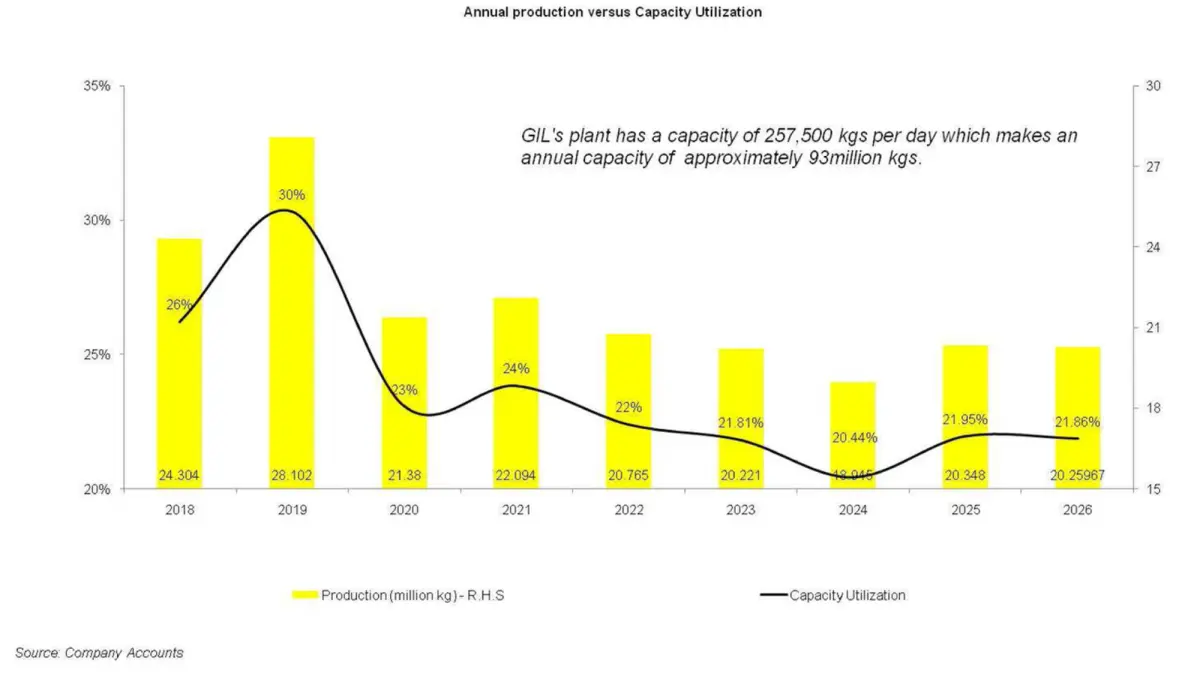
GIL’s production grew by 3.3 percent in 2021 with capacity utilization standing at 24 percent. This translated into annual production of 22.094 million kgs in 2021.
Cost of sales grew by 39.50 percent year-on-year. Gross profit enhanced by 17.66 percent year-on-year in 2021, however, GP margin marched down to 1.87 percent from 2.20 percent in the previous year. This was due to higher support price of wheat especially in Sind and Baluchistan where it jacked up to Rs.2200 per 40 kg.
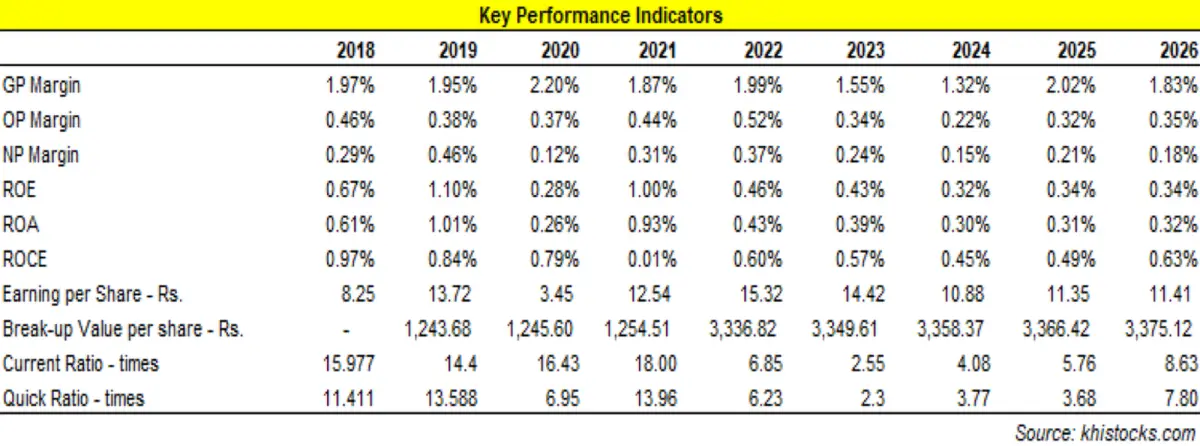
Operating expense spiked by 6.80 percent year-on-year due to higher payroll expense on account of inflation while number of employees stayed intact at 41. Operating profit rebounded by 67.80 percent year-on-year in 2021 with OP margin clocking in at 0.44 percent versus 0.37 percent in the previous year. Finance cost (bank charges) escalated by 28 percent year-on-year. Tax effect of depreciation allowance resulted in 27.53 percent year-on-year plunge in tax charge for the year. Consequently, net profit magnified by 263.31 percent year-on-year in 2021 to clock in at Rs.3.76 million. This resulted in NP margin of 0.31 percent and EPS of Rs.12.54 in 2021 as against NP margin of 0.12 percent and EPS of Rs.3.45 registered in 2020.
In 2022, GIL net sales grew by a marginal 3.35 percent year-on-year to clock in at Rs.1235.29 million. The decline in the net sales of atta largely offset the higher turnover of other categories. GIL’s production slid by 6 percent year-on-year to 20.765 million kgs in 2022. This translated into capacity utilization of 22 percent – the lowest since 2018.
Cost of sales inched up by 3.22 percent, resulting in 10 percent higher gross profit recorded in 2022. GP margin also slightly grew to 2 percent in 2022. Operating expense escalated by 6.75 percent year-on-year in 2022 on account of inflation and rise in employee headcount to 44. Operating profit burgeoned by 19.87 percent year-on-year with OP margin slightly ticking up to 0.52 percent in 2022.
Finance cost/bank charges hiked by 21.77 percent year-on-year in 2022. Net profit picked up by 22.16 percent year-on-year in 2022 in clock in at Rs.4.60 million with NP margin of 0.37 percent and EPS of Rs.15.32 – the highest among all the years under consideration.
The monsoon floods greatly affected the agricultural output of the country during the first half of the year. This created immense shortage of wheat. The Sind government raised the minimum support price to an exorbitant level of Rs.4000 per 40 kg to encourage the growers. However, this resulted in unprecedented level of food inflation in the country.
GIL’s production slid by 2.6 percent in 2023 to clock in at 20.221 million kgs. This resulted in capacity utilization of 21.81 percent. GIL’s net sales grew by 43.32 percent year; however, GP margin fell to 1.55 percent despite 11.52 percent rise in gross profit in 2023.
High inflation and transportation charges pushed operating expense up by 18.81 percent year-on-year in 2023. This squeezed the operating profit by 4.25 percent year-on-year with OP margin sinking to 0.34 percent in 2023.
Finance cost measured up by 3.69 percent year-on-year in 2023. This resulted in 5.80 percent thinner bottomline in 2023. Net profit stood at Rs.4.33 million in 2023 with NP margin of 0.24 percent and EPS of Rs.14.42.
In 2024, GIL’s topline grew by 22.40 percent to clock in at Rs.2166.95 million. This mainly came on the back of higher prices of wheat purchased from Food Department and open market. During the year, the company’s production volume stood at 18.945 million kgs, down 6.3 percent year-on-year. This translated into the lowest ever capacity utilization of 20.44 percent recorded in 2024.
Unprecedented spike in the prices of electricity, transportation as well as other related items resulted in 22.69 percent surge in cost of sales in 2024. In absolute terms, gross profit ticked up by 4.33 percent in 2024, however, GP margin slumped to its multiyear low level of 1.32 percent. Operating expense escalated by 19.82 percent in 2024 particularly due to higher payroll expense which was the result of inflation and increase in workforce from 42 employees in 2023 to 46 employees in 2024.
Operating profit tapered off by 22.48 percent in 2024 with OP margin sliding down to 0.22 percent. Finance cost mounted by 24.73 percent in 2024. GIL recorded 24.65 percent decline in its net profit in 2024 which clocked in at Rs.3.263 million with EPS of Rs.10.88 and NP margin of 0.15 percent.
In 2025, GIL recorded 25.86 percent year-on-year deterioration in its topline which clocked in at Rs.1606.64 million. This was due to decreased rate of wheat in the open market which led the company to align its prices. Reduced commodity prices also enabled the company to record 26.38 percent lower cost of sales in 2025. This translated into 13.50 percent uptick in gross profit with GP margin ticking up to 2 percent.
Operating expense surged by 17.14 percent in 2025 due to inflationary pressure. GIL also recorded other income of Rs.2.76 million in 2025, up 50.55 percent year-on-year. This largely included profit on bank deposits followed by reversal of provision booked for ECL.
Higher profit related provisioning resulted in 10.24 percent spike in other expense in 2025. Operating profit improved by 9.13 percent in 2025 with OP margin ticking up to 0.32 percent. Finance cost (bank charges) escalated by 86.14 percent in 2025. GIL recorded 4.36 percent uptick in its net profit which clocked in at Rs.3.405 million in 2025. This translated into EPS of Rs.11.35 and NP margin of 0.21 percent in 2025.
In 2026, GIL’s net sales grew by 18.83 percent to clock in at Rs.1909.18 million. The growth largely came on the back of increased revenue from atta, katta packing and bran while revenue from maida slid in 2026. The increase in the rate of wheat purchases from the open market pushed the company to increase the prices of wheat products during the year.
Cost of sales also increased by 19 percent in 2026 due to higher price of wheat and inflationary pressure. GIL recorded 8 percent uptick in its gross profit in 2026 with GP margin slightly dipping to 1.83 percent.
Administrative expense plunged by 3.35 percent in 2026 due to lower payroll expense and fee & subscription charges incurred during the year. Number of employees was reduced from 46 in 2025 to 42 in 2026.
Lower provisioning done for WWF resulted in 19.57 percent drop in other expense in 2026. Other income also deteriorated by 78.50 percent in 2026 due to thinner profit on bank deposits and no reversal of allowance booked for ECL recorded during the year.
GIL’s operating profit strengthened by 30.28 percent in 2026 with OP margin slightly inching up to 0.35 percent. 114.76 percent spike in finance cost in 2026 encompassed bank charges as the company is non-geared. Net profit inched up by 0.55 percent to clock in at Rs.3.424 million in 2026. This translated into EPS of Rs.11.41 and NP margin of 0.18 percent in 2026.
Recent Performance (1QFY27)
During the first quarter of FY27, GIL recorded a staggering 91.26 percent year-on-year growth in its topline which clocked in at Rs.639.90 million. This largely came on the back of higher price of wheat in the open market which pushed the company to increase the prices of its products.
Cost of sales also mounted by 94.43 percent in 1QFY27 due to elevated wheat prices. This suppressed the gross profit by 6.75 percent in 1QFY27 with GP margin falling down to 1.53 percent from 3.13 percent in 1QFY26.
Administrative expense also dwindled by 2.28 percent in 1QFY27 likely due to workforce rationalization. Lesser provisioning done for WWF appears to be the cause of 84.81 percent decline in other expense in 1QFY27. Other income strengthened by 83.14 percent in 1QFY27 due to higher return on bank deposits.
GIL recorded 63.32 percent stronger operating profit in 1QFY27 with OP margin clocking in at 0.48 percent versus 0.56 percent in 1QFY26. Finance cost (bank charges) surged by 108.74 percent in 1QFY27.
GIL registered net profit of Rs.4.232 million in 1QFY27, up 109.33 percent year-on-year. This translated into EPS of Rs.14.11 and NP margin of 0.66 percent in 1QFY27 versus EPS of Rs.6.74 and NP margin of 0.60 percent recorded in 1QFY26.
Future Outlook
The future outlook for GIL will largely depend on wheat price movements, the availability of local supplies and the company’s ability to maintain its margins amid rising input and operating costs.
The recently announced National wheat policy has set an indicative wheat price of Rs.4500 per 40 kg for the 2027 crop. This will provide greater visibility to the farmers and encourage cultivation. The government’s plan to maintain strategic wheat reserves of up to six million tons alongside arrangements for additional imports if required will help maintain adequate supply in the local market and keep a check on excessive price volatility in the open market.
On the downside, insufficient water supply, unfavorable weather conditions and the pace of wheat sowing could restrict the supplies and push procurement prices up.
Given GIL’s established presence in the Karachi’s flour landscape and provided its diverse range of wheat products, its revenue prospects are bright. However, improvement in margins and earnings will depend on cost management, procurement mix and operational efficiency.
Source: brecorder
Leave a Reply