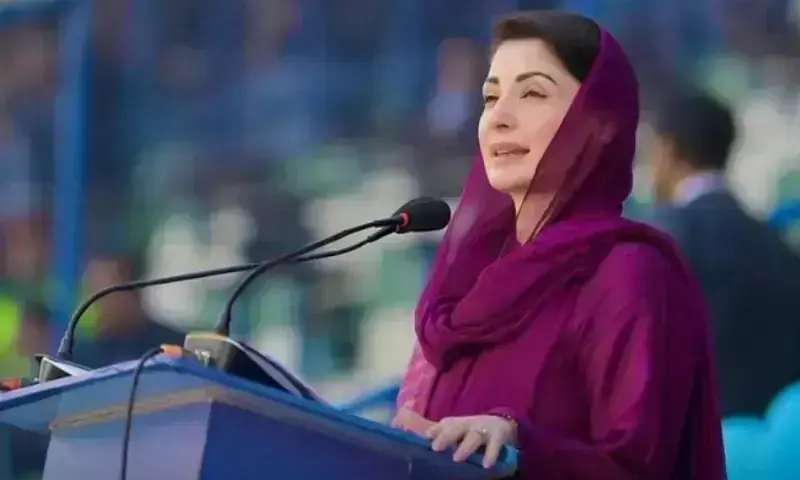
Punjab Chief Minister Maryam Nawaz removed the Jhelum deputy commissioner (DC) from his post on Sunday, after it emerged that computer science papers for intermediate students in the district had been postponed in the district owing to arrangements for the provincial chief executive’s scheduled visit on Nov 10.
Originally scheduled for Nov 10, the computer science papers for the Intermediate Second Annual Examinations 2026 had been deferred on the recommendation of the now-dismissed Jhelum deputy commissioner, Mir Raza Ozgen.
He wrote in a letter to the Rawalpindi Board of Intermediate and Secondary Education (BISE) that due to the deployment of administrative and security personnel during the scheduled visit, “it is not feasible to ensure the smooth and uninterrupted conduct of the said examination in the district. It is, therefore, requested that the examination be postponed and rescheduled for another suitable date to avoid any inconvenience to students and ensure the smooth conduct of both the examination and the VVIP visit”.
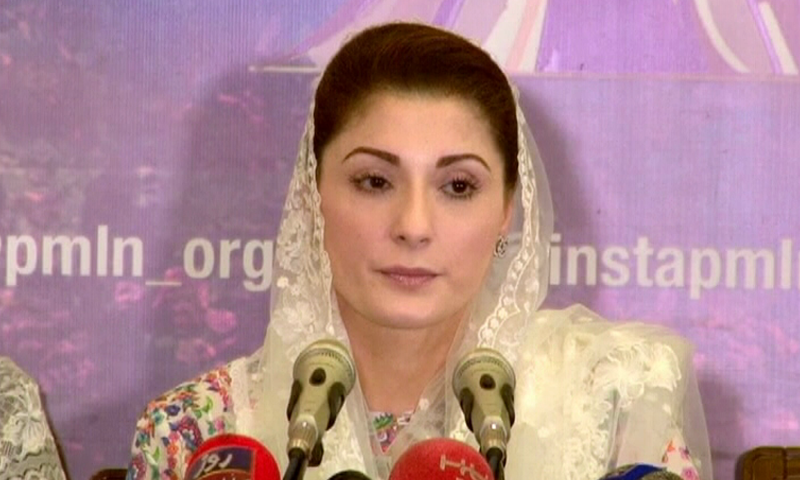
Eventually, Maryam posted on X that the Jhelum DC was being removed from his post with “immediate effect”.
She said she had given “explicit instructions that no inconvenience or disruption whatsoever should be caused to the public during my visits to the districts”.
“This is a clear disregard for my directions,” she added.
In a subsequent post, she also shared a notification that said the DC had been transferred and was instructed to report to the Punjab Services and General Administration Department for further orders.
Maryam also announced that the earlier postponed exams would now be held in line with the original schedule, on Nov 10.
“Notwithstanding any acts of foolishness or misplaced over-smartness on part of the district administration, the examinations shall be held strictly in accordance with the original schedule, i.e. Tuesday, 10th November,” she posted on X.
In another post on X, CM Maryam said she has directed all regional and district police officers as well as commissioners and deputy commissioners to ensure that “no market, shop, business, or any other establishment shall be closed or asked to suspend its operations on account of my visit.”
She added that no residential streets will be blocked or sealed, or any restriction be placed on the movement of residents “under the pretext of security arrangements”.
“Please ensure that all security measures are discreet and do not cause any inconvenience, disruption, or hardship to the general public,” she wrote, adding that the instructions must be “followed in letter and spirit”.
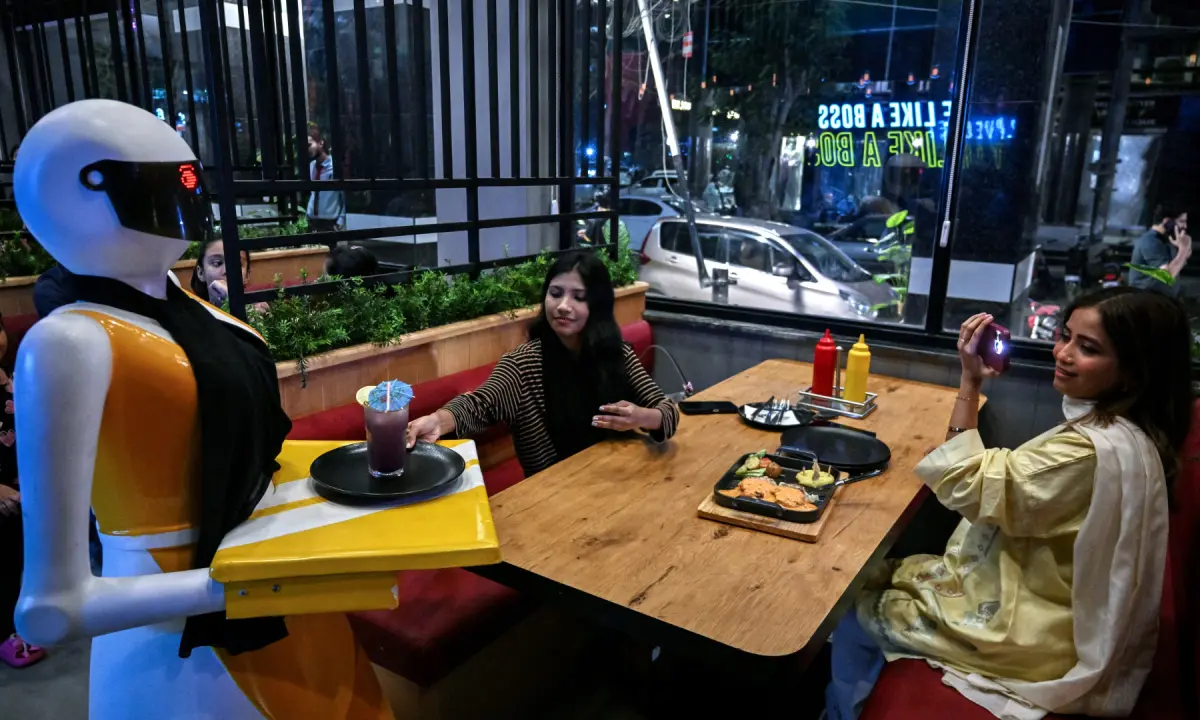
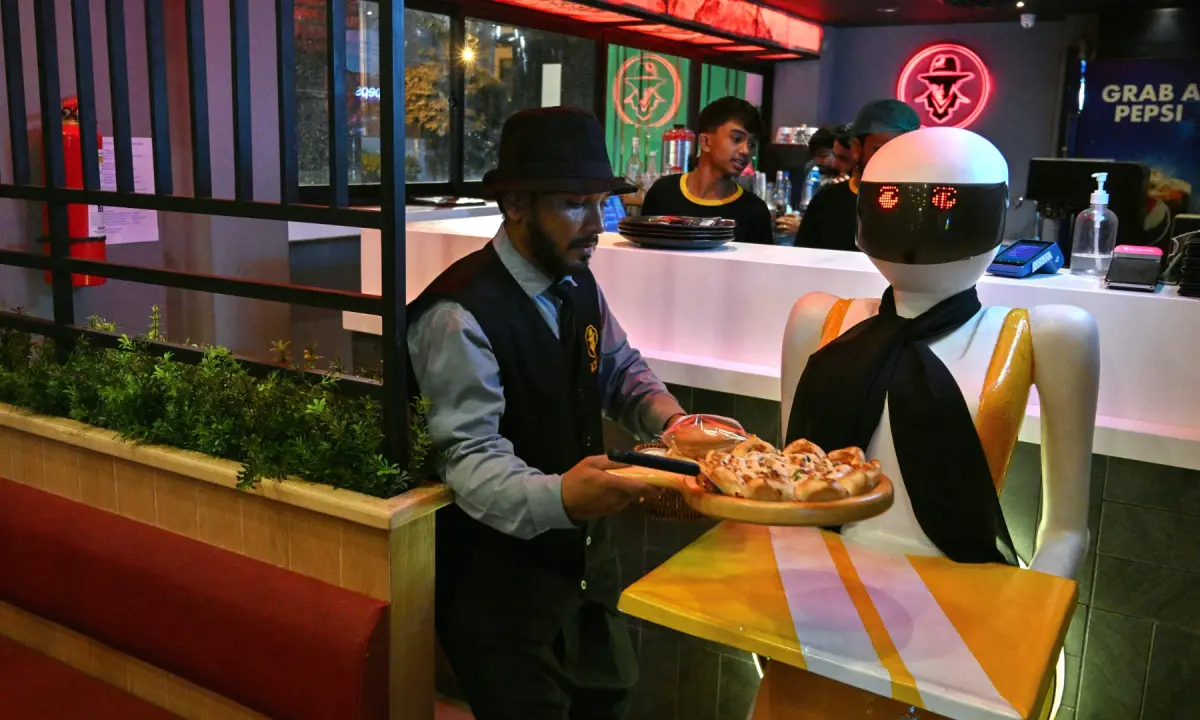
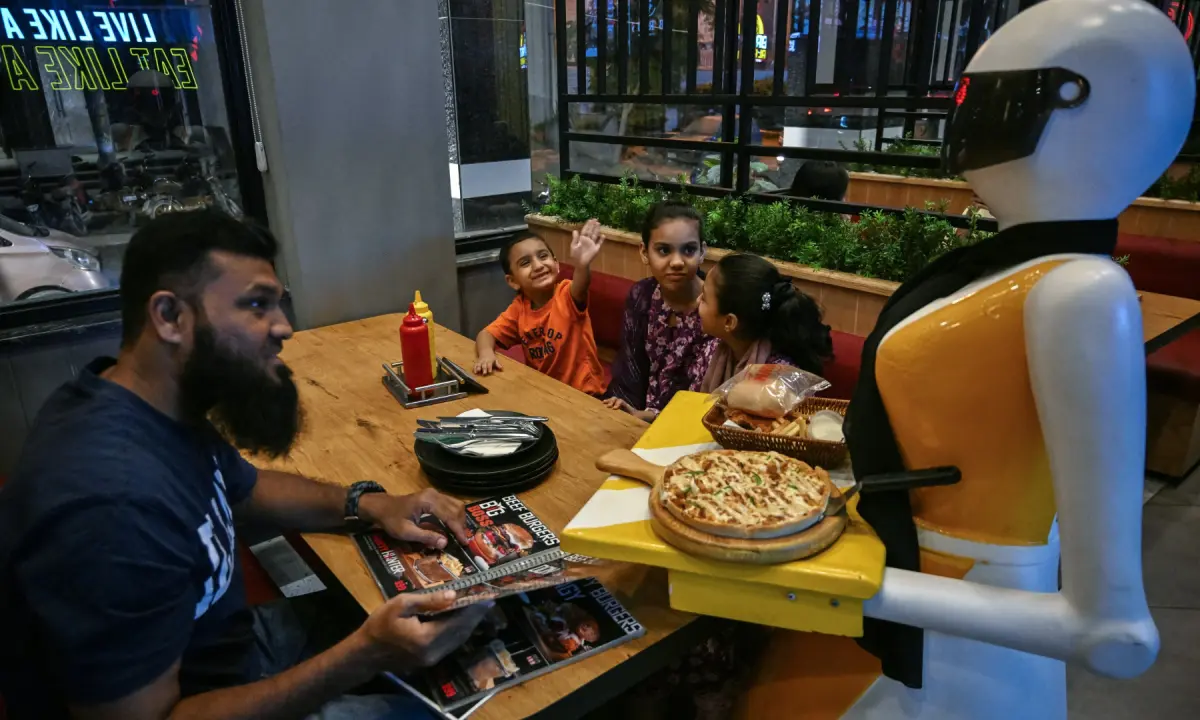
Wheeling its way between dining booths at a neon-lit restaurant in Karachi, a robot waitress drops off a fresh pizza to an awaiting family.
While global buzz is growing around agile humanoids made in the United States, China and elsewhere, robotic staff are a rare sight in the South Asian country.
“Welcome to Sicilian. My name is Robia,” the waitress says in an electronic voice, looking down at diners through blinking red LED eyes.
This photograph taken on October 2, 2026 shows Robia (R) and Jojo (2R), humanoid robot waitresses serving customers at The Sicilian restaurant in Karachi. — AFP
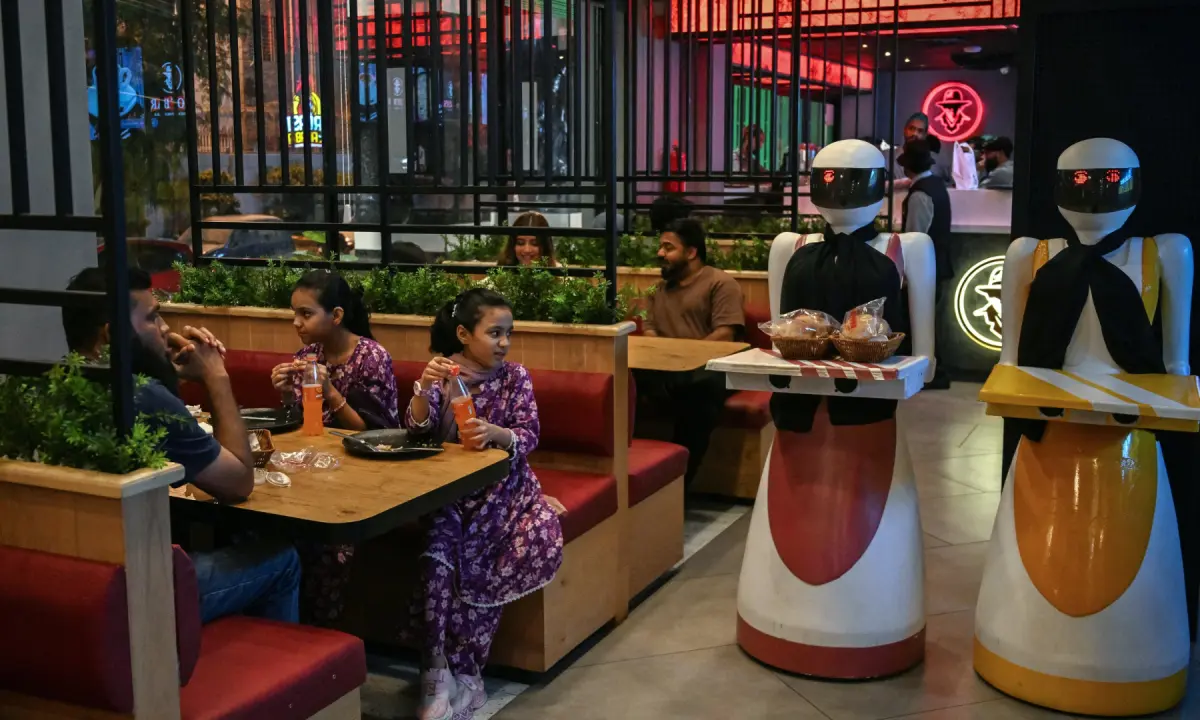
Robia and her colleague Jojo are the DIY creations of Pakistani engineer Syed Osama Aziz, who is bringing a sci-fi reboot to Karachi’s storied dining scene.
They have spherical white heads and dark visors, similar to a motorcycle helmet, and sport black shawls around their neck in the style of a dupatta.
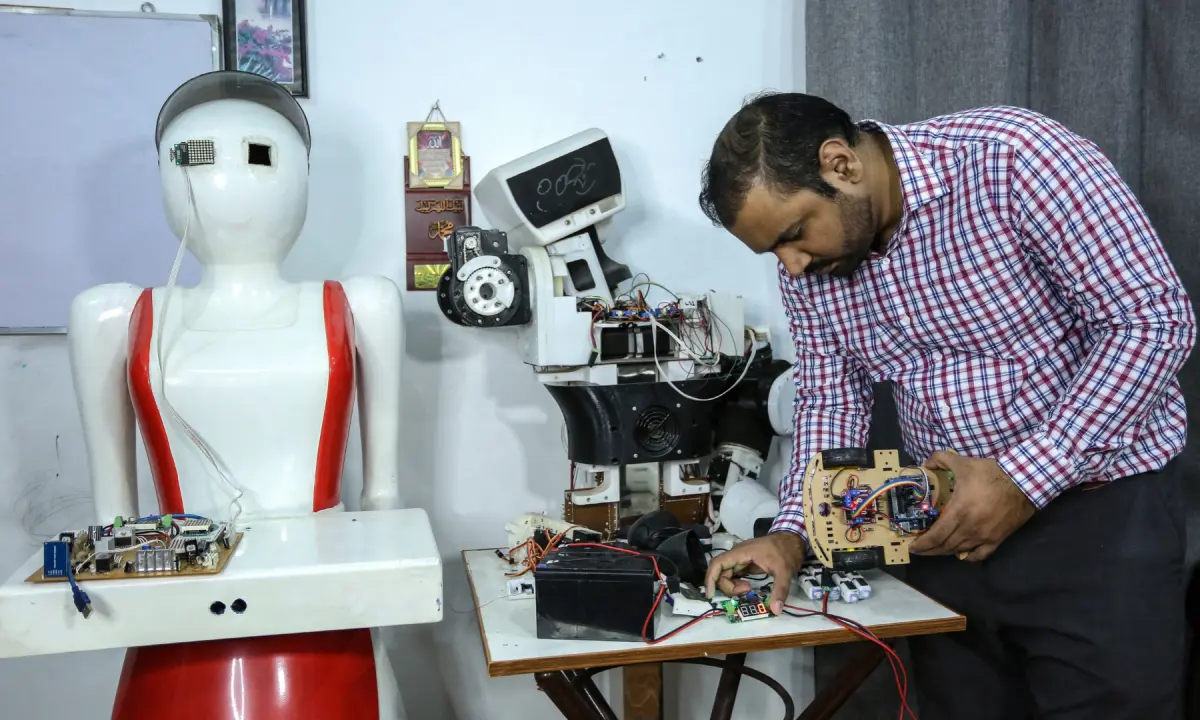
Aziz, who also established The Sicilian restaurant, developed the machines using mostly locally manufactured parts, designing their circuit boards and programming them in his own lab.
“The equipment, the things needed to make robots, are not so easily available here, so we had to arrange them,” he told AFP.
This photograph taken on September 30, 2026 shows a robotics software engineer Syed Osama Aziz working on robot components at his workshop in Multan. — AFP
The duo were developed through his robotics company, Cobot, with help from friends and some electronic components imported from abroad.
In China and other East Asian countries especially, robots are an increasingly common sight, shuttling food to customers in chain restaurants and taking on other jobs from cleaning to greeting hotel guests.
But they remain a novelty in Pakistan, where Aziz’s home-grown creations are attracting curious diners.
When they arrive at a table, the customers must either take the food off their serving tray themselves or wait for a human member of staff to assist them.
This photograph taken on October 2, 2026 shows a staff passing food orders to Robia, a humanoid robot waitress at The Sicilian restaurant in Karachi. — AFP
Excited customers
Aziz, whose workshop manufacturing the robots is located in Multan, hopes to make his creations more sophisticated in the future.
“Our plans are to add camera-based processing and image-processing features,” he said.
“That means the robot will also recognise you by looking at you, and it will remember what you ordered last time, and accordingly it will be able to give you better suggestions.”
For now, the robots are proving a hit with families, who flock to the restaurant to watch the machines in action.
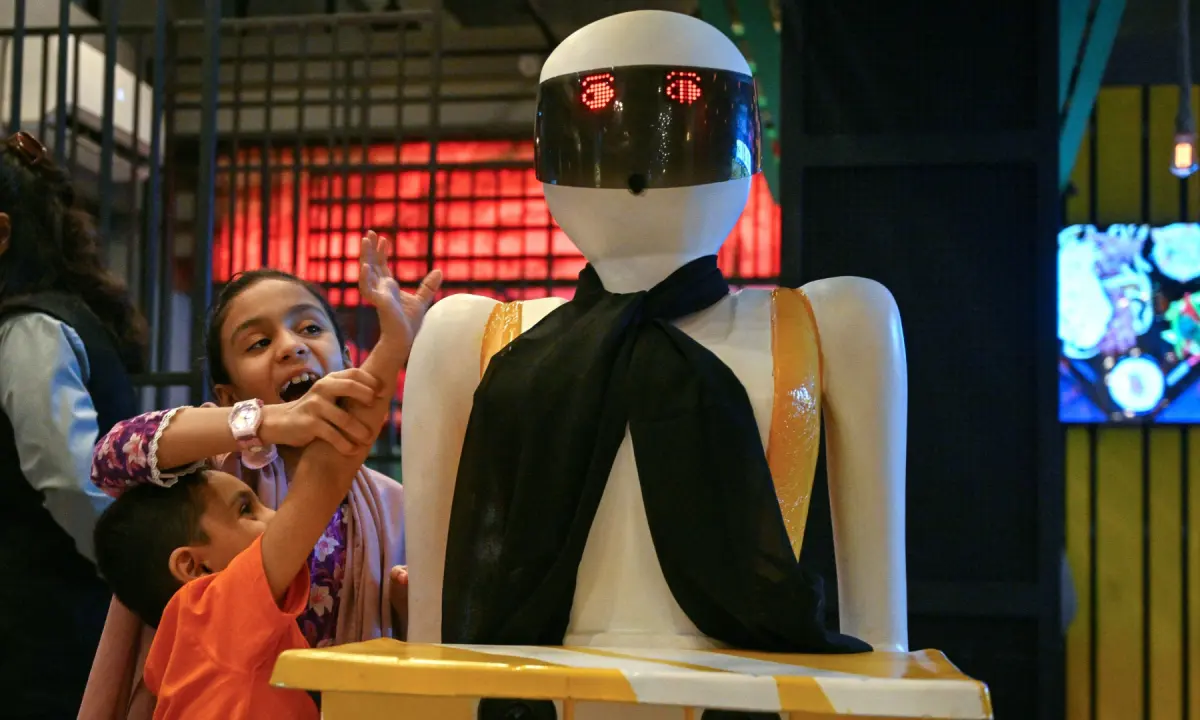
This photograph taken on October 2, 2026 shows children playing around Robia, a humanoid robot waitress at The Sicilian restaurant in Karachi. — AFP
“The best thing about it is that it introduces itself,” excited customer Ahmer Zameer told AFP, explaining the robot also “tells you what things you can order”.
Children reach out to touch the robots while their parents snap photographs and selfies.
Young customer Sonia Dilosker said she was impressed by the androids’ appearance and preferred their approach to serving customers, “because it is a machine and without any emotions”.
Restaurant staff say the novelty has brought a surge in customers — some travelling from across the sprawling port city to meet the robots.
This photograph taken on October 2, 2026 shows Robia, a humanoid robot waitress serving customers at The Sicilian restaurant in Karachi. — AFP
“Our business has grown. People are coming from far away for this. They have seen a robot for the first time here,” staff member Hellen told AFP.
“People are excited to see this.”
Header image: This photograph taken on October 2, 2026 shows Robia, a humanoid robot waitress serving customers at The Sicilian restaurant in Karachi. — AFP
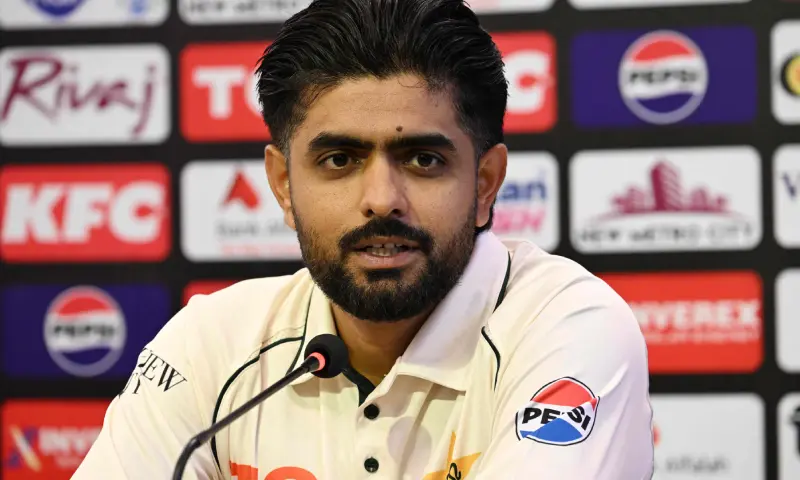
Pakistan captain Babar Azam says team selection is the responsibility of the selectors and coach, adding that his role is to get the best out of the players available to him as a youthful Pakistan side prepares to face Sri Lanka in the opening Test of a two-match series on Monday.
Responding to questions about the omission of certain players despite their not having featured in recent matches, Babar said the squad had been selected after consultations between the selectors and team management.
“When we came back from England the scenario was in front of everyone. After that, when we sat down for this team, the selectors and the coach selected the side. I have been given 15 players. My job is to field them, get performances out of them and make them compete,” he said at his pre-series press conference on Sunday.
“The other things are not in my hands. Selection is their job. Wherever my input is required I give it, and we sit together with the selectors and coach to decide what is best possible. But not everything needs to be explained here about where my job begins and ends,” he added.
Babar’s remarks come as Pakistan prepare to field a considerably revamped side following their disappointing performance in the previous phase of the World Test Championship (WTC).
The captain said the team had decided to shift its focus towards the next cycle after the recent tour of England.
“We are almost out of this year’s Test Championship, so we are looking forward to the next one and preparing for it. We have taken a different step and injected different players.
“We are trying to apply a combination of seniors and juniors so that we get a good mix and give the youngsters the opportunity to express themselves and perform well. InshaAllah, you will see a different team,” he said.
Pakistan are ninth and last in the 2025-27 WTC standings, with a points percentage of 4.63 after nine matches, having won two and lost seven.
Deductions of 19 points for slow over-rates have further compounded their difficulties.
Even a 2-0 series victory against Sri Lanka would do little to revive their chances of reaching the final, although the remaining matches provide an opportunity to build a combination for the future.
Sri Lanka are seventh with a points percentage of 33.33 from six Tests, having won one, lost two and drawn three.
They include Sameer Minhas, Mohammad Taha, Mohammad Suleman, Azan Awais and Arafat Minhas, while recent additions Aamir Jamal, Ali Shabbir, Saqib Khan and Mohammad Tayyab Arif have further strengthened the youthful contingent.
Experienced players Saud Shakeel, Salman Ali Agha and Mohammad Abbas are expected to provide guidance to the newcomers.
The changes follow Pakistan’s 3-0 defeat in England, a result that left their WTC campaign in serious difficulty. Babar, however, said the team would take lessons from the tour rather than dwell on the outcome.
“What has gone is gone. We will learn from it and inject those lessons into the message we give the players about how we need to move forward. Our plan is positive,” he said.
Pakistan’s recent success in white-ball cricket has also provided encouragement ahead of the Test series.
The hosts defeated Sri Lanka in the final of the ODI tri-series towards the end of October, and Babar believes the result has helped lift the team’s confidence.
“Any series or match you win gives you confidence, and we have brought that vibe into the Test matches. When young blood comes into a team it gives a different energy, and I think that is present in this side,” he said.
The captain will also be looking to rediscover his form in the longer format. His last Test century came against New Zealand in Karachi in December 2022, and his prolonged wait for another three-figure score has attracted considerable attention.
Babar said he remained focused on improving his game through hard work and learning from his mistakes.
“My thinking is always positive. As a player and senior player you try to give your best in every match. The more I play and stay on the ground, the more I try to improve. You learn from mistakes; no one is perfect. I figure out where I am going wrong and work on it with the coaches,” he said.
The right-handed batter has enjoyed success against Sri Lanka in the past, scoring two centuries in Pakistan’s 2019 home series against them and another hundred in Galle in 2022.
The upcoming series will provide him with an opportunity to regain his touch while leading Pakistan in home Tests.
Pakistan hold a 23-17 advantage over Sri Lanka in 59 previous Test meetings, with 19 matches ending in draws.
Sri Lanka’s last series victory against Pakistan came in the UAE in 2017, while Pakistan won their most recent encounter 2-0 in Sri Lanka in 2023.
The opening Test will be played at the Rawalpindi Cricket Stadium from November 9 to 13, with the second scheduled at Lahore’s Gaddafi Stadium from November 17 to 21.
Babar said the senior members of the squad would have an important role in helping the younger players handle pressure and adjust to international cricket.
“All the youngsters have a spark and confidence. We seniors try to guide them and share our experience, especially in pressure situations. They believe in themselves because of their performances coming into the side,” he said.
For Pakistan, the series represents an opportunity to rebuild after a difficult WTC campaign while assessing the potential of a new generation of players.
Babar, meanwhile, will be expected to translate the team’s fresh approach into performances on the field, beginning with the opening Test in Rawalpindi.
President Asif Ali Zardari and Prime Minister Shehbaz Sharif on Sunday extended greetings to the Hindu community in Pakistan and worldwide on the occasion of Diwali, reaffirming their commitment to minority rights.
They underscored the government’s commitment to “safeguarding the rights, dignity and religious freedoms of all citizens, irrespective of religion, faith, colour or ethnicity”.
Diwali is a colourful festival involving lighting candles, worship, celebrations and prayers. It is celebrated to mark the day when Lord Rama returned home after his 14-year exile. It is a five-day festival and during this time, houses are cleaned and windows are opened to welcome Lakshmi, the goddess of wealth.
’Pakistan belongs equally to all its citizens’
In his message, President Zardari said, “The festival of lights celebrates the symbolism of triumph of good over evil, light over darkness and hope over despair. Its message of compassion and renewal reminds us that each of us can bring light into the lives of others through kindness, understanding, compassion and care.”
He added that Pakistan’s Hindu community is “an integral part of our national life”, highlighting its contributions to education, healthcare, business, public service, social welfare, arts and culture.
He reaffirmed that “Pakistan belongs equally to all its citizens”.
The president added that “Quaid-i-Azam Muhammad Ali Jinnah envisioned a country where faith, caste or creed would be no barrier to equal citizenship and equal rights”.
“We must honour that vision by ensuring that every citizen can practise their faith freely, live in dignity and enjoy equal protection under the law.
“For me, Quaid-i-Azam’s promise of equal citizenship is a sacred national commitment.”
President Zardari further said that his political party PPP’s tradition was in line with Jinnah’s vision.
He reiterated, “No Pakistani should ever have to prove their belonging because of their faith. This country is their home, its freedoms are their right, and its future is theirs to shape.”
He called on the nation to reject prejudice and discrimination by sharing in each other’s celebrations. “Our diversity is not our weakness but a great strength.”
“It should be clear to all of us that protecting the rights of religious minorities is our shared responsibility.”
PM Shehbaz calls for interfaith harmony
In his message, PM Shehbaz said, “The festival of lights conveys a profound message of promoting peaceful coexistence in human relations and social life.
“The enduring belief in a bright, prosperous and hopeful future is one of the most cherished attributes of Diwali.”
Similar to President Zardari, PM Shehbaz reiterated that the Hindu community is “a valued and integral part of our national fabric”.
“The diverse cultural and religious traditions within our society constitute a valuable social asset. Pakistan takes immense pride in its religious and cultural diversity,” he added.
The premier reiterated the government’s commitment to protecting the religious and civil rights of minorities, as guaranteed by the Constitution of Pakistan.
“Promoting religious harmony, mutual unity and respect is our shared responsibility,” he said.
“A society that embraces diverse cultures and traditions and upholds the principles of peaceful coexistence is one that ensures equal educational and economic opportunities for all its citizens.”
He called on the nation to foster interfaith harmony, strengthen bonds of fraternity and brotherhood and work together towards a future founded on peace, tolerance and mutual understanding.
President Donald Trump ordered the US Justice Department on Saturday to look into Democrats for “threatening a lot of people” with impeachment and other forms of punishment, saying in a social media post that their actions amount to a “criminal act”, without providing evidence.
Democratic candidates routed Trump’s Republicans in midterm elections on Tuesday, giving them control of Congress starting in January. Party leaders have promised to reassert Congress’ oversight of the executive branch once they are in power by holding hearings and conducting investigations into Trump administration actions.
In his post, Trump accused Democrats of sending “threatening letters to many people, all innocent”.
Members of Congress have released copies of letters seeking documents on matters such as tech company donations for the large ballroom Trump is building at the White House.
Trump’s post also referred to Democratic Senator Elissa Slotkin of Michigan, who suggested in remarks last month at the University of Chicago that Congress should investigate people who have enabled Trump’s policies.
“I want young people coming out of school to say, ‘Should I go work for the Trump administration?’… I want them to be like, ‘Lord, that might be buying myself a ton of problems that I don’t want. And so I might avoid participating in that,’” Slotkin said. “I want that deterrence message sent.”
Her comments, within weeks of the midterm elections, were criticised by some Republicans. Republican Senator Mike Lee of Utah wrote on social media that Slotkin was threatening young people who wanted to go into politics. Slotkin responded that Lee had lied about her comments and wrote, “Spare us the manufactured outrage”.
Trump’s Justice Department has investigated Slotkin before. A former CIA analyst, she was among a group of Democratic lawmakers with national security backgrounds whom the department investigated after they posted a video urging service members and intelligence officials to disobey illegal orders from the administration.
A grand jury rejected the attempt to indict them.
Slotkin said in a social media post on Saturday that the issue should not be controversial. “If you break the law or use taxpayer dollars to enrich yourself, you should be held accountable. If you didn’t break the law, then it’s all good,” she said.
The Justice Department did not immediately respond to requests for comment.
Usman Khawaja insisted on Sunday he did not “throw anyone under the bus” by claiming the entire Australian team was in on the 2018 “Sandpapergate” plot and defended taking eight years to go public.
The retired batsman re-ignited the infamous ball-tampering scandal in Cape Town on Saturday ahead of the release of his autobiography this week, where a chapter is dedicated to the issue.
He alleged that it was not just Steve Smith, David Warner and Cameron Bancroft — who were all subsequently banned— who were responsible.
“It was all of us. Not the batters, not the bowlers, not the staff. All of us,” he said.
Khawaja claimed Australia also employed the tactic during the previous Test at Port Elizabeth.
In response Darren Lehmann, who was head coach at the time, denied there was widespread knowledge of the plot while Cricket Australia said it was “comfortable” with the findings of its original investigation.
That probe found only Smith, Warner and Bancroft were in the know.
“When I mentioned it was all of us, that’s implying that whether we like it or not, we’re all responsible for what happened together as a team,” Khawaja said in a lengthy Instagram post on Sunday.
“We need to take that collectively. That is all.” He added: “I haven’t thrown anyone under the bus.
“The guys that are currently in the team right now and the other people that were there on the South African tour, including me, we’re not the victims.
“These three guys (Smith, Warner and Bancroft) took the blame for all of us.
“They’re the victims … people telling them that they’re cheats, getting nailed by the crowd. Public humiliation.”
Khawaja, who retired this year after 88 Tests, defended waiting so long to make the claims, denying it was a marketing ploy to sell his book.
He said he wanted to go public in 2018 once Smith, Warner and Bancroft were suspended.
“But Smudge (Smith) being the man and leader he was, he talked me out of it.
“He wanted to take the blame. I argued with him, but he was having none of it. That’s the first time I tried to come out.”
Khawaja said he again almost spoke up in 2021 when bowlers Pat Cummins, Mitchell Starc, Josh Hazlewood and Nathan Lyon all denied publicly that they knew about the ball-tampering.
But after extensive talks with then-coach Justin Langer he decided not to.
The 39-year-old said he never felt comfortable talking after that while back in the Australian team from 2022.
“Call me a chicken or whatever you want. I didn’t know how to do it because I was still in the team,” Khawaja said. “I was always conscious of putting my team first, but I’m not in that team anymore.”
KARACHI: The station house officer (SHO) of the Pak Colony police station was suspended after an audio clip went viral on social media in which he purportedly sought an apology from a drug dealer.
The action was taken by South DIG Syed Asad Raza against SHO Faisal Gul.
A police spokesperson said in a statement that the department would approach the National Cyber Crime Investigation Agency for verification of the audio clip.
According to an order, an audio recording surfaced on social media on Nov 5, allegedly featuring the SHO and a police constable in an “unauthorised, compromising conversation with a known drug peddler, Kashif alias Dada”.
The SHO had “compromised the writ of law” by pursuing mutual reconciliation with a criminal and directing his subordinate to apologise to the drug peddler, the order stated.
RAWALPINDI: The Board of Intermediate and Secondary Education (BISE) Rawalpindi has postponed the Computer Science papers of the Intermediate Second Annual Examinations 2026 scheduled for November 10 (Tuesday), fixing November 30 as the new date.
On the recommendation of the Jhelum deputy commissioner, the BISE Rawalpindi rescheduled the papers in view of the expected visit of Punjab Chief Minister Maryam Nawaz to Jhelum and Pind Dadan Khan on November 10.
According to a letter addressed to the BISE Rawalpindi chairman, the deputy commissioner recommended postponing the computer science papers in Jhelum district.
The letter available with Dawn stated that the Punjab chief minister was expected to visit Jhelum district on November 10, for which extensive administrative, security and protocol arrangements were being made by the district administration.
“In this regard, due to the consequent deployment of administrative and security personnel, it is not feasible to ensure the smooth and uninterrupted conduct of the said examination in the district. It is, therefore, requested that the examination be postponed and rescheduled for another suitable date to avoid any inconvenience to students and ensure the smooth conduct of both the examination and the VVIP visit,” the letter stated.
Acting on the request, the BISE Rawalpindi rescheduled the computer science papers for both morning and evening groups. According to BISE spokesman Arslan Cheema, Mubashir Saeed, Controller of Examinations at the board, issued a notification announcing the revised schedule.
He said the computer science papers of the Intermediate Second Annual Examination 2026, scheduled for Tuesday, November 10, had been postponed in Jhelum district following the recommendation of the deputy commissioner in view of administrative arrangements in the district.
Mubashir Saeed clarified that the papers would be held as originally scheduled at all examination centres in other districts falling under the jurisdiction of the Rawalpindi board. The new date for the postponed Computer Science papers in Jhelum district has been fixed for Monday, November 30, 2026.
On that day, the computer science paper for the morning group will be held during the morning session, while the corresponding paper for the evening group will take place during the evening session at the previously assigned examination centres.
According to the controller of examinations, new roll number slips will be issued for the convenience of students. However, previously issued roll number slips will also remain valid.
THE commentary that followed the recent Federal Constitutional Court (FCC) judgement dismissing the harassment claim of an NBP employee gives the impression that the court has rolled back the scope of the workplace harassment law so that it now covers only incidents of an overtly sexual nature, excluding conduct that amounts to gender-based discrimination. This is incorrect.
The correct position of the law now is this: allegations of workplace harassment prior to 2022 (which is when the Protection Against Harassment of Women in the Workplace Act was amended) must involve conduct of an overtly sexual nature to fall within the scope of the law. Actions that take place after the 2022 amendment are covered by the law not only if they are overtly sexual in nature, but also if they are rooted in gender-based discrimination. Let’s see why.
First, let’s look at the definition of ‘harassment’. Prior to January 2022, it was defined to cover “any unwelcome sexual advance, request for sexual favours or other verbal or written communication or physical conduct of a sexual nature or sexually demeaning attitudes, causing interference with work performance or creating an intimidating, hostile, or offensive work environment, or the attempt to punish the complainant for refusal to comply to such a request or is made a condition for employment”.
This definition was amended in January 2022 by adding the following: “discrimination on basis of gender, which may or may not be sexual in nature, but which may embody a discriminatory and prejudicial mindset or notion, resulting in discriminatory behaviour on basis of gender against the complainant” (Section 2[h][ii] of the Act).
The court interpreted the original definition restrictively, following the reasoning of the first Nadia Naz judgement.
The amendment was made after the 2021 Supreme Court decision in Nadia Naz vs President of Pakistan. This case, which analysed and applied the original, pre-2022 definition of harassment, concluded that the law only covers harassment of an overtly sexual nature.
The 2022 amendment, passed a few months after the judgement, rectified the limitation in the original definition as interpreted by the Supreme Court in the Nadia Naz judgement of 2021. The amended definition explicitly includes gender-based discrimination within the meaning of harassment.
The amended definition would not apply retrospectively. The expanded definition, which broadens the scope of the actionable wrong, would only cover actions that take place after the amendment.
But in 2023 the Supreme Court, reviewing the Nadia Naz judgement, held that the original definition was broad enough to include gender-based discrimination. Harassment as originally defined should be interpreted to include conduct that is not overtly sexual in nature but amounts to gender-based discrimination. The Supreme Court declared that the bench’s interpretation of the original definition was too restrictive.
The interpretation in the Nadia Naz judgement on review would be brilliant were it not for the 2022 amendment. By interpreting the original definition to have essentially the same meaning and effect as the 2022 insertion, the Supreme Court implies that the 2022 amendment was redundant. This contradicts a basic principle of statutory interpretation, which requires that each statutory provision should be interpreted to give it a distinct meaning.
It may well be that the 2022 amendment was not needed because the original definition should be interpreted as broadly and purposively as the Supreme Court did in the Nadia Naz judgement on review. But when the legislature amended the definition in 2022 to explicitly cover gender-based discrimination, it also implied that the earlier definition was restrictive, which is why the amendment was needed.
By explicitly expanding the definition, it endorsed the view that the original definition did not cover gender-based discrimination.
The FCC in its recent judgement did the same. The FCC interpreted the original definition restrictively, following the reasoning of the first Nadia Naz judgement. It did not refer to the 2022 amendment, and it did not need to because the incidents involved in the case predated the amendment. The amended definition would not apply to these facts. It would have been more edifying if the FCC had clearly explained this, but lucid, well-written judgements are unfortunately uncommon.
Let’s say, as many have argued, that the FCC should have interpreted the original definition more broadly to include gender-based discrimination. What implication would that have for the current definition of harassment? Such an interpretation would entail that the second part of the definition is redundant because the first part covers conduct embodying gender-based discrimination. Such reasoning would again contradict the principle of statutory interpretation, which says that the legislature does not waste its words.
The FCC decision is deeply flawed, but for another reason. The FCC has not applied its own interpretation properly. The harassment at issue in this case was overtly sexual in nature. The evidence put forward at the earlier stages of the case, before the Islamabad High Court and the ombudsperson, shows that the complainant faced harassment that was unambiguously sexual. It is disturbing that the FCC did not consider this conduct to fall within the scope of the original definition.
Flawed as it is, the FCC has not overruled the 2022 amendment to the law. The expanded definition (Section 2(h)(ii)) still stands, but it will only apply to incidents that took place or are alleged to have taken place after the date of the amendment. Prior incidents will be covered by the original definition, which will be interpreted restrictively.
This clarification is important because after the FCC ruling and the outrage against it, many potential claimants believe that the pervasive gender-based discrimination they currently face at the workplace is not covered by the law. People sitting on workplace harassment committees have told me that their mandate is now restricted to only incidents that are overtly sexual in nature. We must remind them that it is not.
The writer is a lawyer and the author of Progressive Laws In Patriarchal Societies.
WHEN railways and factories began transforming 19th-century Europe, the rulers of the Habsburg Empire understood their economic potential. Yet they resisted industrialisation.
Friedrich von Gentz, Metternich’s adviser, explained why: “We do not desire at all that the great masses shall become well-off and independent.” His reasoning ended with a revealing question: “How could we otherwise rule over them?”
The Habsburg rulers were not necessarily ignorant of the economic benefits of technological progress. They feared its political consequences. A more prosperous society might also become more independent, weakening their grip on power.
This historical episode helps explain a persistent puzzle in Pakistan: why do those in power repeatedly choose institutions (rules of the game) and policies that constrain economic progress, even when they too benefit from better alternatives? The answer may lie in the distinction between economic and political returns.
Elites do not necessarily choose arrangements that maximise national income, or even their own immediate economic gains. They also consider how a change might affect their ability to retain power and capture future returns — what we call the political replacement effect in economics.
Technological and institutional changes can expand economic opportunities while simultaneously creating new centres of political power. Incumbents may, therefore, resist changes that threaten their hold on power. The calculation is straightforward. A reform may make the economy larger and even increase the income of existing elites. But if it also raises the probability of their political displacement, or reduces the share of future gains they can command, their expected returns may decline. Under these conditions, elites may rationally prefer an inferior arrangement that preserves their political dominance.
In other words, a smaller pie under a secure scenario may be more attractive than a larger pie with uncertain future distribution.
An economically promising change can redistribute political power.
Pakistan’s recent history offers three institutional and technological choices that are especially revealing.
First is local government. The Constitution requires provinces to devolve political, administrative and financial authority to elected local representatives. Yet successive governments have either delayed local elections or weakened the institutions they create. The largest province, Punjab, last held LG elections a decade ago. Other provinces have also adopted various approaches to limit devolution. KP, for example, recently increased the population threshold for village and neighbourhood councils to reduce the number of councils, potentially weakening representation. In Sindh, transfers to LGs declined from 15.7 per cent of provincial general revenue receipts to just 5.8pc in the 2025-26 budget.
What makes these choices economically questionable? Elected LGs with genuine fiscal and administrative authority can better respond to local needs, improve service delivery, and strengthen accountability. Why, then, resist them?
Because empowered LGs also create political competitors. A mayor controlling development funds and public services can build an independent political constituency. Legislators lose influence over resources that help sustain their electoral networks. Even if improved local governance generates greater prosperity, its political dividends may accrue to someone else.
The second example is fiscal federalism. The seventh NFC award raised provinces’ share of the divisible pool to 57.5pc, with constitutional protection against subsequent reductions. But since then, the federal government has built a parallel fiscal system undermining the very principle of federalism. Petroleum levy collections, which are not shared with provinces, reached Rs1.567 trillion in 2025-26. Provinces were also asked to generate surpluses and, lately, to provide grants to the federal government.
The parallel system may be responding to genuine fiscal pressures, but it preserves fiscal discretion at the centre, despite the constitutional commitment to provincial autonomy. In essence, after the seventh NFC, the provincial share fell without anyone touching the award. The political economy consideration here is that meaningful fiscal autonomy changes the distribution of power. Provinces with independent revenue sources and predictable resources can pursue their own priorities and strengthen their political standing.
But the provinces are no different. While demanding autonomy from Islamabad, they resist transferring meaningful authority and resources to elected LGs. At each tier, those holding resources resist passing them down.
The third example concerns technology: rooftop solar.
Faced with high electricity tariffs, the public began investing in their own power generation. Solar offered consumers cheaper electricity, greater reliability, and reduced dependence on the national grid. Yet policy increasingly moved towards discouraging its adoption.
The government not only imposed a 10pc sales tax on solar panels but, in February, it replaced net metering with net billing for new connections, substantially lowering the compensation for surplus electricity supplied to the grid. A more economically sustainable response would have restructured costly contractual obligations, modernised the grid, and established fair charges for network use.
Why has such adjustment proved so difficult? One explanation is that decentralised electricity generation threatens more than power producers’ revenues. It also weakens an established system through which economic resources, contracts, subsidies, and regulatory discretion are concentrated. These instruments carry financial and political value. Reforming them could improve overall economic performance while reducing the influence of those who currently control them.
These three cases are not identical, but they share a key feature: an economically promising change can redistribute political power, creating incentives for incumbents to resist or dilute it. This is what makes the political replacement argument more powerful than the familiar explanation that elites protect their economic rents. Sometimes they may sacrifice economic gains, including their own, to preserve the political position from which future gains can be secured.
The implication is that Pakistan’s development problem cannot be resolved through better policy advice alone. The harder challenge is creating institutions that reduce the ability of those in power to obstruct changes that might eventually displace them. The stakes extend beyond the current examples. AI is creating new opportunities while challenging existing economic and political hierarchies. Whether or not Pakistan embraces those opportunities will depend largely on how it responds to a technology most capable of redistributing power.
Until the existing calculations change, the country may continue choosing a smaller pie for the sake of a firmer grip.
The writer is an associate professor of economics at the Lahore School of Economics.