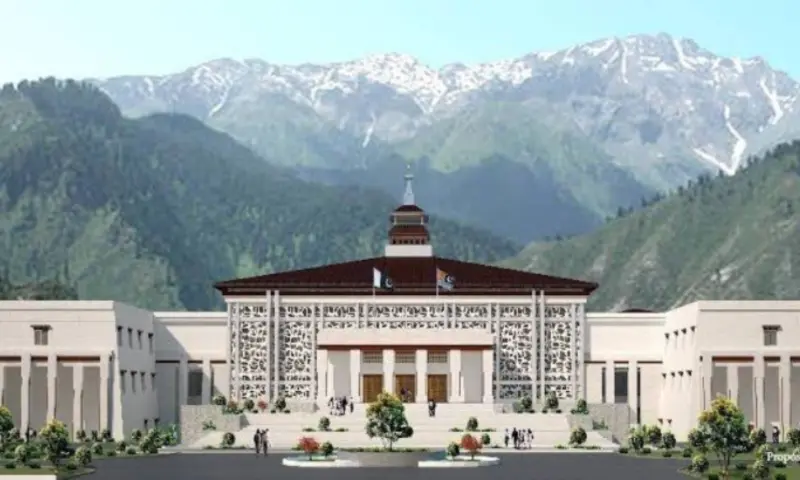
MUZAFFARABAD: The Azad Jammu and Kashmir (AJK) Legislative Assembly on Wednesday offered to reopen negotiations with the proscribed Joint Awami Action Committee (JAAC), subject to the disbandment of armed groups, surrender of those allegedly involved in serious crimes and an unequivocal commitment to pursue demands through constitutional and democratic means.
The region has witnessed violence-marred protests over the past few months, particularly in June and July, with reports of sporadic unrest in recent weeks. At the root of the tensions was JAAC’s demand to abolish the 12 refugee seats in the AJK Legislative Assembly.
Adopting a resolution unanimously, the House on Wednesday also demanded an end to all sit-ins and illegal protests, reopening of highways and other routes, and a public apology by JAAC’s leadership for what it described as anti-state narratives directed against state institutions, law enforcement personnel, Pakistan and the Kashmir freedom movement.
The resolution, jointly moved by Deputy Speaker Mohammad Ahmed Raza Qadri, Forests Minister Waqar Ahmed Noor, Health Minister Dr Mustafa Bashir Abbasi, Education Minister Umair Naeem, Energy and Water Resources Minister Saqib Majeed Raja and MLA Chaudhry Mohammad Ismail, was read out by Noor. The sitting was presided over by Speaker Chaudhry Tariq Farooq.
The House said the AJK government would be prepared to resume meaningful political dialogue with the committee within the framework of the Interim Constitution of 1974 and relevant laws if the stipulated conditions were met. It maintained that a lasting solution to political disputes lay in constitutional means, the rule of law and mutual respect rather than violence and confrontation.
The resolution held the JAAC leadership primarily responsible for the breakdown of negotiations, claiming that the government had accepted several of its demands and provided assurances on others despite violent protests.
It alleged that JAAC had subsequently interpreted the government’s concessions and flexibility as weakness and raised unconstitutional demands incompatible with the existing constitutional and democratic structure of AJK.
The resolution further said the government had also offered several alternative avenues for resolving the dispute, including high-level negotiations, participation in a multi-party conference and the general elections, seeking the AJK Supreme Court’s opinion on constitutional questions through a reference, and holding a referendum on important constitutional matters.
The JAAC leadership, however, had rejected these options, the resolution claimed.
The assembly expressed grave concern over what it described as attempts to disrupt the timely holding of general elections and create anarchy and uncertainty in the state through armed groups and violent marches since June 2026.
It accused elements affiliated with JAAC of obstructing the movement of law enforcement agencies (LEAs), blocking highways, attacking hospitals, threatening government officials, establishing armed checkpoints and causing the closure of universities, medical colleges, schools and other public institutions.
The resolution also alleged that armed groups had obstructed the supply of essential commodities, opened fire with sophisticated weapons and carried out lethal attacks on law enforcement personnel. It particularly condemned the alleged desecration of the bodies of police personnel martyred during the unrest and restrictions imposed on the movement of ordinary citizens through armed checkpoints.
The House said the violence had severely disrupted normal life, caused shortages of essential commodities and forced women, children and elderly people to leave affected areas for the safety of their lives and property. Access to education and healthcare, freedom of movement and protection of life and property had also been affected, it added.
According to figures placed before the assembly, 34 LEA personnel had been martyred and 248 injured during the unrest, which erupted in June.
The assembly paid tribute to all those martyred and expressed condolences and solidarity with their bereaved families.
At the same time, the House made a distinction between the right to peaceful protest and unlawful activities, reiterating that peaceful demonstrations, political dissent and constitutional rights were fundamental entitlements of citizens, which the state was bound to protect.
It maintained that these rights could not be used as a cover for armed violence, holding citizens hostage, damaging public and private property, blocking highways or attacking state institutions.
The resolution echoed the then-AJK government’s allegations that the JAAC leadership had used social media to promote a narrative contrary to facts and exaggerate casualties, spreading anxiety and speculation among Pakistanis and Kashmiris living abroad.
The resolution warned that in case of non-compliance with its demands, the AJK government should discharge its constitutional responsibilities by taking necessary legal action through LEAs to restore state authority, maintain public order and protect citizens’ lives and property. Such action, it stressed, must remain within the bounds of the Constitution, law and human rights.
The House also paid tribute to the historic contributions of the people of Poonch to the Kashmir freedom movement, expressing the expectation that they would help maintain peace, stability and the rule of law in the region.
Reaffirming its commitment to preserving the existing administrative and constitutional structure of AJK, the assembly said the state’s peaceful, stable and democratic character was essential not only for safeguarding the rights and collective interests of its people but also for the broader objectives of the Kashmir freedom movement.
It resolved that political differences and public demands would be addressed through dialogue and constitutional means, but there would be no compromise on the rule of law, state authority and the protection of public life and property.
Additionally, the House approved three resolutions tabled by treasury members Pir Mazhar Saeed and Sehrish Qamar, as well as Opposition Leader Chaudhry Muhammad Yasin.
Through their respective motions, Saeed called for displaying Quranic verses affirming the finality of prophethood in the Assembly hall, Qamar welcomed the recent visit of the PML-N leadership to Muzaffarabad, and Yasin paid tribute to former president Raja Zulqarnain Khan.
On June 5, following the announcement of the JAAC’s June 9 strike, the then-PPP-led AJK government declared the committee a proscribed organisation and placed it under the First Schedule of the region’s anti-terrorism act (ATA).
A day later, AJK authorities launched a crackdown on the JAAC, arresting scores of its leaders and later placing scores of its activists on the Fourth Schedule of the ATA.
Elections in the region were held in three phases on July 27, Aug 2 and Aug 10 amid protests in some parts. The PML-N — which leads the coalition in the Centre — emerged as the winner.
Earlier this month, AJK President Dr Muhammad Najeeb and Prime Minister Iftikhar Gillani called for restraint and peace, with the latter observing that provocative discourse and prevailing unrest were disrupting the lives of ordinary people.
The remarks came days after the Human Rights Commission of Pakistan (HRCP) expressed its concern over “reports of a fresh spate of violence in Rawalakot in AJK, with allegations of casualties among both protesters and law enforcement personnel”.
It called for the media to be “given unhindered access to report from the region independently”. “The priority must be to prevent any loss of life and resolve the situation through political dialogue rather than by force,” HRCP stressed.
Source: dawn
Leave a Reply