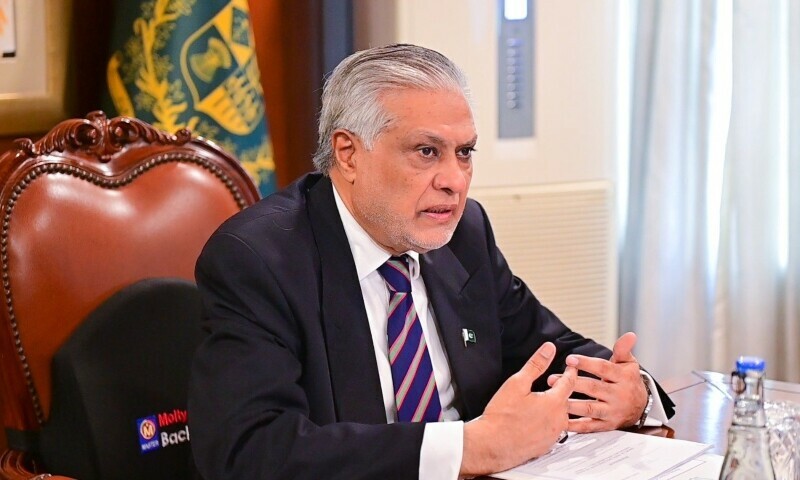
Deputy Prime Minister and Foreign Minister Ishaq Dar stressed the importance of multilateralism, saying bloc politics and unilateralism would not work.
In an interview with Euronews, the foreign minister said Pakistan’s foreign policy was very clear: it was independent.
“We believe in multilateralism,” FM Dar said, emphasising that even in the current environment, countries needed to work “double hard” to support it.
“Bloc politics or unilateral politics will not work,” he added.
Dar recalled that during Pakistan’s three-day presidency of a UN Security Council moot, the theme had been multilateralism and the peaceful settlement of disputes.
He also highlighted Pakistan’s role in the ongoing conflict between the United States and Iran.
“Pakistan believes that diplomacy and dialogue are the only way forward, even amid the extreme conflicts taking place in various parts of the world.
“The more effort is put into dialogue and diplomacy, the more likely a solution will emerge,” he said.
On mediation efforts between the US and Iran, FM Dar said Pakistan was the first country to condemn Israel’s attack on Iran on February 28.
The foreign minister said he had called his Iranian counterpart the following day, urging him to exercise restraint and refrain from retaliating against the attack.
However, he clarified that his message was not to target other Middle Eastern or Gulf countries, expressing regret that they were subsequently attacked.
He maintained that Iranian officials had told Pakistan they were targeting only American military bases and not those countries.
FM Dar also hailed the direct talks between the US and Iran, hosted by Islamabad after 47 years.
The foreign minister said that even during the previous round of indirect talks between the US and Iran in Oman, it had been agreed that Pakistan must be present if direct talks were held.
Dar also hailed the June 18 signing of the Islamabad Memorandum of Understanding between the US and Iran, but regretted the subsequent violations.
“Pakistan hasn’t given up. We are still working hard. We continue to persuade both parties to respect and honour what they signed on June 18,” he said.
Dar also called for the free movement of vessels through all sea routes, stressing that this was a “must”.
“Sooner or later — I hope sooner — we will achieve that objective because the world cannot afford [continued disruption],” he said.
He said disruptions to energy supply chains and rising prices were creating difficulties for people across countries.
However, he praised the government for providing fuel subsidies to low-income groups.
The foreign minister said it was “high time” that regional peace was achieved through an agreed mechanism.
“We all have to see the new security architecture,” he added.
On Pakistan’s economic potential and management, the deputy prime minister said there was a need to unlock the country’s potential, adding that the recent Pakistan Minerals Investment Forum was part of these efforts.
“Our total external debt is $130 billion, while the estimated potential of our mineral resources and rare earth materials is between $6 trillion and $10 trillion.”
“We have the potential and the capacity to match it. It’s a matter of time,” he said.
Responding to a question about Pakistan’s relations with Afghanistan, Dar said, “[…] nobody wishes for Afghanistan to be a stable, economically viable and prosperous country more than Pakistan does.”
Following last October’s major terrorist attacks, Pakistan shared what Dar described as credible evidence with international institutions, pointing to Afghanistan as the source of the attacks and alleging that they were sponsored by other countries.
He added that the Afghan administration had provided no verifiable evidence that it had taken concrete action to curb terrorism.
“We are on the front line. We have lost 100,000 people and Rs150 billion from our economy.
“We genuinely want terrorism to be eradicated and eliminated,” he said.
More to follow
Source: dawn
Leave a Reply