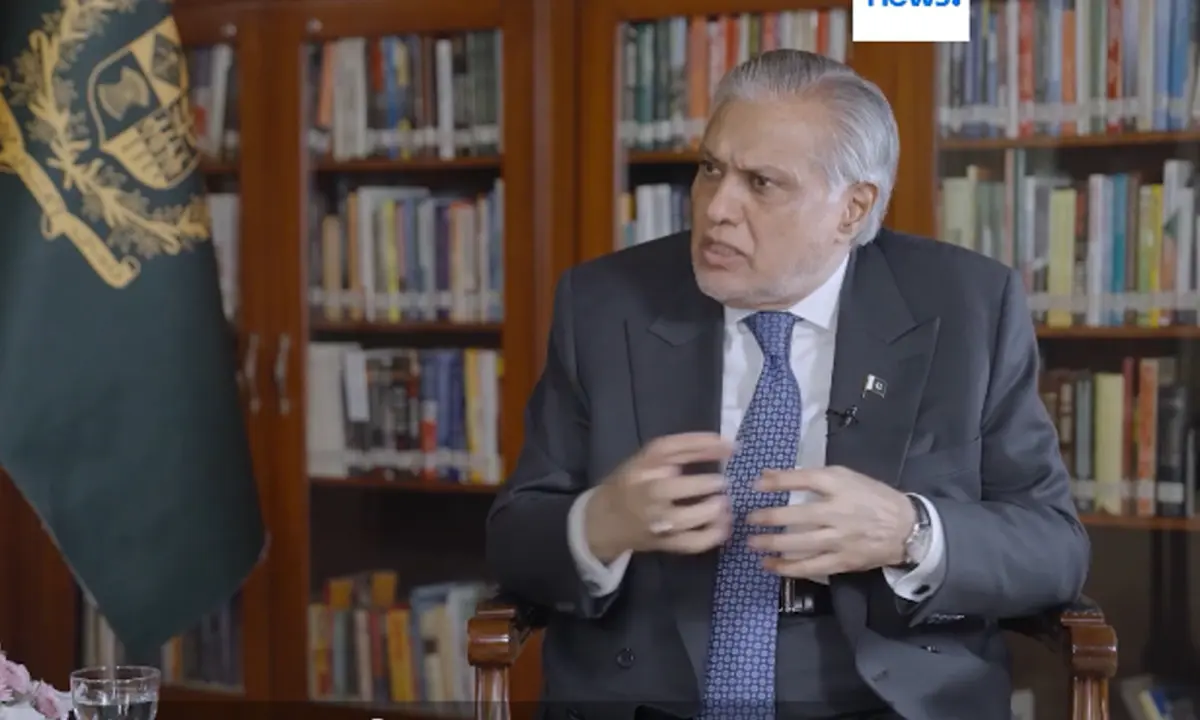
Deputy Prime Minister and Foreign Minister Ishaq Dar has called for a new regional security architecture to promote peace and stability in the Middle East, saying Pakistan is continuing diplomatic efforts to ease tensions between the United States and Iran.
In an exclusive interview with Euronews’ World Conversation programme in Islamabad, Dar said regional countries needed to develop a special mechanism to ensure lasting peace, while taking into account the wider implications of regional conflicts for the global economy.
He said Pakistan, Turkiye, Saudi Arabia and other regional countries were engaging with European nations to develop a framework that could contribute to peace and stability beyond the region.
Dar described the Makkah Joint Defence Agreement, signed by Pakistan, Turkey and Saudi Arabia in August, as a possible starting point for a new regional security architecture.
He stressed that the agreement was not directed against any country and could benefit both regional and international partners.
“The United Kingdom, France and Germany are engaging with the proposed security framework, while Italy has also expressed interest in participating in the dialogue,” he stated.
Pakistan’s mediation efforts
Discussing diplomatic efforts between Washington and Tehran, the deputy prime minister said Pakistan had not abandoned its attempts to reduce tensions between the two countries.
He said Islamabad continued to persuade both sides to respect and honour the Islamabad Memorandum of Understanding, highlighting Pakistan’s diplomatic role in bringing the United States and Iran to an agreement in June.
Dar stressed that dialogue and diplomacy remained the only way forward for resolving differences and ensuring regional peace and stability.
He also reiterated Pakistan’s support for multilateralism, saying bloc-based or unilateral approaches would not work in the prevailing international environment.
Indus Waters Treaty, Kashmir
Responding to questions about relations with India, Dar said the Indus Waters Treaty must be respected and that India could not unilaterally hold it in abeyance.
He also rejected India’s measures in Indian-administered Jammu and Kashmir on August 5, 2019, reiterating Pakistan’s position that the people of the territory should be granted their right to self-determination.
Source: brecorder
Leave a Reply