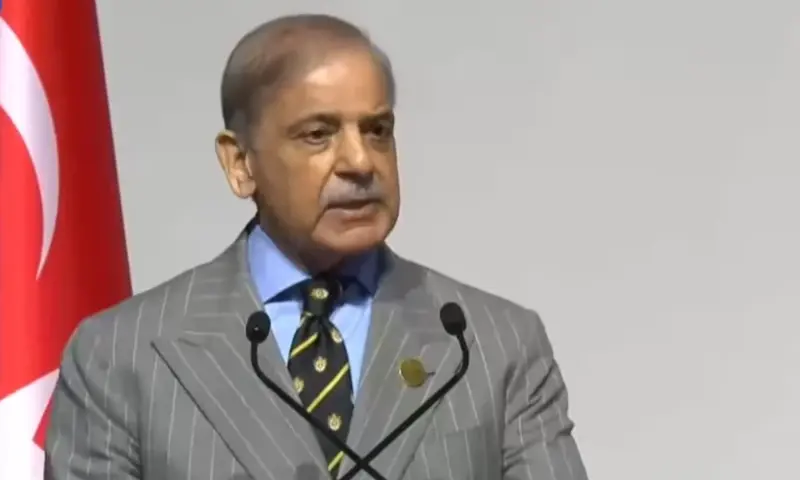
Prime Minister Shehbaz Sharif on Thursday called for grant-based finance and improved resilience and adaptation funds for climate-vulnerable countries at COP31, being held in Turkiye’s Antalya.
This year’s summit focuses on transitioning toward a low-carbon future.
Delegates from nearly 200 countries are meeting in the Mediterranean resort city of Antalya as global greenhouse gas emissions show little sign of falling, while wars, inflation and other crises compete for political attention.
Addressing the summit, Prime Minister Shehbaz Sharif highlighted Pakistan’s efforts to promote clean energy but warned that “national effort cannot replace a fair and just global response”.
“When climate disasters strike, vulnerable countries need timely help and finance that does not deepen their debt,” Shehbaz said, adding that Pakistan called for “grant-based finance, including public-private partnerships, alongside a significant increase in resilience and adaptation funds, which amount to survival funds, especially for struggling economies”.
He said clean energy sources accounted for nearly 55pc of Pakistan’s energy needs, adding that the country was advancing electric mobility and had set a target of reducing projected emissions by about 50pc by 2035.
Recalling the 2025 floods in Khyber Pakhtunkhwa’s Buner district, the prime minister said: “In August 2025, a young man in Buner was just two days away from his wedding when flash floods swept through his village. A home preparing for celebrations became a house of mourning.”
“Their grief was personal, yet the warning signs were global,” the prime minister said, noting that this was the story of “millions of people in Pakistan and across the developing world”.
“People who have contributed the least to climate change bear its heaviest consequences,” he added.
Addressing the summit, PM Shehbaz also recalled the 2022 floods in Pakistan, noting the economic damage and mass displacement the catastrophe caused.
More than 1,700 people lost their lives, and economic losses exceeded $30bn,” the prime minister said.
PM Shehbaz recalled his speech at the UN General Assembly in 2022. “I had warned that what is happening in Pakistan will not stay in Pakistan, and unfortunately, that warning has become a stark reality.
“The future we feared has become the present we are living,” he said.
Underscoring the need for global solidarity, the premier remarked, “Climate change knows no borders and no nation can face it alone. Solidarity must mean real action.”
He then expressed gratitude to Turkish President Recep Tayyip Erdogan for his country’s support for Pakistan during the 2010 and 2022 floods.
Addressing the summit, PM Shehbaz also warned against the weaponisation of water.
“No nation should be allowed to put the lives and livelihoods of people downstream at risk. Water-sharing agreements must be honoured in letter and spirit,” the premier said.
Concluding his address, PM Shehbaz said world leaders had gathered at the summit to “shoulder a shared responsibility to protect life on this earth.”
“Let our success be measured not by promises we make here but by the families we protect, the resources we deliver, and the meaningful action we sustain,” he hoped.
On Tuesday, PM Shehbaz addressed a high-level dialogue on clean energy transition, titled ‘35 by 35: Powering the Future’, where he highlighted Pakistan’s solar power boom.
“In just two years, Pakistan has added nearly 22 gigawatts of rooftop solar capacity — a quiet revolution by ordinary citizens seeking affordable power and a cleaner, more predictable future.”
He had affirmed that Pakistan fully supports the ‘35-by-35 Global Electrification Pledge’, wherein countries agree to aim to increase electricity’s share of total final energy consumption to around 35 per cent by 2035 in line with global climate objectives. The prime minister also held several bilateral conversations with world leaders and international organisations on the sidelines of the summit on Wednesday.
Dozens of leaders are speaking during the “high-level segment” taking place on Wednesday and Thursday, including Erdogan, Iran’s President Masoud Pezeshkian and Brazilian President Luiz Inácio Lula da Silva, whose country hosted last year’s climate talks.
“Nature — no less than people — is also paying a heavy price for armed conflicts. The starkest example of this is Gaza… what has taken place in Gaza is not only a genocide, but it is also an ecocide,” Erdogan said to applause on Wednesday.
The United States, the world’s largest historical emitter, has skipped the talks for the second year in a row after President Donald Trump — who has called global warming a hoax — withdrew the US from climate cooperation following his return to office in 2025.
Negotiators from nearly 200 countries are seeking agreement on a plan to increase the share of electricity in global energy use and revive stalled efforts to move away from fossil fuels.
On Wednesday, the UN chief told world leaders at the summit that the slow international response to climate change so far had placed the world on a path to destruction.
Governments must fight harder to preserve the planet for future generations, he said, in comments that set the tone for two days of rapid-fire speeches by world leaders.
“The brutal truth is that the climate crisis is outrunning us. This is the path to mutually assured destruction,” Guterres said, pointing to rising emissions, global temperatures and worsening climate-driven disasters.
“But science is not telling us to surrender. It is telling us to fight harder.”
Source: dawn
Leave a Reply