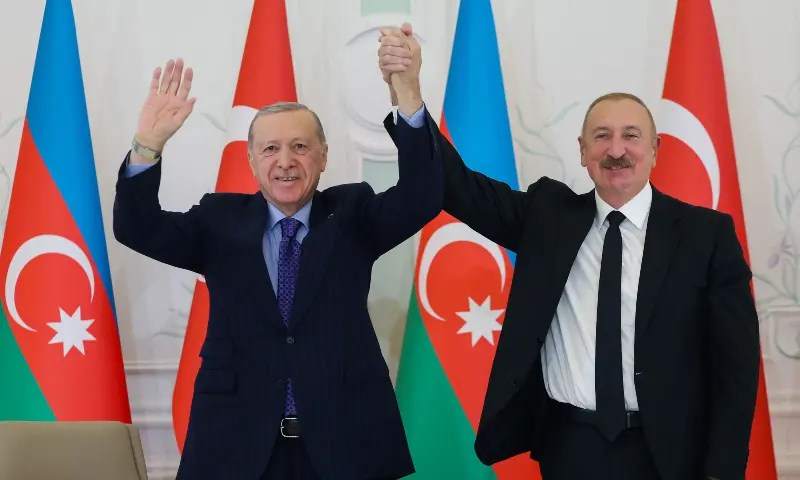
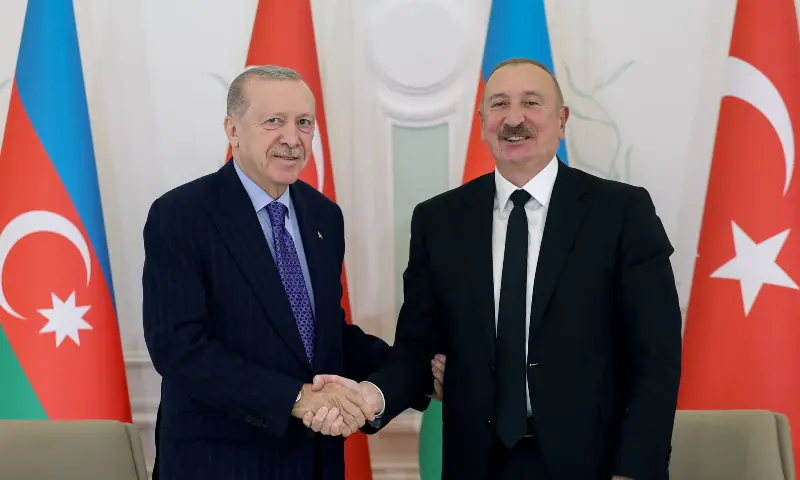
Turkiye’s President Recep Tayyip Erdogan and Azerbaijan’s President Ilham Aliyev vowed on Sunday that their countries’ alliance would remain solid, in a show of unity aimed at overcoming a public rift between the close neighbours.
Tensions flared in September, when Baku revised school uniform regulations to prohibit clothing deemed incompatible with secular education, effectively barring Islamic headscarves in classrooms.
Erdogan’s government has dismantled restrictions on hijabs in Turkiye.
Azerbaijan’s move sparked protests at home and drew criticism from Erdogan’s Justice and Development Party (AKP). Presidential adviser Oktay Saral demanded that Azerbaijan reverse the restrictions.
Aliyev’s ruling party, Yeni Azerbaijan, denounced the comments as “interference in Azerbaijan’s internal affairs”.
Baku also declared 31 Turkish nationals, including an opposition lawmaker and party leaders, persona non grata over critical social media posts.
Erdogan subsequently dismissed Saral, but Aliyev stayed away from an Oct 30 summit of Turkic leaders in Ankara — despite a personal invitation from Erdogan. Instead, he sent Foreign Minister Jeyhun Bayramov.
On Sunday, as Azerbaijan marked Victory Day commemorating a 2020 war with Armenia, Erdogan arrived in the country’s Fuzuli district, which Baku recaptured from Armenian forces six years ago.
A guard of honour lined up at the airport, where Aliyev and First Lady Mehriban Aliyeva welcomed Erdogan and his wife Emine.
“With the permission of Almighty God, our unity will endure forever,” Erdogan told a joint press conference with Aliyev.
“This unity of hearts, which we describe with the motto ‘One Nation, Two States,’ is an everlasting torch that draws strength from our shared past and illuminates our future.”
Aliyev said the alliance — “an important factor across a vast geographical area” — remained unshaken.
“Together, Azerbaijan and Turkiye are even stronger,” he said, adding that Erdogan’s visit “shows the whole world our unity”.
“I am confident that this unity will last forever.”
‘Deeper rift’
Analysts say the quarrel reflects deeper unease over Baku’s diplomatic independence and its close ties to Israel.
“Azerbaijan-Turkiye tensions stemmed from the fact that Baku does not see itself as the younger brother in this alliance and insists on relations between equal partners,” Elkhan Shahinoglu, head of the Baku-based Atlas Research Centre, told AFP.
“The hijab dispute is a symptom of a deeper rift,” Gonul Tol, an analyst at the Washington-based Middle East Institute, wrote on X.
“Tensions have long simmered over a number of issues including Azerbaijan’s sovereignty, Ankara’s influence in Baku, diverging policies toward Israel, and Turkiye’s rapprochement with Armenia.”
Baku has forged strong military and economic ties with Israel, which supplied Azerbaijan with weapons during its 2020 war with Armenia over the breakaway Karabakh region.
This angered Turkiye, which has grown increasingly hostile towards Israel over the Gaza conflict. Erdogan has accused Israel of genocide.
Turkiye is also seeking to normalise relations with Armenia, whose border it closed in the 1990s in solidarity with Azerbaijan, while linking progress to Armenian-Azerbaijani peace efforts.
Nov 8 marks Azerbaijan’s capture of the city of Shusha in Karabakh during its war with Armenia, a victory achieved with Turkish backing.
The Turkic-speaking allies describe their relationship as “one nation, two states” and, despite the friction, remain closely bound by military and energy ties.
Turkiye serves as a key transit route for Azerbaijani oil and gas exports to Western markets.
An ex-Soviet republic, Azerbaijan is a mainly Shia Muslim country, but after decades of Soviet rule it emerged as one of the most secular states in the Muslim world.
Israel’s former military chief Gadi Eisenkot started the tough task on Sunday of forming a government, reaching out to Benjamin Netanyahu’s allies as he warned the veteran prime minister had brought the country to a historic crisis.
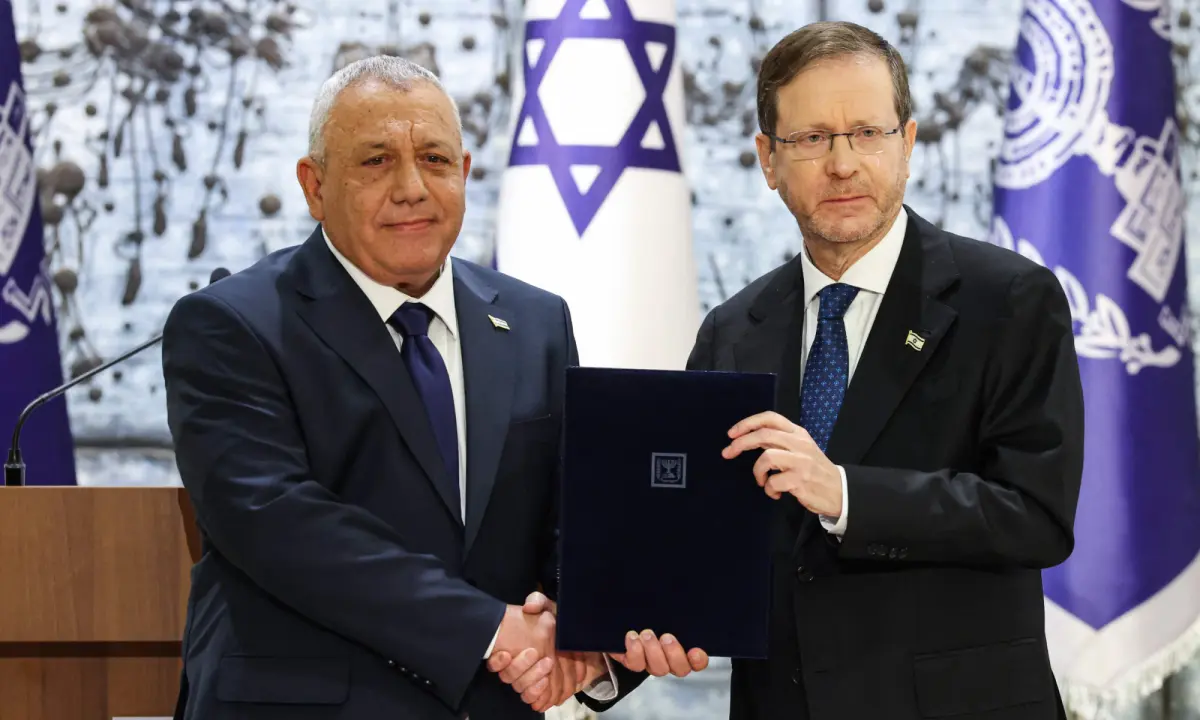
Eisenkot, 66, a political novice who has vowed to bridge Israel’s deep polarisation under Netanyahu, formally received a mandate from President Isaac Herzog, giving him 28 days to form a government despite his bloc lacking a clear majority.
“We are in a state of emergency, approaching a point of no return for the State of Israel,” Eisenkot said at a ceremony at the presidential office.
Both Eisenkot and Herzog acknowledged Israel’s growing isolation under Netanyahu, who is wanted by the International Criminal Court over allegations of crimes against humanity and war crimes in Gaza.
“We are in the midst of a devastating diplomatic crisis. Even our closest friends and strategic allies are saying their relationship with Israel must be reassessed,” Eisenkot said.
“We must form a national emergency government. This will require creative and unconventional political steps,” Eisenkot stressed.
He said Israeli democracy was at a vulnerable moment at a time when it faced immense challenges. “There is great urgency for new leadership, leadership that people can look in the eye and trust,” he said.
Eisenkot appealed to Netanyahu’s Likud Party as well as the far-right party of Finance Minister Bezalel Smotrich to join — but only with himself as prime minister.
“My door is open and my hand is extended, wholeheartedly and willingly, to anyone who understands the gravity of this moment,” he said.
Meanwhile, Herzog cited a threat of attack from Iran, the need to progress towards peace in Gaza and negotiations with Lebanon and other neighbours.
“We need to start shaping the political horizon in the region, and we also have to present the 20 points of the agreement in the Gaza strip, and consultations with our neighbours in Lebanon and the region,” he was quoted as saying in a translation by Al Jazeera.
“We also have to deal with the sanctions and the political challenges in light of the recent political developments in the United States,” the Israeli president said.
In the United States, the most vital ally of Israel, Democrats on Tuesday swept the midterm elections with calls to rein in Israel after the devastation in Gaza and the unpopular Iran war which Netanyahu launched with President Donald Trump.
Eisenkot, born to a family of working-class Moroccan immigrants, would be the first Sephardic prime minister — a community mostly descended from Middle Eastern or North African Jews — in a country long dominated by an Ashkenazi elite with ties to Europe.
Netanyahu is Israel’s longest-serving prime minister, having led the country on and off for nearly two decades. He has taken the country in a sharply rightward direction and led wars against Gaza, Lebanon and Iran since the Oct 7, 2023 attacks by Hamas.
Netanyahu called for a unity government of all Zionist parties to preserve a Jewish state, while giving no indication whether he was prepared to serve under Eisekenkot’s leadership.
“This is the will of the people and the need of the hour,” he said in a statement, ruling out a coalition government with Arabs — who make up 21 per cent of Israel’s population.
Nearly all Jewish parties now share Netanyahu’s rejection of an eventual independent Palestinian state, the basis of internationally endorsed peace efforts since the 1990s.
Negotiations can take 6 weeks
Eisenkot’s potential pathways to power include trying to form a minority government with Arab party support for key issues; forming a coalition with ultra-Orthodox parties that he and his allies have shunned in the past; or forging a unity government with Netanyahu. All three options face formidable obstacles.
Eisenkot has appeared to suggest he is willing to start off with a minority government — relying on outside votes from Arab-Israeli parties — before bringing other lawmakers into his coalition.
He said he will call on all parties to join who meet his main principles. These include recognition of Israel as a Jewish and democratic state; a duty of national service for all to strengthen the military and expand its ranks; and recognition of Hamas as a terrorist organisation and a commitment to destroying its military and governing capacity.
“I am convinced that it is possible and right to form a new government quickly, one that will win a large majority in the Knesset,” Eisenkot said, referring to Israel’s parliament.
Eisenkot now has 28 days plus a possible 14-day extension. If he fails, Netanyahu will likely get his shot at forming a government. Should he also be unable, new elections could be called.
Assaf Shapira, a political expert at the Israel Democracy Institute, said Eisenkot would face an exceptionally fragile government if it only had 48 lawmakers in the 120-member parliament, with extensive negotiations needed on every piece of legislation.
Eisenkot’s views
Eisenkot has vowed to put an end to rampant violence against Palestinians by extremist West Bank settlers supported by Netanyahu’s government and has warned that the incumbent premier does not have the mandate for another attack on Iran.
But he shares Netanyahu’s hawkish security views that have hardened since Oct 7, 2023: he opposes Palestinian statehood and says Hamas’s military wing must be destroyed or dismantled.
He emphasised his security credentials on the campaign trail, citing his “Dahiya doctrine” of responding to attacks with disproportionate force, which he deployed as a commander during Israel’s 2006 war with Hezbollah in Lebanon.
Both Eisenkot and Netanyahu say Israeli troops will not withdraw from Gaza until Hamas is disarmed, and that Israel is prepared to restart fighting to achieve this.
Although Eisenkot has criticised settler violence against Palestinians in occupied West Bank, which has surged since 2023, he favours settlement in principle and says it should comply with Israeli law.
He opposes settlements built without authorisation, aims to dismantle outposts in areas where they are forbidden and has pledged to rein in violent settlers.
Wooing the ultra-Orthodox
In consultations last week with Herzog, Eisenkot received recommendations from parties accounting for 67 lawmakers, against 46 for Netanyahu.
But that vote count included Israeli Arabs, whose seat haul surged to a historic high on anger over Netanyahu’s government and whom several parties oppose having in government.
Potentially making Eisenkot’s job tougher is the position of one opposition leader, Avigdor Lieberman of the Israel Our Home party, who has ruled out a unity government with Netanyahu or a minority government that has backing from Arab parties.
Lieberman, a former Netanyahu aide turned sharp critic who nonetheless shares his hawkish views, has been adamant against any alliance with Arab Israelis, who are descendants of Palestinians who stayed after Israel’s creation in 1948.
But Lieberman has softened his stance on sitting with ultra-Orthodox Jewish parties as long as they agree to support a law under which ultra-Orthodox men serve in the military.
Taking back one of his signature campaign pledges, Lieberman instead voiced an openness to an alliance with ultra-Orthodox Jews, whose almost singular priority is ensuring that they remain exempt from military service.
The exemption for the ultra-Orthodox — whose two main parties had been aligned with Netanyahu but could push Eisenkot to a majority — has been a source of growing resentment for many Israelis as reservists fight on multiple tours of duty.
Lieberman said on Sunday he still backed conscription for all Israelis but that he had to make “difficult decisions” for the higher priority of ousting Netanyahu, who faces corruption charges that could land him in jail if he loses power.
Naftali Bennett, the second strongest opposition leader after Lieberman, has also been outspoken against the ultra-Orthodox community’s military exemption and has stayed quiet since Lieberman’s about-face.
In Tel Aviv, Neri Bar-On, who works in educational technology, said he expected Eisenkot to succeed in forming a government.
“But the problems run deeper,” he said.
“The country is facing a massive internal conflict; even if he manages to form a government, it won’t solve the underlying issues.”
The Federal Board of Revenue (FBR) has introduced a new facility allowing taxpayers to apply for the amendment or cancellation of electronic sales tax invoices even after the prescribed 72-hour time limit has expired.
The facility, available through the FBR’s IRIS portal, requires prior approval from the concerned Commissioner Inland Revenue (CIR). It is intended to help taxpayers correct errors or discrepancies in valid electronic sales tax (DI) invoices that are discovered after the 72-hour period.
According to a user manual issued by the Pakistan Revenue Automation Limited (PRAL), taxpayers can submit an application through IRIS and attach supporting documents for review by the tax authorities.
Here is a step-by-step guide to using the facility.
How to apply for amendment or cancellation
Step 1: Log in to IRIS
Log in to your account on the FBR’s IRIS portal. From the main menu, open the Sales Tax section and select Applications.
Step 2: Select the relevant application
Choose “Application for Amendment in Electronic Sales Tax Invoice (after 72 hrs)” from the available options.
Select the relevant tax period and click Continue.
Step 3: Add the invoice
Open the DI Sale Invoice section and click Add Invoice.
You will need the FBR Invoice Transaction Number, also referred to as the Master Invoice Number. This number can be found in the DI Invoice Management section for the selected tax period. It is the number appearing before the hyphen in the invoice number.
Enter the number in the search field and click Search. Select the relevant invoice from the results.
Step 4: Choose whether to amend or cancel
After selecting the invoice, choose one of the two available options:
– For amendment: Select Load For Modification. Open the invoice, click Edit, make the required changes and select Save Item.
– For cancellation: Select Load For Discard. Choose the invoice, click Delete/Discard and confirm the action by selecting Yes.
An invoice selected for amendment cannot also be included for cancellation in the same application. Similarly, an invoice selected for cancellation cannot be amended through that application.
Step 5: Attach supporting documents
Open the Attachments tab and click the + icon to upload the relevant supporting documents in PDF format. After attaching the documents, click OK.
Review the application and click Submit.
What happens after submission?
Once submitted, the application is forwarded to the tax authorities for review. The concerned tax officer or commissioner may seek further information or clarification through IRIS’s Internal Correspondence facility.
If clarification is requested, taxpayers can respond by opening Outbox, selecting Sales Tax and choosing Application for Amendment in Electronic Sales Tax Invoice (after 72 hrs).
Under the Assignment tab, select the relevant assignment and click Reply. Choose “Clarification Provided”, enter the required explanation and click Save.
The tax authorities will then review the application. The commissioner or tax officer can approve or reject individual invoice items or multiple items together.
Important restrictions to remember
Taxpayers cannot apply for amendment or cancellation of invoices that have already been linked to Annexure-C (Sales) of a sales tax return or a Federal Excise Return.
Applications are also not allowed for invoices that have already been approved by the commissioner under another application, previously submitted or rejected by the commissioner, or are awaiting a decision in another application.
While an application is pending, the taxpayer cannot submit Annexure-C of the sales tax return. The IRIS system will block its submission until a decision is made.
If the application is approved, the amended invoices become available for loading into Annexure-C, subject to system validation. If it is rejected, the original invoices remain unchanged and are loaded into Annexure-C and, where applicable, the Federal Excise Return.
Taxpayers may submit more than one application for the same tax period, provided the invoices included in each application do not fall under the restrictions listed above.
An example
A shop issues an electronic sales tax invoice for a laptop but later discovers that the sale amount, sales tax figure or other invoice details were entered incorrectly. If the mistake is found after five days, the taxpayer can no longer use the ordinary 72-hour facility.
Under the new procedure, the taxpayer can apply through IRIS to amend the eligible invoice, attach supporting documents and seek the commissioner’s approval. If an invoice was generated by mistake, the taxpayer can instead apply for its cancellation.
The changes or cancellation, however, are not automatic. They can only take effect after the application has been reviewed and approved by the concerned tax authority.
The above article is contributed by Baseer Ahmed, Head of Politics Desk at Business Recorder (Digital).
CAIRO: Iranian media suggested explosions in southern Iran on Saturday evening were related to Iranian military activities rather than US strikes while both sides reported that shipping had been hit in or near the Strait of Hormuz.
Iran’s state television said officials had not confirmed any missile strikes on Iranian territory following blasts heard in several areas, including on Qeshm Island in the strait.
President Donald Trump had hinted at renewing major attacks on Iran after last week’s US midterm elections but there has been no sign of a large-scale US military operation, which Iran has said it would respond to by striking US and Israeli targets.
Both sides have continued strikes on vessels in the Strait of Hormuz, however, restricting exports of energy and other commodities vital to the world economy.
Iran’s state television said the evening explosions might be related to Iranian military activity in the waterway, where Iran said two vessels had hit mines and a third had caught fire.
The US said its air force had disabled a vessel in the Gulf of Oman beyond the strait.
Tasnim news agency said two missiles had struck Qeshm Island, with no official information on possible damage. Neither Iran nor the US has commented on that report. Washington said on November 2 that it had struck the island in a limited defensive measure against Iranians using surface-to-air missiles against US assets.
US and Iran both say they struck ships
Since the US and Israel began attacks on Iran in February, Tehran has sought the upper hand by hitting vessels in the Strait of Hormuz to block Gulf energy exports, while US forces began blockading movements to and from Iranian ports in April.
The US military said on Saturday evening that its air force had fired at the stern of a commercial vessel in the Gulf of Oman, disabling it as it tried to get through the blockade.
Iran’s Revolutionary Guards Navy said two oil tankers had caught fire after hitting mines while attempting to pass through an “unauthorized route” in the Strait of Hormuz. A third tanker had also suffered an explosion and caught fire, the semi-official Fars news agency reported later.
Reuters was not able to confirm any of the reported strikes.
Monitors from the United Kingdom Maritime Trade Operations (UKMTO) said a bulk carrier and military forces were involved in an incident in the Gulf of Oman, approximately 18 nautical miles east of the United Arab Emirates’ city of Khor Fakkan, with damage unknown. It was unclear if it was related to the reported US attack.
Saudi state oil company damaged by falling debris
A conflict between Iran-aligned Houthis in Yemen and Saudi Arabia has escalated this month, enlarging the wider Middle East war.
On Sunday, Saudi Arabia’s energy ministry said an administrative building belonging to state oil company Saudi Aramco in Riyadh had been damaged by falling debris after an attempted attack, with no injuries or fatalities reported.
Qatar, which has been mediating in talks to try to end the conflict that has shaken the world economy, on Saturday denied reports that the US and Iran had failed to reach a deal.
The Qatari prime minister had affirmed that both sides were continuing to work toward an agreement, it said.
Iran has submitted a nuclear proposal to Washington through Qatar, a senior Iranian official told Reuters on Thursday, saying the US was reviewing it but discussions would depend on Washington first meeting Tehran’s seven demands.
These include sanctions relief, access to frozen assets and war reparations, while Washington insists nuclear issues must feature in initial talks.
On Saturday, the US military said it was launching a task force to crack down on the movement of advanced weapons and other sanctioned material to Iran via its land borders and the Caspian Sea – part of economic measures to try to pressure Tehran.
Iran’s Revolutionary Guards dismissed the plan as “wordplay”, saying it would not work because Tehran had made preparations and communicated closely with its neighbours.
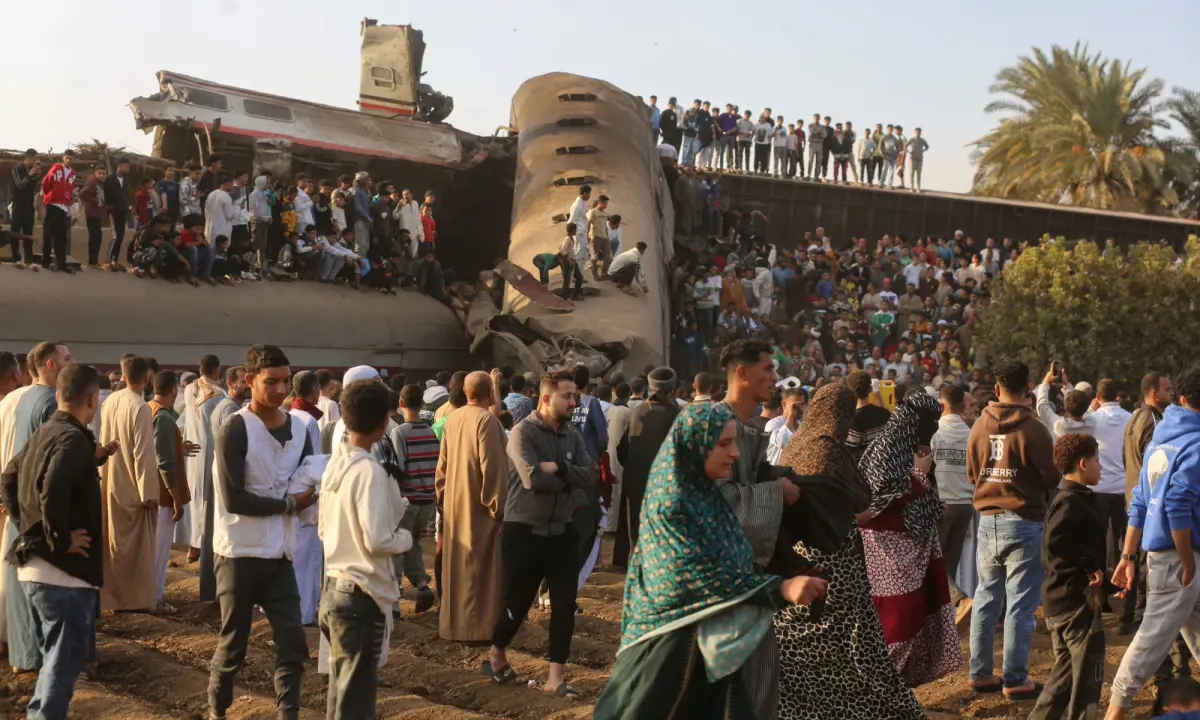
CAIRO: Two passenger trains collided some 76 km (47 miles) south of Cairo on Sunday, killing at least four people and injuring 88, Egypt’s health ministry said.
The state railway authority said a train travelling from Giza to Fayoum hit the back of another heading from Cairo to Aswan, derailing several carriages.
President Abdel Fattah al-Sisi ordered a swift investigation and said anyone found negligent should be held accountable, according to a separate statement.
Emergency crews were clearing the wreckage to restore services on the Cairo-Upper Egypt line, the railway authority said, without giving any indication of how long this would take.
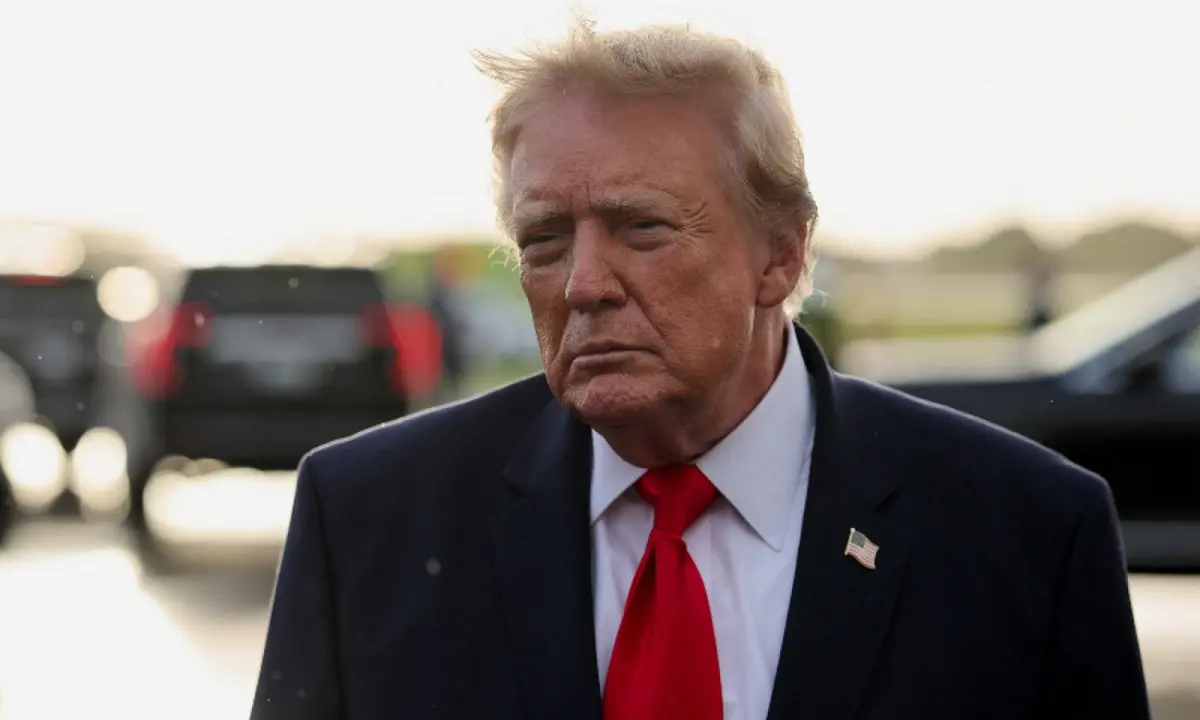
United States President Donald Trump vowed on Sunday to bounce back stronger from a massive midterm elections loss that he called a “giant step back in history” for the US.
Democrats captured both chambers of Congress in last Tuesday’s midterms that dealt historic losses for Trump’s Republican Party in states they had dominated for decades.
“America took a giant step back in History with the results of the last Election,” Trump said in a post on Truth Social, saying that the stock market that had grown during his tenure took a loss after the vote.
“But have no fear, we will be back, BIGGER AND STRONGER THAN EVER BEFORE!”
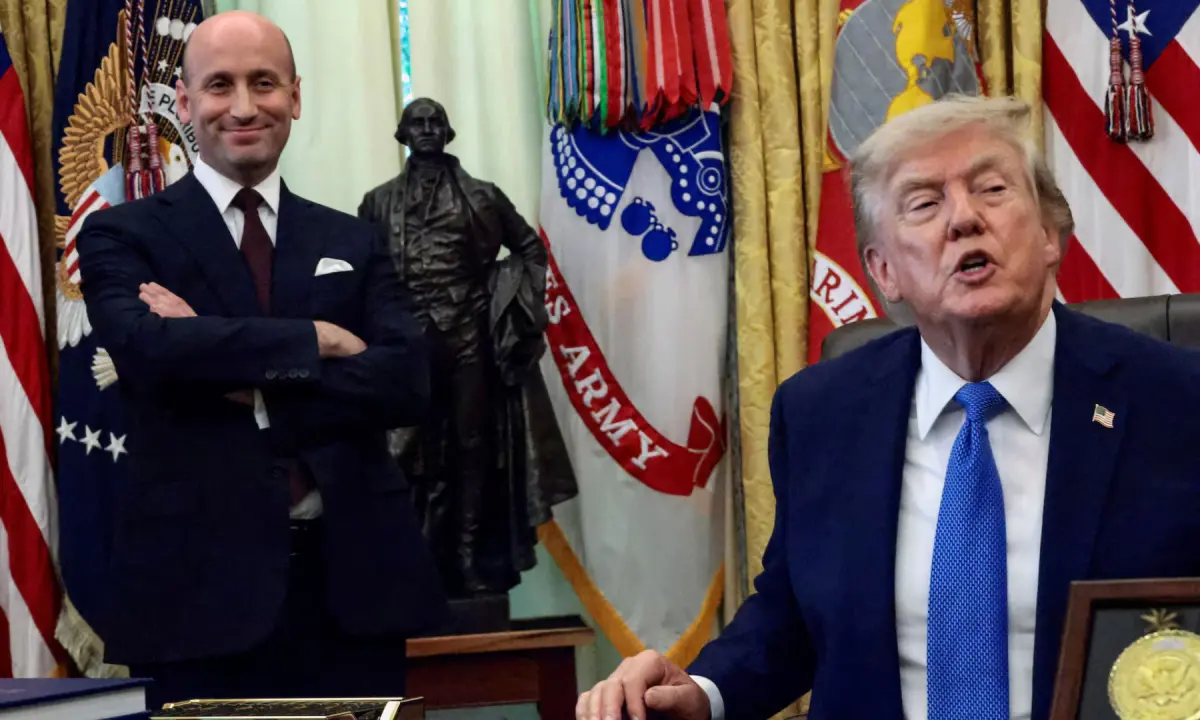
While Republican lawmakers have been licking their wounds over the setback, Trump has sounded defiant and on Friday appointed hardline advisor Stephen Miller as his new chief of staff, signaling a bare-knuckle fightback.
Democrats have pledged to hold the Trump administration to account and fight “every step of the way” against Miller, architect of Trump’s tough immigration policy.
It will be the first time that Trump, a Republican who also held the White House from 2017 to 2021, has had to contend with a Democratic-controlled Congress in both chambers.
House Democratic leader Hakeem Jeffries has said the incoming majority will be focused on affordability and accountability.
“We don’t work for Donald Trump,” the New York lawmaker told reporters on Wednesday. “We work for the American people. And the days of the House of Representatives functioning like a wholly owned subsidiary of the Trump administration are over.”
The result was a personal humiliation for the 80-year-old Trump, leaving him as a lame duck president for the remaining two years of his term and signaling an end to his stranglehold on the Republican Party.
He had previously attempted to brush off the election results, spending the beginning of his first public appearance on Wednesday talking to reporters about the marble and Corinthian columns of his new $400 million ballroom.
But he conceded that what Vance had said about the Iran war was “largely true because it drove the gasoline up” — a key issue for voters angered by the rising cost of living.
“But at the same time, if I had it to do again, I’d have to do it again.
Because long term, it’s the only answer. You can’t let Iran have a nuclear weapon,” he said.
Vice President JD Vance publicly split with Trump over the Iran war a day after the vote, saying the conflict was the “reason we lost” as he distanced himself from the unpopular war ahead of a possible 2028 White House run.
“The reason we lost is the war,” Vance wrote in a long social media post. “The president himself said so last night. If you’d like to argue it was worth it, that losing the Senate for the next six years was worth it, then do so. Argue it was a worthwhile cost to pay.”
Two trains collided south of the Egyptian capital on Sunday, derailing several carriages, killing four and injuring dozens, according to the authorities.
Egypt’s railway authority said a train travelling from Giza to Fayoum crashed into the rear of another service heading south from Cairo to the city of Aswan.
The health ministry said an initial count put the toll from the crash at four passengers killed, with 88 others currently being treated for injuries in hospitals around the Giza area.
State-owned media had earlier reported 120 people were wounded, without clarifying the degree of injury.
President Abdel Fattah al-Sisi said he was following the accident “with great concern”, and had directed authorities to conduct an urgent investigation to “hold accountable anyone found to have been negligent”.
Emergency crews used cranes to remove the wreckage, the authority said.
Authorities said they had launched an investigation into the cause of the crash, which occurred in Giza’s Al-Ayyat area, the site of Egypt’s worst-ever rail disaster.
In 2002, more than 370 people were killed when a fire swept through a train carrying holiday travellers south of Cairo.
In 2009, multiple train crashes in the area killed dozens.
Egypt’s 110 million people depend heavily on rail transport, but the network — one of the largest in Africa — has suffered repeated deadly accidents.
Over the past decade, Egypt has poured billions of dollars into updating its transport infrastructure, including new highways and high-speed rail lines, but has yet to overhaul much of its ageing rail network.
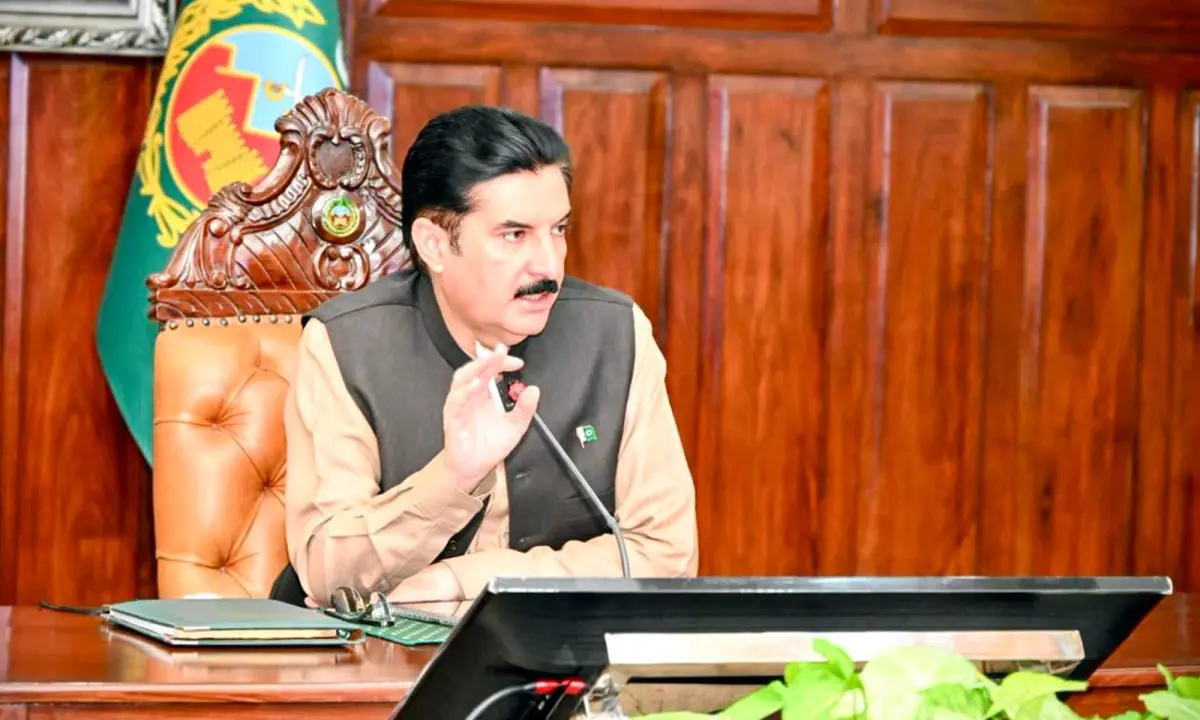
Khyber Pakhtunkhwa Governor Faisal Karim Kundi on Sunday said intelligence-based operations are necessary to restore law and order and eliminate terrorism in the province, ruling out talks with those who reject the state, Constitution and law and take up arms.
Addressing a press briefing on the province’s security situation in Peshawar, Kundi said the province’s security policy would be determined in Islamabad rather than Jalalabad, Kandahar or Kabul.
He said the government had adopted a zero-tolerance policy against terrorism and would respond to those taking up arms against the state.
The governor said the provincial government had sought Rs160 billion for security requirements, a demand supported by the federal government. He described restoring peace as a top government priority and pledged full support to security forces and police in their fight against terrorism.
Kundi said police would be provided with modern weapons and ammunition, while salaries and compensation packages for the families of martyred personnel would also be improved. “Initiatives taken by Punjab, Sindh and Balochistan will be considered for adoption through better coordination among the provinces,” he added.
He said development projects could only benefit the people when their lives were secure, adding that restoring public confidence and strengthening relations between police and citizens could help win half the battle against terrorism.
The governor also criticised the previous provincial government, accusing it of not providing adequate support to the federal government in efforts to combat terrorism. He expressed concern over what he described as its silence on statements by Afghan officials about taking control of Peshawar and on drone attacks from Afghanistan into Pakistan.
Kundi said the provincial government would take political responsibility for security and provide the police with all possible support. He added that he would continue to raise the province’s rights and resource requirements with the federal government, but action against those taking up arms against the state was necessary.
Security measures
On this occasion, the forum was informed that security forces had killed 3,788 terrorists over the past three years. By September this year, 255 military personnel, 302 police personnel and 304 civilians had been killed, according to the briefing.
The proposed measures include expanding the Counter Terrorism Department’s (CTD) operational jurisdiction to all 34 districts, establishing District Nerve Centres and setting up a Safe City Authority in 10 districts.
Artificial intelligence tools will also be used to counter what officials described as false and fabricated narratives on social media. Smart Front Desks are planned at 406 police stations in major cities across the province.
The meeting further decided to establish Dispute Resolution Councils and Tribal Liaison Committees in all districts, besides holding monthly open courts and regular jirgas.
Officials also discussed improving police capacity, strengthening coordination and adopting measures to build public trust in law enforcement agencies.
US President Donald Trump’s decision to elevate loyalist Stephen Miller to run his White House indicates that he plans to ramp up confrontation in his final two years in office and block outside political and economic pressures, Trump administration officials and other Republicans say.
Voters delivered a historic rebuke to Republicans in Tuesday’s midterm election, but with Miller as White House chief of staff, the Trump administration is expected to continue its aggressive immigration crackdown, amplify cultural conflicts and give no ground to a Democratic-controlled Congress, say officials and experts who spoke to Reuters.
They say wavering Republicans will face increased pressure to stay in line, while businesses may have a harder time making their case to the White House.
“This signals the administration is going to have a fighting-from-a-bunker approach the last two years,” said Dan Eberhart, a Trump donor and energy executive.
Although Trump has said he can work with Democrats, he has shown a feisty approach since the midterm election results became clear.
On Saturday, he ordered the Justice Department to “look into” Democrats whom he accused of sending “threatening letters” to Republican donors and other Trump allies.
The president also offered the job of White House press secretary to combat sports promoter Dana White.
‘This man saved America’
Miller, 41, marks a sharp contrast with outgoing chief of staff Susie Wiles, a former lobbyist who ran Trump’s 2024 presidential campaign.
Wiles lacked significant Washington experience but was seen as a deft manager of competing interests.
Miller, by contrast, is regarded by allies and foes alike as a combative ideologue with a deep knowledge of the levers of power and an unswerving loyalty to Trump.
“If it wasn’t for President Trump, the United States of America would not exist right now. This man saved America,” Miller said at an event at Trump’s Florida estate on Friday.
Miller joined Trump’s first presidential campaign in 2016 and served throughout his two terms in the White House. He is best known for driving Trump’s aggressive immigration crackdown, which has galvanised Trump’s supporters but alienated many voters.
Only 37 per cent approve of Trump’s handling of immigration, according to an October Reuters/Ipsos poll, down from 50pc when he took office.
Still, four US immigration officials told Reuters that there have been no signs that the administration will let up. “Nothing is changing, same quotas,” said one official, who spoke on condition of anonymity.
Representative Don Bacon of Nebraska, an occasional Trump critic who is retiring, told Reuters that Miller “was in denial” as he and other Republican lawmakers tried to warn him before the election that Trump’s immigration and tariff policies were driving away voters.
“We said, ‘You’re going to give us a bad midterm election,’ and he rejected it,” Bacon said.
‘Doubling down on a failed strategy’
The White House said Miller will continue to deliver “historic successes” in his new role, but Bacon said most of his peers in the House view it as “doubling down on a failed strategy”.
“It’s going over like a lead balloon in most of Congress,” Bacon said of Miller’s appointment.
Miller has also overseen Trump’s executive orders, giving him an expansive understanding of the administrative tools available to the president.
Several people interviewed for this story said they expect the White House to rely on executive orders more extensively rather than working with lawmakers.
Republican legislators will face pressure to stick with Trump through Democratic-led investigations to come, even if they damage the party as a whole.
“Those on Capitol Hill looking to break away from the Trump administration will know that Stephen Miller is not going to sit idly by and watch that happen,“ said Republican strategist Ron Bonjean.
Ending the Mideast war?
As well as the domestic issues he has focused on for most of his career, Miller now will have a greater say in foreign affairs.
Miller opposes prolonging the war with Iran, according to three sources familiar with his thinking who spoke on condition of anonymity, but he strongly supports Israel — potentially putting him at odds with a president who has threatened to resume strikes on Iran and announced he will end aid to Jerusalem.
Miller’s elevation also has unnerved some corporate lobbyists, who worry he will not be as responsive to their issues as Wiles, who cultivated relationships with top executives.
“This will be a big change,” said a senior lobbyist at a Trump-aligned firm who spoke on condition of anonymity.
“Miller is there to focus on political priorities, like immigration and tariffs, stuff Trump cares about, and won’t have the same approach as Susie, who understood policies have unintended consequences.”
Miller’s appointment was met with praise from senior cabinet officials and political supporters, who described him as the fighter they will need in Trump’s final stretch.
“I think Donald Trump has found his wartime consigliere,” Trump ally Roger Stone told Reuters.
RAWALPINDI: Anchorperson Rabia Ahsan was found shot dead at her home in the Gulshanabad area of Rawalpindi on Sunday, police said.
In a statement, City Police Officer (CPO) Hassan Mushtaq Sukhera said Ahsan’s husband was taken into custody and the suspected weapon was seized.
He added that an investigation has been launched.
CPO Sukhera, along with the senior superintendent of police (SSP) operations and the SSP investigations, arrived at the scene with a team of forensic experts to inspect the crime scene.
As per the statement, a male domestic worker at their house informed the police that the victim’s husband said the gunshot had been fired accidentally.
CPO Sukhera said that Punjab Forensic Science Agency (PFSA) teams were collecting evidence from the scene of the incident, while the body was being taken to the hospital for postmortem examination.
Sukhera said that a case of the incident was being registered, adding that an investigation on merit will be ensured.
While investigation into the motive was under way, First Lady Aseefa Bhutto-Zardari “expressed deep sadness over the killing” and “strongly condemned the violence”.
She called for a thorough, impartial and transparent investigation to establish the facts and ensure that those responsible are held accountable, a statement by the Presidency said.
She also expressed dismay over the “disturbing pattern of killing of another professional woman in the same metropolitan area”.
Aseefa recalled the murder case of Hina Javed, a 45-year-old digital media executive who was found dead at her Rawalpindi residence in August with signs of torture.
“Such incidents demand serious attention and accountability. Women must be able to live and work without fear for their lives,” she stressed.
The First Lady noted that the outcome of the investigation into Hina’s case was still awaited. According to a DNA analysis report, DNA samples of Hina’s domestic servant matched postmortem swabs collected from her body, while her husband’s DNA also matched samples taken from multiple items at the crime scene.
In a subsequent comment, Punjab Chief Minister Maryam Nawaz had noted that “DNA test results and polygraph test suggest that the murder and rape were committed by the servant; however the investigation is ongoing”.
On Oct 29, Aseefa had met with Hina’s family at the Parliament and called for the family’s demand of a judicial commission to be “given due consideration”.