Category: Brecorder

  • LSM moderation continues

    LSM moderation continues

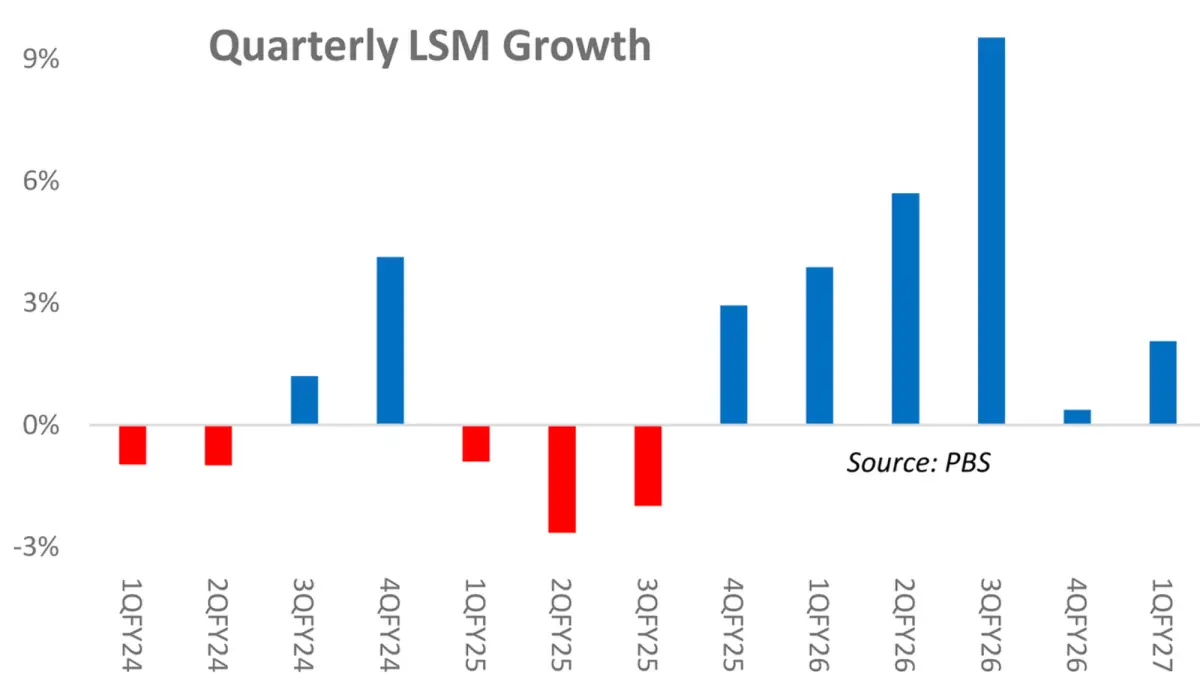
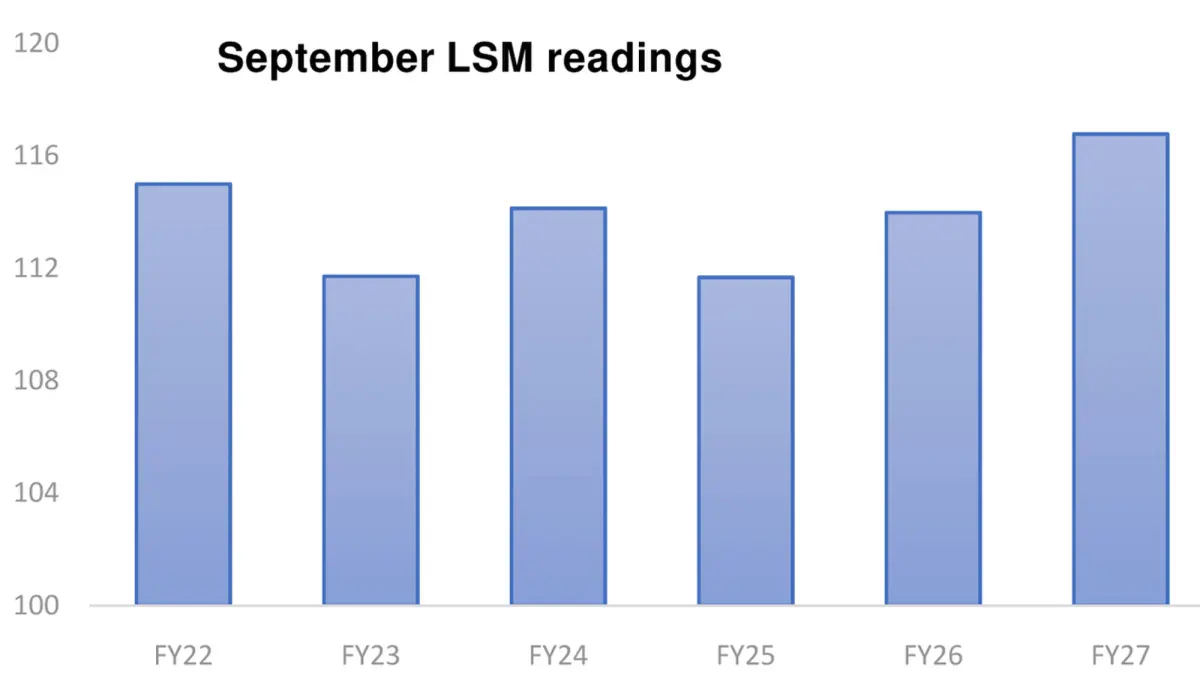
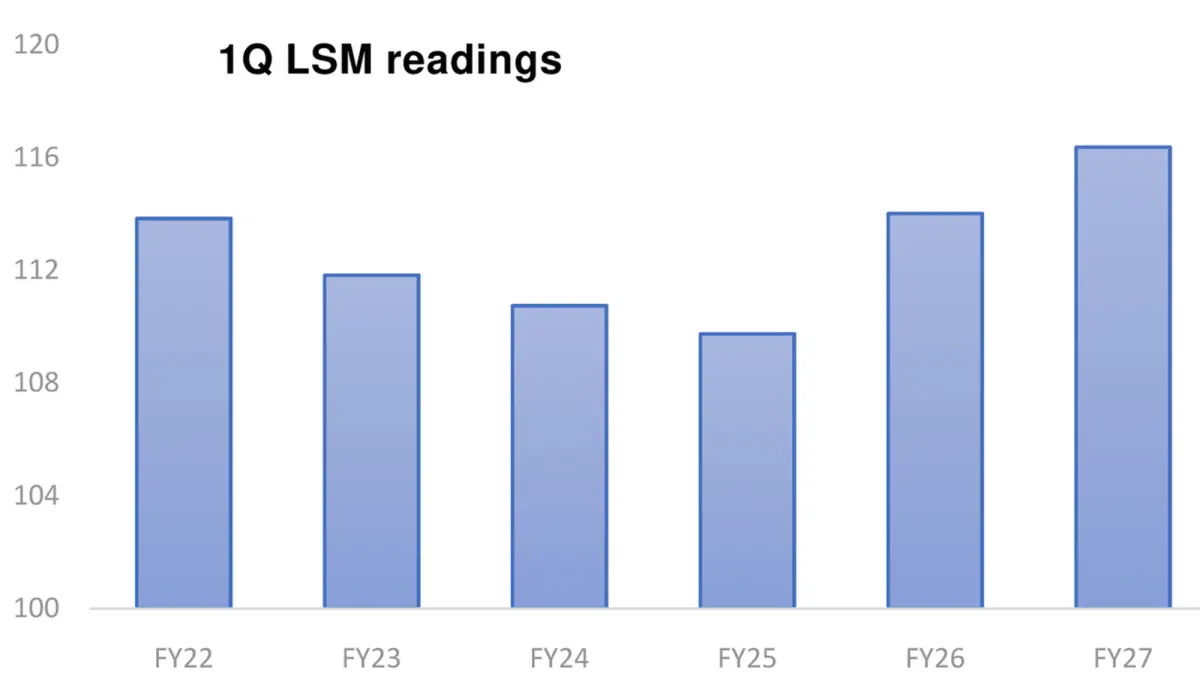
    Large-scale manufacturing (LSM) growth remains modest, with cumulative growth for 1QFY27 clocking in at 2.07 percent, below the corresponding period last year. This follows two consecutive quarters of relatively subdued growth, after four quarters of stronger expansion leading up to 3QFY26. The industrial recovery has not stalled, but the momentum seen earlier has clearly moderated.

    More striking is how dependent the latest growth has become on a single sector. Wearing apparel, tracked through ready-made garment export quantities, accounts for more than half of the positive contribution to LSM growth.

    Export volumes have remained exceptionally strong, rising 17 percent YoY during 1QFY27. October has brought little change in that trajectory: RMG export quantities were up 17.6 percent in 4MFY27, suggesting that garments will continue to lead the LSM growth contribution in the months ahead.
    LSM moderation continues

    Automobiles are the second-largest contributor, although the sector’s impressive growth rates need to be viewed in the context of the exceptionally weak production base created by the demand collapse of 2023-2025. The recovery has been meaningful, but that base effect is gradually narrowing. Growth is therefore likely to moderate as the fiscal year progresses, making sustained production levels a more useful indicator than headline year-on-year rates.

    Petroleum products rank third among positive contributors. Higher refinery utilization, supported by (the then) attractive refining margins amid the ongoing Middle East conflict, has lifted domestic production. Motor gasoline output in September remained close to its all-time high. The improvement in refinery throughput has provided an important boost to the LSM index, although its continuation remains tied, in part, to refining economics.

    The weakness elsewhere is more telling. The diffusion index shows 10 sectors in negative territory, the highest count since August 2025. Food was the biggest drag in September, with production of ghee and vegetable oil falling sharply. Ghee output was at its lowest level in almost a decade, while cooking oil production hit a four-year low. For a sector with a substantial weight in the manufacturing basket, this is a significant setback.
    LSM moderation continues

    The next few months could bring a change in fortunes for food manufacturing. Sugar production was a major source of support during the second half of FY26, and the new crushing season will again be central to the sector’s performance. Early indications point to a larger sugarcane crop than last year. If that translates into higher sugar output, food could return to positive territory from November onwards.

    Chemicals and pharmaceuticals remain under pressure, with supply disruptions and higher input costs continuing to constrain production. Lower industrial energy costs, helped by the incremental consumption package, have offered some relief. But the benefit is being offset in several cases by more expensive raw materials and procurement difficulties. Cheaper electricity cannot do much to support factory output when key inputs are costly or unavailable, and demand remains weak.

    That brings the discussion back to the demand side. Pakistan’s macroeconomic stabilization is no longer in question, but the improvement has yet to translate into a broad-based revival in industrial activity.
    LSM moderation continues

    Household purchasing power remains constrained, while businesses continue to face uncertain demand and elevated input costs. Nor is there much reason to expect interest rates to decline rapidly, which could further delay the recovery in interest-sensitive sectors.

    For now, the LSM outlook remains one of moderate growth, at least through the first half of FY27. Garment exports are providing a strong anchor, automobiles are recovering from a depressed base, and refineries are benefiting from favourable margins. But with 10 sectors in decline and food manufacturing struggling, the industrial recovery still needs more contributors. The next leg of growth will depend less on the performance of these few bright spots and more on whether domestic demand can finally catch up with macroeconomic stability.

    Source: brecorder

  • Panel informed: CCP completes comprehensive pharmaceutical sector study

    Panel informed: CCP completes comprehensive pharmaceutical sector study

    ISLAMABAD: The Competition Commission of Pakistan (CCP) has informed a parliamentary panel that it had completed a comprehensive study of the pharmaceutical sector, covering approximately 802 medicines and involving 30 pharmaceutical firms, and the study found no conclusive evidence of market-wide cartelisation or coordinated pricing among pharmaceutical manufacturers.

    CCP official stated this here on Monday while briefing the Senate Standing Committee on National Health Services and Regulations held under the Chairmanship of Senator Amir Waliuddin Chishti.

    The panel reviewed the status of compliance with and implementation of the committee’s previous recommendations regarding the regulation and advertisement of formula milk for infants and young children aged 1–36 months by the Ministry of National Health Services Regulation and Coordination (MNHSR&C), Drug Regulatory Authority of Pakistan (DRAP) and Pakistan Electronic Media Regulatory Authority (PEMRA).

    CCP officials said that the study examined medicine price increases, market trends and possible anti-competitive practices, including cartelization, saying that no conclusive evidence of market-wide cartelization or coordinated pricing among manufacturers had been established.

    However, they added that significant price increases were observed in several medicines, with 31.3 percent of the products recording price increases exceeding 50 percent and 7.7 percent witnessing increases of over 100 percent.

    The CCP stated that establishing a mechanism for regular price monitoring, quarterly reporting to the regulator and improved coordination to identify potential anti-competitive practices.

    During the discussion, members also raised concerns over the shortage and disappearance of essential and life-saving medicines, delays in hardship price-increase cases, and the availability of medicines in the black market.

    The Chairman Committee emphasized the need for effective monitoring and regulatory oversight and called for relevant healthcare regulatory bodies, including provincial Healthcare Commissions and Islamabad Healthcare Regulatory Authority (IHRA), to be invited to a future meeting to examine the issues.

    During the discussion, the chairman of the committee emphasized that deregulation should not mean allowing manufacturers to increase medicine prices arbitrarily. It was observed that the relevant regulatory authorities must continue to monitor market practices and protect consumers from unjustified price increases.

    CCP informed the committee that show-cause notices had been issued to manufacturers identified during the price survey, and that the commission was reviewing their responses to determine which price-increase justifications were genuine. CCP further assured the committee that a detailed report on the action taken against the manufacturers would be submitted to the standing committee.

    The panel taking up the matter of formula milk advertisement on media outlets and directed all the relevant authorities for strict enforcement regarding formula milk regulations, initiating nationwide breastfeeding awareness campaign and effective monitoring of medicine prices.

    The panel also expressed serious concern over the government’s failure to enforce formula milk regulations, stating that the issue involved the future of coming generations and could not be treated lightly.

    PEMRA officials informed the committee that the matter was already pending before the court, further clarifying that creating public perception did not fall within the regulatory body’s mandate and that while the authority could impose fines for violations in matters falling within its regulatory jurisdiction, it was not in a position to impose penalties in the present case.

    The officials also highlighted that DRAP had taken the position that the matter did not fall within its mandate and instead came under the jurisdiction of the food authorities.

    Senator Chishti emphasized that the committee was dealing with a highly sensitive matter and that its recommendations must be taken seriously. He further stated that the objective was to protect children’s health and ensure that the issue received due attention.

    Senator Rubina highlighted that, like medicines, formula milk was also recommended through medical prescriptions. She emphasized that it should not be treated as ordinary milk, as it was a powdered formula product. Officials stated that they were unable to take further action due to the stay order.

    The Chairman clarified that the stay order pertained only to two letters and did not suspend the implementation of the law. He further stressed that DRAP should exercise its regulatory authority over the product, as it did in the case of medicines. The Chairman directed that the relevant Act must be implemented.

    Senator Samina Mumtaz Zehri called for strict legislative measures, while Senator Aunsha Rehman stated that no advertisement should be aired in violation of the law.

    She expressed serious concern over the matter and questioned PEMRA’s handling of the issue, reminding the Chairperson of PEMRA to act according to the recommendations of the committee, rather than supporting the formula-making industry. Senator Shahzaib Durrani reiterated that the existing law must be enforced in its actual form.

    Senator Masroor Ahsan expressed concern that essential and life-saving medicines were often unavailable in the market but could be found in the black market at significantly higher prices, causing serious difficulties for patients. He stressed the need for effective monitoring to ensure the regular availability of medicines and prevent their illegal sale at inflated prices.

    He also mentioned that all political parties were on the same page on the said issue.

    The Chairman expressed dissatisfaction with DRAP’s lack of seriousness in implementing the committee’s earlier directive regarding laboratory testing. He also referred to the matter pending before the Supreme Court and questioned the regulatory position concerning the product.

    Health ministry officials acknowledged the importance of promoting breastfeeding and agreed that mother’s milk was the best nourishment for infants.

    The Committee further emphasised that advertisements of formula milk and related products prohibited under the law must not be aired. PEMRA representatives assured the Committee that the relevant restrictions would be implemented and that no such advertisements would be allowed in violation of the law.

    The committee also discussed the establishment of the National Infant Feeding Board under the relevant law. It was emphasised that the Health Ministry was responsible for ensuring the implementation of the Act and the constitution of the Board, which would oversee matters relating to infant feeding and nutrition. The Ministry was asked to ensure the preparation of the awareness advertisement within 15 days.

    The committee directed that the existing laws and provisions must be followed and implemented in letter and spirit, instructing the concerned authorities to provide a written response on the regulatory jurisdiction of the product and ensure compliance with the committee’s recommendations. The Committee also stressed that the relevant provisions regarding violations and penalties must be enforced.

    During the discussion, members questioned the legal basis for transferring the regulatory jurisdiction of formula milk from DRAP through an executive notification, maintaining that any change falling within the scope of existing legislation should be brought through the proper legislative process. DRAP officials provided clarification regarding the relevant legislation, proposed amendments, and consultations with government departments and industry stakeholders.

    The committee further directed that the relevant authorities should ensure effective coordination and implementation of the Committee’s decisions. The media was also urged to report the matter responsibly, highlighting that formula milk was a commercial infant-feeding product and that the issue concerned public health and the well-being of children.

    The committee also discussed concerns regarding policies and notifications issued by the Pakistan Medical and Dental Council (PMDC). It was decided that PMDC representatives would be invited to the next meeting to explain the policy decisions and notifications issued in this regard. The Ministry was also asked to ensure that the relevant officials attended the next meeting to clarify the outstanding matters.

    The meeting was attended by Senators Syed Masroor Ahsan, Dilawar Khan, Nadeem Ahmed Bhutto, and Samina Mumtaz Zehri; Dr Zarqa Suharwardy Taimur, Rahat Jamali, and Shahzaib Durrani; and Anusha Rehman through video link; Minister for National Health Services, Regulations and Coordination Mustafa Kamal; along with representatives of the health Ministry, DRAP, PEMRA, and other relevant stakeholders.

    Copyright Business Recorder, 2026

    Source: brecorder

  • Digital platform: PSX, JazzCash, Next Capital partner to offer govt Sukuk

    Digital platform: PSX, JazzCash, Next Capital partner to offer govt Sukuk

    KARACHI: Pakistan Stock Exchange (PSX), JazzCash and Next Capital Limited have signed a memorandum of understanding (MoU) to facilitate retail investment in Government of Pakistan Sukuk through JazzCash’s digital platform, aiming to expand access to government securities among individual investors.

    The agreement brings together PSX’s capital market infrastructure, JazzCash’s nationwide digital distribution network and Next Capital’s brokerage and technology capabilities to provide investors with a simplified digital channel for investing in government Sukuk.

    The MoU was signed at the PSX in Karachi in the presence of Farrukh H. Sabzwari, Managing Director and CEO of PSX; Murtaza Ali, CEO of JazzCash; Najam Ali, Vice Chairman of Next Capital; and Humaira Asad, CEO of Next Capital.

    Under the proposed arrangement, PSX will provide market access, while the National Clearing Company of Pakistan Limited (NCCPL) will support account opening, clearing and settlement. JazzCash will lead customer outreach and digital distribution, while Next Capital will act as the securities broker and provide the investment platform.

    The parties will finalise the operational and commercial frameworks for the initiative. Short-term sovereign hybrid Sukuk will be introduced in the initial phase, with a broader range of investment products planned for subsequent phases.

    PSX Managing Director and CEO Farrukh H. Sabzwari said the partnership marked a step towards widening retail investor access to Pakistan’s capital market by combining the exchange’s infrastructure with JazzCash’s digital reach and Next Capital’s brokerage and technology capabilities.

    He said the initiative was aligned with PSX’s objective of expanding access to Shariah-compliant investment avenues and enabling more people across the country to invest in government Sukuk through a digital process.

    JazzCash CEO Murtaza Ali said the partnership would extend access to capital market products to customers across the country. He described government Sukuk as the next addition to the platform’s investment offerings following Treasury Bills and equities.

    Next Capital CEO Humaira Asad said the company aimed to make investing as simple as digital payments, with user experience at the centre of its services. She said the partnership would enable the brokerage to offer government Sukuk to millions of JazzCash users through a digital investment facility.

    The initiative is intended to bring household savings into the formal capital market by making government securities more accessible to retail investors. However, the operational and commercial arrangements are yet to be finalised.

    Copyright Business Recorder, 2026

    Source: brecorder

  • Parliament must debate creation of new provinces: PA Speaker

    Parliament must debate creation of new provinces: PA Speaker

    LAHORE: Punjab Assembly Speaker Malik Ahmad Khan has called for an open parliamentary debate on the creation of new provinces, arguing that the issue is fundamentally linked to equitable distribution of resources, public representation and strengthening the relationship between citizens and the state.

    Talking to the media on Monday, he said the relationship between the people and the state was weakening and could only be strengthened through fair distribution of resources and ensuring that citizens received their rightful share.

    According to him, all political parties should clearly explain their positions on the creation of new provinces, particularly the Pakistan Peoples’ Party (PPP), which supports new provinces in Punjab but opposes the division of Sindh. Questioning the PPP’s position, he asked what logic underpinned its support for new provinces in Punjab while opposing a similar move in Sindh.

    Public consultation and changes in provincial boundaries were two separate matters, he said, adding that the Constitution did not prohibit seeking public opinion on altering provincial boundaries.

    “Why the National Assembly and Senate had passed resolutions in 2012 regarding the division of Punjab if the matter fell exclusively within the jurisdiction of provincial assemblies,” he questioned. He maintained that the opposition had a constitutional right to raise and debate the issue of new provinces in the Punjab Assembly, stressing that the matter should be discussed openly in the House.

    Referring to the proposed referendum, Malik said the previous two referendums had been held during military regimes whereas the proposed exercise would be different as it would originate from Parliament. Parliament was the appropriate forum for a comprehensive debate on the referendum and could determine the questions to be put to voters and the geographical areas where it should be held.

    He pointed out that the constitutional procedure for holding a referendum was already provided in the Constitution and the matter was not an issue that necessarily required resolution by courts. Any constitutional interpretation, he said, should come from the relevant constitutional forum.

    Commenting on the constitutional role of the judiciary, he said courts should interpret the Constitution rather than rewrite it, adding that any misuse of constitutional provisions should be addressed by removing the flaws instead of allowing their continued misuse.

    He further said the establishment of new provinces should not be viewed merely through the lens of administrative expenditure. The central issue was equitable resource distribution and ensuring that people felt included in the state system.

    On former Prime Minister Nawaz Sharif’s position regarding provinces, he said his eventual statement on the issue would carry significant weight and that he was rightly taking time before expressing a final position.

    Copyright Business Recorder, 2026

    Source: brecorder

  • Nvidia reinstates Jensen Huang as CEO amid pressure from Trump, investors

    Nvidia reinstates Jensen Huang as CEO amid pressure from Trump, investors

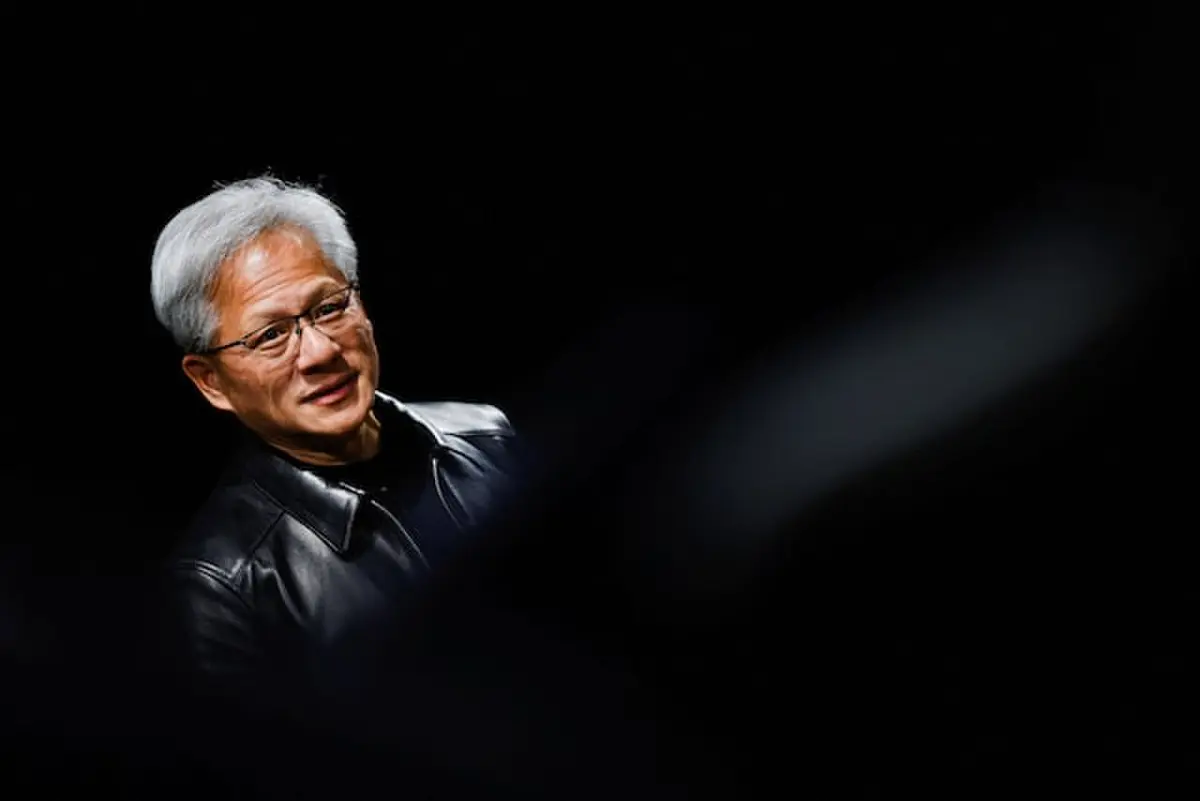
    Nvidia reinstated Jensen Huang as CEO at the urging of US President Donald Trump in a stunning reversal following his resignation over revelations of extramarital affairs, including one with an alleged spy for China, that roiled markets and the AI ecosystem.

    Huang’s reinstatement sent the company’s shares soaring 33%, with the board saying it unanimously approved his return and that it saw no national security risk. He has also been accused of having affairs with at least two Nvidia employees.

    Nvidia is facing multiple investigations, including by the US Securities and Exchange Commission and the Justice Department, over issues ranging from potential accounting irregularities to alleged chip smuggling.

    Corporate America has a long history of calling founders and former bosses back in a crisis, from Steve Jobs at Apple to Bob Iger at Disney. But comebacks after personal misconduct that sparked sweeping regulatory scrutiny are far rarer.

    Trump, who last week urged Nvidia to bring Huang back after its board ruled out his return, praised the reversal as the “correct and proper decision.”

    In a post on Truth Social, Trump said the US government had no reason to believe Huang’s return posed a national security risk and had no evidence he had engaged in unlawful conduct.

    Also read: ’No national security risk’: Nvidia reinstates Jensen Huang as CEO

    Several top leaders from the AI industry hailed his return,including Elon Musk, who said on X: “The mistake has been corrected”.

    “There were definitely a lot of people who wanted him back. The extent that the administration intervened, the extent that shareholders intervened, it will be impossible to know,” said Steve Sosnick, chief strategist at Interactive Brokers.

    “But it tells us to some extent that Jensen Huang was too big to be fired.”

    Trump’s sweeping support for huang

    Huang “did nothing wrong,” Trump told CNBC in an interview on Monday. He added: “We have to protect our geniuses, and he’s certainly a genius.”

    Trump nevertheless urged Nvidia to continue reviewing its compliance with US export controls to ensure it was adequately protecting national security.

    Nvidia’s board had asked the administration for assurance on the national security risks, and “we gave them the assurance,” Trump said, adding he has been speaking to the board “directly and indirectly”.

    Trump had been increasingly pushing for Huang’s reinstatement over the past few days. As he departed Washington last week for his Asia trip, he said he would not mind seeking Huang’s return to the company, saying “I think he learned a big lesson.”

    Taking credit for Huang’s return, Trump told CNBC on Monday, “I believe my intervention was very important to get Jensen Huang back.”

    Unexpected reversal

    The reversal underscores Huang’s deep influence over Nvidia and and raises questions in about how dependent one of the world’s most valuable companies remains on its co-founder.

    Just days ago, Nvidia Chairman Harvey Jones had said the company would not rehire Huang as his personal behavior was inconsistent with the company’s code of conduct, standards, and cultural norms.

    The board’s strong stance against Huang at the time came despite a growing campaign for his return. The board had appointed CFO Colette Kress as interim CEO, who said it would be “business as usual” for the company.

    Also read: Jensen Huang’s daughter helped steer Nvidia response to Megaspeed scrutiny, reports

    “I am honored to return to NVIDIA and lead one of the most consequential technology companies in the world at the beginning of a new industrial revolution,” Huang said in a statement on Monday.

    Huang resigned on November 12, dealing a massive blow to the AI trade, in which he has emerged as one of the most prominent faces.

    His departure reverberated from Silicon Valley to Taipei and Washington. A petition calling for his reinstatement drew more than 180,000 signatures, including one from Musk, underscoring the unusually strong support for an executive who stepped down amid controversy.

    Compliance focus at Nvidia

    The Nvidia board has formed a committee to investigate whether foreign intelligence efforts targeted Huang and is also starting a search to name a new chief compliance officer. The company said Kress would continue as CFO.

    The moves come as Nvidia faces heightened scrutiny in Washington over the flow of advanced AI chips to China. US authorities have tightened licensing rules for some chip shipments and overseas data centers serving Chinese companies, while lawmakers are preparing to question Huang, who has pushed for greater access to the Chinese market.

    Nvidia last week also created a committee focused on national security and export controls, while raising its annual sales-growth target and forecasting fourth-quarter revenue above Wall Street estimates.

    Huang’s abrupt exit from Nvidia had also threatened its business in China, Reuters reported on Monday, with some customers there cancelling or hesitating to place orders, jeopardising billions in revenue.

    AI trade

    Huang’s reinstatement on Monday rippled across markets, with Nvidia set to add $900 billion to its market value. Shares of Nvidia-backed neocloud companies CoreWeave and Nebius jumped nearly 25%.

    Huang, 63, built Nvidia from a video-game chip designer into the dominant supplier of AI processors, playing a central role in its chip roadmap, major customer relationships and ties with Washington.

    He ran the chip giant with a hands-on style, overseeing some 60 direct reports and delving into problems across the company. He also used Nvidia’s growing cash pile to invest across the AI ecosystem, including in cloud providers CoreWeave and Nebius and suppliers Marvell and Corning.

    Legal overhang

    Huang’s return echoes OpenAI’s 2023 saga, when Sam Altman returned as CEO four days after his ouster, following a staff revolt in which nearly all of the startup’s more than 700 employees at the time threatened to leave unless he was reinstated.

    “Jensen’s return is not a total shock, but it does send a troubling message about the state of corporate governance in America,” James St. Aubin, chief investment officer at Ocean Park Asset Management, said.

    “Clearly, the Trump administration had a big role to play in this decision by effectively immunizing Jensen and the board from any involvement by the Justice department.”

    Nvidia is facing a shareholder suit alleging the company and Huang defrauded shareholders by concealing Huang’s alleged relationship with Alice Huang, the Chinese businesswoman who allegedly had ties with Beijing.

    Securities fraud plaintiffs must show that Nvidia and Huang knowingly misled investors, that investors relied on those misleading statements and that those misleading statements artificially inflated the stock.

    Reuters reported exclusively last week that Huang misled several of the company’s leaders, including its general counsel, about the nature of his relationship with Alice Huang.

    The company is also facing a so-called derivative lawsuit seeking to hold the board liable for failing to make a good faith effort to oversee the business and Huang, alleging the board allowed Nvidia to make repeated assurances about the company’s dealings with Megaspeed and did not act on warning signs.

    Source: brecorder

  • Govt cuts petrol price by Rs3 per litre, keeps diesel rate unchanged

    Govt cuts petrol price by Rs3 per litre, keeps diesel rate unchanged

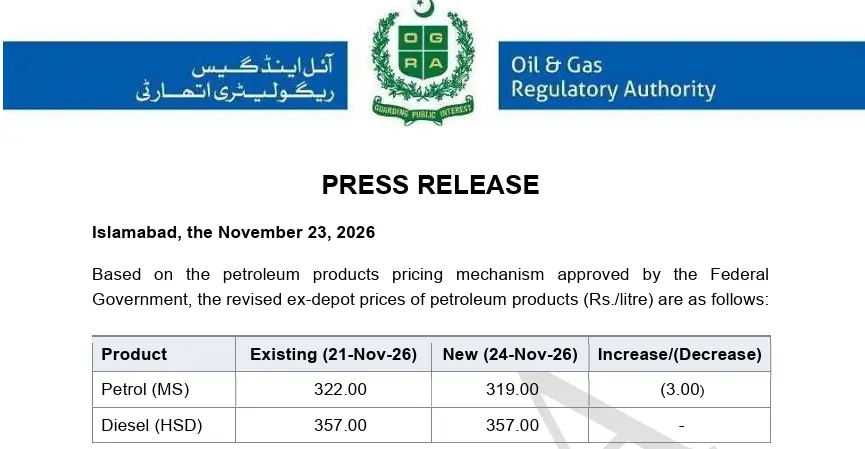
    Pakistan government decreased the price of petrol by Rs3 to Rs319 per litre and kept the diesel rate unchanged at Rs357 per litre, effective for Tuesday, November 24, 2026.

    The Oil and Gas Regulatory Authority (OGRA) announced the revised ex-depot prices in a notification issued on Monday, saying they were worked out under the petroleum products pricing mechanism approved by the federal government.

    Govt cuts petrol price by Rs3 per litre, keeps diesel rate unchanged

    The new prices are effective for Tuesday, November 24.

    In the previous review on Friday, the government reduced the price of petrol by Re1 to Rs322 per litre, while increasing the diesel rate by Rs2 to Rs357 per litre.

    Globally, oil prices fell on Monday as a rise in supplies from the Middle East and the restart of a Libyan oil pipeline offset unease about persistent shipping and refinery attacks in the region.

    Brent crude futures fell $2.02, or 2.18%, to $90.55 a barrel by 1436 GMT. US West Texas Intermediate futures were down $1.59, or 1.91%, at $81.82 a barrel.

    Earlier in the session, both contracts fell by more than 3%, with Brent hitting its lowest level in two weeks at $89.48 a barrel while WTI fell to its lowest since August 27 at $80.55.

    Source: brecorder

  • Bangladesh vows to arrest Hasina if she returns from India

    Bangladesh vows to arrest Hasina if she returns from India

    DHAKA: Bangladesh will arrest and jail former ​Prime Minister Sheikh Hasina if she returns from India, a senior government minister said, as her plans to come home in ‌December fuel political tension and renewed street violence.

    Dhaka is instead seeking Hasina’s extradition from India, where she has lived since fleeing Bangladesh in 2024, and expects New Delhi to comply with an existing extradition treaty, State Minister for Foreign Affairs Shama Obaed Islam told Reuters.

    India’s foreign ministry did not immediately respond to a request for ​comment. In April, the ministry said it was examining Bangladesh’s request to extradite Hasina.

    Hasina faces a death sentence in Bangladesh and ​her Awami League party is banned following the 2024 uprising that ended her long rule. The United Nations ⁠has said as many as 1,400 people were killed during the unrest.

    Hasina fled Dhaka in August 2024 as protests demanding her resignation swept the ​country. She has since sought a new passport and identity card ahead of a planned return in December, requests the government has rejected.

    “As soon as ​she tries to enter Bangladesh, she will be arrested. And she will be taken to jail, and the law will take its course,” Obaed said in an interview on Sunday.

    “We would like India to honour the extradition treaty and return her as a convict, and the law will take its course. She (Hasina) will have to ​face the music.”

    The standoff has brought Hasina’s Awami League supporters out on the streets. The party this month announced a week of protests and rallies ​in support of Hasina’s return, culminating in a nationwide lockdown on November 19.

    Police have recorded dozens of crude bomb blasts and incidents of arson targeting vehicles ‌in at ⁠least 28 districts over the past 10 days, with several police officers and civilians injured, according to local media.

    Obaed called the violence a survival tactic by Hasina’s “politically bankrupt political party.”

    Khalid Mahmud Chowdhury, a senior Awami League official, said the current political establishment was responsible for the violence.

    The minister said there had been no official discussions with India about sending an aircraft to bring Hasina back, adding that Dhaka wanted balanced ties with New ​Delhi that did not compromise Bangladesh’s “dignity, ​self-respect and interests.”

    “India needs to ⁠decide what kind of foreign policy they need to adopt for Bangladesh,” Obaed said.

    Rohingya verdict

    Dhaka is also stepping up diplomatic pressure on neighbouring Myanmar over the return of Rohingya refugees after the UN’s highest court ruled that ​thousands of killings and widespread sexual violence by Myanmar’s security forces against the Muslim minority in 2017 ​amounted to state-sponsored genocide.

    Myanmar ⁠has criticised the ruling by the International Court of Justice said Rohingya would only be able to return “when situations permit”.

    “Now, this verdict gives us, Bangladesh, the strength, the Rohingya community the strength to fight,” Obaed said, adding that they deserved to return “with dignity and safety”.

    About 1.2 million Rohingya live in ⁠Bangladesh after repeated ​repatriation attempts failed. Their return has been complicated by Myanmar’s civil war and the ​Arakan Army militia’s control of nearly all of Rakhine State, which is home for most Rohingya.

    Obaed called for greater international pressure on Myanmar and the Arakan Army.

    “Bangladesh did not create ​this crisis. Myanmar created this crisis, so Myanmar has to end it,” she said.

    Source: brecorder

  • Pakistan, Syngenta discuss cooperation to modernise agriculture

    Pakistan, Syngenta discuss cooperation to modernise agriculture

    Federal Minister for National Food Security and Research Rana Tanveer Hussain held a meeting with a Syngenta delegation to discuss the use of modern seed technologies, biotechnology, and agricultural research to improve Pakistan’s agriculture sector, a statement said on Monday.

    Syngenta Group is a global agricultural technology (AgTech) company, headquartered in Basel, Switzerland, with over 50,000 employees in more than 90 countries.

    During the meeting, Hussain emphasised that agricultural modernisation, improved seed quality, technological innovation, and enhanced crop productivity “remain central to the government’s vision for ensuring national food security and strengthening the agricultural economy”.

    “The minister highlighted the importance of facilitating responsible investment in agricultural research and development, particularly in advanced seed technologies capable of improving yields, strengthening climate resilience and increasing farmers’ profitability,” the statement said.

    According to the details, the delegation discussed the implementation of the National Biotechnology Policy and opportunities for promoting the responsible commercialisation of genetically modified (GM) crops in accordance with national biosafety requirements and applicable regulatory frameworks.

    Hussain underscored the need for “an efficient, transparent and science-based regulatory environment that encourages agricultural innovation while ensuring environmental protection, biosafety and farmers’ interests”.

    The meeting also explored opportunities for improving coordination among relevant institutions to facilitate timely evaluation, registration and introduction of modern crop varieties.

    Discussions further covered the potential for introducing improved cotton and maize varieties, strengthening access to high-performing international germplasm and supporting the growing demand for grain and silage production.

    The federal minister particularly welcomed opportunities for collaboration in wheat research and development, including emerging hybrid wheat technologies. He emphasised that improving wheat productivity was a national priority, given the crop’s strategic importance for food security and the country’s agricultural economy.

    The delegation also shared suggestions concerning seed import procedures, crop variety evaluation, plant quarantine requirements and regulatory processes. Matters relating to the classification of biological agricultural products and pesticide shelf-life regulations were also discussed.

    Hussain emphasised that relevant proposals should be examined through appropriate institutional consultations, keeping in view scientific evidence, international best practices and Pakistan’s regulatory requirements. He stressed the importance of maintaining an appropriate balance between regulatory efficiency, agricultural innovation and national biosafety standards.

    Highlighting the significance of private-sector participation, the federal minister stated that international agricultural technology companies could play an important role in supporting Pakistan’s transition towards a more productive, competitive and climate-resilient agricultural sector.

    He further emphasised that collaboration between government institutions, research organisations and the private sector was essential for accelerating technology transfer, strengthening domestic agricultural capabilities, and ensuring that farmers benefit from modern agricultural advancements.

    The meeting concluded with a shared commitment to continued engagement, stronger institutional coordination, and exploring practical avenues for cooperation in seed development, biotechnology and agricultural innovation.

    The Syngenta delegation included Minji Ying, Head of Seeds for Africa, Middle East and Asia; Zeshan Baig, General Manager, Syngenta Pakistan; Khurram Shahzad, Business Unit Head, Field Crops; Muhammad Shoaib, Manager, Seeds and Traits Regulatory Affairs; and Hamad Taifoor Abbassi, Coordinator, Corporate Affairs.

    Source: brecorder

  • Trump says Nvidia’s reinstatement of Huang ‘correct and proper’

    Trump says Nvidia’s reinstatement of Huang ‘correct and proper’

    WASHINGTON: US President Donald Trump on Monday hailed AI giant Nvidia’s decision to bring back co-founder Jensen Huang less than two weeks after he resigned over an alleged spy scandal.

    In a Truth Social post Trump, who has been calling for Huang to be brought back, also said the US government “has no reason to believe that Jensen’s return to NVIDIA poses any risk to National Security.”

    “The NVIDIA Board of Directors has made the correct and proper decision to return Jensen Huang to the position of CEO,” Trump wrote.

    He added: “the Attorney General of the United States has confirmed that the US Government does not possess evidence that he has engaged in any unlawful conduct.” He called Huang “a Great Patriot.”

    Trump said Nvidia should press on with an internal investigation into its compliance with US rules designed to keep China from obtaining the company’s most advanced chips for training and running AI models.

    In separate remarks Monday to a PBS reporter, Trump declined to comment on a New York Times report that the alleged spy at the heart of the scandal was in touch with an official from China’s top spy agency during the affair with Huang.

    US Treasury Secretary Scott Bessent insisted Sunday the administration needs to know more about Nvidia’s sales abroad of its top-line chips.

    Source: brecorder

  • Nvidia shares up almost 30% in pre-market trading on Huang’s return as CEO

    Nvidia shares up almost 30% in pre-market trading on Huang’s return as CEO

    NEW YORK: Shares of Nvidia rocketed about 30 percent higher in pre-market trading Monday as the tech giant announced it reinstated Jensen Huang as chief executive.

    The board voted unanimously to bring Huang back to lead the artificial intelligence juggernaut after he stepped down on November 12 following reports he had an affair with a woman US officials suspected was spying for China.

    Nvidia said it took Monday’s action after input from senior US government officials left its board confident Huang posed no national security risk.

    Source: brecorder