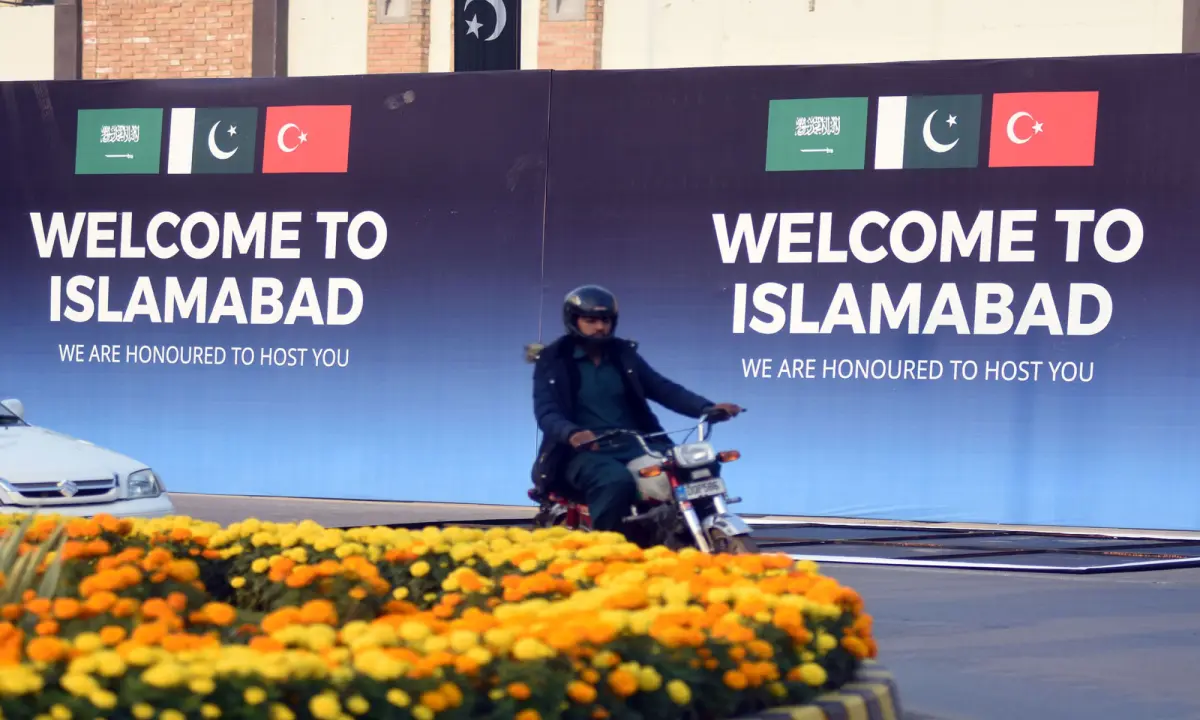
Pakistan is set to host a two-day meeting of the tripartite Makkah Defence Alliance’s top decision-making body from today, with discussions also expected to feature the conflict between Saudi Arabia and Houthi fighters in Yemen.
The third session of the Strategic Political and Defence Committee (SPDC) is set to be held in Islamabad, where authorities have announced a public holiday today and imposed special movement restrictions in view of the high-level gathering. A local holiday has also been announced in Rawalpindi.
The Islamabad meeting is also expected to focus on finalising standard operating procedures (SOPs), establishing an implementation mechanism and defining coordination between the three countries’ political, defence and military institutions, a Pakistani official said.
Defence Minister Khawaja Asif said on Thursday that the foreign and defence ministers of Saudi Arabia, Turkiye and Pakistan would participate in the meeting and the “continuous turmoil south of Saudi Arabia will obviously be one agenda point in the meeting”.
“It is very important,” he remarked.
Saudi Arabia has faced repeated attacks by Yemen’s Ansar Allah movement, commonly known as the Houthis, targeting cities, oil facilities and shipping since fighting in Yemen’s civil war intensified in July.
“Any threat to Saudi Arabia is a threat to Pakistan and Turkiye according to the pact, which is absolutely clear,” Asif said.
The alliance
The three countries signed the Makkah Joint Defence Agreement on Aug 7. The pact provides that an armed attack on any one member will be considered an attack on all, obliging the other two to extend assistance through available means, including military support.
The SPDC, which brings together the foreign and defence ministers and chiefs of defence staff of the three countries, is the alliance’s principal decision-making forum.
A permanent secretariat has been established in Riyadh to coordinate its work, with Pakistan’s retired Lt Gen Nauman Mahmood appointed as its first secretary general for a three-year term. A working committee comprising officials from member countries is also functioning.
Turkiye’s ratification of the agreement has completed the accession process for all three member states, but the alliance’s institutional and operational framework remains at what Asif described as a “nascent stage”.
“Initially, we need to have frequent meetings to steer what is being formulated, in a way that in the next couple of months we have everything in place so that we can move forward,” the defence minister said.
The alliance has yet to publicly define its doctrine, the composition of forces, command arrangements or procedures governing a collective military response.
An emergency SPDC meeting in Riyadh on Oct 5 had called for moving towards practical implementation of collective defence commitments, including arrangements for the rapid deployment of agreed forces and capabilities, subject to national laws.
Wider regional tensions
The alliance’s formation also comes against the backdrop of wider regional tensions involving Iran, the United States and Israel.
While the three members share an interest in strengthening regional deterrence, their differing strategic priorities make it important to define the alliance’s scope without allowing it to become an instrument for wider military confrontation.
Asif declined to comment on how the alliance would respond to a direct Iranian attack on Saudi Arabia, but identified Israel as a possible threat to other countries in the region.
“The possibility of some conflict, or aggression from the Israeli side exists, so we need to close our ranks, the countries of this region,” he said.
Managing relations with Iran will be particularly important for Pakistan, which has sought to preserve diplomatic engagement with Tehran while deepening defence cooperation with Saudi Arabia and Turkiye.
A meeting in Tehran involving representatives of the three countries and Iranian officials, held on Pakistan’s initiative, reflected efforts to keep channels of communication open between the two sides.
Pakistan brokered a June accord that led to a brief halt in fighting between the US and Iran and laid out a roadmap for reopening the Strait of Hormuz and negotiations on Tehran’s nuclear programme.
However, the truce collapsed, with Washington and Tehran accusing each other of violating the agreement, prompting months of shuttle diplomacy led principally by Qatar and Pakistan.
Asif said Pakistan had played “a very, very constructive role” between Washington and Tehran, but the outcome of ongoing mediation was “still fragile” and peace was “not yet embedded in a way people were expecting”.
Recent Pakistani military deployments, including JF-17 aircraft, drones and air defence systems such as the HQ-9, were made under bilateral cooperation predating the alliance, a security source said, adding that these existing arrangements would now become part of the trilateral framework.
Meanwhile, Turkiye has stressed the defensive character of the agreement and remained cautious about involvement in combat operations in Yemen.
Source: dawn
Leave a Reply