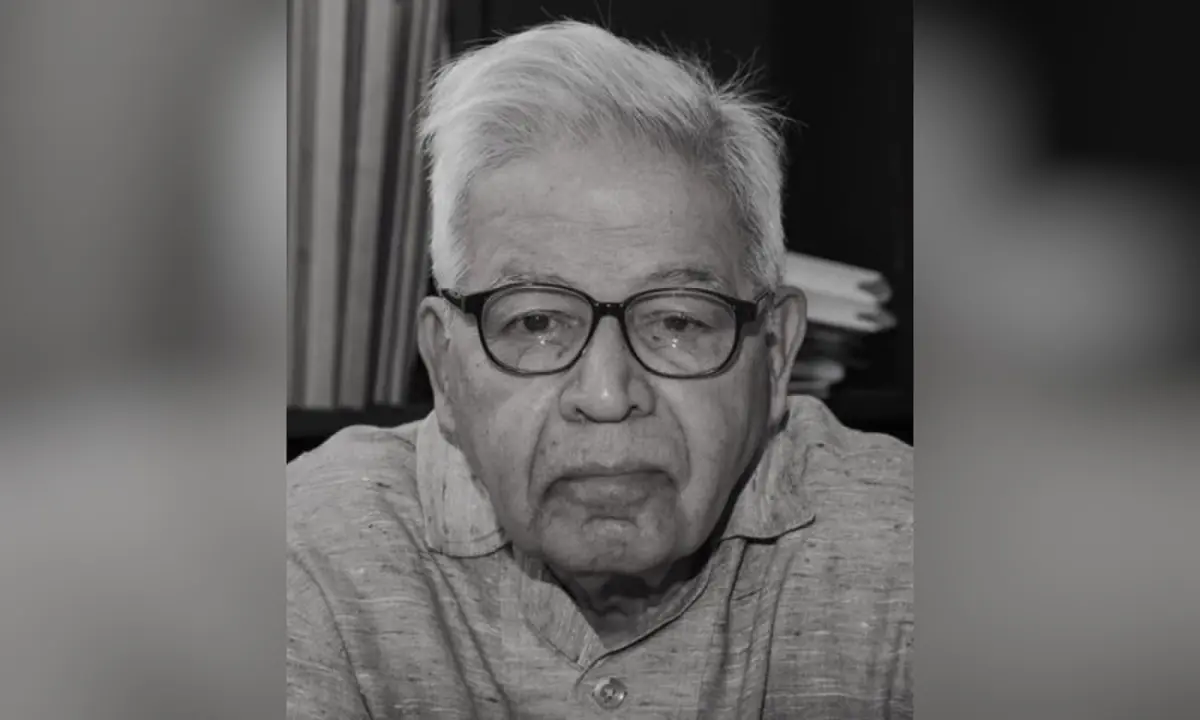
HUSAIN Naqi was undoubtedly one of the most courageous and outspoken journalists this country ever produced.
His honesty, integrity and truthfulness were never in question. Throughout his life, both as a journalist and human rights activist, he remained fully engaged in raising his voice for just causes and underserved communities. Freedom of expression and issues affecting the disenfranchised segments of society were particularly dear to him.
His unflinching commitment to advocating people’s causes brought him hardship, unemployment and even imprisonment, but nothing deterred Naqi. Dissent was a duty and compromise was not a word that was part of his dictionary.
As the sun rose on Sunday, the news arrived that he was no more. It was a one-line message from his son, Akbar, in Lahore. I must confess I was not prepared for the sad tidings. We had been in regular contact for most of our relationship, but in recent days I had been less proactive about reaching out, mainly due to my own lethargy.
Even though Naqi’s championing of just causes brought him personal hardship, compromise was not a word that was part of his dictionary
Not Naqi, though. On Saturday, just hours before his death, he attended a book launch organised by the Human Rights Commission of Pakistan (HRCP), meeting fellow journalists, lawyers and human rights activists. Unfortunately, he suffered a heart attack later that evening and passed away in hospital in the early hours of Sunday at the age of 88.
A large number of his comrades, journalists, rights defenders, political figures and members of civil society attended his funeral, held at the Jamia Al-Muntazir in Model Town, Lahore.
Student politics
Born in 1936 into a large household headed by a prominent lawyer in Lucknow, he received his early education in his hometown. His family wanted him to pursue engineering, which took him to Aligarh, but his destiny lay elsewhere.
In the mid-1950s he moved to Pakistan, marking the beginning of his long journey of fighting for just causes.
After being elected vice president of the Karachi University Students’ Union from the platform of the left-wing National Students Federation, his first confrontation with university authorities came when he took up the cause of victimised students from Balochistan.
Dr I.H. Qureshi was the vice chancellor at the time. The ideological differences between the two were sharp, ultimately resulting in his expulsion from the university, which, according to him, was not such a bad deal.
He also campaigned for better educational facilities, safe transport for female students, timely examinations and the restoration of student unions. He strongly believed that student unions helped develop democratic attitudes and taught young people to respect differences.
Naqi’s involvement in student politics came at a volatile time, when students were agitating against the despotic policies of the state. Conscious of the prevailing political climate, Naqi found himself among contemporaries such as Mairaj Mohammad Khan, Fatehyab Ali Khan, Ali Mukhtar Rizvi, Johar Husain and many others, who would galvanise the country’s politics in later years.
Foray into journalism
His expulsion from university propelled Naqi towards the world of journalism. His fight against obscurantist forces continued. Having weathered many challenges, he eventually moved to Lahore, where he became deeply involved with the city’s politicians and intellectuals.
He joined Pakistan Press International (PPI), eventually becoming its bureau chief, but later parted ways with the organisation rather than compromise his principles.
Despite being an urbanite from Oudh, he comfortably adjusted to life in the heartland of Punjab, launching what many consider to be the first proper Punjabi daily newspaper, Sajan.
During a long and illustrious career, he remained associated with several newspapers and publications, including The News, Frontier Post, Frontier Guardian, Daily Star etc.
Guided by the philosophy that one must continue to fight, even when standing alone, he also brought out Punjab Punch, a weekly newspaper.
Naqi was also committed to organising journalists and defending their professional rights. As a trade unionist, he believed that press freedom could not be secured without protecting the rights, dignity and independence of media workers. He remained associated with journalists’ struggles against censorship, restrictions on freedom of expression and the misuse of authority.
For young journalists and rights activists, Naqi was more than a senior colleague, he was a mentor who encouraged them to question official narratives, develop independent opinions and never surrender their professional integrity.
Sherry Rehman, mourning his loss, recalled how many young journalists had learnt at his desk and walked in rallies under his leadership. She described him as a person who spoke truth to power but never encouraged hatred, instead defending the right to disagree with dignity and respect.
Decades of activism
After retiring from active journalism, he joined the illustrious I.A. Rehman at the HRCP, where he continued to work energetically for the causes he held dear for around three decades.
He played a part in many campaigns for democracy, civil liberties, minority rights, freedom of expression and the protection of vulnerable communities. Even though his activism brought him imprisonment and pressure from the authorities, it failed to weaken his determination to speak against injustice.
In a statement condoling his demise, HRCP summed it up thus: “One of the strongest voices for people’s rights and democracy in Pakistan has gone silent”.
Naqi’s demise marks the end of an era. In a sense, he was among the last of a generation of journalists and public intellectuals for whom speaking truth to power was not merely a professional obligation, but a way of life.
At a time when independent journalism, freedom of expression and democratic space continue to face challenges, the life and work of Husain Naqi serves as a reminder that these freedoms should not be taken for granted; they have to be defended through courage, commitment and collective struggle.
Amjad Mahmood in Lahore also contributed to this report
Published in Dawn, November 23rd, 2026
Source: dawn
Leave a Reply