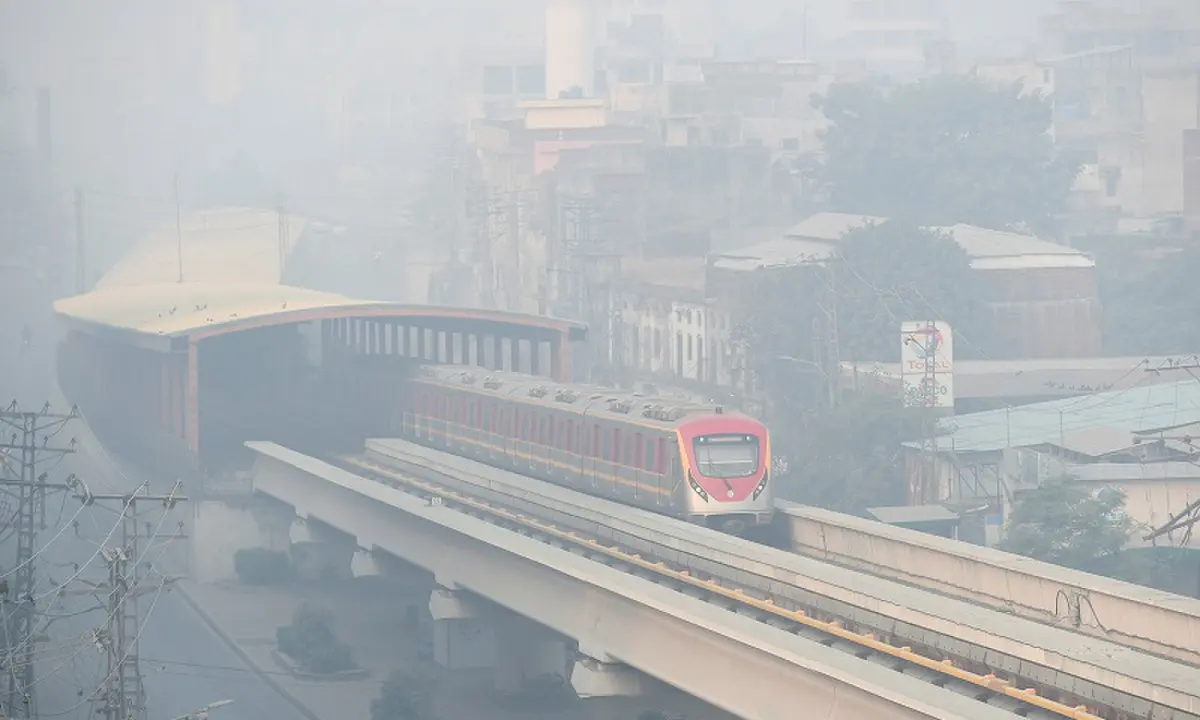
LAHORE: Heavy smog pushed air quality in several Punjab cities into the hazardous category on Friday, with Lahore recording an hourly AQI reading of 465 between 7am and 8am, while Gujranwala and Multan registered readings of 661 and 641, respectively, according to real-time air quality data.
Lahore’s historical hourly air quality graph classified the reading of 465 as hazardous, indicating extremely polluted conditions and serious health risks for residents.
A separate ranking of Pakistani cities placed Gujranwala at the top with an AQI of 661, followed by Multan at 641 and Lahore at 426. Other Punjab cities also reported elevated pollution levels, including Sargodha (289), Sialkot (232), Rahim Yar Khan (228) and Bahawalpur (198).
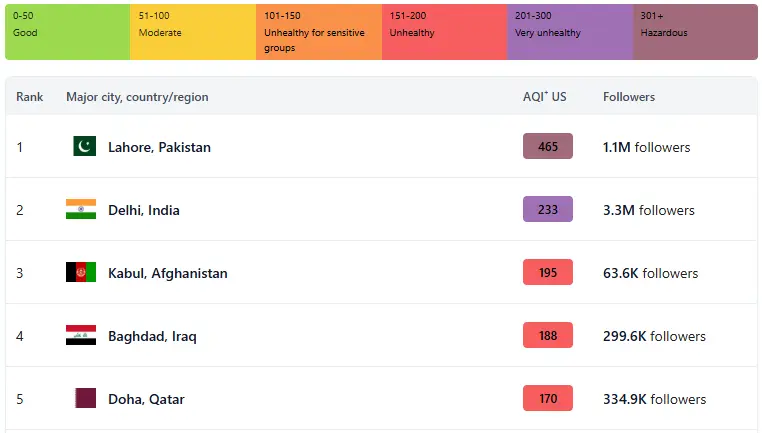
The readings indicate a widespread deterioration in air quality across Punjab, with several cities experiencing hazardous pollution levels that pose serious health risks, particularly to children, elderly people and those suffering from respiratory and cardiovascular diseases.
Residents have been advised to minimise outdoor activities, keep windows closed, wear protective masks when going outside and use air purifiers indoors. Prolonged exposure to high concentrations of fine particulate matter (PM2.5) can aggravate respiratory and cardiovascular conditions.
The deterioration in air quality comes despite intensified enforcement operations by the Punjab Environment Protection and Climate Change Department against sources of pollution, particularly non-compliant brick kilns.
According to departmental figures, enforcement teams conducted 84,370 inspections of brick kilns across the province between Jan 1 and Nov 18, demolishing 1,429 units, sealing 968 and registering 1,248 FIRs against violators. Fines totalling Rs178 million were also imposed.
During the critical smog period from Sept 1 to Nov 18, the department conducted 29,999 visits, demolished 519 kilns, sealed 494 and registered 408 FIRs, besides imposing fines totalling Rs101.45m.
In the first 18 days of November, enforcement teams conducted 7,509 visits, demolished 101 kilns, sealed 161 and registered 96 FIRs, while imposing fines totalling Rs27.6m.
On Nov 18 alone, 552 brick kilns were inspected, 22 demolished and 19 sealed. Fourteen FIRs were registered and fines totalling Rs3.5m were imposed.
The department has also introduced repeated inspections to monitor previously inspected kilns and identify units that resume environmentally harmful practices after initial enforcement action.
Environment Protection and Climate Change Department Secretary Silwat Saeed has directed sustained field enforcement and coordination to address pollution at its sources, while Director General EPA Punjab Abdullah Nayyar Sheikh has maintained a zero-tolerance approach towards environmental violations.
Meanwhile, Pakistan’s average PM2.5 concentration stood at 67.3 micrograms per cubic metre in 2025, nearly 14 times the World Health Organisation’s annual guideline of 5 micrograms per cubic metre, according to the 2025 World Air Quality Report. This concentration corresponded to an average AQI of 156, placing Pakistan among the world’s most polluted countries.
The latest readings underline the continuing challenge of controlling air pollution in Punjab despite enforcement measures against industrial and other sources of emissions.
Source: dawn
Leave a Reply