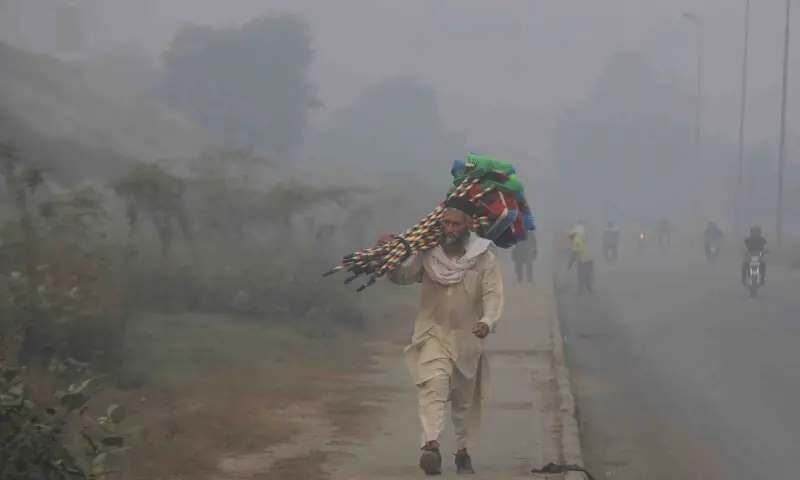
LAHORE: The Pakistan Space and Upper Atmosphere Research Commission (Suparco) has warned of worsening smog conditions across Punjab over the next three days, with satellite observations detecting 690 active fire incidents in Punjab and adjoining transboundary areas, while Lahore on Wednesday topped the list of the world’s most polluted major cities.
According to Suparco’s smog assessment for Nov 17, satellite observations recorded 386 active fire detections in Punjab and 304 in the transboundary region during the preceding 24 hours. The assessment covered 36 districts and used VIIRS and MODIS satellite observations to identify fire incidents.
The bulletin identified seven districts – Jhang, Narowal, Sheikhupura, Sialkot, Hafizabad, Gujranwala and Dera Ghazi Khan – as having high or severe smog conditions.
The mean aerosol optical depth (AOD), an indicator of atmospheric aerosol concentration, was recorded at 0.25, with the highest levels over Chiniot, Jhang and Faisalabad. Tropospheric nitrogen dioxide (NO2), however, was 21pc below the 2019-2025 average for this time of the year.
Jhang, Narowal, Sheikhupura, Sialkot, Hafizabad, Gujranwala and DGK to have high or severe smog conditions in coming days
Despite the lower NO2 levels compared with the historical average, the satellite assessment warned that atmospheric conditions were likely to deteriorate over the following three days.
The Copernicus Atmosphere Monitoring Service (CAMS) model projected PM2.5 concentrations of around 51 to 71 micrograms per cubic metre.
Suparco cautioned that model estimates were generally lower than ground-based monitoring readings during winter. Atmospheric dispersion was also assessed as very poor, indicating that pollutants were likely to remain trapped close to the ground.
The satellite-based monitoring is intended to track the geographical spread of smog, identify fire hotspots and provide an assessment of atmospheric conditions across Punjab.
Meanwhile, Lahore remained at the top of IQAir’s global major city pollution ranking on Wednesday morning, recording an Air Quality Index (AQI) of 339 during the 10am-11am period.
The city’s air quality subsequently improved, with the AQI falling to 167 at 5pm, but began deteriorating again, reaching 178 at 6pm.
In the global ranking, Lahore was followed by Dhaka with an AQI of 221, Baghdad 199, Tashkent 182 and Kolkata 178. Karachi ranked sixth with an AQI of 174.
The real-time Pakistan city ranking showed hazardous pollution levels in several other Punjab cities. Faisalabad topped the national list with an AQI of 686, followed by Gujranwala at 550, Kahna Nau at 516, Multan at 437, Kasur at 371 and Lahore at 339. Khanewal recorded an AQI of 327, Sargodha 314, Sahiwal 253 and Dera Ghazi Khan 238. Readings above 300 fall in the hazardous category.
The Pakistan Meteorological Department (PMD) also forecast fog and smog at isolated places in Lahore, Sialkot, Narowal, Sheikhupura, Okara, Kasur, Faisalabad, Jhang, Khanewal, Multan and surrounding areas during morning and night over the next 48 hours. Dry weather is expected across most districts, with no significant rainfall forecast.
Meanwhile, the Punjab Environment Protection Agency (EPA) deployed five senior directors from its headquarters across different divisions to supervise anti-stubble burning operations and coordinate with agriculture officials and district administrations.
EPA Director General Abdullah Nayyer Sheikh said the deployment was aimed at ensuring direct supervision of field operations, verifying reported fire incidents and ensuring timely action against crop-residue burning.
In Multan, the district administration has received two modern anti-smog gun vehicles on the directives of Chief Minister Maryam Nawaz.
Deputy Commissioner Dr Faisal Saleem said the vehicles would operate round the clock and spray water in different parts of the city during morning and evening hours. He said the administration was also taking action against people burning crop residues and garbage.
Published in Dawn, November 19th, 2026
Source: dawn
Leave a Reply