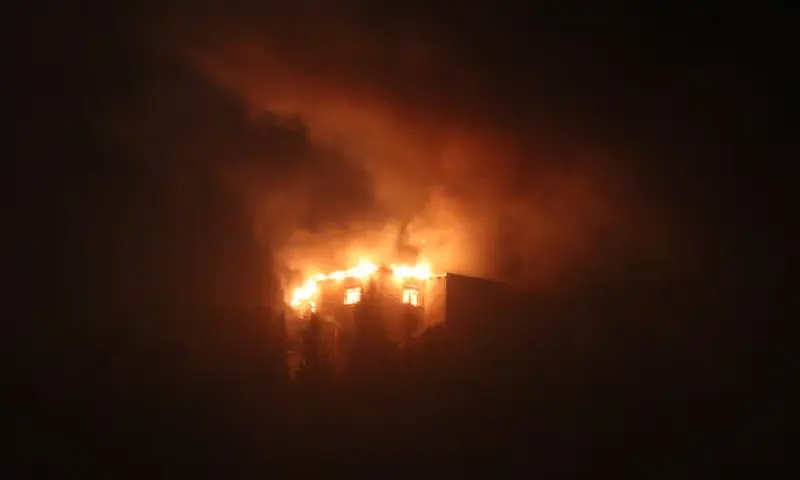
PERCHED on a ridge high in the German Alps lie the burned-out ruins of a mountain house frequented by Adolf Hitler, which is now at the heart of an intense debate about Germany’s Nazi past.
Called The Eagle’s Nest, or Kehlsteinhaus in German, the retreat was built by the Nazis in 1938. After World War II it was classified as a historical monument.
But after it was gutted in a suspected arson attack last month, some believe it is time for the site to be completely destroyed, so it can shed the mantle of its Nazi past, BBC News reported.
Others, however, want it either partially or completely rebuilt, wary of the risk of turning it into a lightning rod for neo-Nazi elements at a time when Germany is witnessing the resurgence of the far-right.
Before it was burned down on Oct 23, the Eagle’s Nest had been a popular tourist attraction, owned by the state of Bavaria and operating for many years as a restaurant.
Visitors would take a bus and then ride the original brass and mirror-panelled lift through the mountain to the Kehlsteinhaus to savour the magnificent views above the town of Berchtesgaden.
Unlike Hitler’s nearby summer residence, the Berghof, which was bombed in World War II and demolished in 1952, the Eagle’s Nest survived the war.
In the 1990s, amid concerns that the site did not do enough to confront the crimes of the Nazi past, a museum, the Obersalzberg Documentation Centre, was opened close by.
Although the Eagle’s Nest itself was “largely destroyed” by the
fire, according to police, the documentation centre survived unscathed.
The authorities have not commented on a possible motive, but a 33-year-old man with a history of mental illness has been detained on suspicion of arson.
According to BBC News, some feel that this is an opportune moment to allow the site to fade into history.
“It’s been torched now. It’s been destroyed. I think they should just clear away the rubble and leave the mountain as it should be in its natural state,” said Prof Sir Richard J. Evans, a specialist in Nazi Germany at the University of Cambridge.
That has happened with “quite a few other Nazi sites”, he argued, including the bunker in Berlin where Hitler killed himself.
But Bavaria’s authorities take a different view about the site’s future. Both the state’s interior minister, Joachim Herrmann, and its minister for the arts, Markus Blume, have spoken out in favour of rebuilding the Kehlsteinhaus.
Germany and Austria have long struggled to deal with the fraught legacy of buildings and sites connected to the Nazi era.
With the recent rise of the far-right AfD and the Austrian Freedom Party, the debate over Erinnerungskultur (Culture of Remembrance) has taken on a new urgency.
A row broke out recently in Germany when AfD and conservative CDU councillors in a town in Saxony decided to ban “stumbling stones” memorials – embedded small brass plaques in the streets – to victims of the Nazis.
In Austria over the summer, a police station was opened in the house where Hitler was born in Braunau am Inn. It followed years of controversy about how the house should be used.
The Austrian government said the police presence would help prevent neo-Nazi ‘pilgrims’. But others want the site to become a centre of responsibility, actively confronting the Nazi past.
Published in Dawn, November 9th, 2026
Source: dawn
Leave a Reply