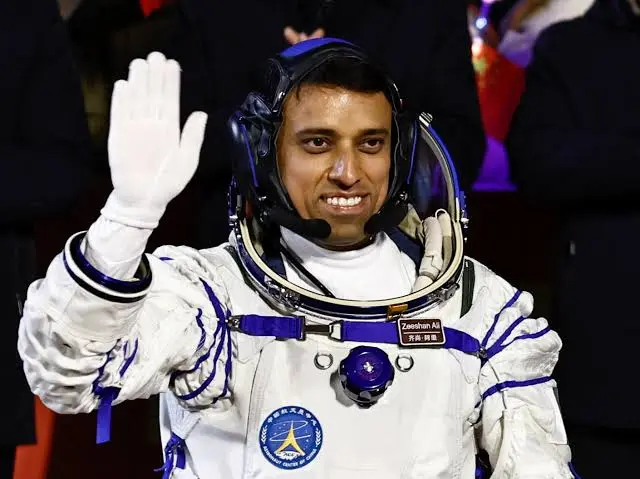
Zeeshan Ali, who became the first Pakistani to travel into Earth’s orbit and the first foreign national to visit China’s Tiangong space station, on Saturday urged young people to pursue education, science and technology, as Prime Minister Shehbaz Sharif hailed the mission as a milestone in the two countries’ longstanding strategic partnership.
The 40-year-old former Pakistan Air Force pilot, speaking live from the Chinese space station during an interaction with Pakistani leadership at the Space and Upper Atmosphere Research Commission (SUPARCO), said he was conducting scientific research as planned, around 400 km above Earth.
“I would like to give a clear message to the youth of this nation to promote education and to excel in science and technology.
“I hope that the next generation of astronauts, engineers, and scientists will travel even farther into space and explore further for the betterment of humanity.”
Zeeshan made history on November 25, 2026, when he travelled aboard China’s Shenzhou-24 mission.
During his interaction, he described representing Pakistan in space as a “great honour”.
“Everything is going very well over here and according to the plan, and I’m doing my best to perform my duties and the scientific research work as per the expectations of the entire nation,” he said.
PM Shehbaz congratulated Zeeshan on his achievement, saying his journey had inspired a generation to explore new frontiers.
“Your success has ignited a renewed spirit of ambition in a generation eager to push boundaries, explore new frontiers, and take our nation to greater heights,“ Sharif said during the live interaction.
The mission comes as Pakistan and China mark 75 years of diplomatic relations.
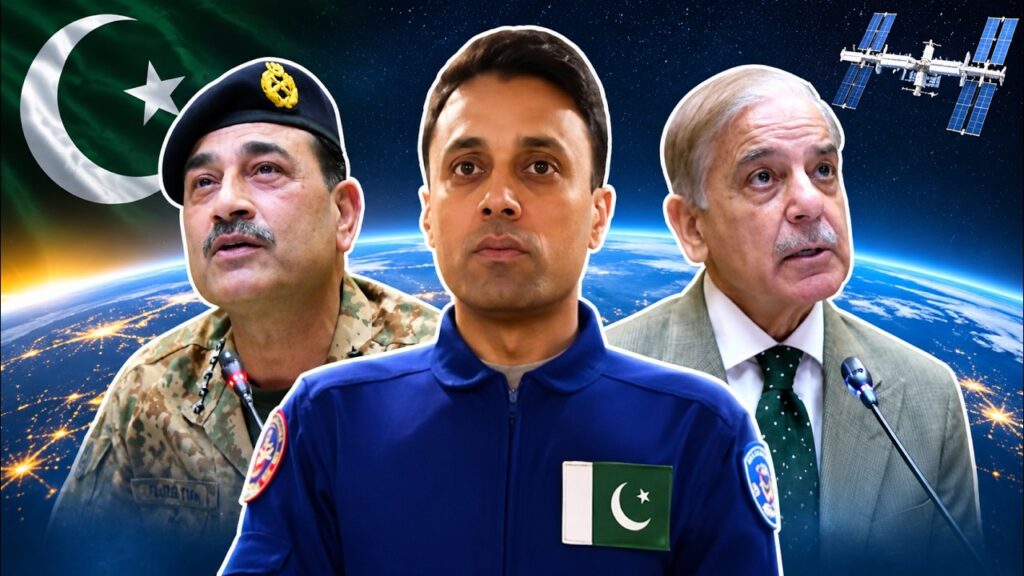
Sharif, who was accompanied by Field Marshal Asim Munir, Chief of Defence Forces and Chief of Army Staff, and Deputy Prime Minister Ishaq Dar, congratulated SUPARCO and the China Manned Space Agency on the achievement.
Zeeshan Ali was selected in April 2026 to train for China’s human spaceflight program, being one of two Pakistani candidates chosen, with fellow pilot Khurram Daud serving as his backup. He spent seven months training at the Astronaut Centre of China in Beijing, where his preparation included spacecraft systems, space-station operations, scientific procedures, emergency response, and intensive Chinese-language training.
He is serving as a payload specialist, focusing on scientific experiments and research activities234. He is participating in four Pakistan-China research projects covering materials science and biotechnology, including studies on graphene-based composite materials, self-healing carbon-fibre composites, the effects of microgravity on quinoa seeds, and microalgae and cyanobacteria.
Source: brecorder
Leave a Reply