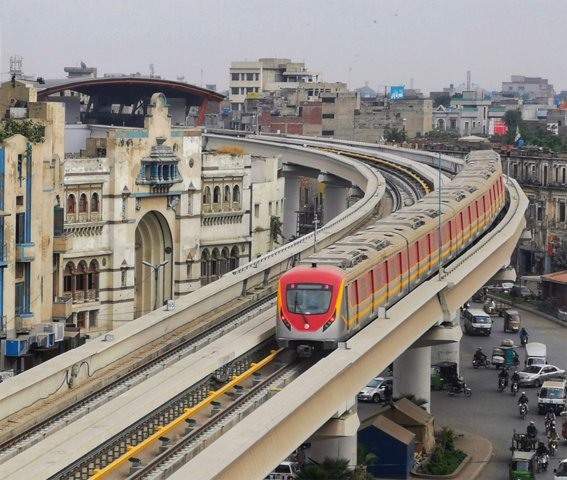
LAHORE: Lahore’s Orange Line Metro Train now carries about 260,000 passengers every day, and total ridership has passed 360 million since the service opened six years ago, its chief executive said.
Tan Zidong, CEO of the Orange Line Metro Rail Transit System, made the remarks while briefing journalists on a visit organised by Muhammad Mehdi, chairman of the Institute of International Relations and Media Research (IIRMR).
Tan said ridership had risen steadily year after year, which he described as a sign of growing public confidence in the service and its role in improving urban mobility.
Tan said operations had been hampered by severe smog and heavy rain, and that train speeds are reduced in bad weather because passenger safety is the top priority.
Nationwide power outages were another major problem, he said. Blackouts can halt trains and complicate passenger management, particularly when a train is stranded on the mainline, forcing crews to carry out emergency evacuations.
Tan, who has worked on the project for seven years, said about 1,400 local staff are employed by the joint venture. “We have helped each other a lot and exchanged our cultures and mindsets,” he said. “I think everyone here has grown together with the Orange Line.”
The journalists were also briefed on the Sahiwal Coal Power Plant, a flagship project of the China-Pakistan Economic Corridor (CPEC), by Liu Binxiang, vice president of Huaneng Shandong Ruyi (Pakistan) Energy (Private) Limited.
The 1,320MW plant, built around two 660MW supercritical units, was among the first major CPEC energy projects to go into commercial operation. The units were commissioned in May and June 2017, and the plant began commercial operation on October 28, 2017.
Liu said the plant, built with an investment of about $1.8 billion, has generated more than 57 billion kilowatt-hours of electricity. It produces over 6 percent of the country’s electricity from roughly 2.5 percent of installed capacity, and supplies an estimated four million households, or more than 20 million people.
He said the plant has paid more than $820 million in taxes to the federal and Punjab governments and has supported a network of Pakistani small and medium-sized businesses in coal handling, maintenance, transport, logistics and engineering.
During the nationwide blackout in 2020, the plant was reconnected to the grid within five hours, Liu said. At peak demand during Ramadan 2026, it reached an output of 1,252MW, above its regulatory benchmark.
The project has won awards including the Government of Pakistan’s Outstanding Achievement Award and the CPEC Shared Prosperity Outstanding Contribution Award, he said, adding that it also contributes to local employment, professional training and cultural cooperation between Pakistan and China.
Copyright Business Recorder, 2026
Source: brecorder
Leave a Reply