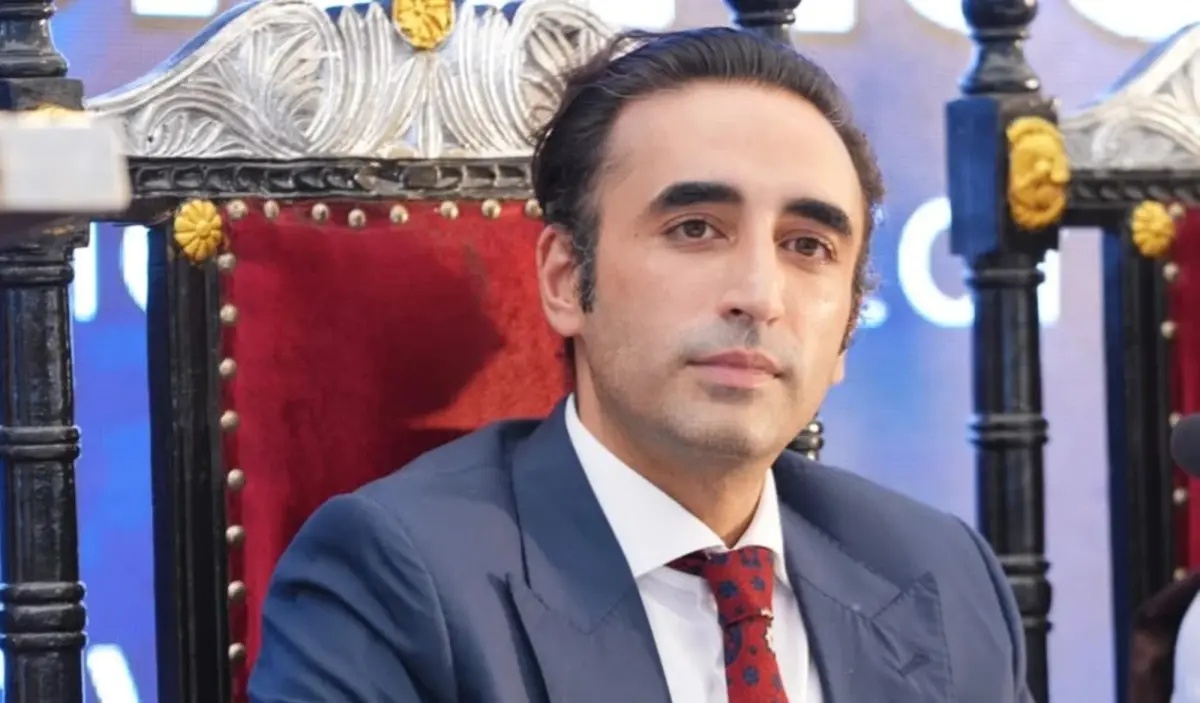
Pakistan Peoples Party (PPP) Chairman Bilawal Bhutto-Zardari on Wednesday indicated that his party could leave the treasury benches and sit on the opposition benches if the PML-N-led government was unwilling to listen to the views and concerns of its coalition partners.
Speaking in an interview with Hum News programme Faisla Aap Ka, Bilawal defended his recent remarks on the country’s political situation, insisting that he had spoken the truth and urging government representatives to have the courage to listen to differing opinions.
The PPP chairman reiterated his call for a political and democratic reset, cautioning against attempts to create new provinces and stressing that political leadership should focus on addressing the economic difficulties facing the public.
The debate gained momentum in July after Interior Minister Mohsin Naqvi called for the creation of additional provinces and administrative units as part of a broader overhaul of the country’s governance system.
The proposal triggered strong opposition from the PPP, which governs Sindh and has repeatedly rejected any move to divide the province. The issue resurfaced in subsequent months, with other government figures, including Defence Minister Khawaja Asif, also expressing support for creating more provinces to improve governance. Bilawal had earlier insisted that the matter should be debated in parliament rather than at business forums.
Addressing a ‘Meet the Press’ event at the Karachi Press Club on Tuesday, Bilawal said the governance system had not collapsed on its own but had been “made to collapse”.
He argued that creating new provinces would not address the underlying problems and called for a political reset focused on restoring the legitimacy of state institutions and resolving public issues, including poverty, unemployment and inflation.
He also opposed any unconstitutional move or referendum to create new provinces, warning that forcibly dividing Sindh could trigger serious unrest.
He said his remarks were made against the backdrop of the US-Iran conflict, which has affected economies worldwide through rising energy costs.
“Elites do not have the idea of what kind of difficulties Pakistanis are facing,” he said, urging politicians to set aside their political differences and work together to fix the system.
Bilawal maintained that being part of the ruling coalition did not undermine his right to criticise government policies. Rather, he argued, his party’s position as a major stakeholder made it more important for the government to hear its proposals.
“You may disagree with my suggestions, but at least listen. You should have the courage to listen to the truth,” he said.
He added that he was raising concerns as a stakeholder and wanted the government to take stock of the situation.
The PPP chairman questioned why the debate over governance and a possible political reset had not been brought to parliament, saying it had instead been initiated in front of business representatives.
He also rejected the notion that Pakistan’s political discourse could be restricted to one-sided debates.
Bilawal said the country’s geopolitical and security challenges required political unity, pointing to tensions with India, the near-war situation with Afghanistan and the ongoing fight against terrorism.
He questioned the government’s decision to open multiple political fronts while the country was facing an economic crisis.
“The government has been deciding that we will fight the PTI; now the new decision is that they will also fight JUI, and it seems that after my truth, they have also decided they must fight me too,” he remarked.
“If you are going to fight everyone, and fight everyone internally as well, then who will lead Pakistan and its people out of this economic crisis?” he asked.
Bilawal described the reactions of federal ministers to his recent remarks as further evidence that politicians lacked the courage to hear criticism.
He said that if government representatives could not listen to his concerns, it raised questions about how ordinary Pakistanis could expect their grievances to reach the prime minister, ministers or parliament.
‘Unaware of what is behind this debate’
The PPP chairman said he did not know what had prompted the debate over creating new provinces, claiming that neither the prime minister, any federal minister nor another political stakeholder had discussed the proposal with him or President Asif Ali Zardari.
He said the country was facing a historic economic crisis, but little attention was being paid to resolving it.
Bilawal also questioned the role of Interior Minister Mohsin Naqvi in initiating discussions about a political reset, referring to his additional position as chairman of the Pakistan Cricket Board (PCB).
He asked whether the PCB chairman had been given the authority to determine how the country’s political system should be restructured, including whether provinces should be divided.
Asked whether his remarks signalled that the PPP would adopt a confrontational approach, Bilawal said he had not issued any protest call but was presenting the concerns of his party’s voters.
He said a political and democratic reset was needed to bring politicians together rather than have them fight among themselves while the public struggled with economic hardship.
Bilawal also criticised the government’s response to Jamiat Ulema-e-Islam-Fazl (JUI-F) chief Maulana Fazlur Rehman’s criticism, describing it as irresponsible.
He alleged that the government’s response to political dissent included demolishing houses, arresting political leaders’ family members and pressuring party workers.
On the possibility of dividing Sindh, Bilawal said the PPP was not a party that resorted to violence but warned that forcibly dividing the province could trigger serious consequences.
Referring to Sindh’s political history since the 1980s, he said attempts to create divisions in the province’s politics had previously been orchestrated rather than emerging organically.
He warned that any forced division of Sindh could aggravate the law and order situation, making it difficult for authorities to contain the resulting unrest.
Source: brecorder
Leave a Reply