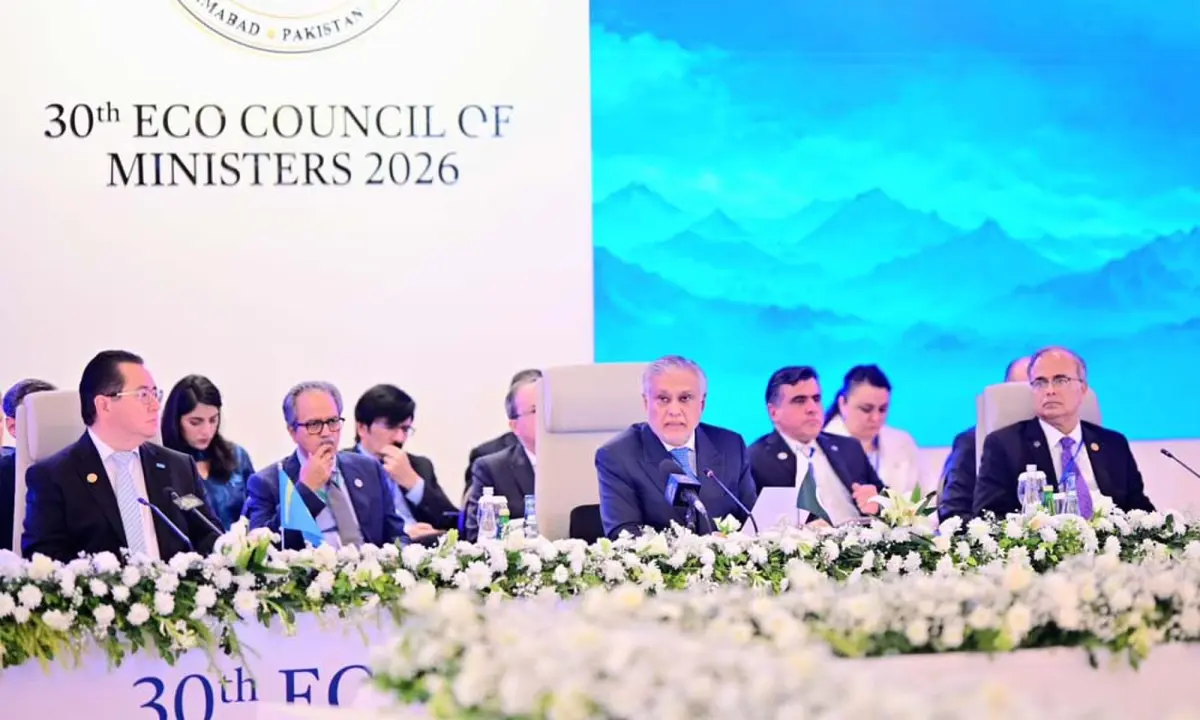
Senior officials from Turkiye, Azerbaijan, Kazakhstan, Iran, Kyrgyzstan, Tajikistan, Turkmenistan, and Uzbekistan attended the 30th Meeting of the Economic Cooperation Organisation (ECO) Council of Ministers, held in Islamabad on November 15-16, 2026.
Officials from Afghanistan, also part of the organisation, were not present.
About ECO
- The ECO is a regional forum dedicated to promoting trade, investment, and economic cooperation among its member states. It was originally established in 1964 as the Regional Cooperation for Development (RCD) by Pakistan, Iran, and Turkey, and was later rechristened as ECO in 1985.
- The organisation comprises 10 member countries and serves as a key platform for regional integration, connecting various geographical areas from north to south, east to west, Asia to Europe, and Eurasia to the Arab world.
The recently concluded meeting produced several important developments for Pakistan’s regional trade, investment, transport and economic integration agenda.
Here are the main takeaways from ECO 2026
1. ECO adopts 10-year economic cooperation roadmap until 2035
ECO member states adopted the Strategic Goals of Economic Cooperation 2026–2035, also known as ECO Vision 2035.
The framework aims to strengthen regional economic integration through trade, investment, market access and regional value chains.
It also envisages stronger cooperation in transport, energy, digital technology and climate resilience.
2. Pakistan assumes ECO chair
Pakistan assumed the chair of the ECO Council of Ministers for 2026-2027, with the theme “Reviving Regionalism for a Resilient ECO”.
As ECO chair for 2026-27, Islamabad would focus on strengthening regional connectivity, deepening regional integration, reinforcing regional partnerships, and promoting collective efforts toward greater prosperity, sustainable development, and a more integrated, resilient ECO region.
3. Pakistan’s five priorities
Deputy Prime Minister and Foreign Minister Ishaq Dar outlined five priorities for Pakistan’s chairmanship, which included expanding market access and investment, improving connectivity to Pakistan’s ports for landlocked states, implementing the ECO Trade Agreement (ECOTA) roadmap, enhancing cooperation in disaster preparedness and climate-resilient infrastructure, and investing in human capital through research and vocational training.
4. Acknowledgement of Pakistan’s diplomatic efforts
The Islamabad Communiqué acknowledged Pakistan’s diplomatic efforts to de-escalate tensions between Iran and the United States, endorsing its mediation initiative.
The endorsement comes against the backdrop of heightened geopolitical tensions, underscoring Pakistan’s emerging diplomatic role in promoting regional stability and facilitating dialogue between key international stakeholders.
5. Commitment to regional connectivity
Prime Minister Shehbaz Sharif reiterated Pakistan’s commitment to developing road, rail, and multimodal transport corridors to enhance regional connectivity, highlighting the potential of Karachi, Port Qasim, and Gwadar ports for landlocked ECO member states.
On regional security, Shehbaz underscored Pakistan’s commitment to dialogue and diplomacy for the peaceful resolution of disputes and called for collective efforts to address threats to regional stability.
Source: brecorder
Leave a Reply