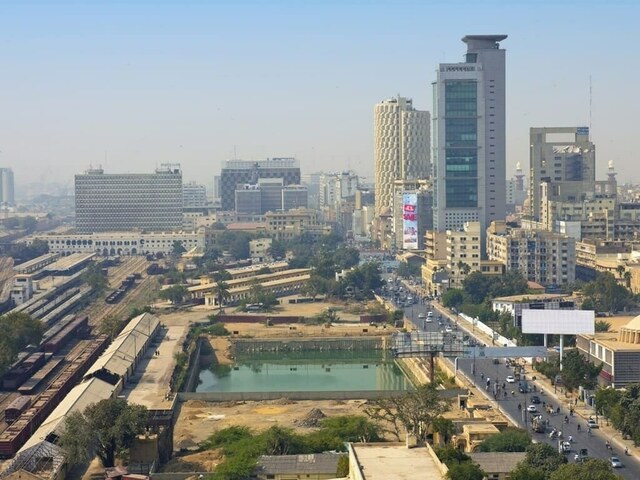
KARACHI: Chairman of the Senate Standing Committee on Privatisation Senator Dr. Afnan Ullah Khan has said that achieving the target of a PKR 1 trillion economy is not possible without improving Karachi.
He said the city possesses immense economic potential and some of the country’s finest human resources.
Prime Minister Shehbaz Sharif is committed to improving Karachi’s infrastructure, while the PML-N government is making concerted efforts to promote the city’s development.
He said the business community could play a bridging role and contribute to Karachi’s improvement and economic growth.
Federal government attention was essential to resolving the city’s longstanding problems, adding that he would raise issues concerning electricity and water supply at the federal level.
He expressed these views during a meeting with industrialists and business community representatives at the Korangi Association of Trade and Industry (KATI), Senator Afnan Ullah Khan said the PML-N government had played a significant role in completing major development projects and addressing security challenges in Karachi in the past.
He said developing Karachi was a responsibility because of the city’s substantial contribution to national revenue. If the PML-N received greater public support in Karachi, the scope of development projects in the city could be further expanded.
Commenting on the privatisation of Pakistan International Airlines (PIA), he said it had been a major challenge. An attempt in 2017 had failed, followed by another effort in 2022, while success was finally achieved in the fourth attempt.
He said the government had determined PIA’s value after conducting a comprehensive assessment and obtaining an independent third-party valuation.
The privatisation process had been kept fully transparent, and it was encouraging that the airline remained under Pakistani ownership.
He added that the model for the privatisation of electricity distribution companies (DISCOs) had been adopted from Türkiye, while Islamabad International Airport was also included in the government’s privatisation list.
He said the Sukkur and Quetta electric supply companies accounted for approximately 90 percent of the overall power-sector losses, with the Quetta Electric Supply Company alone responsible for 70 percent of these losses.
The government was making efforts to improve the performance of these entities.
He also said that a solar park could be established outside Karachi with the cooperation of the business community.
KATI and industrialists were encouraged to submit practical recommendations, which would be conveyed to the Prime Minister and the federal government for consideration.
Senator Afnan Ullah Khan further stated that efforts were underway to resolve railway-related issues.
The financial closing of the Main Line-1 (ML-1) project had been achieved, and work on the project was expected to begin soon.
Its implementation would help address many of the problems associated with the existing railway tracks.
Earlier, KATI President Sheikh Umer Rehan said Karachi contributed more than half of Pakistan’s national revenue, while the Korangi Industrial Area accounted for approximately 60 percent of the city’s overall revenue. He said just six major export-oriented industries in the Korangi Industrial Zone contributed five per cent to Pakistan’s total exports, while the area’s overall exports had reached USD3.1 billion.
Despite this significant contribution, he said, Karachi’s business community faced numerous challenges at federal, provincial and local government levels. KATI was actively raising these issues at every relevant forum to secure solutions for the industrial sector.
He pointed out that industries were being supplied electricity and energy at some of the highest rates in the region, resulting in a substantial increase in production costs and making it increasingly difficult for Pakistani products to compete in international markets. Expensive energy was a major obstacle to export growth and required immediate attention.
Sheikh Umer Rehan said KATI wanted all federal ministers to visit Karachi every month, following the example of the FBR Chairman, who visits the city monthly on the Prime Minister’s directives to meet stakeholders.
He urged federal ministers to hold regular meetings with industrialists and business representatives to understand and address their concerns directly.
He said regular visits by the Prime Minister and federal ministers would accelerate the resolution of Karachi’s problems and boost the confidence of the business community.
Karachi had enormous economic potential, and greater federal government attention could further enhance the city’s contribution to national economic growth.
KATI Deputy Patron-in-Chief Zubair Chhaya said Karachi’s business community was working for the country’s economic prosperity regardless of political affiliations.
He stressed that Karachi’s development was directly linked to Pakistan’s progress, noting that industrial development in the country had begun in Karachi when Quaid-e-Azam Muhammad Ali Jinnah laid the foundation stone of Valika Textile Mills after the establishment of Pakistan.
He said Karachi had endured severe lawlessness, deteriorating infrastructure and widespread corruption.
Despite these serious challenges, the city continued to contribute approximately 60 percent to the national economy. Karachi also accounted for 95 percent of the Sindh Revenue Board’s collections.
Chhaya observed that Punjab had witnessed rapid development, crediting the leadership of Nawaz Sharif and the Pakistan Muslim League-N.
He said Karachi deserved similar attention and focused development initiatives.
If monthly visits by the FBR Chairman were producing visible improvements, regular visits by federal ministers could help resolve numerous longstanding problems facing the city.
He expressed hope that Senator Dr. Afnan Ullah Khan would effectively represent Karachi’s concerns at the federal level and help address the challenges confronting industry and trade.
Highlighting the importance of the railway sector, Zubair Chhaya said an efficient railway system was essential for improving the national economy.
The federal government had to provide a grant of Rs64 billion to sustain railway operations and cover its losses.
He further said the railway system could become a major source of revenue if an effective freight transportation service was reintroduced.
Providing freight services through the railway network would offer businesses a more affordable transportation option, reduce the burden of heavy traffic on roads and help lower the country’s diesel import bill.
He urged the federal government to prioritise Karachi’s issues in view of the city’s vital importance to Pakistan’s industrial and economic landscape.
KATI President Sheikh Umer Rehan, Deputy Patron-in-Chief Zubair Chhaya, Senior Vice President Farrukh Qandhari, Vice President Nasir Sheikh, Sardar Ismail Gabol, Khawaja Tariq Nazir, Daniyal Munaf Kherani, Sardar Rehan, and a large number of industrialists and KATI members were present in the meeting.
Copyright Business Recorder, 2026
Source: brecorder
Leave a Reply