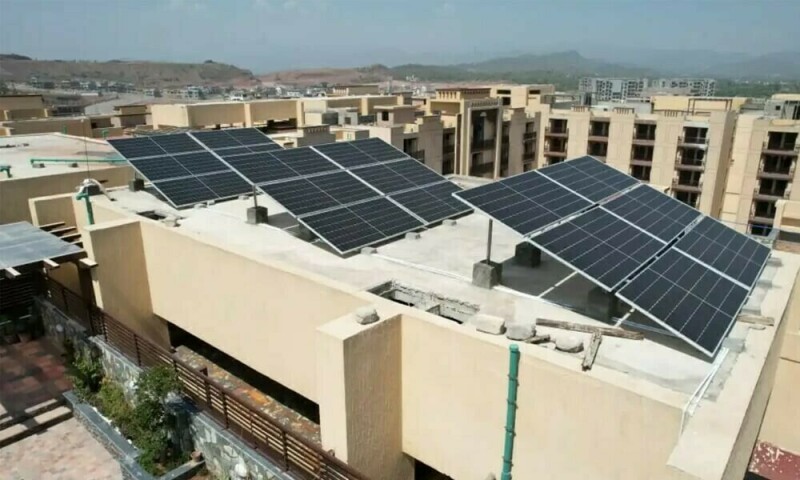
Pakistan’s rapidly expanding solar market was transforming the country’s energy landscape, but millions of low-income households risk being left behind as the high upfront cost of installations and lack of maintenance support limit access to affordable electricity, speakers warned at the Sindh Energy & Climate Conference (SECC26).
The disparity was highlighted during a discussion on solar energy access at the two-day conference held in Karachi last week, where experts, government representatives, labour groups, and community activists examined whether the country’s growing shift towards renewable energy was benefiting those most in need or primarily serving consumers who could afford the initial investment.
The scale of the country’s solar expansion is striking. Dr Omais Abdur Rehman of Renewables First said during a session on solar energy access that Pakistan’s power plants had a combined capacity of approximately 45 gigawatts, while consumers had independently installed nearly 38 gigawatts of solar capacity.
But he cautioned that the number of installations alone offered little indication of whether communities were enjoying reliable and sustainable access to electricity.
Citing a World Bank-supported programme, he said only 33% of distributed solar systems remained operational after ten years, largely because of inadequate maintenance skills.
“Giving solar panels is not a success. Access does not equal success,” he said.
The problem is not limited to maintaining solar systems. For many households, the initial investment remains the biggest obstacle.
Hussain Rizvi of the Climate Action Center presented survey findings showing that 86% of respondents in Karachi’s low-income neighbourhoods experienced between 13 and 20 hours of load-shedding. Many residents of informal settlements were also struggling with unaffordable electricity bills, despite being interested in switching to solar power through instalment-based financing.
The divide between those benefiting from the solar transition and those being left behind was perhaps best illustrated by a garment factory worker, Muneer Ahmed. Although his factory operated on solar power, he told participants that his monthly salary of Rs30,000 to Rs40,000 made it difficult to afford a similar system for his own home.
The contrast raised a broader question about the distribution of benefits from Pakistan’s energy transition: if businesses can turn to solar power to reduce their electricity costs, what options are available to the workers who keep those businesses running?
Wasim Jamal, Director of Public Relations at the Sindh Employees Social Security Institution (SESSI), proposed a provincial solarisation programme linked to the Benazir Income Support Programme (BISP), suggesting an initial pilot that would provide systems costing approximately Rs150,000 per beneficiary. He also proposed developing mini-grids to extend electricity access to rural communities.
But making solar power more accessible is only one part of a much larger challenge. As renewable energy installations increase, Pakistan must also rethink how its electricity grid operates and how surplus power can be distributed.
Participants called for modernising existing grid infrastructure and introducing community-based electricity-sharing arrangements that would allow households and businesses to supply excess solar power to others rather than letting it go unused.
The rapid expansion of solar technology has also brought concerns about substandard equipment and the potential accumulation of electronic waste. Speakers stressed the need for stronger quality controls, recycling facilities, and technical training, warning that an energy transition built around renewable technology must also account for what happens when equipment reaches the end of its working life.
The national grid, they argued, would remain indispensable even as solar adoption increases, particularly as demand grows with the wider use of air conditioners, household appliances and electric vehicles.
Speakers also highlighted the curtailment of wind power and called for investment in battery storage, flexible transmission infrastructure, and real-time data-sharing to ensure that renewable electricity generated in the country is not wasted.
The transition is also beginning to reshape public transport. Behram Amir Memon, Managing Director of the Sindh Mass Transit Authority, said 84 electric buses were already operational, with another 1,100 planned in principle and 500 proposed through public-private partnerships. He also referred to the distribution of 1,000 pink electric scooters.
Mehrosh Fatima of the National Energy Efficiency and Conservation Authority (NEECA) said 161 electric vehicle charging stations were operational across Pakistan, while work was under way on an integrated online portal for charging infrastructure.
Yet the shift towards electric mobility will require more than introducing vehicles. Participants stressed the need to expand charging networks beyond major cities and develop domestic manufacturing capacity for batteries and motors.
For Sindh, however, the climate crisis is not a distant threat tied only to future energy choices. Its effects are already being felt in workplaces, agricultural fields, and communities struggling with increasingly extreme weather.
During a discussion on heat-related challenges, labour representatives and community activists drew attention to the risks faced by agricultural workers, women, children, and industrial labourers. Inadequate workplace ventilation, limited access to drinking water, and prolonged electricity outages were identified as major concerns.
They called for dedicated heat-protection policies, workplace risk assessments, cooling facilities, and mandatory rest breaks for workers exposed to extreme temperatures.
Water security added another dimension to the province’s climate challenges. At a session examining the relationship between water and energy, participants questioned the social and environmental costs of dams, barrages, and changing river flows, particularly for communities whose livelihoods depend on agriculture and fishing.
Speakers raised concerns about inadequate compensation around hydropower projects, environmental damage and the absence of effective mechanisms through which affected communities could pursue reparations.
The situation in parts of Badin illustrated the scale of the problem. Panelists said some communities received irrigation supplies for only five days annually, contributing to food insecurity and preventing farmers from cultivating rice this year.
They also discussed the wider economic implications of hydropower development, particularly questioning where projects are financed through loans and repayment costs ultimately fall on electricity consumers. More equitable water distribution and meaningful consultation with affected communities, they argued, must become central to infrastructure planning.
The question of who pays for development and who benefits from it also surfaced in discussions on international climate finance.
Despite repeated global commitments to support climate-vulnerable countries, participants said a significant gap remained between promised funding and the resources actually reaching communities on the ground. They warned that access to finance alone would not be enough without transparent spending and accountability.
Pakistan’s experience of repeated climate disasters, particularly the 2022 floods that caused more than $30 billion in combined damage and economic losses, underscored the urgency of the issue. Speakers called for stronger local governments, improved early-warning systems, affordable crop insurance and greater involvement of coastal and delta communities in climate adaptation planning.
Closing the conference, Sindh Governor Nehal Hashmi argued that climate action must extend well beyond renewable energy projects and technical discussions, calling for environmental awareness to become part of everyday community life.
He stressed that clean water, hygiene, sanitation, drainage, urban infrastructure, and marine conservation deserved greater attention in discussions about climate change, noting that environmental sustainability was closely linked to public health and the quality of life in communities.
Drawing attention to Karachi’s coastline, Hashmi expressed concern over the condition of coastal waters and the marine environment, urging greater efforts to address pollution and protect marine ecosystems. He also pointed to the future potential of ocean-based energy, suggesting that Asian countries could increasingly explore energy generation from the sea in the coming years. However, he stressed that such opportunities would depend on protecting marine resources and improving coastal water quality.
The Governor also raised the issue of electricity theft, particularly in urban markets and commercial areas, arguing that energy discussions should address not only increasing supply but also responsible consumption, efficient distribution, and the prevention of wastage.
He called for stronger collaboration between government institutions and civil society organisations, describing the latter as an important link between policymakers and communities. Their understanding of local concerns, he said, could help government departments develop more practical responses to environmental and energy challenges.
Hashmi urged the conference organisers to share their recommendations with relevant government departments and the Governor House, while calling for climate awareness campaigns to move beyond seminars and conference halls into schools, universities, and coastal communities.
SECC26 highlighted that Sindh’s energy transition is about far more than producing more electricity or installing solar panels. Its real success will depend on whether cleaner energy becomes affordable for ordinary households, whether workers and farmers are protected from the growing pressures of climate change, and whether communities most affected by development have a voice in decisions shaping their future.
The challenge, participants suggested, was not simply to power Sindh differently, but to build a fairer, more resilient, and sustainable province.
Source: brecorder
Leave a Reply