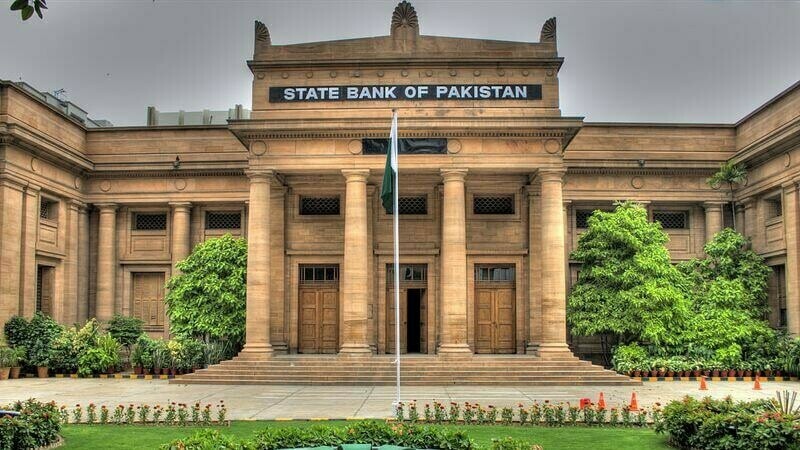
Pakistan may be deindustrialising before it has properly industrialised. The State Bank of Pakistan (SBP), in its annual report for FY26, raises an important concern about the direction in which the country’s economy is heading.
The space has highlighted many times that manufacturing has largely stagnated. At the same time, it can be seen that the reliance on services is increasing, which could be partly because of struggling manufacturing. The concern that the central bank highlights is that the transition is happening at a relatively low level of income and productivity, and at a time when the country needs jobs more than ever.
Historically, it is seen that developing economies have moved from agriculture to manufacturing and eventually towards services as their incomes and productivity have risen. Manufacturing has played a central role in this transition, particularly in East Asian economies, by absorbing surplus agricultural labour, generating exports, attracting investment, and facilitating technological advancement. Pakistan, however, appears to have largely bypassed this phase.
According to the SBP, manufacturing’s share in GDP has declined over the past three decades, while labour has gradually moved from agriculture towards services. However, this movement has largely been towards activities such as wholesale and retail trade, transport, construction, and real estate. These sectors provide employment but have limited scope of productive gains compared to manufacturing and modern tradable services.
There is nothing inherently wrong with an economy becoming more services oriented. The problem lies in the kind of services that are expanding. Pakistan’s better performance in the services sector is driven by real estate. As a result, structural weakness are increasingly visible in the labour market.
The country’s relationship between economic growth and employment generation has weakened considerably over time. SBP estimates Pakistan’s employment elasticity at just 0.11 during 2000–2025, compared to earlier estimates of 0.2 during 2000–2018 and 0.6 during 1972–1978. In simple terms, economic growth is generating proportionately fewer jobs.
Employment elasticity has also declined in countries such as China and Vietnam. However, in these economies, the decline has been associated with technological advancement, greater capital investment, and rising labour productivity.
The country’s export performance tells a similar story. As per SBP’s report, Pakistan’s exports as a percentage of GDP declined from an average of 16.3 percent during the 1990s to 9.5 percent during 2016–2025. Over the same periods, the average for lower-middle-income countries increased from 16.6 percent to 21 percent. Pakistan has become less export-oriented while many of its peers have become more integrated into the global economy.The export basket, too, has changed little. Pakistan remains heavily dependent on textiles and agricultural products, with limited diversification into more sophisticated goods. Weak integration into global value chains has further restricted opportunities for technological upgrading, knowledge transfer, and better-paying jobs.
Why has Pakistan struggled to industrialise? Frequent policy changes, an uneven tax system, poor infrastructure, limited investment in technology and skills, and repeated economic crises have made industries less competitive. Businesses have often found it more profitable to serve protected domestic markets or invest in sectors like real estate than to manufacture goods for export.
Can the growing IT sector fill this gap? While the growth of Pakistan’s IT sector is encouraging, its ability to generate employment on a large scale remains limited. As the central bank points out, high-productivity services such as IT and finance primarily employ skilled workers and cannot absorb the country’s large pool of low-skilled labour. Manufacturing, therefore, remains important for job creation.
And the window for traditional industrialisation may also be narrowing. With automation and AI, cheap labour is no longer enough to attract industrial investment. Skills, technology, and better infrastructure matter increasingly more.
Pakistan may not be able to follow the same path as East Asian economies, but manufacturing remains important for exports and job creation. While the recent recovery in large-scale manufacturing is encouraging, a few quarters of growth do not necessarily mean that the industry is back on its feet. Therefore, the debate needs to move beyond macroeconomic stability and GDP growth: Where that growth is coming from and whether it is creating productive jobs and raising incomes.
Source: brecorder
Leave a Reply