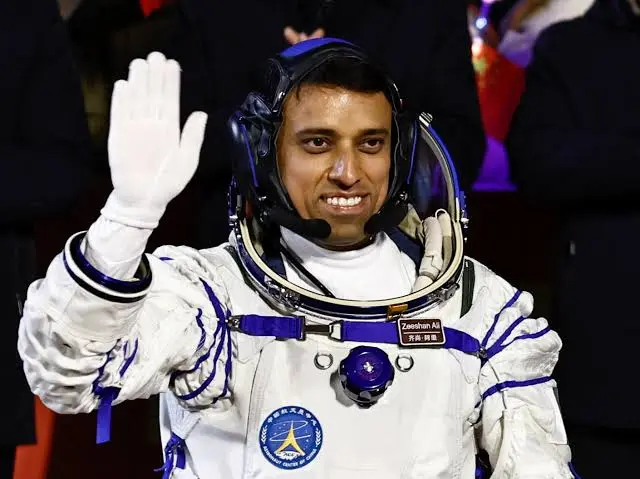
Pakistan has entered a new chapter in its space programme. Muhammad Zeeshan Ali, a 40-year-old former Pakistan Air Force pilot, has become the first Pakistani to travel into orbit and the first foreign astronaut to join a crewed mission to China’s Tiangong space station.
Ali arrived at the station on November 25, 2026, aboard China’s Shenzhou-24 spacecraft, alongside Chinese astronauts Tang Hongbo and Wu Yi. But his journey is about more than a historic first: he is there to help carry out scientific experiments developed through Pakistan-China cooperation.
Who is Muhammad Zeeshan Ali?
Ali is a former Pakistan Air Force pilot who was selected in April 2026 to train for China’s human spaceflight programme. He was one of two Pakistani candidates chosen for the opportunity, alongside fellow pilot Khurram Daud, who served as his backup.
Ali travelled to China in April and spent seven months training at the Astronaut Centre of China in Beijing. His preparation covered spacecraft systems, space-station operations, scientific procedures and emergency response. He also received intensive Chinese-language training so he could communicate with his crewmates and understand mission commands.
At a press conference before the launch, Ali said his first flight represented not just him, but his country.
What is the Shenzhou-24 mission?
The Shenzhou-24 mission launched from the Jiuquan Satellite Launch Centre in northwestern China on November 25, 2026, aboard a Long March-2F rocket.
Ali is travelling as a payload specialist. This means his role is focused on scientific experiments and research activities rather than commanding or piloting the spacecraft. The mission is led by Chinese astronaut Tang Hongbo, with Wu Yi serving as flight engineer.
The crew docked with China’s Tiangong space station on the same day. Ali is expected to spend between five and 10 days in orbit, considerably shorter than the roughly six-month rotations typically undertaken by Chinese astronauts.
What will he be doing in space?
Ali will participate in four Pakistan-China research projects covering materials science and biotechnology. They were selected from more than 300 proposals submitted to Pakistan’s Space and Upper Atmosphere Research Commission (SUPARCO).
The experiments include research into lightweight, graphene-based composite materials that could help shield spacecraft from radiation; self-healing carbon-fibre composites that may repair tiny cracks; and the effects of microgravity and cosmic radiation on quinoa seeds, including their potential as a food source for future missions.
A fourth project will examine microalgae and cyanobacteria. These organisms could potentially help regenerate oxygen, remove carbon dioxide and support food production in space.
The research has applications beyond this particular flight. Stronger spacecraft materials and more sustainable ways of producing food and oxygen could become important as humans undertake longer missions.
Yes, specially prepared halal food is part of the mission
China has also made arrangements for Ali’s dietary requirements. Reports say specially prepared halal meals were developed for him to eat during his stay aboard the space station.
The support team also prepared operating manuals in Chinese and English to help him work alongside his Chinese crewmates. It is a small but telling detail about the practical arrangements involved in sending an astronaut from another country into space.
He will return in a different spacecraft
One particularly unusual detail of Ali’s mission is that he is not scheduled to return in the spacecraft that carried him to the station.
He travelled to Tiangong aboard Shenzhou-24, but is expected to return to Earth aboard Shenzhou-23, together with two Chinese astronauts, Zhang Zhiyuan and Li Jiaying.
Shenzhou-23 is already docked at the space station. The arrangement means Ali will join the returning crew for their journey home, rather than travelling back in the same spacecraft in which he arrived.
Why does this matter for Pakistan?
The flight is part of a wider space partnership between Pakistan and China, which has involved satellite launches and scientific cooperation for decades.
For Pakistan, the mission offers an opportunity to put its researchers’ experiments into orbit and build experience in human spaceflight. It does not mean Pakistan has its own crewed spacecraft or space station: the launch, transport and orbital laboratory are all part of China’s space programme.
Ali has described the mission as a starting point for further cooperation, expressing hope that future joint flights could extend to the Moon, Mars and beyond.
For now, his journey marks a first: a Pakistani astronaut has reached orbit, carrying experiments developed by Pakistani researchers and opening a new chapter in the country’s space ambitions.
Source: brecorder
Leave a Reply