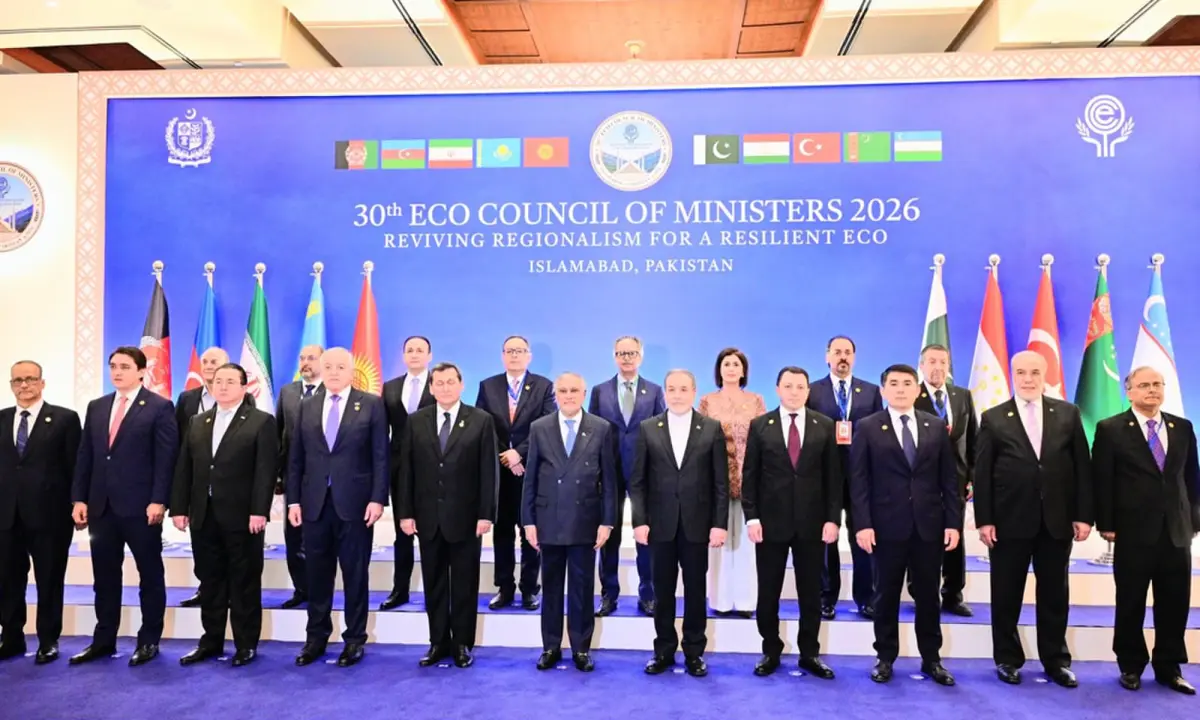
The Economic Cooperation Organization (ECO) is a 10-member regional bloc aimed at promoting trade, investment and economic cooperation across South Asia, Central Asia and West Asia.
For Pakistan, the organisation offers an important platform to strengthen regional trade, improve connectivity with landlocked Central Asian countries and expand access to international markets through its seaports.
Pakistan assumed the chairmanship of the ECO Council of Ministers for the 2026-2027 term following the organisation’s 30th meeting in Islamabad on November 15-16. Under the theme “Reviving Regionalism for a Resilient ECO”, Islamabad aims to prioritise regional connectivity, trade, investment, climate resilience and human development.
How was the ECO established?
The ECO was established in 1985 as the successor to the Regional Cooperation for Development (RCD), which Pakistan, Iran and Turkey had founded in 1964 to promote economic, technical and cultural cooperation.
In 1992, the organisation expanded its membership by welcoming Afghanistan, Azerbaijan, Kazakhstan, Kyrgyzstan, Tajikistan, Turkmenistan and Uzbekistan, bringing its total membership to 10 countries.
Headquartered in Tehran, Iran, the ECO connects a strategically important region linking Asia with Europe and providing access to major trade routes and markets.
Its members are Pakistan, Iran, Turkey, Afghanistan, Azerbaijan, Kazakhstan, Kyrgyzstan, Tajikistan, Turkmenistan and Uzbekistan.
What does the ECO aim to achieve?
The organisation seeks to strengthen cooperation in trade and investment, transport and transit connectivity, energy, tourism, education, technology and sustainable development.
One of its key initiatives is the ECO Trade Agreement (ECOTA), which aims to reduce tariffs and facilitate trade among member states. However, intra-regional trade remains limited, accounting for less than 8% of the region’s total trade, according to figures cited by Pakistani officials.
Why is the ECO important for Pakistan?
Pakistan’s geographical location gives it the potential to serve as a transit and trade hub for landlocked Central Asian countries seeking access to international markets through the Arabian Sea.
The ports of Karachi Port, Port Qasim and Gwadar Port could provide these countries with alternative routes for overseas trade, while improved road and rail links could facilitate the movement of goods across the region.
Pakistan has therefore called for stronger transport corridors, simplified customs procedures, easier cross-border movement and effective implementation of ECOTA.
Greater regional connectivity could create opportunities for Pakistani exporters, manufacturers, transport operators and investors while strengthening economic ties with Central Asian markets.
What are Pakistan’s priorities during its chairmanship?
Pakistan aims to expand market access, strengthen regional value chains, attract investment and encourage private-sector participation, particularly by small and medium-sized enterprises.
Other priorities include improving road, rail and multimodal transport links between Central and South Asia, modernising regional trade arrangements, and enhancing cooperation in energy, disaster preparedness and climate-resilient infrastructure.
Islamabad has also advocated greater airline connectivity and relaxed visa arrangements to promote tourism and facilitate travel across the region. ECO members unanimously adopted Pakistan’s proposals on airline connectivity and visa facilitation at a tourism-related meeting in Uzbekistan in April 2024.
What came out of the November 2026 meeting?
The 30th ECO Council of Ministers meeting in Islamabad resulted in the adoption of the Islamabad Communiqué and the Strategic Goals of Economic Cooperation 2026-2035.
The documents provide a common framework for member states to pursue regional cooperation over the next decade, with priorities including trade, investment, connectivity and economic integration.
What challenges does the ECO face?
Despite its geographical reach and economic potential, the organisation faces persistent obstacles, including low intra-regional trade, tariff and non-tariff barriers, differences in customs procedures, inadequate transport infrastructure and political tensions.
The implementation of ECOTA and the development of cross-border transport networks also require sustained commitment and investment from member states.
For Pakistan, the success of its ECO chairmanship will ultimately depend on translating regional agreements and commitments into practical measures that increase trade, improve connectivity and deliver tangible economic benefits.
Source: brecorder
Leave a Reply