ISLAMABAD: Pakistan has invited Turkmenistan to become part of the Central Asia-South Asia Electricity Transmission and Trade Project (CASA-1000) and proposed enhancing electricity transmission capacity to Gwadar through the Iranian grid, as Islamabad seeks to strengthen regional energy connectivity and integrate electricity markets.
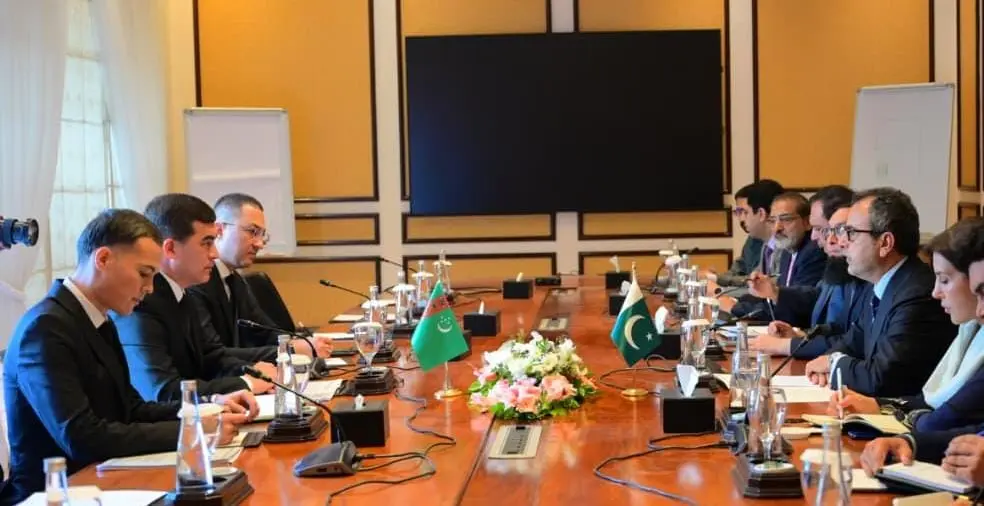
The proposals were discussed during a meeting between Federal Minister for Energy (Power Division) Sardar Awais Ahmad Khan Leghari and Turkmenistan’s Minister of Energy Annageldi Saparov, who called on him here on Monday.
According to an official statement, both sides held detailed discussions on bilateral cooperation in the energy sector, with particular emphasis on the Turkmenistan-Afghanistan-Pakistan (TAP) power transmission project and regional electricity connectivity.
READ ALSO: CASA-1000 project: Govt saves $27m as care & custody cost capped at $9m
Leghari invited Turkmenistan to join the CASA-1000 project, while informing his counterpart that Pakistan had encouraged Tajikistan and Kyrgyzstan to explore extending the CASA-1000 transmission line to Uzbekistan and Turkmenistan.
The Federal Minister said future industrial and commercial activities in Gwadar would create an extraordinary increase in electricity demand, requiring additional power supplies.
He proposed that Iran and Turkmenistan explore the possibility of enhancing electricity transmission capacity to Gwadar through the Iranian grid. A joint group of experts from the countries could deliberate on the proposal and examine its feasibility.
Pakistan, he said, was committed to integrating regional energy markets and providing affordable electricity, stressing that economic and financial viability was essential for the success of regional transmission projects so that their benefits could directly reach end consumers.
Leghari noted that Pakistan currently had surplus electricity generation and was introducing a competitive electricity market.
He also highlighted the possibility of converting CASA-1000 from its existing one-way electricity flow arrangement into a two-way transmission system, enabling participating countries to exchange electricity during periods of mutual need.
According to him, two-way electricity flows would improve the economic and financial sustainability of the project and provide greater flexibility to participating countries.
Discussing progress on the TAP power transmission project, Leghari stated that seven fundamental technical data sets were required to advance the initiative, of which Pakistan had already provided three.
He stressed that the exchange of requisite technical information from Turkmenistan needed to be expedited and proposed an early meeting of technical working groups from both countries.
The meeting, he said, would help develop a clear roadmap within a few weeks and accelerate progress on the feasibility assessment and implementation of the project.
Turkmenistan’s Minister of Energy Annageldi Saparov thanked the Government of Pakistan for its hospitality and reiterated his country’s firm commitment to completing the TAP power transmission project.
He informed the Pakistani side that the project would provide electricity to more than 300 million people in the region.
Saparov said Turkmenistan had already completed laying the transmission line up to Afghanistan, while the remaining phases and feasibility assessment of the 1,150-kilometre-long, 500-kV project, with a capacity of 1,200 MW, from Afghanistan to Quetta would be pursued through the technical working group.
The Turkmen minister also expressed gratitude for the information provided by Pakistan and assured that his country would share the requisite technical data soon.
He said he would personally oversee the resolution of matters related to the TAP project.
Both sides agreed to maintain regular online and in-person contact between their focal persons to resolve technical issues, complete the feasibility study and move the project towards implementation.
At the conclusion of the meeting, Pakistan and Turkmenistan reiterated their commitment to further strengthening bilateral cooperation in the energy sector, particularly regional electricity connectivity and power transmission initiatives.
Copyright Business Recorder, 2026
Source: brecorder
Leave a Reply